
Is It Better to Work Quietly Inside Systems or Publicly Protest as a Doctor?
What do you do when you know a policy is harming patients: keep your head down and fix what you can on the inside, or grab a sign, go public, and risk your job?
Let me be blunt: neither “always quiet” nor “always protest” is the right answer. The right move depends on three things: your goal, your leverage, and your risk tolerance. And most doctors pick the wrong strategy because they don’t think about those three clearly.
This isn’t an abstract ethics seminar question. It’s:
• Do you sign that controversial open letter?
• Do you post about your hospital on X/Instagram?
• Do you testify at city council?
• Do you join a walkout?
• Or do you stay “non-political” and work your angles in committee rooms?
Let’s cut through the fluff.
The Core Trade‑Off: Influence vs. Risk
Here’s the fundamental tension:
Working inside the system:
- Higher chance of stable, long‑term influence
- Lower personal and professional risk (usually)
- Slower, less visible change
- You’re constrained by hierarchy, politics, and NDAs
Public protest and advocacy:
- Faster visibility and pressure on decision‑makers
- Higher personal and professional risk
- You might force issues onto the agenda that insiders are “not allowed” to say
- You can burn bridges or even your career if you do it poorly
The mistake people make is treating this as an identity question: “I’m the quiet, evidence‑driven clinician” vs. “I’m an activist doc.” That’s the wrong frame.
The right frame: “For this specific issue, at this specific point in my career, which tactic gives me the best ratio of impact to risk?”
You need a decision framework, not a personality type.
A Simple Framework: 6 Questions Before You Go Quiet or Go Loud
Before you decide whether to stay inside or go public, run through these six questions. Honestly.

| Step | Description |
|---|---|
| Step 1 | See harmful policy |
| Step 2 | Consider public action fast |
| Step 3 | Map internal options |
| Step 4 | Start inside system |
| Step 5 | Build alliances and external pressure |
| Step 6 | Assess risk and legal protections |
| Step 7 | Choose mix of internal and public actions |
| Step 8 | Urgent threat to patient safety |
| Step 9 | Real internal leverage |
1. How urgent and harmful is the issue?
If patients are being immediately and seriously harmed—unsafe staffing, denial of lifesaving meds, discriminatory triage policies—your bar for public action drops.
Example:
- Unsafe nurse–patient ratios in an ICU during a respiratory surge. You’ve documented incidents. Internal reporting has gone nowhere.
In that scenario, “I’ll wait and see if the new staffing committee helps over the next 18 months” is cowardice, not prudence.
If the harm is real but slower burn—like prior auth hassles, opaque billing, generic burnout—then internal work has more time to matter.
2. Have you actually exhausted internal channels?
A lot of people say “I tried internally” when what they really did is mention it once at a meeting and get brushed off.
Internal options often include:
- Morbidity and mortality (M&M) conferences
- Quality/safety reporting systems
- Ethics committee consults
- Union structures (if you have one)
- Department and medical executive committees
- Quiet conversations with nursing leadership, risk management, legal, or compliance
- Hospital ombuds, DEI leads, wellness committees
- Specialty societies or local medical societies
You don’t need to do all of these. But you should be able to honestly say: “I escalated this through at least 2–3 serious internal routes, with documentation, and the response was inadequate or clearly performative.”
If you haven’t done that yet, don’t jump straight to Twitter threads and op‑eds. You’ll get written off as impulsive.
3. What’s your actual leverage inside?
Your title, relationships, and reputation matter.
High internal leverage examples:
- You’re a senior attending or division chief
- You’re on key committees (credentialing, quality, utilization, ethics)
- You’re the “go‑to” person leadership calls when things are on fire
- You have a solid track record and people owe you favors
Low internal leverage examples:
- You’re a PGY‑1 or PGY‑2 with no union and a shaky visa status
- You’re a new attending just off probation
- You’re a med student on a short rotation
If you have high internal leverage, you’re usually foolish not to use it first. You can often move more with one sharp comment in the right closed‑door meeting than with 1,000 retweets.
If you have low internal leverage, you’re more likely to need alliances and—eventually—public pressure.
4. What are the real risks—to you and to patients?
Not the imagined, catastrophized ones. The actual risks.
You should be thinking in four buckets:
| Risk Type | Working Inside | Public Protest |
|---|---|---|
| Job/contract risk | Low–Moderate | Moderate–High |
| Visa/license risk | Low | Moderate |
| Reputation locally | Moderate | High |
| Reputation broadly | Low | Can be positive |
If you’re on a visa, on probation, in a small specialty in a small city, or in a politically hostile environment, the risk of going public is not theoretical. I’ve seen residents quietly blackballed for “unprofessional social media use” after posting screenshots of their ED board.
On the flip side, if you’re in an academic center that pays lip service to “advocacy” and media loves quoting you, your risk profile is very different.
You also need to think about risk to patients:
- Will going public scare patients away from needed care?
- Will it cause loss of services if a rural hospital shuts down instead of reforming?
- Will your messaging increase mistrust in vaccines, public health, etc.?
If your protest undermines core trust in evidence‑based care, you’re not being “brave.” You’re being reckless.
5. Where will your voice add the most value?
Ask yourself: what do you uniquely bring?
Inside systems, physicians often bring:
- Data: patterns you see in EMR, quality metrics, staffing logs
- Stories: de‑identified but powerful case examples
- Solutions: feasible workflow or policy fixes that administrators can actually implement
- Legitimacy: “This isn’t just finance vs nurses; this is a clinical safety issue”
Publicly, physicians bring:
- Credibility with media and the public
- Translating jargon into human language
- Bridging patient stories with structural causes (insurance, policy, racism, etc.)
- Pressure on institutions that care about reputation
If you’re not adding anything unique in a public protest, you might be better off bolstering those who are (organizing data, prepping talking points, helping with op‑eds, talking to legislators privately).
6. What are your long‑game goals?
If your main professional goal is to become CMO, department chair, or a major clinical leader inside a big hospital system, then torpedoing relationships with a viral “my hospital is killing patients” thread is… not strategic.
If your goal is policy work, public health, or national advocacy (e.g., Physicians for a National Health Program, Doctors Without Borders, climate and health advocacy), then building a visible, principled public profile is actually an asset.
Your advocacy strategy should fit your long game, not fight it.
When Staying Inside Is More Effective
Let’s talk about when “working quietly” is not cowardice but smart strategy.
1. When you control or strongly influence the process
Examples:
- You’re on the committee rewriting the triage protocol.
- You sit on the hiring panel for new ED leadership.
- You help determine call schedules or service lines.
In those roles, your job isn’t to grandstand; it’s to build coalitions, adjust language, and get signatures. Quietly ruthless is often what works.
2. When the problem is mainly operational, not ideological
If the core issue is:
- Broken workflows
- Poor staffing models
- Misaligned incentives that nobody’s looked closely at
- Clunky EMR or documentation policies
Then internal QI projects, data presentations, and pilot programs are usually way more powerful than external shaming.
Example: Instead of tweeting “My hospital doesn’t care about burnout,” you collect data showing increased errors on 28‑hour call, present a pilot 16‑hour system, and get buy‑in. That gets actual human beings more sleep.
3. When you’re very early in your career
As a med student, intern, or PGY‑2, your best advocacy leverage usually isn’t a solo protest—it’s joining organized efforts:
- Your local or national specialty society’s advocacy arm
- Medical student advocacy groups (e.g., AMSA chapters)
- Resident unions, if available
- Public health departments and physician coalitions
You still speak up, but you do it inside groups with lawyers, political experience, and media savvy. You learn the game before you try to flip the table.
When Public Protest Is Necessary (And Ethical)
Now, let’s not kid ourselves. There are times when staying quiet inside is complicity.
Public protest, whistleblowing, and visible advocacy are ethically justified—and sometimes required—when:
1. Patient safety is being systematically ignored or suppressed
Red flags:
- Serious events repeated with no corrective action
- Leadership explicitly telling people not to document or report
- Retaliation against those who raise safety concerns
- Gaslighting of patients and families
Here, going public may be the only way to protect patients.
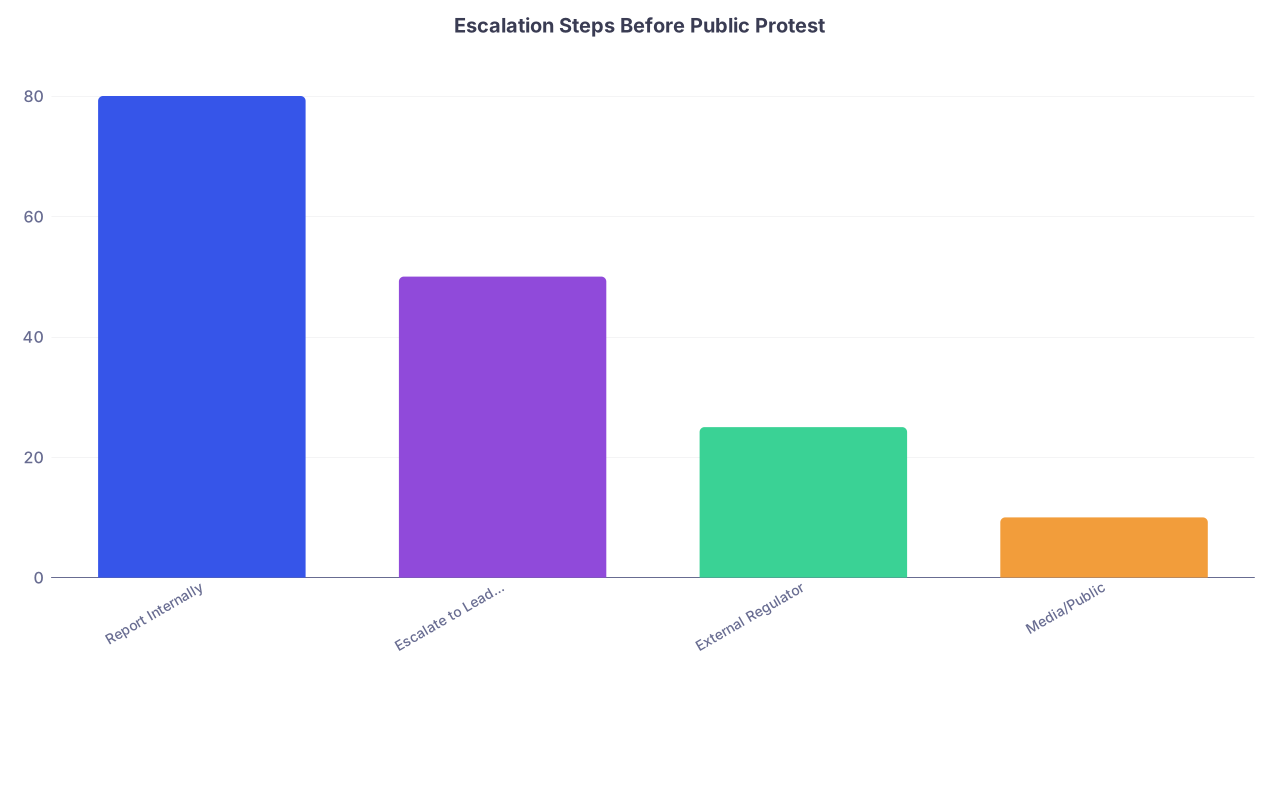
But do it with a plan:
| Category | Value |
|---|---|
| Report Internally | 80 |
| Escalate to Leadership | 50 |
| External Regulator | 25 |
| Media/Public | 10 |
That chart isn’t about “how often” you use each step; it’s how many clinicians stop before they get to the more serious ones. Most people never get past level one. That’s the problem.
2. The issue is fundamentally political or structural
If you’re talking about:
- Insurance coverage and prior authorization rules
- Abortion access and reproductive rights
- Climate change and its health effects
- Racist policing, carceral health, migrant detention conditions
- Gun violence as a public health crisis
These are not problems you can solve in your hospital’s quality committee. These are policy issues.
Public action—op‑eds, marches, testimony, social campaigns, lawsuits—is not “being unprofessional.” It’s doing public health.
3. Leadership is using your silence as cover
This one happens more than people admit.
You’ll hear: “Our clinicians are fully on board with this change,” or “We haven’t heard major concerns from frontline staff.” Meanwhile everyone is raging in call rooms and group chats.
If your silence is being weaponized to justify harmful decisions, then breaking that silence—strategically—is often necessary.
That might mean:
- Signing or drafting a collective letter with dozens of co‑signers
- Speaking at a town hall with media present
- Joining a coordinated, legal walkout or work‑to‑rule action
- Talking to journalists with legal guidance and de‑identification
The Hybrid Approach: The Most Powerful (And Underused) Option
Here’s where most high‑impact physician advocates actually live: they do both internal work and public advocacy, but in a sequenced and deliberate way.
A practical pattern I’ve seen work:
Document the problem.
Emails, screenshots, incident reports, EMR data, staffing logs. Clean, de‑identified, organized.Use internal channels hard and early.
Don’t just “mention concerns.” Write memos. Propose specific changes. Ask for timelines. Get responses in writing.Build quiet alliances.
Nurses, social workers, RTs, hospitalists, ED docs, maybe a sympathetic administrator. The point is: don’t be a lone wolf.Prepare an external strategy in parallel.
Not as a threat, but as a backup: policy briefs, media connections, legal consults through your professional organization or union.Time your public action.
You go public when:- Internal efforts have clearly stalled or been ignored, and
- You can clearly say: “We tried to fix this inside. Here’s what we did. Here’s what we were told. We’re going public because patients are still at risk.”
That sequence is hard to dismiss as “unprofessional ranting.” It looks like what it is: responsible escalation.
How to Decide Today: A Quick Personal Checklist
You’ve probably got a specific issue in mind right now. Do this:

| Step | Description |
|---|---|
| Step 1 | Identify specific issue |
| Step 2 | Rate harm 1 to 5 |
| Step 3 | List internal steps taken |
| Step 4 | Assess leverage and risk |
| Step 5 | Choose tactic mix |
| Step 6 | Set next action within 7 days |
On a piece of paper (or notes app), write:
- The one issue that bothers you most right now (not 10; one).
- Harm score: 1–5 (1 = annoying, 5 = serious patient harm).
- Internal steps you’ve taken (be honest).
- Names of 2–3 people you could ally with.
- Your personal risk factors (visa, probation, no union, small town, etc.).
- One internal next step. One possible external step.
You’ll see pretty fast whether you’re under‑using your internal voice or hiding behind “process” to avoid necessary public conflict.
Bottom Line: So Which Is Better?
Here’s the answer you probably don’t want but need:
If you’re in a position of internal power and safety and you never use it because you’d rather tweet, you’re not being brave. You’re outsourcing the hard, boring work of change.
If you see serious, ongoing harm, have tried serious internal channels, and still refuse to go public because you’re scared of being “that doctor,” you’re not being prudent. You’re protecting yourself at patients’ expense.
The ethical sweet spot:
Use your internal leverage as far as it will go.
Prepare for public action before you need it.
And when the balance tips—when harm is clear, internal routes are blocked, and your conscience won’t shut up—you step out and speak up, strategically, not impulsively.
FAQ (5 Questions)
1. Can I get fired or disciplined for publicly criticizing my hospital?
Yes, you can absolutely face consequences, even if you’re telling the truth. Contracts often have “non‑disparagement” or “professionalism” clauses that are vague but enforceable. That’s why you:
- De‑identify patient and colleague information
- Focus on policies and outcomes, not personal attacks
- Use professional channels (op‑eds, testimony, letters) rather than rage posts
- Talk to your union, professional society, or an attorney before major public actions
2. Is it ethical to stay completely “non‑political” as a doctor?
If by “non‑political” you mean “I refuse to comment on any policy that affects my patients,” then no, I don’t think that’s ethically defensible. Health care is shaped by policy—insurance, housing, immigration, climate, criminal justice. You don’t have to be a full‑time activist, but total silence in the face of harmful structures is a choice. And not a neutral one.
3. As a resident, should I ever join a strike or walkout?
Sometimes, yes—but only with eyes wide open and as part of an organized, legally vetted action. Residents have successfully struck for better staffing, pay, and safety (e.g., multiple resident unions in the US). You balance:
- Patient safety (emergency coverage, urgent care maintained)
- Legal guidance (through a union or labor lawyers)
- Clear demands and end points
Solo walkouts and dramatic exits? High risk, low impact. Coordinated action is different.
4. How do I advocate publicly without getting dragged into partisan politics?
Stick to:
- Patient stories (de‑identified)
- Data and evidence
- Specific policy asks
Avoid: - Campaigning for specific candidates in your white coat
- Ad hominem attacks
- Conspiracy‑ish rhetoric
You can say, “Here’s how this insurance policy harms my patients,” without turning your Twitter into a campaign ad feed.
5. What’s one thing I can do this month if I’m new to advocacy?
Pick one:
- Attend a local medical society or specialty society advocacy meeting
- Write a short, evidence‑based op‑ed or letter to the editor on a health issue you see daily
- Join a physician advocacy group aligned with your values (climate, gun violence, reproductive rights, health equity)
- Volunteer to present a brief “policy impact on our patients” slide at your next department meeting
Then do it. Today, open your calendar and block 30 minutes this week to take that single step.