
The worst way to choose a public health issue is to pick something that sounds impressive but you secretly do not care about. That is how you burn out, waste years, and never move the needle for patients.
You’re a physician (or heading there). Your time and credibility are scarce resources. You cannot “care about everything equally” in public health and expect to make real impact. You have to choose.
Here’s how to do that like an adult, not like a personal-statement writer.
Step 1: Accept That You Must Narrow Your Focus
You cannot “work on health equity, climate change, mental health, food insecurity, and addiction” in any serious way. Not all at once. Not meaningfully.
Public health issues are massive systems problems. Each one could eat a 40‑year career:
- Diabetes prevention in one city
- HIV care in one country
- Lead exposure in one zip code
- Firearm injury in one hospital catchment area
They’re bottomless. That’s the point.
So the first mindset shift: you are not choosing The One True Cause Of Medicine. You’re choosing your lane. One defined by:
- Where your skills are sharpest
- Where you have or can build real leverage
- Where you can sustain anger, curiosity, and hope for years
If you find yourself trying to keep five “issues” equally alive so your CV looks broad, you’re already off track.
Step 2: Start With Three Concrete Filters
Skip the abstract hand‑waving. Run every issue through three hard filters:
- Do I actually feel something about this?
- Do I have (or can realistically gain) leverage here?
- Does this align with my clinical work or likely career setting?
If an issue fails all three, drop it. If it passes at least two, it’s a live candidate.
1. Real Emotional Charge (Not Performative Concern)
You need an issue that reliably pisses you off or pulls you in.
Ask yourself:
- What recurring patient story keeps me up on post‑call days?
- What do I rant about to co-residents in the workroom when the pager finally dies?
- When I read the news, which health stories do I click every time?
Examples I’ve actually heard from trainees:
- “I’m tired of seeing uninsured patients wait until they have metastatic cancer to show up.”
- “Every week I admit another 30‑year‑old in DKA because insulin is unaffordable.”
- “We discharge kids with asthma back to mold‑infested apartments and pretend an inhaler fixes it.”
Those are clues. If an “issue” only interests you when someone asks in an interview, it’s not your issue.
2. Leverage: Where Your Role Actually Matters
You’re not a UN agency. You’re one physician with some letters after your name, some institutional access, and limited time.
Leverage means:
- You can access data, people, or systems others can’t.
- Your clinical role gives you credibility with specific decision‑makers.
- You’re physically located where the problem plays out.
For example:
- A hospitalist seeing the same pattern of readmissions for heart failure has more leverage on that problem than on global tobacco policy.
- An EM physician in a high-violence area has leverage on firearm injury prevention (data, stories, local coalitions).
- A pediatrician in a school-based clinic has leverage on vaccines, obesity, and mental health in that district.
3. Alignment With Where You’ll Actually Practice
You can care about anything. But you should focus on something that touches:
- Your specialty or likely specialty
- Your practice environment (safety-net hospital vs private clinic vs rural outpost)
- Populations you actually see
If you’re going into dermatology, climate change still matters—but you might focus it into heat-related occupational skin conditions in farmworkers, not generic “climate health.”
If you’re going into psych, overdose policy and incarceration may be more natural fits than neonatal outcomes.
Step 3: Use a Simple Framework to Sort Options
Let’s make this less theoretical. Here’s a basic 2×2 that works in real life.
| Issue Example | Emotional Charge High/Low | Leverage High/Low | Good Candidate? |
|---|---|---|---|
| Hospital readmissions | High | High | Yes |
| Global pandemic preparedness | Low | Low | No |
| Local firearm injury prevention | High | High | Yes |
| International nutrition policy | Medium | Low | Maybe |
| Climate anxiety in teens (clinic) | High | High | Yes |
You don’t need a spreadsheet. Just be honest:
- High feeling + high leverage → prime issue
- High feeling + low leverage → find a smaller angle or local entry point
- Low feeling + high leverage → okay for a project, bad for a career anchor
- Low on both → stop pretending you’ll work on it
Step 4: Respect the Ethics, Not Just the Optics
You’re not just choosing a hobby. You’re choosing where you’ll spend influence and moral energy.
There are a few ethical questions you should force yourself to answer:
Am I centering my ego or the population?
Are you more excited about being “a global health person” than about doing the boring work that actually improves health in a small place?Am I prepared to listen more than I speak?
If your dream issue involves communities you don’t belong to (rural Indigenous health, for example), you have an ethical obligation to build humility and long-term relationships, not parachute in with a project.Can I commit beyond the CV cycle?
Policies take years. Culture change takes decades. If you’re choosing an issue because you need research output in 12 months, that’s fine—but don’t call that your “life’s work.”Am I reinforcing or challenging structural harm?
Some “public health” efforts are window dressing that leaves the underlying injustice intact. A classic example: focusing on “healthy choices” posters in neighborhoods without grocery stores.
Public health ethics is not just about consent forms. It’s about who sets the agenda and who benefits.
Step 5: Match Issue Type to Your Natural Skill Set
Different issues reward different kinds of brains.
If you’re a data nerd who loves messy spreadsheets, you’ll thrive in:
- Chronic disease epidemiology
- Quality improvement at scale
- Injury surveillance
- Health services research
If you’re more of a storyteller and communicator:
- Vaccine confidence and misinformation
- Mental health stigma reduction
- School-based health education
- Policy advocacy and testimony
If you enjoy building things and grinding through bureaucracy:
- New clinic models for high-risk populations
- Care coordination for frequent ED users
- Reentry clinics for people leaving incarceration
- Payment reform projects at your institution
Pick an issue where the day-to-day work will not make you miserable. Because you’ll be doing a lot of that, not just giving TED talks.
Step 6: Look for the Intersection of Issue + Population + Place
You do not need “a public health issue” in the abstract. You need a specific problem, in specific people, in a specific context.
Instead of: “I’m interested in health equity.”
Try: “I’m focused on reducing insulin rationing among uninsured adults with type 1 diabetes at our county hospital.”
Notice the specificity:
- Issue: medication affordability / diabetes outcomes
- Population: uninsured adults with type 1
- Place: county hospital system
That’s something you can actually study, pilot interventions on, and advocate around.
Here’s a quick visual of how careers actually accrete around a few tight intersections:

Most impactful physicians I know end up living in one quadrant of that map for 20+ years.
Step 7: Pressure-Test Your Choice With Reality, Not Fantasy
Before you “declare” your issue, test it.
Ask:
- Are there existing projects, clinics, or initiatives at my institution that touch this?
- Can I name at least 2–3 faculty or community leaders already working on it?
- In the next 6–12 months, can I:
- Join a working group
- Collect a small data set
- Do a needs assessment
- Present something locally?
If the answer to all of those is no, you either chose something too abstract (“ending poverty”) or too far removed from your current environment.
This is where your calendar matters more than your inspiration. You want an issue you can engage in week by week, not just in interview answers.
To make this concrete, look at how residents often allocate impact efforts over a few years:
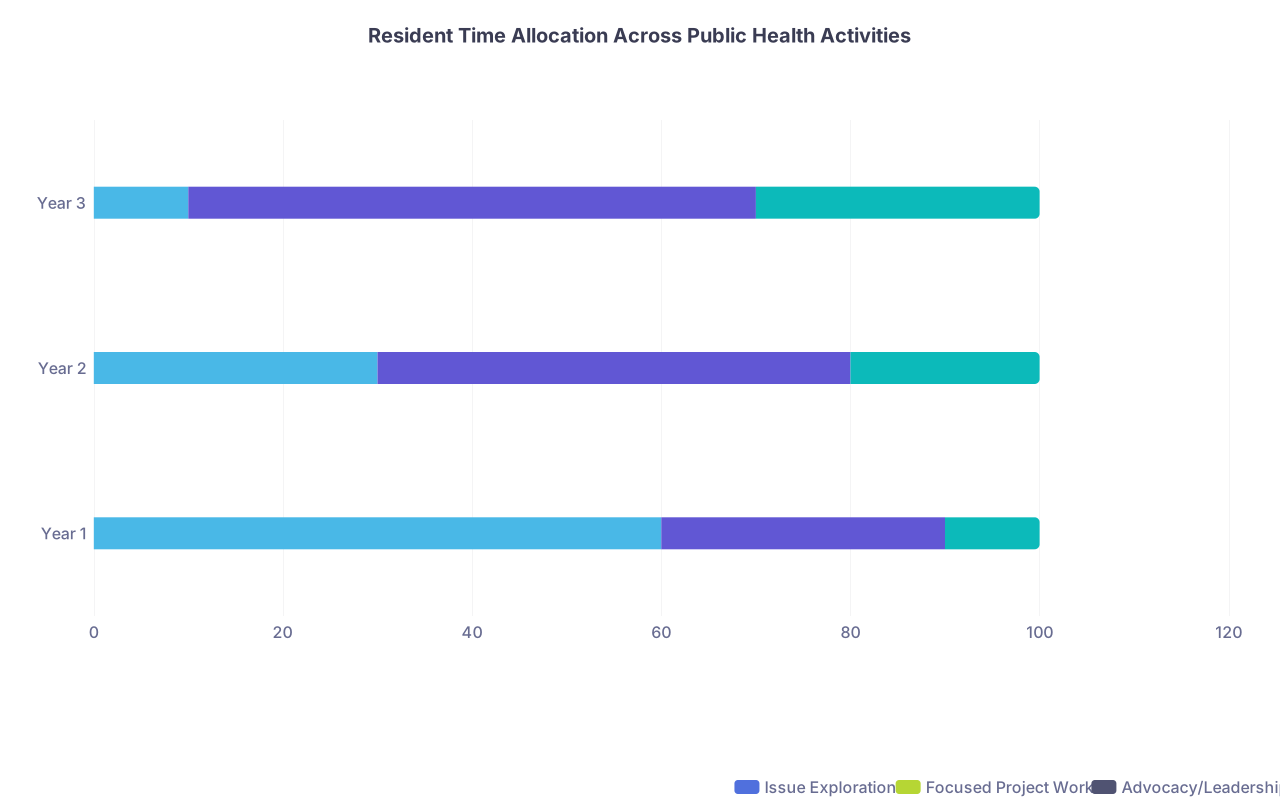
| Category | Issue Exploration | Focused Project Work | Advocacy/Leadership |
|---|---|---|---|
| Year 1 | 60 | 30 | 10 |
| Year 2 | 30 | 50 | 20 |
| Year 3 | 10 | 60 | 30 |
The point: you explore early, then you narrow. Not the other way around.
Step 8: Common Traps and How to Avoid Them
Let me be blunt about a few patterns I see over and over.
Trap 1: Chasing Prestige Issues
Everyone suddenly cares about global health, climate, or AI ethics—until the fellowship match is over.
If you catch yourself picking an issue because “it’s hot right now” or “looks strong for X fellowship,” stop. That’s a short-term CV strategy, not a public health focus.
Better approach: choose an issue that will still bother you when the news cycle moves on.
Trap 2: Picking Something So Broad You Never Act
“I care about social determinants of health” is a sentence that allows you to sound profound while doing nothing in particular.
Force yourself to name:
- One clinic population
- One measurable outcome
- One policy lever or intervention type
If you can’t get that specific, you’re still at the slogan stage.
Trap 3: Confusing Exposure With Commitment
You did a 4‑week elective in Kenya one summer. That doesn’t mean “global maternal health” is your focus. It means you visited.
To turn that into a real focus you need:
- Ongoing partnerships
- Longitudinal work with local organizations
- Willingness to learn the politics, funding, and local priorities
Otherwise call it what it was: useful exposure, not your life’s work.
Trap 4: Choosing an Issue That Conflicts With Your Actual Life
Some issues require constant travel, evening community meetings, or living in a certain region. If you know you want a very specific lifestyle or geography, choose something compatible.
You cannot do serious rural health systems work while living your entire career in a Manhattan subspecialty clinic. Be honest with yourself.
Step 9: A Simple 30‑Day Plan to Clarify Your Issue
If you still feel stuck, here’s a concrete way to get unstuck in a month.
Week 1: Observation
- Write down every patient encounter that feels unjust, preventable, or system‑driven.
- Aim for 15–20 short entries. No analysis, just description.
Week 2: Clustering
- Read your list. Group them into 3–5 buckets (e.g., housing, insurance, violence, addiction, language barriers).
- Circle the 1–2 buckets that provoke the most emotional response.
Week 3: Reality Check
- For each circled bucket, answer:
- Who at my institution is already working on this?
- What local organizations care about this?
- What data exist in my hospital/clinic?
Week 4: Commitment Test
- Pick one bucket.
- Email 2–3 people already working on it asking how you can plug in.
- Attend one meeting, start one small data project, or shadow one clinic/program.
If after 30 days you’re more energized, good. You’ve found a solid candidate issue. If you’re bored or drained, also good. Cross it off and move on.
Step 10: Give Yourself Permission to Evolve (But Not to Flail)
Your focus will mature over time. That’s normal.
What you want to avoid is constant flailing: three months on homelessness, six months on telehealth policy, a paper on vaping, then nothing sustained.
Healthy evolution looks like:
- Starting broad (“addiction and incarceration”)
- Then narrowing (“opioid use disorder in people leaving county jail”)
- Then deepening (“linkage to MOUD within 7 days of release in our county”)
Your “issue” stays recognizable, even as the projects change.
Quick Recap: How to Choose Your Public Health Issue as a Physician
Three points, stripped to the essentials:
Pick where emotion + leverage + alignment overlap. If you do not genuinely care, cannot realistically influence it, or will never see it in your day-to-day practice, it’s probably the wrong issue.
Make it specific: issue + population + place. “Health equity” is not a focus. “Reducing insulin rationing among uninsured adults at our county hospital” is. Specificity forces real work.
Test it in the real world, then commit for years, not months. Join existing efforts, do small projects, and see how it feels. Once you find a fit, stay long enough to actually move an outcome—not just decorate your CV.
That’s how you choose a public health issue that’s not just impressive on paper, but actually changes lives when you put your MD behind it.