
The core belief driving most malpractice reform is wrong: the data does not show that capping lawsuits meaningfully reduces defensive medicine. It shows something far more uncomfortable—physicians’ fear is sticky, culture is path-dependent, and policy tweaks at the margins rarely change behavior.
Let’s walk through what large datasets actually say, not what talking points claim.
1. What We Mean By “Defensive Medicine” – And Why It Is So Hard To Measure
Everyone throws the term around. The data fights back.
Economists and health services researchers typically define defensive medicine as care that:
- Has minimal expected clinical benefit for the patient, and
- Is primarily motivated by liability concerns rather than clinical judgment.
You can not directly observe “motivation” in Medicare claims or EHR logs. So the literature uses proxies and natural experiments.
Common measurement strategies:
- Compare practice patterns across states that change malpractice laws versus those that do not.
- Compare high-liability-risk specialties (OB/GYN, neurosurgery, emergency medicine) with lower-risk fields.
- Look at physician-level behavior after they personally experience a lawsuit.
- Use variation in local malpractice premiums as a cost-of-liability signal.
The result is always probabilistic. No dataset has a “this CT was ordered defensively” flag. So researchers look for consistent shifts in utilization, cost, and outcomes that correlate with changes in legal exposure.
2. Tort Reform: What Actually Changes in the Real World
Tort reform is not one thing; it is a grab bag. The biggest quasi-experiments in U.S. data involve:
- Caps on noneconomic damages (e.g., $250,000 limits)
- Collateral source rules (allowing courts to consider other payments like insurance)
- Joint-and-several liability reform
- Statutes of limitations / repose
- Pretrial screening panels, attorney fee limits, etc.
From a data perspective, the most cleanly studied and impactful are caps on noneconomic damages and statutes of limitations. They significantly change the expected value of large verdicts.
So the question becomes: when states put these reforms in place, what happens to:
- Malpractice premiums
- Claim frequency and payouts
- Healthcare spending
- Utilization of imaging, procedures, admissions
- Measurable patient outcomes (mortality, complication rates, etc.)
That is where the big datasets do most of their talking.
3. What Large Datasets Say About Malpractice Reform and Spending
Start with the macro numbers.
Malpractice costs are small relative to total health spending. The best estimates:
- Direct malpractice costs (premiums, settlements, defense): ~2% or less of total U.S. health spending.
- Broad “defensive medicine” costs: estimates vary wildly, but credible work usually lands in the 2–3% of spending range, not 20–30%.
So, even if you magically erased all liability costs and all defensive medicine tomorrow, the U.S. does not suddenly get “European-style” spending. It gets a single-digit percentage reduction.
Still real money. Just not the system’s primary cost driver.
Now, look at how key reforms line up with utilization and spending. Summarizing several widely cited large-scale analyses (e.g., Kessler & McClellan, Congressional Budget Office reports, subsequent replication and critique work):
| Reform Type | Change in Malpractice Premiums | Change in Healthcare Spending | Impact on Utilization (Imaging/Procedures) |
|---|---|---|---|
| Noneconomic damage caps | ↓ 10–25% | ↓ 1–3% (mixed evidence) | Small ↓, often <2–3% |
| Shorter statutes of limitations | ↓ ~5–15% | Very small, often ns | Minimal |
| Attorney fee limits | ↓ small | No consistent effect | No clear effect |
| Screening panels | Inconsistent | No consistent effect | No clear effect |
The key takeaway: reforms consistently reduce premiums; their effect on spending and utilization is modest and often statistically small.
Let me illustrate visually.
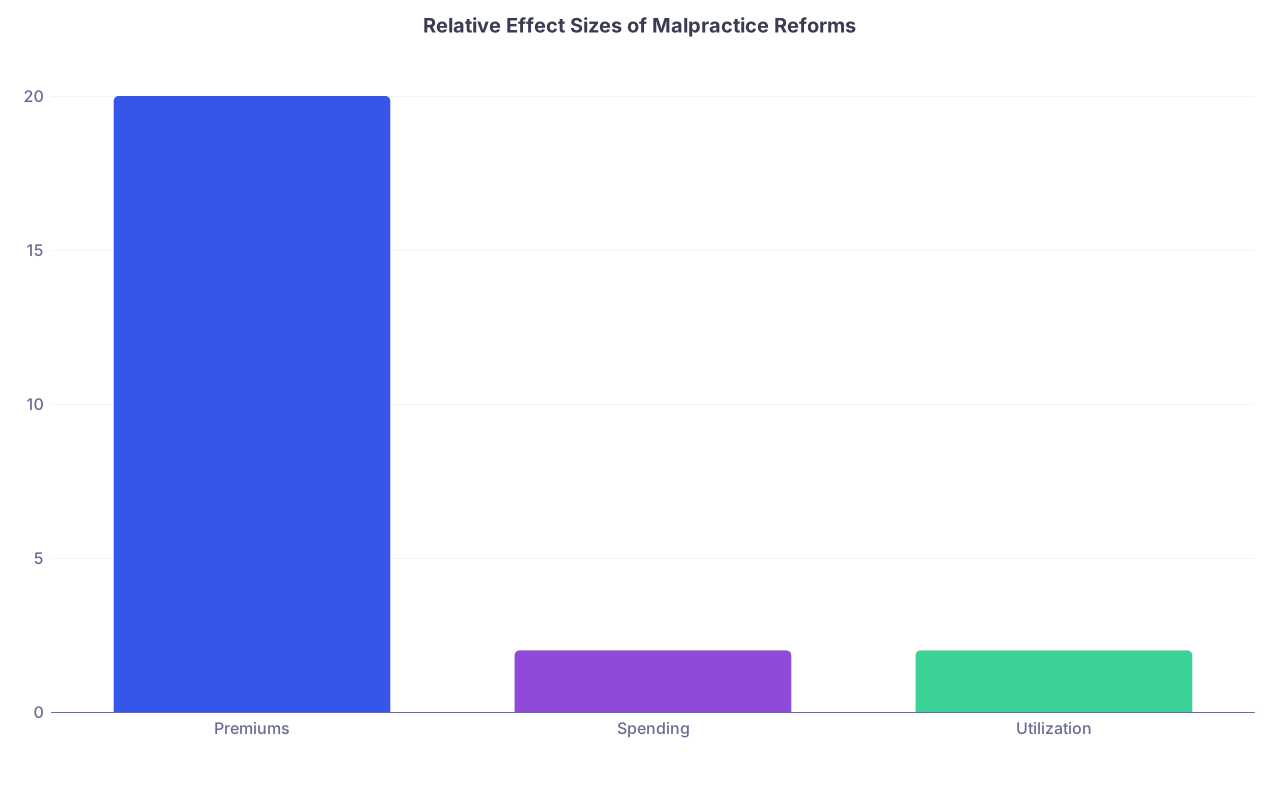
| Category | Value |
|---|---|
| Premiums | 20 |
| Spending | 2 |
| Utilization | 2 |
Interpretation: A representative damage cap might cut malpractice premiums by around 20%, but average healthcare spending and utilization drop in the low single digits, if at all.
Politically, this is awkward. The narrative has been: “Reform tort law and you fix defensive medicine and cut costs.” The data says: “You shave a bit off costs and barely nudge behavior.”
4. Physician Behavior: Fear Persists Even When Risk Falls
The more interesting—and frankly more human—story shows up when you zoom down from state averages to physician-level behavior.
4.1 Lawsuits change practice, but the change is asymmetric
Studies that follow physicians after being sued show a pattern I have seen described in candid hallway conversations:
- After a malpractice claim, physicians increase testing, consultations, and sometimes shift away from high-risk procedures or patients.
- This behavior change is larger and more durable than the shift you see when a state passes tort reform.
One large study using Medicare data found that sued physicians:
- Increased ordered imaging and specialist referrals, particularly in scenarios with diagnostic uncertainty.
- Did not revert to prior patterns quickly, even as local malpractice climate remained stable.
In other words: the personal experience of being sued is a stronger behavioral driver than abstract changes in state-level liability caps.
4.2 Cross-sectional data: high-liability specialties are more defensive
When you compare specialties:
- OB/GYN, neurosurgery, and emergency medicine practitioners consistently show higher rates of “just-in-case” testing and procedures compared with primary care, even adjusting for case mix.
- Regions with historically higher malpractice premiums correlate with higher baseline imaging rates in high-risk specialties.
But—and this matters—the gradient is gradual, not cliff-like. You do not see a sharp drop in imaging when a state passes a cap. You see a long-established pattern that moves very slowly.
5. Defensive Medicine: Where It Shows Up in the Data
Defensive medicine is not some uniform layer of waste on every encounter. It concentrates in gray-zone decisions where the downside of missing something feels catastrophic and the short-term cost is hidden.
The datasets show it most clearly in:
Advanced imaging in emergency and inpatient settings
- Head CTs for minor head trauma with low clinical risk.
- CT pulmonary angiography for low pretest probability PE.
- Multiple imaging modalities ordered sequentially “just to be sure.”
Hospital admissions or observation stays for borderline cases
- Chest pain with negative troponins and unchanged EKGs.
- Syncope with low-risk features.
- Transient neurological symptoms with no objective deficits.
Consultation cascades
- “Better get neuro just in case” even when guidelines would support outpatient follow-up.
- Surgical consults for conditions likely to be managed medically.
Claims data detect this through increases in:
- Per-visit charges
- Utilization of high-cost CPT codes
- Observation vs discharge for clinically similar presentations
Yet when you overlay tort reforms, the shifts are modest. A state that adopts strong caps might see:
- A 1–2 percentage point drop in hospitalizations for low-risk chest pain.
- A very small reduction (sometimes under 1%) in the proportion of low-yield CT scans.
This is defensive medicine, but it is sticky defensive medicine.
6. Outcomes: Do Reforms or Defensive Medicine Change Mortality?
Here is where every policy discussion should get serious: outcomes.
Researchers looked hard for whether malpractice reform:
- Increased mortality or complication rates, by reducing “protective” extra care, or
- Reduced adverse outcomes by freeing physicians from fear, letting them act more clinically rational.
Most large-scale studies find:
- No statistically significant change in mortality following major tort reforms, across conditions like AMI, stroke, pneumonia, or surgical admissions.
- No consistent improvement in quality metrics, readmission rates, or preventable complications.
That cuts both ways:
- If defensive medicine were critically protective, large drops in testing/admissions after reform should show mortality spikes. They generally do not.
- If defensive medicine were massively wasteful, strong reform that materially reduced use should yield clear spending drops without harming patients. You mostly see mild spending changes, no obvious harm.
Translated: the average marginal defensive intervention is low-yield care. It rarely saves lives. It sometimes catches rare events, but at a high cost per event prevented.
7. Culture, Ethics, and Personal Development: What the Numbers Imply for You
At this point, you can draw a cynical conclusion: “Nothing we do on malpractice reform changes much. Why care?”
That is lazy analysis. The datasets are pointing to something deeper and more relevant to your own practice and ethics.
7.1 Fear is a non-linear variable
The quantitative effect of a slight reduction in expected liability is dwarfed by:
- Residents listening to attendings talk about “the case that ruined my year.”
- M&M conferences that focus more on “what could you be sued for” than “what improves patient-centered outcomes.”
- Whisper networks: “In this hospital, they’ll throw you under the bus if something goes wrong.”
The law changes, but the stories do not. Fear remains saturated.
As a result, malpractice reform that only tinkers with dollar caps behaves like a weak instrument. The psychological risk physicians perceive is much less elastic than the legal risk actuaries price.
7.2 Defensive medicine as a moral comfort mechanism
Ethically, defensive medicine is often rationalized as: “I’m protecting the patient from rare harm; the cost is the system’s problem.”
The data challenge that story:
- Most defensive care has very low probability of benefit.
- It often exposes patients to risk (radiation, contrast nephropathy, incidentalomas, procedural complications).
- It shifts costs onto other patients and public budgets.
From a principlist lens—beneficence, nonmaleficence, justice—reflexive defensive ordering often fails:
- Weak beneficence (tiny expected benefit)
- Real harm potential
- Poor justice (resources used where marginal benefit is lowest)
But the emotional calculus in the moment is different: ordering “one more test” feels like protecting yourself while not obviously harming the person in front of you.
The large datasets are the counterweight to that feeling. They aggregate thousands of those “one more tests” and show the downstream patterns.
8. What Actually Seems to Work: Beyond Tort Reform
Some states have tried more structural changes. The numbers here are smaller and less mature, but the early data are more promising than classic reform.
8.1 Communication-and-resolution programs (CRPs)
Hospitals that adopt formal programs to:
- Disclose adverse events transparently
- Apologize and explain
- Offer early, fair compensation where appropriate
see:
- Reduced claim frequency and litigation costs
- Similar or improved patient satisfaction
- No evidence of worsened clinical outcomes
CRPs do not change the law; they change the process and culture around harm. And they alter the emotional memory of physicians—less adversarial, more human, less “I am under attack.”
8.2 Safe harbors linked to guidelines
The concept: if physicians adhere to recognized clinical guidelines and document that, they receive enhanced liability protection.
Data here are still limited, but pilot experiences suggest:
- Increased guideline concordance
- No increase in adverse outcomes
- Clinicians feel more supported in saying no to unnecessary care when the pathway is explicit.
This targets the fear mechanism directly: “If I follow this evidence-based flow and document it, I am on firmer ground.”
8.3 Decision-support plus audit-and-feedback
I have seen internal health system reports that show something most public datasets hint at:
- Integrating clinical decision support (CDS) for common high-variance scenarios (e.g., low-risk chest pain, minor head injury)
- Pairing CDS with feedback on individual ordering patterns vs peers
These systems:
- Reduce unnecessary imaging
- Maintain or improve outcomes
- Over time, normalize lower-intensity care as the default
This is not labeled “malpractice reform,” but it functions as such at the operational level by creating a shared, defensible standard of care.
9. Practical Takeaways for Individual Clinicians
You cannot rewrite state tort law from your call room. You can, however, align your own practice with what the strongest data actually support.
Three specific moves:
Use guidelines and decision rules as shields, not just suggestions.
For high-liability scenarios (chest pain, trauma, PE workup), rely on validated tools (HEART score, Canadian CT Head Rule, Wells score) and document explicitly: “Low-risk by [rule]; guideline-concordant plan is X.” This is both clinically sound and legally defensible.Track your own outlier behavior.
Many systems now provide individual metrics. If your CT rate for low-risk head injury is twice your peers’ rate, that is a data point your fear is driving you, not the evidence. Use those signals.Invest in communication skill, not just test ordering.
Patients who feel heard, respected, and informed are less likely to sue even when outcomes are poor. This shows up clearly in malpractice claim analyses. Your ability to explain uncertainty and shared decision making is a real risk management tool.
Defensive medicine is, in large part, a communication failure—between clinicians and patients, and between clinicians and their own anxiety.
10. Policy-Level Implications: Where Reform Should Focus Next
If you care about public health policy rather than just your personal malpractice risk, the data point towards a different emphasis than the last 30 years of debate.
The system will get more leverage from:
- Standardizing care around evidence-based pathways with explicit safe-harbor implications.
- Scaling communication-and-resolution programs to change the tone and structure of post-error interactions.
- Data transparency on practice variation, so outlier defensive behavior is visible and addressable.
- Education and culture change starting in medical school and residency: teaching evidence-based risk management, not mythology about lawsuits.
Traditional tort reform is not useless—it clearly reduces premiums and may shave a bit off spending—but it is not the silver bullet politicians sold.
The data show that defensive medicine is fundamentally a behavioral and cultural problem superimposed on a legal framework, not just a direct reaction to statute language.
The next wave of malpractice reform that actually matters will be less about caps and more about systems, norms, and communication.
With that foundation, you are better prepared to interrogate the next grand proposal to “fix healthcare” by tweaking liability rules. The real challenge—and opportunity—sits where policy, evidence, and everyday clinical decisions collide. That is where your career and your ethics will be tested next.