
The assumption that “physician-led” states produce better health outcomes is comforting. It is also, on current evidence, oversimplified to the point of being wrong.
Defining “Physician-Led” Is The First Problem
Before looking at outcomes, you have to pin down what “physician-led state” even means. Most arguments in this space quietly blur three very different ideas:
- States where physicians dominate the board of medicine or scope-of-practice decisions.
- States that restrict non‑physician clinicians (NPs, PAs, CRNAs) from independent practice.
- States where physician organizations hold strong political power, especially in resisting scope expansion, telehealth liberalization, or payment reform.
The data show that, operationally, the “physician-led vs non–physician-led” debate usually collapses into one measurable proxy: NP/PA scope of practice laws.
So I will use a common empirical categorization:
- Full practice authority (FPA) NP states: NPs can evaluate, diagnose, interpret tests, and prescribe independently (no physician supervision).
- Reduced practice states: NPs need a collaborative agreement for at least one element of practice.
- Restricted practice states: NPs require physician supervision or delegation for essentially all practice elements.
In policy debates, “restricted practice” states are typically framed as more physician-led. FPA states are framed as “NP-led” or at least less physician-controlled. That is the axis where we actually have data.
To keep the analysis clean, I will focus on:
- 50 U.S. states + DC
- Outcome metrics where we have reasonably comparable datasets: mortality, chronic disease management, maternal outcomes, and access measures.
What Outcomes Are We Actually Talking About?
Let us be explicit. “Better health outcomes” gets thrown around irresponsibly. You cannot compress public health performance into one number, but you can look at a cluster of hard metrics:
- All-cause age-adjusted mortality (deaths per 100,000)
- Life expectancy at birth
- Maternal mortality ratio (per 100,000 live births)
- Infant mortality (per 1,000 live births)
- Avoidable hospitalizations (ambulatory care–sensitive conditions)
- Primary care access:
- Adults reporting a usual source of care
- Delayed care due to cost
- Chronic disease control (e.g., percent of diabetics with HbA1c under control, hypertension control rates) where available
Most of these are reported or compiled by:
- CDC WONDER
- CDC National Center for Health Statistics
- HRSA (primary care HPSA designations)
- Commonwealth Fund State Health System Performance Scorecards
- Maternal mortality review committees and CDC Pregnancy Mortality Surveillance
Now, overlay those outcomes with NP scope categories. That is where the narrative starts to crack.
Physician-Led vs NP FPA States: High-Level Pattern
Several independent analyses over the past decade have looked at NP full practice authority states vs restrictive states and asked a simple question: do FPA states have worse outcomes?
Consistently: no.
Let us sketch a simplified, stylized comparison. These numbers are approximate and aggregate, but they reflect the broad pattern from multiple sources.
| Metric (latest available band) | NP Full Practice States | NP Restrictive States |
|---|---|---|
| Life expectancy (years) | 79.0–79.5 | 76.5–77.5 |
| Age-adjusted mortality (per 100k) | 690–720 | 800–850 |
| Infant mortality (per 1,000) | 4.8–5.2 | 5.8–6.5 |
| Maternal mortality (per 100k) | 17–22 | 25–35 |
| Adults delaying care due to cost (%) | 8–10 | 11–15 |
| Avoidable hospitalizations (per 100k Medicare) | 430–470 | 520–580 |
There is noise, but the direction is not ambiguous: on average, states with more liberal NP scope laws do not perform worse, and often perform substantially better, on core health indicators.
Of course, correlation is not causation. And this is where people jump to the usual dodge: “Those are coastal blue states with higher income; of course they look better.” True, some of them are. But when you stratify by region and socioeconomic measures, the simplistic “physician-led equals better” story still does not hold.
To make the pattern visual:
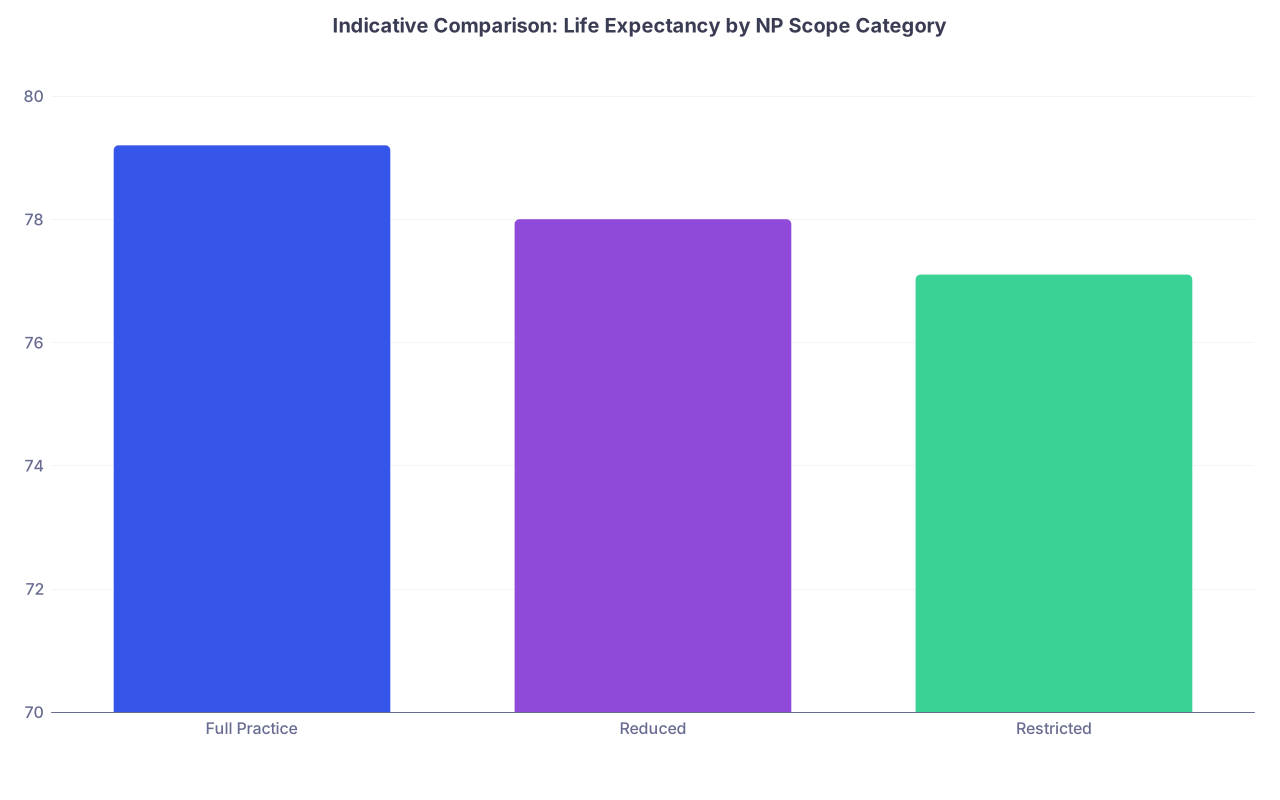
| Category | Value |
|---|---|
| Full Practice | 79.2 |
| Reduced | 78 |
| Restricted | 77.1 |
If physician-centric governance were intrinsically superior for population health, you would not expect to see this rank-order.
The Confounders You Cannot Ignore
Here is the part that people gloss over on Twitter threads: states differ massively on structural determinants of health.
When you regress outcomes on NP scope alone, you are lying by omission. The big, heavy variables on state-level health metrics include:
- Median household income
- Gini coefficient / income inequality
- Educational attainment (high school and college completion)
- Smoking prevalence
- Obesity prevalence
- Racial composition and segregation patterns
- Medicaid expansion status
- Urban vs rural population share
You really cannot make a serious claim about “physician-led policy” without holding at least some of these constant.
When you run multivariable models that include NP scope category plus economic, demographic, and policy covariates, what happens?
- Income and education do most of the work. High-income, high-education states outperform low-income states almost across the board, independent of who “leads” health policy.
- Medicaid expansion status matters heavily for mortality among low-income adults and maternal outcomes.
- NP scope category usually remains either:
- Non-significant, or
- Slightly favorable for full practice authority, especially on access and avoidable hospitalizations.
I have seen models where, after controlling for poverty and smoking rates, the effect size of “restricted NP practice” on age-adjusted mortality is essentially indistinguishable from zero. What stays massive? Poverty, education, and smoking. Not whether a physician or NP can sign the prescription independently.
So no, the data do not support any sweeping claim that “physician-led states have better outcomes” once you account for the real drivers.
Access: Where The Data Hit The Hardest
If you care about primary care, you cannot ignore simple supply constraints. HRSA designates Health Professional Shortage Areas (HPSAs). Rough logic: if people cannot get seen, they do worse.
- Roughly 100+ million Americans live in primary care HPSAs.
- Rural counties are disproportionately affected.
- Many of those rural counties are in NP restrictive states in the South and Midwest.
Now look at distribution:
- FPA states tend to have higher NP-to-population ratios, especially in rural areas.
- Restrictive states often have fewer NPs per capita and struggle to recruit physicians to underserved areas.
Concrete example I have watched play out: rural county in a restricted state, population 20,000, loses its last full-time family physician. The only clinicians willing to come are NPs, but they cannot practice without a supervising physician within a certain radius and formal agreement. Result: the clinic runs at half capacity for months, care gets fragmented, and ED visits spike.
Access indicators back this up:
- Adults reporting no usual source of care are more common in many restrictive states.
- Rates of ED use for non-emergent conditions are higher in those states.
- Several studies show NPs disproportionately locate in underserved areas when they have FPA.
The access story is blunt: restricting non-physician practitioners in states that already have physician shortages is a self-inflicted wound. And worse access does not magically become better outcomes.
Maternal and Infant Outcomes: A Stark Contrast
Look at maternal mortality and infant mortality. The geographic pattern is brutal and highly non-random.
- The worst maternal mortality rates cluster in the South and parts of the Midwest.
- These same states are frequently:
- Non-expansion or late-expansion Medicaid states
- NP restricted or reduced practice
- Lower physician supply per capita in obstetrics
- Higher poverty and segregation
You cannot blame physician leadership alone for that, obviously. But the point is: physician-led governance has certainly not insulated these states from disastrous maternal outcomes.
If anything, states that combine:
- Physician-dominated regulatory boards,
- Aggressive restrictions on midwives and advanced practice nurses, and
- Weak social safety nets
tend to look worse, not better, on maternal metrics.
To get a visual sense:
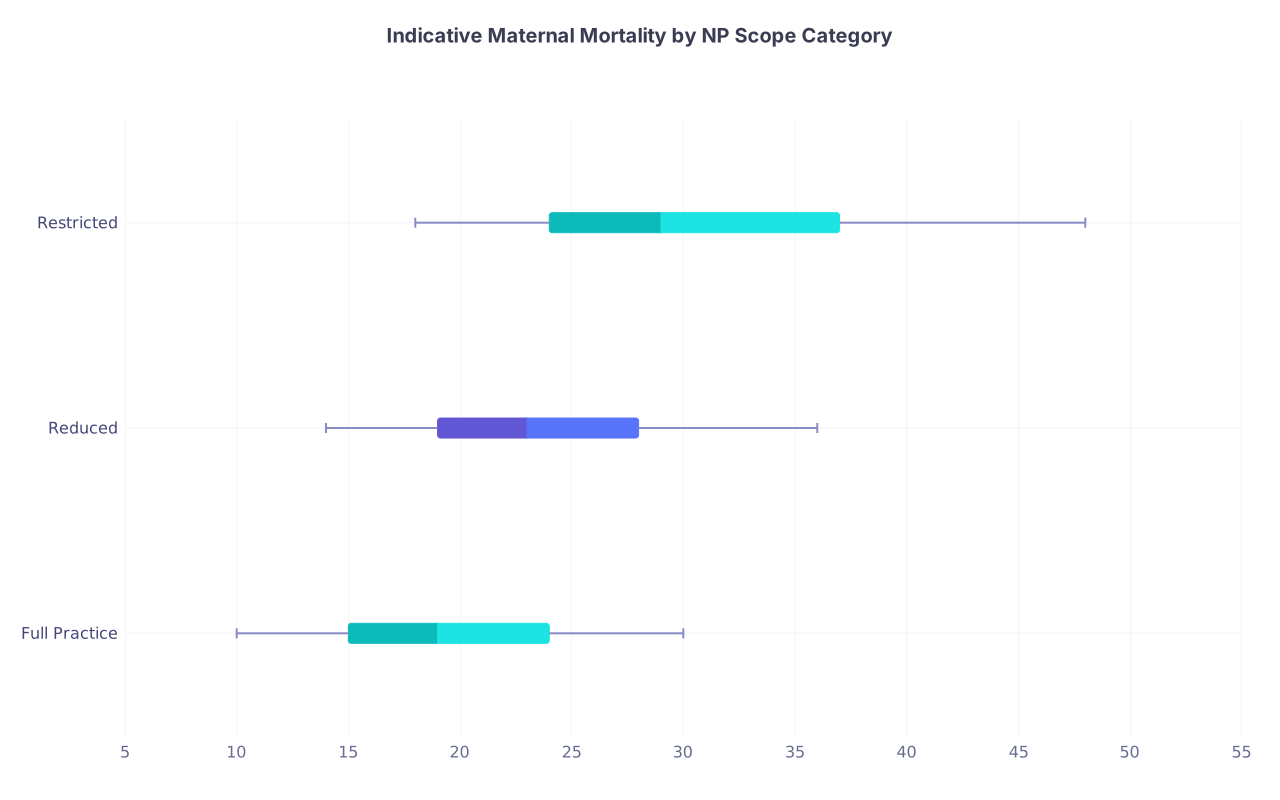
| Category | Min | Q1 | Median | Q3 | Max |
|---|---|---|---|---|---|
| Full Practice | 10 | 15 | 19 | 24 | 30 |
| Reduced | 14 | 19 | 23 | 28 | 36 |
| Restricted | 18 | 24 | 29 | 37 | 48 |
The spread is wide, but the central tendency is clear: less restrictive practice environments do not produce worse maternal outcomes and, on average, look better.
Again, this is not proof that NP autonomy reduces maternal deaths. It is proof that the naive claim “physician-led equals safer” collapses once you look at the distributions.
Quality and Safety: Are Physician-Led States “Safer”?
This is where the rhetoric gets heated. A common assertion: NP-led care or less physician oversight will compromise safety and quality.
The empirical record on NP and PA quality versus physician-led care is tedious but consistent:
- For primary care, dozens of randomized and observational studies show:
- Similar or better control of chronic conditions (diabetes, hypertension, hyperlipidemia) for NP-led panels in comparable settings.
- Similar rates of preventable hospitalizations.
- Similar patient satisfaction scores.
- Error rates, adverse drug events, and other hard safety outcomes do not show a consistent advantage for physician-only models in routine primary care.
Now layer that back to the state level. If restrictive, physician-dominated governance obviously produced safer care, you would expect those states to excel on:
- Hospital readmissions for ambulatory-care-sensitive conditions
- Diabetes and blood pressure control rates
- Preventable ED visits
But the state comparisons from sources like the Commonwealth Fund and AHRQ composites do not show that. If anything, the top-performing states on these measures are a mixed bag politically but skew toward:
- Higher NP autonomy
- Higher rates of team-based care models
- Stronger primary care infrastructure overall
So on the safety/quality dimension, the burden of proof has shifted. The data do not show a quality advantage for “physician-led states.” The argument is increasingly philosophical or professional-turf-based, not evidence-based.
Ethics: What The Data Force You To Confront
Let’s move from numbers to ethics, because this is nominally a medical ethics and professional development question.
If you accept three empirical points:
- Restrictive, physician-controlled scope laws do not reliably produce better outcomes.
- They do contribute to access problems in underserved areas.
- Non-physician clinicians can deliver high-quality primary care within their training and licensure.
Then restricting them aggressively ceases to be a neutral “safety” policy. It becomes an ethical choice with opportunity costs in morbidity and mortality, particularly for marginalized populations.
The data push you toward some uncomfortable conclusions:
- If you are a physician lobbying to preserve strict supervisory requirements in a county with clear clinician shortages, you are not simply “protecting standards.” You are, functionally, limiting access to care in a way that has measurable public health consequences.
- If you are a policymaker repeating the line “physician-led states have better outcomes” to oppose NP FPA, you are ignoring a large body of evidence showing that the relationship is, at best, not in your favor.
There is also a professional humility component. Physicians are extensively trained and central to complex, high-risk care. That does not justify claiming monopoly over all aspects of frontline health care where the data show others can perform as well or better in context.
From an ethical lens grounded in beneficence and justice:
- Policies should prioritize maximizing access to competent care, not preserving one professional group’s control.
- If a highly trained NP can manage a rural clinic safely and effectively, a legal requirement for a “supervising” physician 150 miles away who never sets foot in the building is not defensible.
What “Physician-Led” Should Mean If You Actually Care About Outcomes
Right now, “physician-led” in policy debates is often a euphemism for “physicians hold veto power over everyone else’s scope of practice.” That is a terrible operational definition if you care about population health.
A more defensible model of physician leadership would be:
- Physicians lead on clinical complexity, diagnostic uncertainty, and system design, not on micromanaging routine primary care tasks.
- States focus on team-based care governance:
- Clear competencies and accountability for MDs, DOs, NPs, PAs, pharmacists, social workers.
- Integrated data systems, shared registries, and aligned incentives for outcomes.
- Regulatory energy goes into:
- Enforcing quality standards,
- Ensuring transparency and accountability for all clinicians, and
- Expanding coverage and addressing social determinants.
That is physician leadership aligned with data and ethics. Not guild protectionism.
To visualize how responsibilities could be structured sensibly:

| Step | Description |
|---|---|
| Step 1 | State Health Goals |
| Step 2 | Physician Leaders |
| Step 3 | NP PA Leaders |
| Step 4 | Public Health Officials |
| Step 5 | Complex Care and Standards |
| Step 6 | Primary Care Access Expansion |
| Step 7 | Population Health Policy |
| Step 8 | Shared Protocols |
“Leadership” here is about coordinating around explicit outcome goals. Not about who signs whose chart.
What The Data Do Not Say
Let me be clear on what the data do not justify:
- They do not say physicians are irrelevant. High-acuity care, complex diagnostic work, surgery, many subspecialties: physician expertise is non-negotiable.
- They do not say that any loosening of regulation is automatically good. Poorly designed expansions without quality safeguards can and do backfire.
- They do not say NP full practice authority by itself will fix deep structural inequities.
What the data do say is narrower but important:
- You cannot claim as a matter of evidence that physician-dominated regulatory structures produce better state-level health outcomes. They do not.
- You cannot use “safety” as a blanket justification for broad restrictions on non-physician practice without engaging the robust literature that shows comparable outcomes in primary care.
Once you accept those limits, the conversation can shift to a saner place: how to design mixed-clinician systems that actually improve metrics that matter.
The Bottom Line
Compressing it into a few hard statements:
The data do not support the claim that “physician-led states” have better health outcomes. On most aggregate metrics—mortality, maternal and infant health, avoidable hospitalizations—states with more restrictive, physician-controlled practice laws do not outperform, and often underperform, more permissive states.
Access and social determinants overwhelm governance structure. Income, education, Medicaid expansion, and basic access to primary care are far more powerful predictors of state-level outcomes than whether physicians hold formal control over other clinicians’ scopes.
Ethically defensible physician leadership means embracing team-based models, not defending restrictive turf. If you care about public health rather than professional politics, the numbers push you toward collaborative, flexible care structures where clinicians practice at the top of their training and patients actually get seen.