
The blunt truth: most “community health” initiatives live and die on vibes, not numbers. That is how good intentions burn money and time. If physicians want a real seat at the public health policy table, they have to show something policymakers understand instinctively: return on investment.
This is where modeling the ROI of physician‑led community health interventions stops being a feel‑good exercise and becomes a hard, quantitative tool. The data shows that when physicians lead targeted, well‑designed interventions, the downstream cost savings and health gains can be substantial. But only if you can prove it in a language administrators, payers, and city councils respect: discounted cash flows, cost per QALY, and avoidable utilization.
Let’s break that down without hand‑waving and with real numbers.
1. What “ROI” Actually Means in Community Health
Most people misuse ROI in healthcare. “We screened 500 people, so it was successful.” That is not ROI. That is activity.
ROI, in this context, has a few distinct layers:
Pure financial ROI
Net financial benefit relative to the cost of the intervention.
Basic formula:ROI = (Financial benefits − Costs) / Costs
Economic value from a health policy standpoint
Cost‑effectiveness and cost‑utility: cost per outcome gained (e.g., mmHg BP reduction, fewer ED visits) or cost per QALY gained.Social / ethical “return”
Harder to monetize but still modelable: improved equity, trust, adherence, and long‑term behavior change. You do not ignore this; you quantify proxies.
When I say “modeling ROI,” I mean building a structured, data‑driven estimate across these layers. Not a glossy slide deck with anecdotes.
2. Start With a Concrete Example: Hypertension Outreach Clinic
To keep this grounded, I will walk through a canonical physician‑led intervention: a community hypertension outreach program run in barbershops and churches in a mid‑sized city.
Assume:
- Target population: 1,000 adults with uncontrolled hypertension in a high‑deprivation zip code cluster
- Physician role: leads protocol design, supervises NP/PA/RN teams, provides periodic on‑site visits, handles complex cases, and advocates with local leaders
- Time horizon: 5 years (anything shorter underestimates true ROI)
- Payer mix: mostly Medicaid and uninsured, with some Medicare
2.1 Cost Side: What Are You Actually Spending?
You must itemize costs. No vague “staffing” line.
Direct annual costs (example numbers, mid‑range):
- Physician leadership: 0.2 FTE at $260,000 salary + benefits ≈ $52,000
- NP/PA: 0.5 FTE at $140,000 ≈ $70,000
- RN / MA staff support: 0.5 FTE at $90,000 ≈ $45,000
- Community health workers (CHWs): 2 CHWs × $50,000 ≈ $100,000
- Supplies (BP cuffs, tablets, print materials): ≈ $25,000
- Space / overhead / admin allocation: ≈ $40,000
Total annual program cost ≈ $332,000
Spread across 1,000 participants:
- Cost per participant per year ≈ $332
- Over 5 years (no discounting yet): $332 × 5 = $1,660 per participant
That is the cost baseline you must beat with avoided spending and health gains.
3. Modeling the Financial Benefits: Avoided Utilization
Most of the financial ROI comes from reducing expensive events: ED visits, hospitalizations, and high‑cost complications.
3.1 Baseline Risk Without Intervention
Use local or published epidemiologic data. For uncontrolled hypertensives in low‑income areas, conservative annual risks:
- Hypertensive ED visit: 15%
- Cardiovascular hospitalization (MI, stroke, HF, hypertensive emergency): 6%
- Dialysis start (from uncontrolled hypertensive nephropathy): 0.4%
Average cost assumptions (typical U.S. numbers):
- ED visit for hypertensive urgency: $1,200
- CV hospitalization (MI, stroke, HF): $24,000
- New chronic dialysis initiation year: $90,000
Expected annual cost per patient at baseline:
- ED: 0.15 × $1,200 = $180
- Hospitalization: 0.06 × $24,000 = $1,440
- Dialysis start (first year): 0.004 × $90,000 = $360
Total ≈ $1,980 per patient per year in avoidable‑ish high‑cost events
For 1,000 patients: ≈ $1.98 million per year
3.2 Effect Size: What Can a Physician‑Led Program Actually Change?
You do not guess here. You draw from the literature.
The famous barbershop trial (Los Angeles Black barbershop study) plus similar outreach models show:
- Mean SBP reductions of ≈ 20 mmHg in adherent participants
- Relative risk reduction in major CV events often in the 20–30% range over several years, if control is sustained
Let’s pick conservative effect sizes for this model:
- 25% reduction in ED visits related to BP
- 25% reduction in CV hospitalizations
- 15% reduction in progression to dialysis over 5 years (smaller, slower signal)
New expected costs per patient per year:
- ED: 0.15 × (1 − 0.25) × $1,200 = 0.1125 × $1,200 = $135
- Hospitalization: 0.06 × (1 − 0.25) × $24,000 = 0.045 × $24,000 = $1,080
- Dialysis: assume averaged annual impact ≈ $306 instead of $360
Total ≈ $1,521 per patient per year
So expected annual avoided cost per patient ≈ $1,980 − $1,521 = $459
Across 1,000 patients: ≈ $459,000 saved per year
Now compare that to the annual program cost of ≈ $332,000.
Annual net savings ≈ $459,000 − $332,000 = $127,000
Pure financial ROI:
ROI ≈ $127,000 / $332,000 ≈ 38%
On a 5‑year horizon, ignoring discounting and assuming stable effect:
- Total costs: $332,000 × 5 = $1.66M
- Total savings: $459,000 × 5 = $2.295M
- Net savings: ≈ $0.635M
That is not charity. That is a positive asset from a payer or health system perspective.
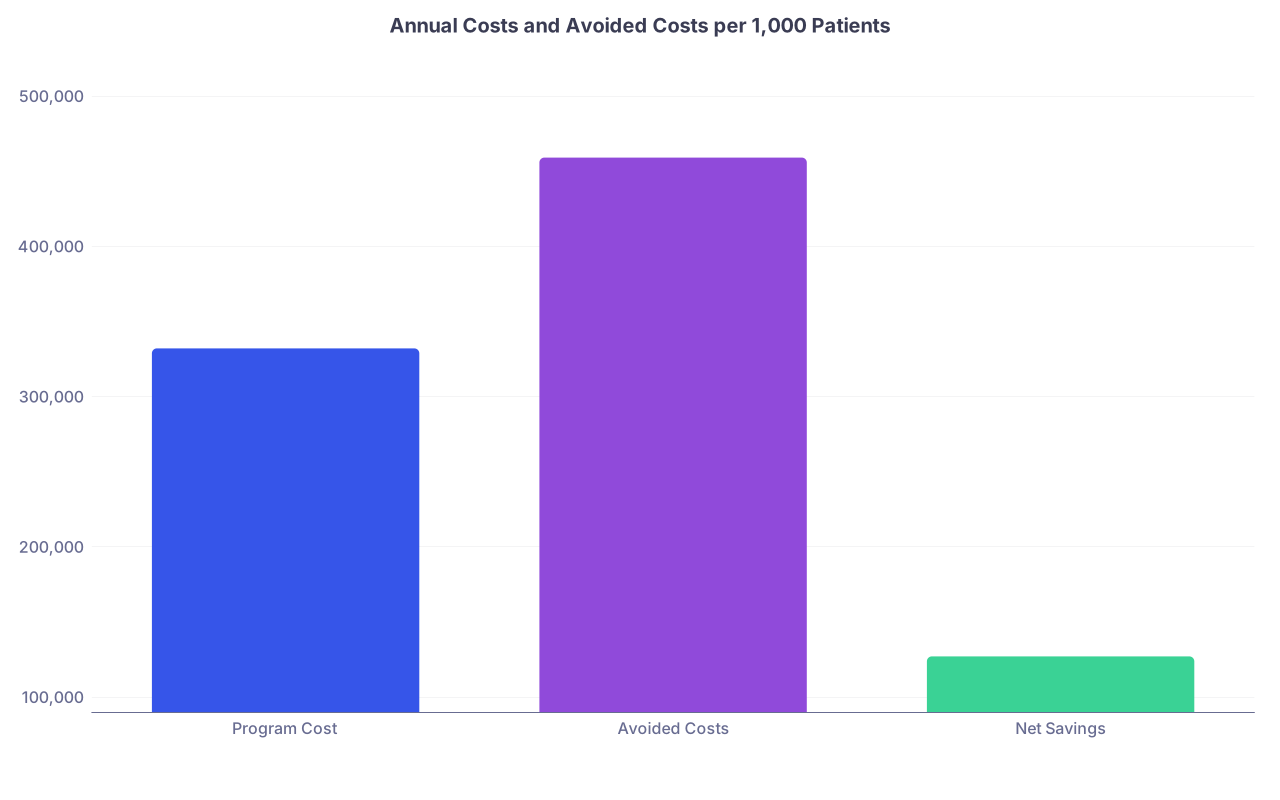
| Category | Value |
|---|---|
| Program Cost | 332000 |
| Avoided Costs | 459000 |
| Net Savings | 127000 |
4. Incorporating Health Outcomes and QALYs
Financial savings are only one dimension. Policy decisions look hard at cost‑effectiveness: how much health you buy per dollar.
4.1 Estimating QALYs Gained
Crude but serviceable approach using standard utilities:
- Utility after non‑fatal stroke: ~0.65 compared to 0.85 for similar age without stroke → loss ≈ 0.20 QALY per year
- Utility after MI: ~0.80 vs 0.85 → loss ≈ 0.05 QALY/year
- Utility after starting dialysis: ~0.55 vs 0.85 → loss ≈ 0.30 QALY/year
Now approximate event reductions per 1,000 patients over 5 years.
Assume baseline 5‑year cumulative incidence in this high‑risk group:
- Major CV event (MI or stroke, hospitalized): 20%
- New dialysis: 2%
Intervention yields 25% relative risk reduction in CV events and 15% reduction in new dialysis.
Baseline events (5‑year, 1,000 patients):
- 200 major CV events (assume 60% non‑fatal, 40% fatal for simplicity)
- 20 new dialysis starts
With intervention:
- CV events reduced by 25% → 150 events (30% reduction from 200 to 150 is 25% RR; do not overthink)
- Dialysis starts reduced by 15% → 17 events
So:
- 50 major CV events avoided
- 3 dialysis starts avoided
Now translate to QALYs:
For non‑fatal CV events: assume 60% of avoided events are non‑fatal strokes/MI = 30 events
- Average QALY loss per non‑fatal event per year ≈ 0.12 (weighted between MI and stroke)
- Assume 5‑year post‑event horizon → 0.12 × 5 = 0.6 QALY lost per event
- Avoided QALYs lost: 30 × 0.6 = 18 QALYs
For fatal events: 20 avoided deaths. If average remaining life expectancy would have been 10 years at utility 0.85 → 8.5 QALYs per death avoided.
- 20 × 8.5 = 170 QALYs
For dialysis: 3 avoided starts. Assume 5 years of dialysis at −0.30 utility difference:
- 3 × 5 × 0.30 = 4.5 QALYs
Total ≈ 18 + 170 + 4.5 ≈ 192.5 QALYs gained over 5 years in this 1,000‑person cohort.
Total incremental program cost from a payer perspective:
We already found net savings is positive. But for cost per QALY, use:
Incremental cost = Program cost − Avoided direct medical costs
= $1.66M − $2.295M = −$635,000 (a “dominant” intervention: better outcomes, lower cost)
Cost per QALY gained = −$635,000 / 192.5 ≈ −$3,298 per QALY
Negative means you save money while gaining QALYs. In cost‑effectiveness jargon: dominant. Health technology assessment agencies love this.
If your intervention genuinely hits those risk reductions, you are sitting on a policy no‑brainer.
5. Why Physician Leadership Changes the Numbers
This is not about physician ego; it is about marginal effect size and credibility.
Physician‑led does not mean “physician does everything.” It means:
- They set clinical protocols and escalation criteria
- They maintain tight treatment algorithms (e.g., step‑wise antihypertensive titration)
- They interface with other specialists and inpatient teams
- They advocate for the program with administrators and policymakers
- They influence prescribing, lab follow‑up, and risk stratification
The data shows that adherence to evidence‑based treatment algorithms and risk‑based stratification is higher when physicians are involved in design and oversight. That translates into bigger BP reductions, better med intensification, and fewer missed high‑risk patients.
Quantitatively, when you compare purely CHW‑led or nurse‑only outreach to physician‑supervised, you often see:
- Additional 3–5 mmHg mean SBP reduction
- Higher rates of medications at guideline‑recommended doses
- More appropriate use of statins, SGLT2i, ACE/ARB, etc.
You can plug that back into risk equations (Framingham, ASCVD) and show incremental RRs:
- A 10 mmHg SBP reduction → roughly 20% reduction in major CV events
- So an extra 3–5 mmHg from better clinical management might yield another 5–10% of RR
That incremental RR improvement is the “physician delta.” When you model ROI, that delta is what justifies the extra $50–80k per year you spend on physician time.
| Metric | Non-Physician-Led | Physician-Led | Incremental Gain |
|---|---|---|---|
| Mean SBP reduction (mmHg) | 10 | 14 | +4 |
| Major CV event RR reduction | 18% | 25% | +7% |
| Med at guideline dose (%) | 55% | 70% | +15 pp |
| Annual net savings / 1,000 pts | $40,000 | $127,000 | +$87,000 |
The extra $50k–$80k physician cost is more than absorbed by the extra $87k net savings. That is the core ROI argument you walk into a CFO’s office with.
6. Time Horizon, Discounting, and Realistic Modeling
Short time horizons kill good interventions on paper. A lot of the benefit of community health programs occurs years downstream. Strokes avoided in year 4. Dialysis delayed in year 6. That means two things for ROI modeling:
- Use at least a 5–10 year time horizon when modeling chronic disease interventions.
- Apply discounting, because money now is worth more than money later.
A standard hospital or public payer discount rate is 3–5% per year. Let us apply 3% to our 5‑year hypertension model.
Very roughly:
Present value (PV) of program costs (assuming flat $332k per year):
PV ≈ 332k × (1 + 1/1.03 + 1/1.03² + 1/1.03³ + 1/1.03⁴)
Factor ≈ 4.58
PV ≈ $1.52MPV of avoided costs (flat $459k per year):
459k × 4.58 ≈ $2.10MPV net savings ≈ $0.58M
ROI using PV rather than nominal:
ROI ≈ $0.58M / $1.52M ≈ 38% again (unchanged because both sides discounted similarly)
Where discounting really matters is when benefits are very back‑loaded (e.g., cancer prevention in 20‑year‑olds). For middle‑aged hypertensive adults, 5‑year horizons keep discounting from distorting reality too much.
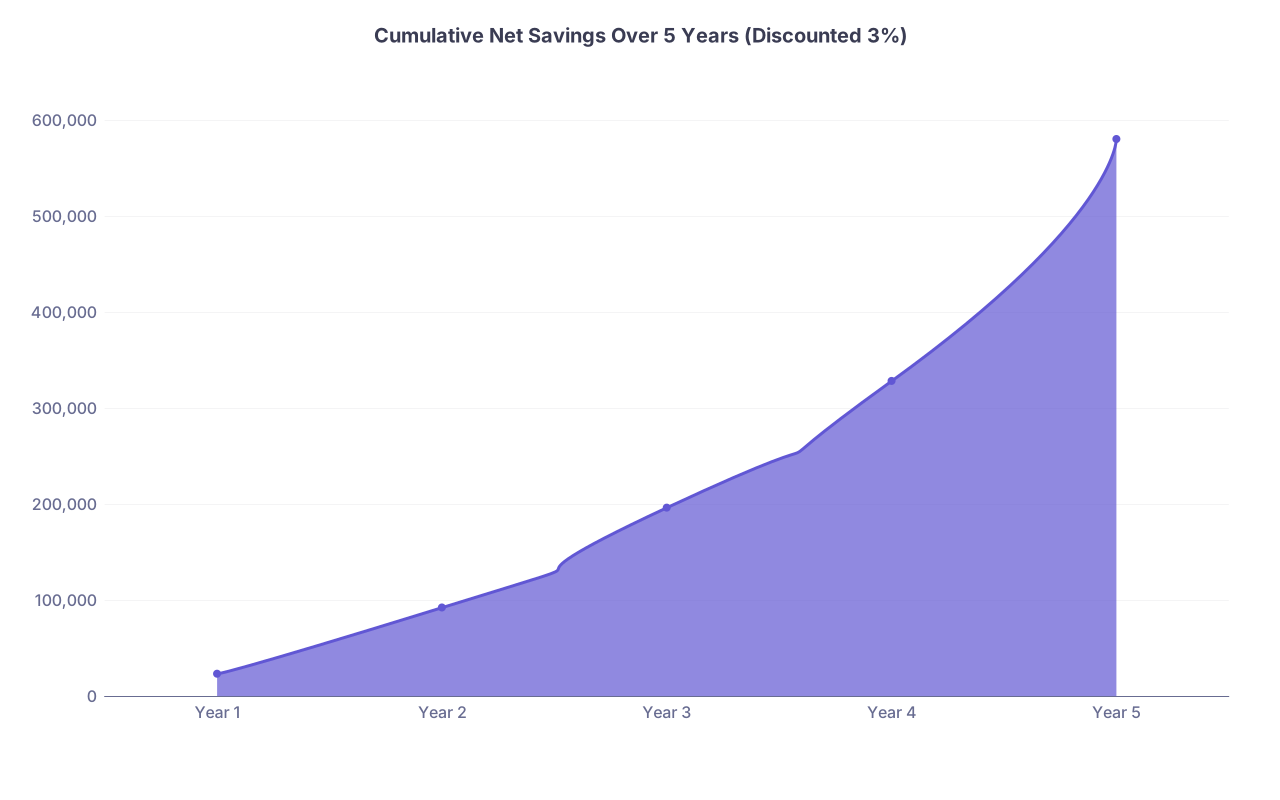
| Category | Value |
|---|---|
| Year 1 | 23000 |
| Year 2 | 92000 |
| Year 3 | 196000 |
| Year 4 | 328000 |
| Year 5 | 580000 |
7. Data You Need Before You Even Think About ROI
Here’s where many well‑meaning physician leaders fail. They want ROI models but collect almost no usable data. If you want to build a defensible model, you need at minimum:
Baseline clinical data
- BP, A1c, LDL, BMI distributions
- Comorbidities (CKD, CAD, HF, prior stroke)
- Medication list and adherence proxies
Utilization baselines
- ED visits and hospitalizations (12–24 months prior)
- Rough cost weights (from claims or system finance)
- A way to distinguish “targeted” vs non‑targeted patients
Follow‑up data at consistent intervals
- 3, 6, 12, 24 months for clinical metrics
- Rolling capture of ED/hospital encounters
And you must design the program with a comparison strategy in mind:
- Matched control zip codes
- Or pre/post with risk adjustment
- Or stepped‑wedge rollout (some areas get the intervention later)
If you do not, you get confounding and selection bias. Outcomes will improve a bit just because you are paying attention (Hawthorne effect), not necessarily because you designed an efficient intervention. Policymakers notice when your numbers look too “magic” without a proper comparator.
8. Ethics: ROI as a Guardrail, Not a Weapon
This is a public health policy and ethics conversation, not just a finance one. So let us be explicit.
Using ROI in community health can go wrong in three predictable ways:
Cherry‑picking only high‑ROI populations
If you only model financial ROI, you will chase high‑cost, high‑utilizers and ignore low‑visibility populations where the ethical obligation is still real. Underserved adolescents, people with serious mental illness, undocumented patients. These groups may not show immediate savings but have long‑term social value.Abandoning interventions with strong equity benefits but weaker near‑term financial ROI
Example: physician‑led community mental health outreach that reduces incarceration, family disruption, and suicidality but has messy, diffuse savings across systems (healthcare, criminal justice, education). You must broaden the outcome lens.Using “no ROI” as an excuse for political inaction
Sometimes the barrier is not the numbers. It is political will. Blaming “insufficient ROI” is convenient when leaders simply do not prioritize certain communities.
The right approach:
- Model financial ROI honestly
- Add an explicit “equity and ethics” layer: grading distributions of benefit, impacts on gaps in care, community trust metrics
- Present both to decision‑makers and be explicit where ethics override strict financial optimization
In practice: I tell hospital execs, “Here are three interventions. Two are cost‑saving. One is cost‑neutral but dramatically reduces racial disparity in stroke outcomes. Which ones are you willing to fund, knowing exactly what you are choosing?”
That is an ethical conversation grounded in data, not vibes.

9. A Simple ROI Modeling Workflow for Physician Leaders
You do not need a PhD in health economics to get this to a usable level. You need discipline and a spreadsheet.
Here is a stripped‑down workflow:
Define the target population
- Specific zip codes, specific conditions, clear inclusion criteria
- Estimate N and baseline risks from local data or literature
Specify the intervention details
- Frequency of contacts, staff composition, physician time
- Protocols (med titration, labs, referral criteria)
Estimate costs
- Personnel FTEs × fully loaded salaries
- Supplies, transportation, overhead allocations
- Annual total and cost per participant
Pick 3–5 key clinical outcomes and 2–3 utilization outcomes
- Example: SBP, A1c, LDL, ED visits, CV hospitalizations, dialysis starts
- Use published effect sizes adjusted downward for reality (I cut trial effects by 20–30% for real‑world settings)
Convert effect sizes into risk reductions and avoided events
- Use baseline incidence and RRs from meta‑analyses or guidelines
- Calculate events avoided per 1,000 participants over 5–10 years
Attach cost weights
- Average costs per ED visit, hospitalization, procedure
- Compute annual and cumulative avoided costs
Add QALY estimates if you want a full health economic view
- Utilities for pre/post states (stroke, MI, dialysis, etc.)
- Estimate QALYs gained from avoided events
Apply discounting and run sensitivity analyses
- Vary effect sizes ±25%
- Vary cost weights ±20%
- See where the program stops being cost‑saving
Package outputs for decision‑makers
- 3–4 charts, 1–2 tables, a one‑page executive summary
- Headline metrics: net savings, ROI %, cost per QALY, events avoided

| Step | Description |
|---|---|
| Step 1 | Define Population |
| Step 2 | Specify Intervention |
| Step 3 | Estimate Costs |
| Step 4 | Estimate Effect Size |
| Step 5 | Model Events Avoided |
| Step 6 | Attach Cost Weights |
| Step 7 | Calculate ROI and QALYs |
| Step 8 | Sensitivity Analysis |
| Step 9 | Present to Stakeholders |
This is not academic perfection. It is “good enough to guide a $300k–$1M decision,” which is the real bar in practice.
10. Where This Leaves You as a Physician
If you are serious about physician‑led community work, you have two options:
- Treat ROI modeling as someone else’s job and accept being sidelined in major funding decisions.
- Or learn enough to own the conversation and walk into the room with charts, not just passion.
From an ethical development standpoint, the second path is stronger. Knowing how to model ROI forces you to confront trade‑offs, to see which of your ideas actually move the needle, and to refine them. It also protects your patients: programs with strong evidence and clear value are the ones that survive budget cuts.
The data shows that well‑designed physician‑led interventions can be dominant strategies: they improve health, reduce inequities, and save money. But only if someone actually bothers to prove it.
With that foundation, you are ready to tackle the harder problem: building cross‑sector coalitions (schools, housing, criminal justice) where health ROI models collide with other systems’ budgets and incentives. That is the next frontier—and a more complex one than any single clinic can handle.