
The common claim that “we need more doctors in government” is only half right. The data show something sharper: we do not just need more physicians in legislatures; we need the right physicians, with the right training, incentives, and ethical grounding, or we simply recreate the same policy failures with nicer stethoscopes.
Let me walk you through the numbers.
How Many Physicians Are Actually in Congress?
Start with Congress because that is where most people’s imagination goes when they think of “physicians in politics.”
Historical tallies from the Congressional Research Service, ProPublica, and various academic reviews show a consistent pattern:
- Total members of Congress: 535 (100 Senators, 435 Representatives).
- Physicians in the 118th Congress: roughly 17–20, depending on how you count dentists and retired physicians still licensed.
That puts physicians at about 3–4 percent of Congress.
Compare that to physicians in the general population. The U.S. has about 1 million active physicians for ~335 million people. That is roughly 0.3 percent of the population.
So physicians are overrepresented in Congress by about a factor of 10x relative to their share of the population.
But that headline masks something more subtle. When you look inside committees and party breakdowns, the pattern shifts.
| Category | Count | Share of Group |
|---|---|---|
| Total Members of Congress | 535 | 100% |
| Physicians (MD/DO only) | 17 | ~3.2% |
| Senate Physicians | 3 | 3% of 100 |
| House Physicians | 14 | 3.2% of 435 |
The data show physicians are not absent. They are just concentrated in specific political and ideological niches.
Party and Specialty Skew
Look at party identification and specialty, and you get a very non-random distribution:
- Historically, roughly 70–80 percent of physician-legislators in Congress are Republicans.
- Surgical and procedure-heavy specialties are overrepresented:
- Orthopedic surgery
- General surgery
- Cardiology
- Emergency medicine
- Anesthesiology
- Primary care (family medicine, general internal medicine, pediatrics) is underrepresented relative to its share of the physician workforce.
This skew matters because specialty predicts not just clinical practice but political attitudes. Multiple surveys (AMA, Medscape, and peer-reviewed work) show:
- Surgeons and proceduralists trend more conservative, more market-oriented, more skeptical of broad public insurance expansion.
- Primary care physicians trend more supportive of public coverage, social determinants, and safety-net investment.
So when someone says “doctors in Congress,” the statistical reality is closer to “mostly conservative proceduralists in Congress.” That does not invalidate their perspective, but it does bias which “physician voice” is getting amplified.
State Legislatures: Where Physician Presence Really Drops
Congress actually looks generous compared to statehouses.
Most state legislatures have 0–3 physicians total. Some have none. A few “medical-heavy” states may have 5–10 if you count dentists, veterinarians, and other health professionals, but practicing MD/DO legislators are rare.
Take a simple ratio:
- Average state House + Senate size: ~140 members.
- Physicians per legislature: 0–3 typical.
That gives you a physician share usually between 0 and 2 percent, below the 3–4 percent we see in Congress but still above the raw population proportion of 0.3 percent.
In practice, that means:
- Many states pass sweeping health legislation without a single actively practicing physician in the room as a peer legislator.
- Testimony from physicians is then “external expertise,” which has political weight but not voting power.
The gap becomes very obvious on technical topics: scope-of-practice expansions, Medicaid payment carve-outs, certificate-of-need, prescriptive authority. I have watched committee hearings where no one in the room could accurately explain the difference between a hospitalist and an internist, yet they were rewriting hospital staffing rules.
Do Physician-Legislators Change Health Policy Outcomes?
Now to the real question: does having physicians in legislatures actually move health policy in a measurable way?
You would expect yes. The reality is more nuanced.
Voting Patterns: Physician vs Non-Physician
Several political science analyses have done the basic comparison:
- Create a dataset of roll-call votes on health-related legislation.
- Label legislators as physicians vs non-physicians.
- Adjust for party, ideology score, district characteristics.
- Look for statistically significant differences.
What you see is not magic. Party dominates. In most models, once you control for party and overall ideology (e.g., DW-NOMINATE scores), the “physician” coefficient shrinks sharply.
In plain English:
A Republican orthopedic surgeon in Congress votes much more like a Republican lawyer than like a Democratic pediatrician. Party > profession.
But “much more like” is not “identical.” There are some consistent, measurable shifts:
Physician-legislators are slightly more likely to:
- Support medical liability reform (caps on damages, tort reform).
- Oppose broad single-payer style reforms.
- Support telemedicine and certain regulatory flexibilities.
- Push for specific disease-focused or specialty-focused funding (cancer centers, cardiology, veterans’ health, rural emergency care).
They are not systematically more likely, once you control for party, to:
- Expand Medicaid.
- Regulate pharmaceutical prices aggressively.
- Increase public health budgets, vaccine program funding, or social determinants interventions.
That last cluster surprises people. Many assume “doctor in office” means more aggressive public health. It does not, by default.
Where Physician Presence Has Clear Impact
Where the physician footprint is visible, you see it in three areas:
Technical amendments and error correction.
During markups, physicians can say, “That clause will inadvertently ban X,” or “The wording here conflicts with current clinical guidelines.” I have seen bill drafts that would have effectively made standard ICU sedation practices illegal until a physician-legislator flagged the wording.Committee agendas.
When a physician chairs or vice-chairs a health committee, the data show more hearings on clinical and payment issues and fewer on abstract “culture war” health topics. Not zero, but fewer.Symbolic and agenda-setting bills.
Opioid prescribing limits, surprise billing protections, mental health parity enforcement—physicians often sponsor or co-sponsor these, using clinical narratives to drive attention.
The impact is more about the shape and feasibility of health policy than about flipping major ideological outcomes.
Ethical Tensions: Representation vs Self-Interest
From a medical ethics and professional development standpoint, the question is not just “how many doctors” but “which doctors, with what incentives.”
The data show some uncomfortable patterns.
Income, Specialty, and Policy Positions
Let me simplify a consistent finding:
Specialties with higher average income (surgery, radiology, cardiology) have legislators who:
- Are more likely to oppose fee cuts and payment reform that shifts money toward primary care or public health.
- Are more aggressive on malpractice reform.
- Are wary of any policy that looks like rate setting or global budgeting.
Lower-paid, cognitively heavy and primary care specialties lean toward:
- Payment reform that values evaluation and management.
- Expanding coverage (because they see the uninsured daily).
- Supporting team-based care and nurse practitioner roles with guardrails rather than pure protectionism.
There is a direct line between relative income position and policy preference. That should not shock anybody, but it raises a blunt ethical problem: Are physician-legislators reliably acting as stewards of public health, or as sophisticated industry lobbyists with votes?
The answer: mixed. Some do one. Some do the other. The aggregate patterns show strong ties to financial self-interest at the specialty level.
Conflicts of Interest and Industry Ties
Look at public financial disclosures. You find:
- Ownership stakes in imaging centers, ambulatory surgery centers, specialty clinics.
- Consulting or speaking fees from device or pharma companies (sometimes discontinued once elected, sometimes not).
- Board seats on hospitals or health systems.
Now layer that over policy votes on:
- Site-of-service differentials.
- Stark Law changes.
- Medicare Advantage regulation.
- Prior authorization rules.
There is no way to pretend this is a purely “public health” game. The risk is not theoretical. I have seen state-level scandals where a legislator quietly pushed for a reimbursement tweak that directly increased their own practice revenue.
From an ethics standpoint, the profession has not built strong enough norms for how physicians in office should manage these conflicts. Compare that to judicial ethics or even some corporate boards—medicine is behind.
What the Data Say About Public Health Outcomes
You might ask the cleanest possible question: do states or countries with more physician-legislators have better health outcomes?
The blunt answer: there is no consistent, robust, adjusted association that holds up under serious statistical control.
When researchers try to correlate:
- Physician density in legislatures
with - Life expectancy, infant mortality, vaccination rates, avoidable hospitalizations, or preventable mortality
…any naive correlation is quickly swamped by:
- Income levels
- Overall partisan control and policy ideology
- State Medicaid generosity
- Urban-rural mix
- Baseline public health infrastructure
At best, you get weak, noisy signals in a few niches. For example:
- States where physicians held key health committee leadership roles during the opioid crisis sometimes implemented earlier PDMP (prescription drug monitoring program) policies or more thoughtful opioid prescribing rules.
- Some states with vocal physician-legislators saw earlier adoption of cancer screening coverage or palliative care initiatives.
But that is case-by-case, not a law of political physics.
The pattern is more: physician-legislators can marginally improve technical quality and implementation detail of health policies their party already supports. They very rarely overturn the fundamental direction set by ideology and interest group coalitions.
Personal Development: Should Physicians Go Into Politics?
So what does all this mean for you as a physician or future physician thinking about public service?
The data show three critical realities.
1. Political Skill > Clinical Brilliance
Clinically outstanding physicians do not automatically become effective legislators. In fact, they often fail if they assume data and logic win by themselves.
Successful physician-legislators tend to:
- Learn legislative procedure cold: committee rules, amendment tactics, budget cycles.
- Build cross-sector coalitions: patient groups, insurers, unions, business associations, not just medical societies.
- Translate clinical data into politically salient narratives, rather than drowning colleagues in jargon or journal citations.
You can see it in bill passage rates. Physician-legislators with strong political skills have significantly higher rates of getting their sponsored health bills out of committee and onto the floor. Those who rely purely on “I am the doctor here” rarely move anything substantial.
2. Ethical Anchors Must Be Explicit, Not Assumed
Medical training does not inoculate anyone against self-interest. The numbers on specialty-driven voting patterns and financial disclosures make that obvious.
If you are serious about ethical service, you need to:
- Publicly disclose all relevant financial interests—beyond the legal minimum.
- Recuse yourself from specific votes where you stand to benefit directly.
- Anchor your policy priorities in population-level metrics: coverage rates, mortality, equity gaps, rather than specialty revenue.
That means using benchmarks like:
- Uninsured rate by district.
- Excess mortality by race or zip code.
- Primary care access within 15–30 miles.
- Opioid overdose fatalities per 100,000.
Not just: “How does this affect surgical RVUs?”
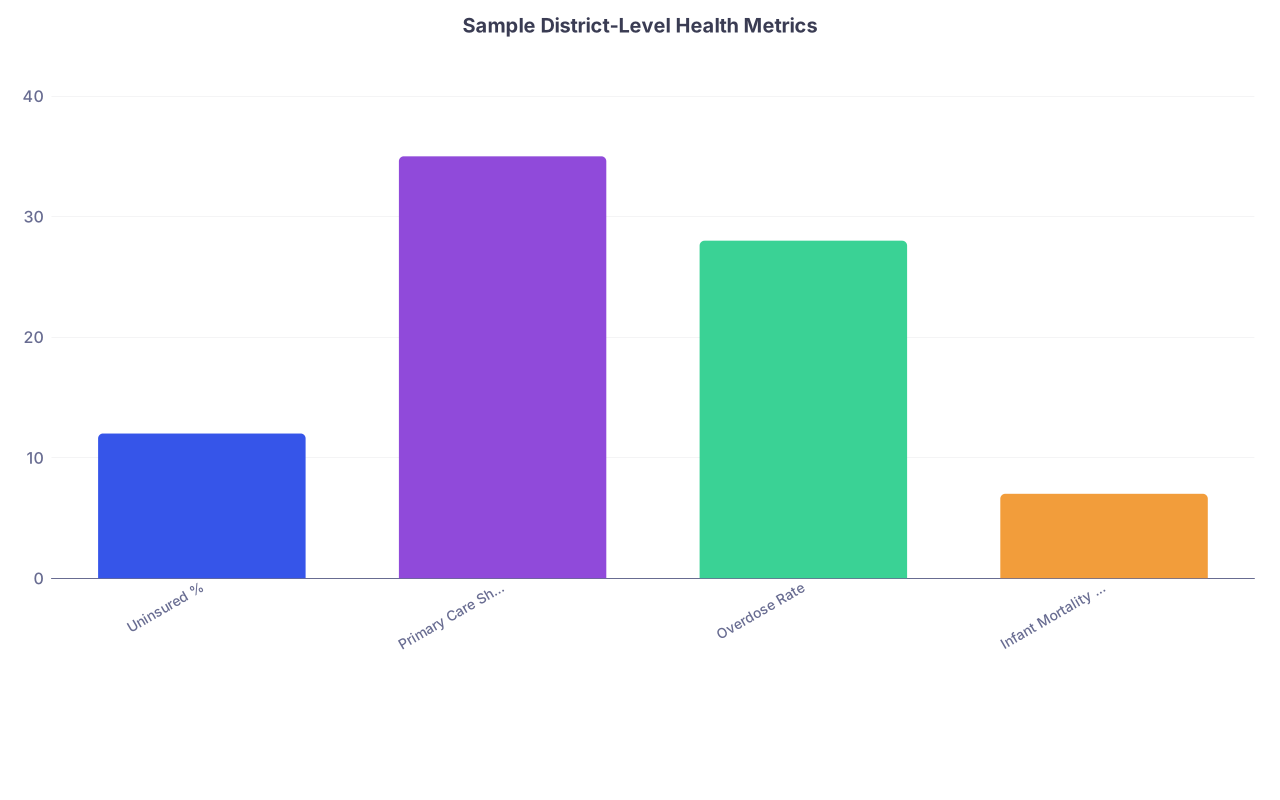
| Category | Value |
|---|---|
| Uninsured % | 12 |
| Primary Care Shortage Index | 35 |
| Overdose Rate | 28 |
| Infant Mortality Rate | 7 |
If you do not ground yourself in data like this, you will drift toward the same narrow interests as everyone else—just dressed up in white coat language.
3. Alternative Roles May Have Higher Impact
The marginal impact of one more physician in a 100- or 400-member chamber is modest. The marginal impact of a physician who:
- Leads a major public health department,
- Runs a large community health system with policy clout, or
- Becomes a trusted expert repeatedly called to testify across parties,
…can be larger.
The “physician in politics” pipeline does not have to end in elected office. Appointed roles, non-profit leadership, and data-driven advocacy often let you affect the same policies with fewer ethical landmines and better alignment with evidence.
How Physicians Can Actually Improve Policy Quality
Let me be concrete about behavior that moves the needle, grounded in the data and repeated patterns.
Use Data, Not Just Stories
Good physician-legislators do both. They bring a patient story and then slam down numbers.
- When discussing Medicaid expansion, do not just say “my patients need it.” Show the projected drop in uninsured, the state-level federal match leveraged, and the historical data on uncompensated care declines.
- When arguing about scope-of-practice, present comparative quality and safety data, not just “I worry about patient safety.”
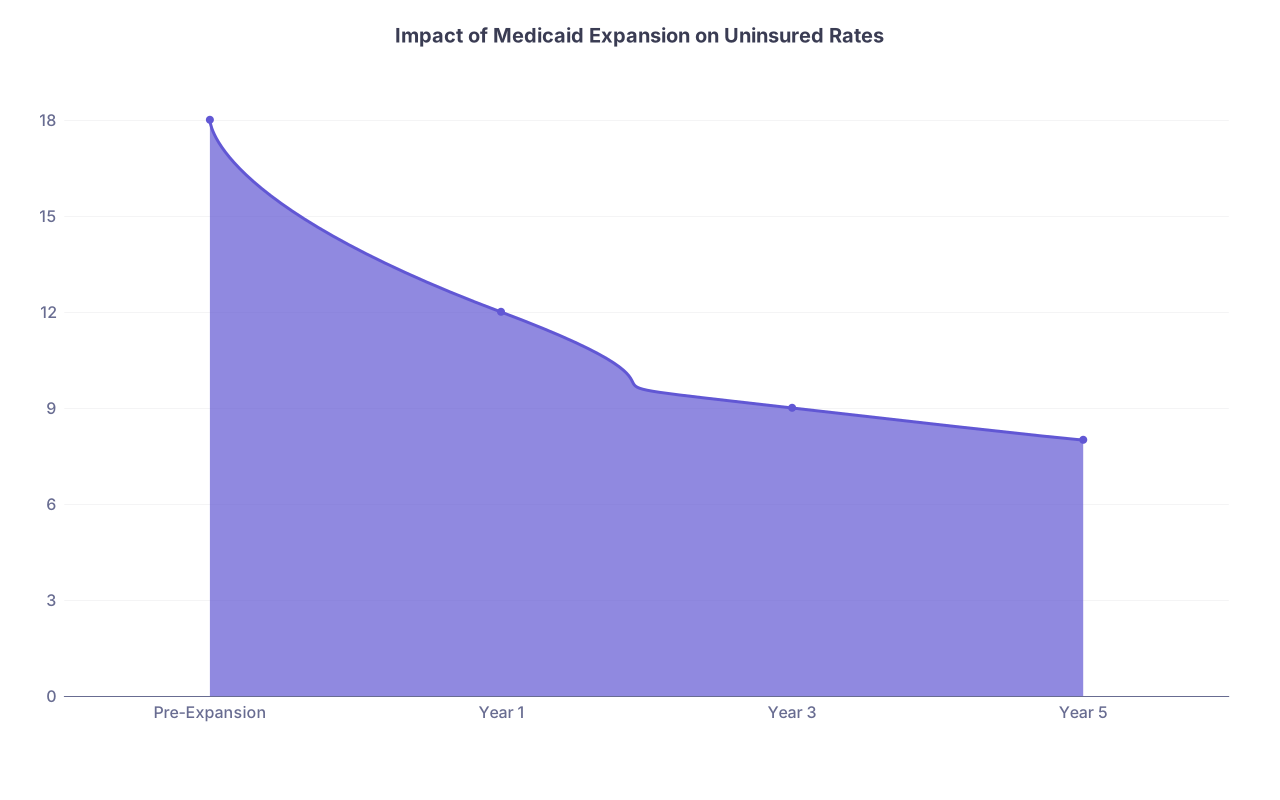
| Category | Value |
|---|---|
| Pre-Expansion | 18 |
| Year 1 | 12 |
| Year 3 | 9 |
| Year 5 | 8 |
Legislatures are drowning in anecdotes. They are starved for clean, interpretable metrics that fit within a 5-minute attention span.
Frame Health as Economic Policy
Raw public health arguments rarely win long-term. Framing counts.
The data are clear:
- Poor health outcomes drive higher disability rolls, lost productivity, and lower tax revenues.
- Evidence-backed interventions (vaccination, smoking cessation, early mental health treatment) have positive return on investment at the state budget level.
Physicians who translate “reduce heart failure readmissions” into “keep 500 more adults in the workforce each year, raising local income tax receipts by X dollars” get traction. Those who stay confined to clinical language lose votes.
Bring Cross-Disciplinary Literacy
The physician-legislators who are consistently effective almost always have an additional language:
- Health economics
- Behavioral science
- Data science / biostatistics
- Law / regulatory design
If you want to develop yourself for this kind of work, you are not done at the end of residency. Learn to read a budget. Learn to interpret an interrupted time series. Learn why a randomized controlled trial may not predict community-level impact under moral hazard and implementation constraints.
That is where physicians often fall apart. They know RCTs. They do not know how policies cascade through systems with feedback loops and perverse incentives.
The Bottom Line
Strip away the white coat mystique, and the numbers are simple:
Physicians are overrepresented in Congress relative to the general population, but heavily skewed toward certain specialties and political ideologies. Party and ideology drive most voting behavior; “being a doctor” adds nuance, not transformation.
Physician-legislators improve the technical accuracy and implementation detail of health policy more than they change its ideological direction. They can prevent harmful mistakes and design smarter programs, but they rarely override deep partisan structures.
Without explicit ethical standards and a data-driven focus on population health, physician-legislators drift toward specialty and financial self-interest like everyone else. If you want to be different, you must measure different things and act on those metrics, not on your income line.
If you are a physician thinking about stepping into politics, do it with eyes open. Bring your statistics, your humility, and your ethics manual—then decide whether your impact will be greatest on the floor of a legislature, or from a different but equally powerful seat at the policy table.