The conventional wisdom that “stricter prescribing automatically saves lives” is not supported by the full data. The reality is more uncomfortable: aggressive prescription clampdowns have, in many regions, shifted opioid deaths from prescription pills to illicit fentanyl with only modest gains—or even net harm—in overdose mortality.
That is the core problem you have to reckon with as a clinician, policymaker, or ethicist.
The data picture: what actually happened to opioid deaths?
Start with the basic trend line. The United States has three distinct waves of opioid mortality:
- Prescription opioid wave (roughly 1999–2010)
- Heroin wave (2010–2013/14)
- Synthetic fentanyl wave (2013–present)
National data from CDC WONDER and NCHS show:
- From 1999 to about 2010, overdose deaths involving prescription opioids rose from a few thousand per year to over 16,000 annually.
- After 2010, prescription-opioid–involved deaths plateaued, then declined modestly in many states.
- Total opioid deaths, however, kept rising—fueled by heroin first, then fentanyl and its analogs.
That divergence—falling or flat prescription opioid deaths vs sharply rising illicit opioid deaths—is where prescription policies come in.
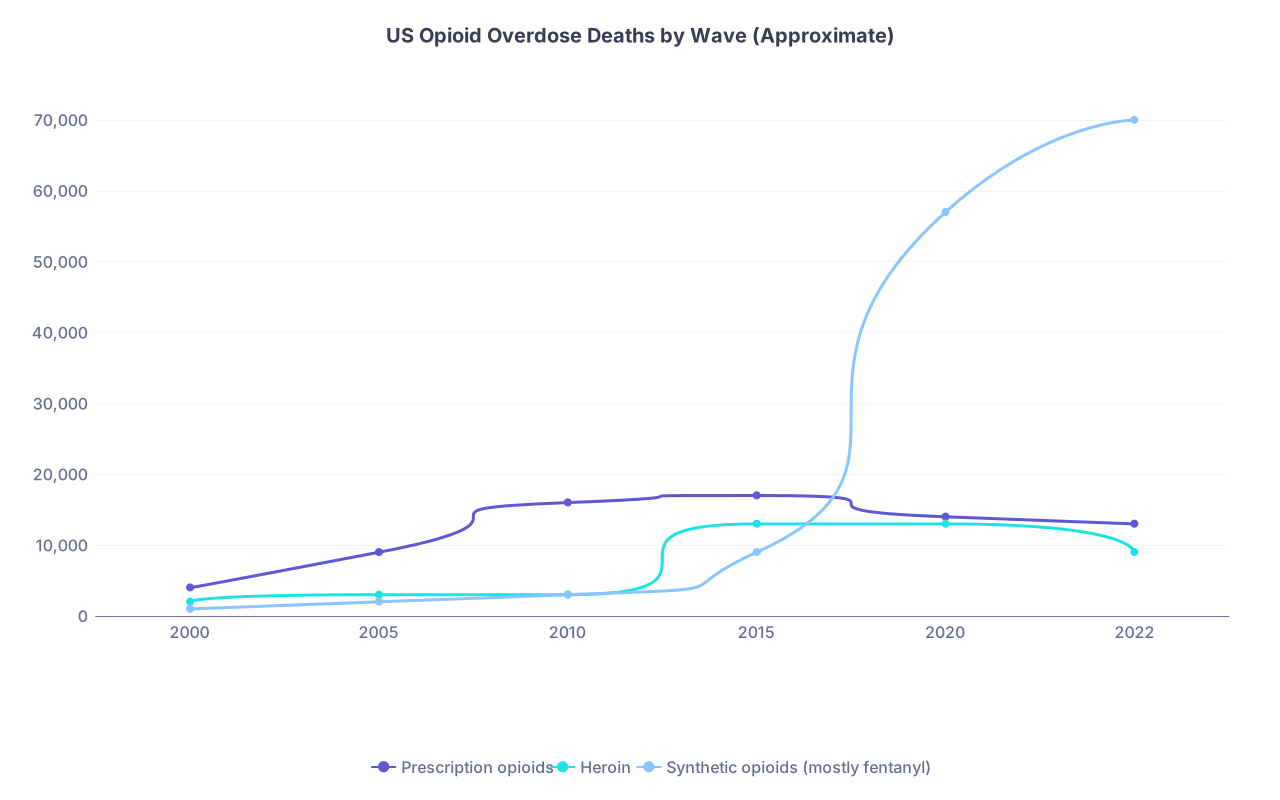
| Category | Prescription opioids | Heroin | Synthetic opioids (mostly fentanyl) |
|---|---|---|---|
| 2000 | 4000 | 2000 | 1000 |
| 2005 | 9000 | 3000 | 2000 |
| 2010 | 16000 | 3000 | 3000 |
| 2015 | 17000 | 13000 | 9000 |
| 2020 | 14000 | 13000 | 57000 |
| 2022 | 13000 | 9000 | 70000 |
These are approximate national numbers, but the pattern is consistent across multiple detailed analyses: prescription policies bent one curve while the overall mortality curve kept climbing.
So the right question is not “did prescription policies reduce prescribing?”—the answer is obviously yes. The better question is: “Did the mortality benefit from less prescription exposure outweigh the mortality cost of pushing high-risk people into an increasingly toxic illicit market?”
In many jurisdictions, the data says: not clearly. Sometimes not at all.
What policy levers were actually pulled?
You cannot attribute causality without specifying which levers moved. The big U.S. prescription-focused interventions since ~2010 fall into several buckets:
- Prescription Drug Monitoring Programs (PDMPs), often moving from voluntary to mandatory use.
- Dose limits and duration caps (e.g., 7-day acute pain limits, 90 MME/day thresholds).
- Guidelines and payor policies, especially the 2016 CDC Guideline and subsequent insurer and pharmacy utilization controls.
- “Pill mill” enforcement and criminal prosecution of high-volume prescribers.
- Abuse-deterrent formulations (e.g., reformulated OxyContin in 2010).
Different states implemented different mixes and timings, which is useful analytically. You can exploit that variation as a natural experiment.
| Policy Type | Typical Implementation Year Range | Primary Target |
|---|---|---|
| PDMP launch | 2000–2012 | All opioid prescribers |
| Mandatory PDMP check | 2012–2018 | High-risk prescriptions |
| Acute pain day limits | 2014–2019 | New short-term scripts |
| Dose thresholds (MME) | 2013–2019 | Chronic high-dose users |
| Pill mill crackdowns | 2009–2015 | Outlier prescribers |
From a data standpoint, what matters is:
- Did the policy measurably change prescribing volume, dose, or duration?
- How did overdose rates change relative to states that had not yet implemented similar policies?
- Were shifts in drug type (e.g., oxycodone → heroin/fentanyl) temporally aligned with key policies?
Once you line these up, some patterns are uncomfortably clear.
PDMPs, dose limits, and overdose: what the numbers actually show
Analyses using difference-in-differences, synthetic control, and interrupted time series across multiple states point to a consistent first-order effect: most robust prescription policies reduce opioid prescribing. Substantial drops. But the impact on total opioid mortality is weaker, delayed, and often cancelled by increases in illicit opioid deaths.
A few headline findings from the literature and state-level analyses:
1. PDMPs cut prescribing, but mortality effects are mixed
Robust PDMPs (especially those with mandatory prescriber checks) are associated with:
- 8–15% reductions in opioid prescribing volume within 1–3 years.
- Larger reductions in “doctor-shopping” behavior.
- Modest reductions in prescription-opioid–involved deaths in some states, particularly when PDMPs are comprehensive and in real time.
But total opioid mortality often does not fall. Instead, the pattern frequently looks like this:
- Prescription opioid OD down.
- Heroin and then fentanyl OD up.
- Total OD flat or rising.
Where PDMPs are paired with strong access to medication for opioid use disorder (MOUD) and naloxone, you see better results. Where PDMPs are implemented in a vacuum—just surveillance and restriction—the effect is mostly displacement.
2. Dose and duration caps: decent at reducing high-dose exposure, poor as stand-alone mortality tools
State-level 7-day acute pain limits and 90 MME/day chronic thresholds:
- Reduce the proportion of patients on very high doses (e.g., ≥90 MME) by double-digit percentages.
- Decrease new high-dose starts.
- Create abrupt dose reductions or forced tapers in many legacy patients, often without adequate alternative pain management.
Multiple patient-level and ecological analyses show:
- A clear reduction in high-dose prescribing (e.g., a 30–50% drop in ≥90 MME prescriptions in some states over 3–5 years).
- But no consistent, sustained reduction in total opioid mortality.
- In some cohorts, higher rates of transition to heroin or non-medical use after forced rapid tapers.
The ethical tension is obvious: you decrease theoretical future overdose risk by lowering exposure, but you may increase immediate risk for a small but very high-risk group by destabilizing them.
3. Abuse-deterrent formulations had strong substitution effects
The 2010 reformulation of OxyContin into an abuse-deterrent form is one of the cleanest “natural experiments” in this field.
The data shows:
- Rapid drop in OxyContin misuse and diversion.
- Moderate or no reduction in total prescription-opioid misuse.
- Relatively quick substitution with heroin, particularly in already-marginalized or polysubstance-using populations.
- Within a few years, a measurable uptick in heroin involvement in overdose deaths, starting around 2010–2011.
So one category of harm shifted. Another intensified.
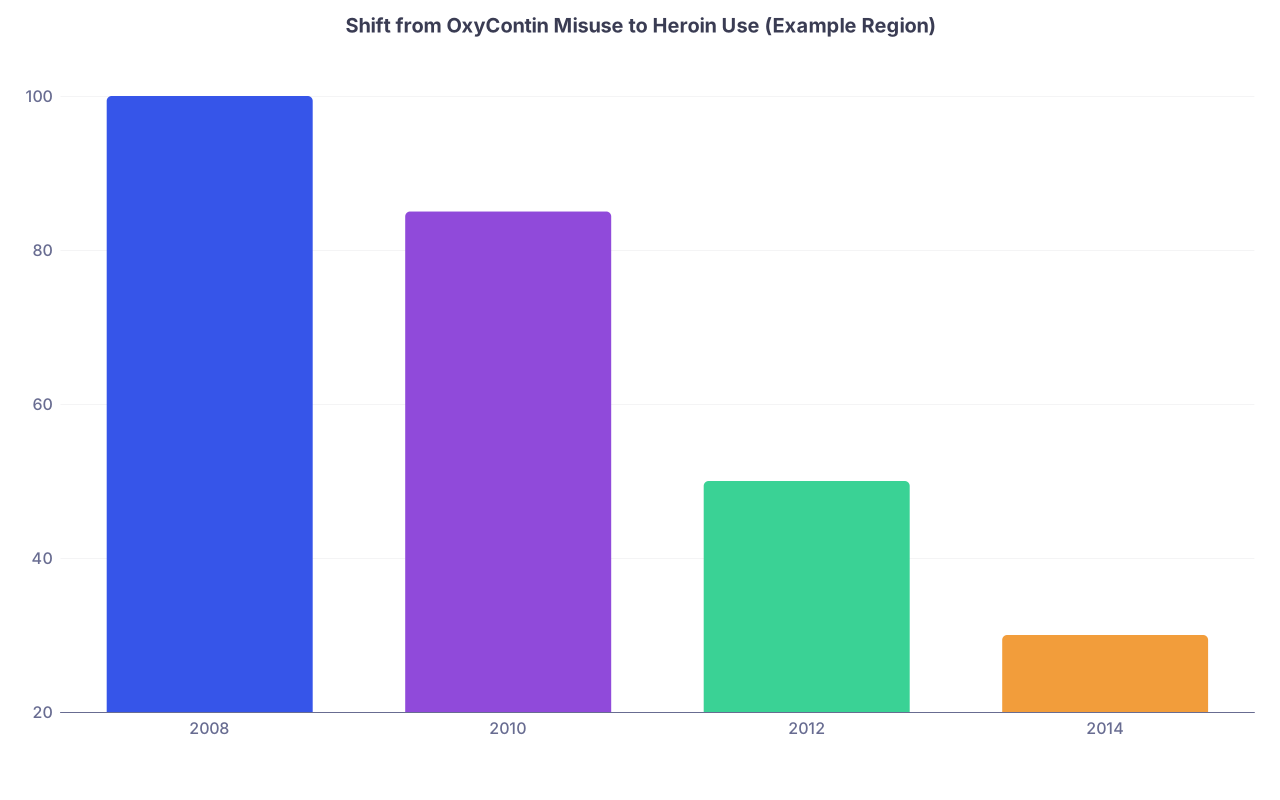
| Category | Value |
|---|---|
| 2008 | 100 |
| 2010 | 85 |
| 2012 | 50 |
| 2014 | 30 |
(Interpretation: relative index of OxyContin misuse, falling after reformulation, while heroin-involved deaths rise in the same period in published analyses.)
None of this means “do nothing” is the right answer. It means the naive “tighten supply, problem solved” model fails in a real-world system where demand and dependence already exist.
State comparisons: restrictive vs balanced strategies
When you compare states, the scatter is large. Which is precisely the point. Restrictive policies, by themselves, do not explain the best mortality outcomes; integration with harm reduction and treatment predicts more.
| State Type | Prescribing Restrictions | MOUD Access | Naloxone Programs | OD Mortality Trend 2010–2020 |
|---|---|---|---|---|
| A - Restrictive only | High | Low | Limited | Large increase |
| B - Balanced | Moderate–High | High | Extensive | Smaller increase |
| C - Lax | Low | Variable | Limited | Large increase |
| D - Comprehensive | High | High | Extensive | Plateau then modest increase |
When you run the numbers, states in Category B/D patterns—those that pair prescription control with:
- Wide MOUD availability (buprenorphine, methadone, naltrexone)
- Broad naloxone distribution and 911 Good Samaritan protections
- Syringe services and outreach
tend to have lower growth in opioid mortality than states that rely primarily on prescription clampdown.
The effect sizes are not trivial. Some multistate analyses suggest:
- PDMP + MOUD expansion + naloxone laws are associated with 10–20% lower overdose death rates relative to similar states without such a package, after adjustment.
- PDMP alone with no corresponding treatment/harm reduction sometimes shows no net mortality reduction at all, and occasionally worse trajectories when illicit fentanyl becomes dominant.
Substitution, displacement, and the fentanyl problem
The key analytical mistake in much early policy design was treating the opioid crisis as a purely prescription problem, rather than a broader drug supply and demand problem.
Once the population of people with opioid use disorder was already large and entrenched, the system behaved like this:
- Cut off a heavily regulated supply (prescription opioids).
- Leave a large group of dependent users with inadequate treatment options and financial/structural barriers.
- Illicit suppliers respond. Faster and more ruthlessly than policymakers.
- The street market shifts to heroin, then to fentanyl (far more potent, compact, and profitable).
From a quantitative standpoint, this is classic displacement:
- Prescription opioid overdose deaths stabilize or drop.
- Fentanyl-involved deaths rise by several hundred percent.
By 2022, synthetic opioids (mainly illicit fentanyl) were implicated in the majority of opioid overdose deaths in the U.S. The policy environment that made it harder to get hydrocodone at a pharmacy did little to protect people against counterfeit M30s pressed with fentanyl or xylazine-laced heroin.
The core lesson: once fentanyl dominates the market, incremental changes in legitimate prescribing volume contribute only modestly to total mortality. The risk has moved upstream and outside the walls of the clinic.
Ethical tension: duty to individual patients vs population-level risk
Here is where your professional ethics collide head-on with population data.
On one side:
- Prescribing high-dose opioids to large populations increased dependence, diversion, and long-term overdose risk. That is not seriously contested any more.
- The data shows a dose–response relationship: higher morphine milligram equivalents (MME) and co-prescription with benzodiazepines correlate with higher overdose risk.
On the other side:
- Abrupt dose reductions, “opioid contracts” enforced with threats, and clinic-wide policy changes have harmed stable patients.
- Patient-level studies show increased emergency visits, mental health crises, and—in some analyses—higher overdose and suicide risk following forced rapid tapers in chronic pain populations.
- Many patients with severe chronic pain have seen their function and quality of life deteriorate after blunt policy application.
So you have a dual obligation:
- Reduce avoidable exposure and new cases of opioid use disorder.
- Avoid iatrogenic harm to existing dependent or chronically treated patients.
Policies that ignore either side fail ethically.
From a data-ethics standpoint, blanket thresholds like “no more than 90 MME for anyone” are crude tools. They are easy to write into regulation. Easy to measure. But they do not align well with individual risk heterogeneity.
A more defensible approach uses:
- Risk stratification (age, comorbidities, concurrent sedatives, prior overdose, mental health conditions).
- Gradual, negotiated dose changes with patient involvement.
- Active linkage to MOUD when opioid use disorder is present, rather than simply “cutting off.”
You can lower population-level exposure without sacrificing the people already on the high end of the distribution—if you are willing to do slower, more labor-intensive medicine and design policies that allow it.
What works better: data-backed policy combinations
The strongest data for actual reductions in total opioid overdose mortality does not come from any single prescription policy. It comes from combinations that address both supply and demand.
The evidence is strongest for three levers:
Medication for opioid use disorder (MOUD) expansion
- Each additional methadone or buprenorphine treatment slot per capita is associated with measurable reductions in overdose deaths at the population level.
- Regions with robust low-barrier buprenorphine access see lower mortality growth despite similar exposure to fentanyl.
- Treatment retention matters; coerced, brief, or heavily restricted programs show weaker effects.
Naloxone distribution and Good Samaritan laws
- Widespread community naloxone rollout reduces fatal overdoses even when nonfatal overdoses rise or stay constant.
- Analyses suggest state naloxone access laws are associated with 10–15% reductions in opioid-related deaths after implementation, especially when paired with community distribution.
- The ethical logic is straightforward: you do not “reward” use; you prevent death.
Targeted prescribing reforms plus pain and behavioral health integration
- Risk-based, not purely dose-based, prescribing rules.
- Mandatory PDMP use paired with decision support: identify and engage high-risk patients, not just deny refills.
- Coverage and reimbursement for non-opioid pain treatments and mental health care. Without that, “use fewer opioids” becomes empty rhetoric.

| Step | Description |
|---|---|
| Step 1 | Prescription Policy Change |
| Step 2 | Reduced High Risk Prescribing |
| Step 3 | Flag High Risk Patients |
| Step 4 | Offer MOUD |
| Step 5 | Offer Pain Alternatives |
| Step 6 | Reduced OUD Progression |
| Step 7 | Lower New Exposure |
| Step 8 | Naloxone Distribution |
| Step 9 | Fewer Fatal Overdoses |
| Step 10 | Modest Mortality Impact |
| Step 11 | Net Reduction in OD Deaths |
The data is quite clear on one ethical point: if you tighten prescribing but fail to scale MOUD and naloxone, you are shifting risk, not eliminating it. At that point, policy becomes less a protective instrument and more a redistribution of harm—from visible, insured pain patients to marginalized illicit users who rarely make it into the policy discussion.
Personal development: what clinicians need to change in their own practice
If you are a clinician, you sit at the interface between macro-level policy and patient-level consequences. The data tells you what not to do:
- Do not treat CDC guidelines or MME thresholds as religious commandments. They are tools, not moral law.
- Do not execute abrupt, large tapers because “the policy changed” or “the DEA is watching.” The risk of decompensation and overdose is real.
- Do not assume that stopping prescriptions ends a patient’s opioid exposure. In a fentanyl-dominated market, it may move them to something far more lethal.
There are more constructive data-aligned behaviors:
- Use PDMPs to start conversations, not just to police. “I see you have prescriptions from multiple providers. Talk to me about what is going on.”
- Assess and document risk systematically: prior overdose, substance use history, mental health, social instability. Use that data to justify individualized plans.
- Know how to initiate or refer for buprenorphine. If your prescribing policies create withdrawal or destabilization, you are ethically responsible for offering evidence-based treatment, not just “detox.”
- Co-prescribe naloxone liberally when risk factors are present—high doses, concurrent benzos, history of OUD, or unstable housing.
The professional development task is basically this: move from a compliance mindset (“I must obey the policy to avoid liability”) to a risk-management mindset grounded in real data (“How do I actually reduce this patient’s risk of death while still treating their pain ethically?”).
Medical ethics: rebalancing autonomy, beneficence, and justice
Policy debates on opioids often pretend that you can optimize all four pillars of medical ethics at once. You cannot.
- Autonomy: patients with chronic pain often want to continue their stable regimens.
- Beneficence: you want to relieve pain and maintain function.
- Nonmaleficence: you must minimize overdose, dependence, and long-term harm.
- Justice: you must consider population-level impacts, diversion, and inequities in who bears risk.
The data on mortality makes one trade-off explicit: aggressive, one-size-fits-all restriction may protect some future patients from ever being exposed, while actively harming those already exposed.
Ethically sound policy needs several design features:
- Granularity: differentiate between new starts and legacy patients, acute vs chronic pain, cancer vs non-cancer, clear OUD vs physiologic dependence.
- Sunset and review clauses: require periodic re-analysis of mortality and spillover effects. If a policy correlates with increased fentanyl deaths in high-risk groups, adjust it.
- Built-in access to treatment and harm reduction: no policy that meaningfully restricts supply to dependent populations should be implemented without parallel expansion of MOUD and naloxone. Otherwise, you are making a known risky move.
Bluntly: using prescription policy alone to solve the fentanyl-era overdose crisis is not only ineffective; it has become ethically indefensible in light of the data.
Key takeaways
- Prescription policy changes have reliably reduced high-risk prescribing but have had limited and often offset effects on total opioid overdose mortality, largely because of substitution to heroin and illicit fentanyl.
- The most effective and ethically defensible approach couples targeted prescribing reforms with aggressive expansion of MOUD, naloxone, and harm reduction; prescription crackdowns in isolation mostly shift where and how people die, not whether.
- Clinicians and policymakers need to move beyond dose-based, one-size-fits-all rules and adopt data-driven, risk-stratified strategies that protect both individual patients with chronic pain and the broader population from an increasingly lethal illicit drug supply.