
The public conversation about tobacco policy is driven more by slogans than by data. That is a problem, because the numbers are not subtle: where strong tobacco control laws exist, hospitalizations fall. The hard part is not proving that association; it is interpreting it correctly without fooling yourself.
You asked about “Tracking Tobacco Policy and Hospitalizations: Interpreting the Evidence.” Good. Because this is exactly where clinicians, policymakers, and even some epidemiologists get sloppy. They either oversell weak findings, or they dismiss robust evidence because it does not fit their priors.
I will walk through how the data around tobacco policy and hospital use actually look, what designs generate the strongest evidence, and what you, as a clinician or future clinician, should accept, question, or push back on ethically.
1. What the data consistently show
Start with the headline result: comprehensive smoke‑free laws and higher cigarette taxes are strongly associated with fewer acute cardiovascular and respiratory hospitalizations. That pattern repeats across countries, health systems, and time periods.
The magnitudes are not trivial.
Across multiple quasi‑experimental studies:
- Acute myocardial infarction (AMI) admissions typically drop 10–17% in the first few years after comprehensive smoke‑free laws.
- Hospitalizations for acute exacerbations of COPD and asthma fall in a similar 8–15% range.
- Stroke admissions show somewhat smaller but still meaningful declines (often 5–10%).
Those are not cherry‑picked. They are about where the median estimate lands when you line up a few dozen studies using difference‑in‑differences or time‑series approaches.
Here is a rough comparison of effect sizes from common policy levers:
| Policy Type | Primary Outcome | Typical Short-Term Change* |
|---|---|---|
| Comprehensive smoke-free | AMI hospitalizations | −10% to −17% |
| Comprehensive smoke-free | COPD/asthma hospitalizations | −8% to −15% |
| Partial smoke-free | AMI hospitalizations | −0% to −8% |
| $1 cigarette tax increase | Total smoking prevalence | −3% to −7% |
| $1 cigarette tax increase | AMI hospitalizations | −2% to −5% |
*Typical 1–3 year post‑policy estimates from quasi‑experimental studies; ranges summarize multiple jurisdictions.
The pattern is consistent:
- Stronger and more comprehensive policies → larger and quicker drops.
- Partial restrictions (bars but not restaurants, workplaces but not hospitality) → smaller and sometimes statistically null effects.
- Cardiac and acute respiratory indications respond first; cancers and chronic outcomes lag, as expected biologically.
If you see a paper claiming a 40–50% reduction in AMI admissions within six months of a ban, your skepticism should spike. Not because policy is ineffective, but because the claim exceeds what the broader distribution of estimates supports.
To make this visual:
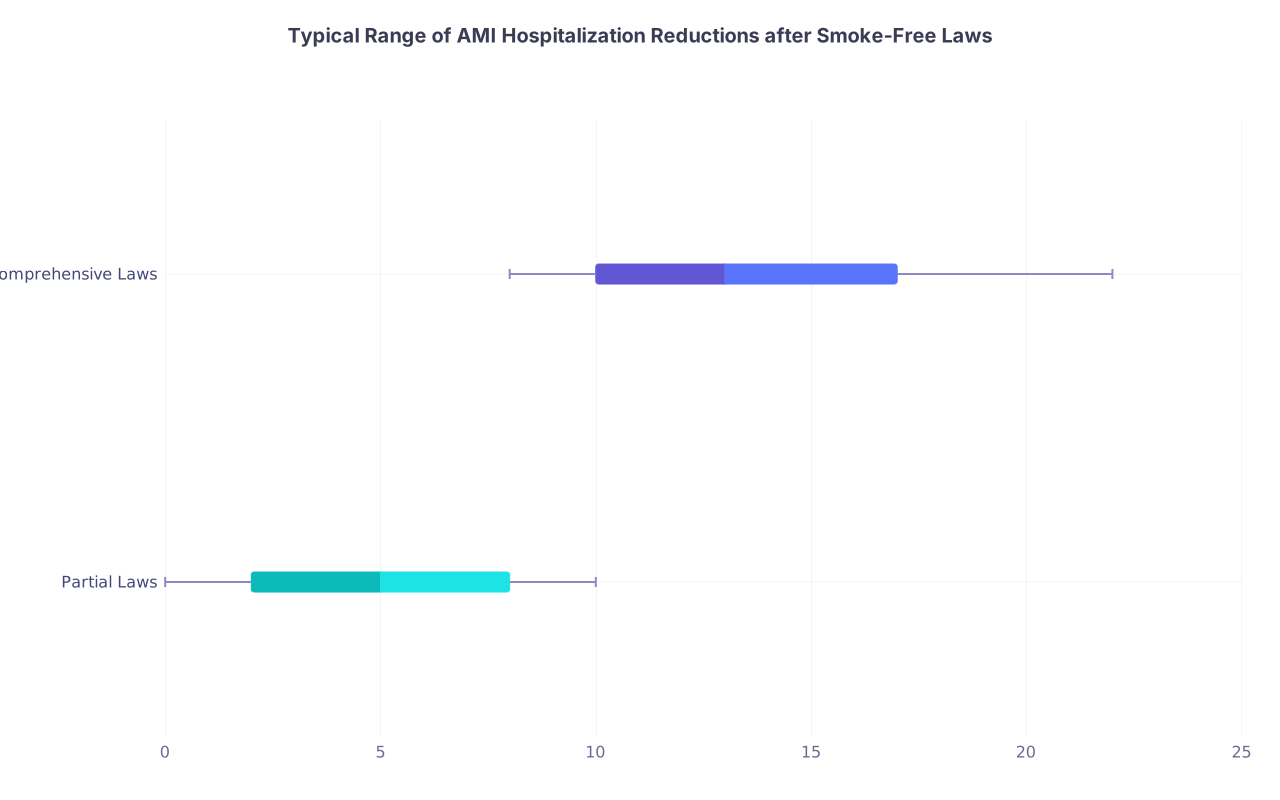
| Category | Min | Q1 | Median | Q3 | Max |
|---|---|---|---|---|---|
| Partial Laws | 0 | 2 | 5 | 8 | 10 |
| Comprehensive Laws | 8 | 10 | 13 | 17 | 22 |
The data cluster where you would expect if the underlying story is straightforward: less smoke exposure → fewer acute events triggered.
2. How the strongest tobacco policy evidence is built
You cannot randomize countries to ban smoking in bars. So you rely on quasi‑experiments. Some are solid, some are garbage dressed up with regression tables.
There are three main workhorses.
2.1 Interrupted time series (ITS)
You take several years of hospitalization data, identify the month the law took effect, and fit a segmented regression:
- Pre‑policy slope
- Immediate level change at policy implementation
- Post‑policy slope
If hospitalizations suddenly drop or the slope bends downward right after the policy, above and beyond background trends and seasonality, you infer policy impact.
When done correctly, ITS:
- Uses monthly (or weekly) counts over 5–10+ years.
- Adjusts for seasonality (winter spikes in respiratory admissions, etc.).
- Includes a control outcome that should not respond to policy (e.g., appendicitis admissions).
When done badly, it:
- Uses only 1 year pre and 1 year post.
- Ignores auto‑correlation and seasonality.
- Attributes any wiggle near the policy date to the policy.
If you are reading a paper and the ITS looks like 12 points before and 12 after, and they claim strong evidence of structural change, you should mentally downgrade that evidence by at least half.
2.2 Difference‑in‑differences (DiD)
Classical design: compare changes in outcomes over time between “treated” (policy) and “control” (no policy yet) regions.
The logic is simple:
- If Region A passes a comprehensive smoke‑free law in 2010, and Region B does not,
- And AMI hospitalizations were moving in parallel up to 2010,
- And after 2010, A’s rates fall relative to B,
- Then the best explanation is the law, assuming no major concurrent shocks differing between A and B.
The parallel trends assumption is critical. Most poor DiD work either:
- Never shows pre‑policy trends graphically, or
- Shows obvious divergence before policy but still proceeds to estimate.
The better work does two things:
- Presents event‑study style plots (coefficients at −3, −2, −1, +1, +2, +3 years relative to policy) showing flat pre‑policy effects and clear movement post‑policy.
- Tests robustness with alternative control groups, lags, and specifications.
You should treat DiD studies that satisfy those conditions as close to “causal enough” for policy decisions.
2.3 Synthetic controls
Used when you have one or a few treated units (e.g., a single state) and many potential controls.
You build a weighted “synthetic” region from non‑adopting jurisdictions whose pre‑policy trends match the treated region almost perfectly. Then you compare post‑policy trajectories.
Example: A classic synthetic control analysis of a strong smoke‑free law might show:
- Pre‑policy: Treated and synthetic both at ~150 AMI admissions per 100,000 adults, moving nearly identically.
- 3 years post‑policy: Treated at 125, synthetic at 140 → about a 10–12% gap, plausibly attributable to the law.
The strength here is visible fit before policy. If pre‑policy match is poor, you can safely ignore the fancy method.
3. Confounding, co‑policies, and over‑claiming
Now the part people routinely gloss over. Tobacco policies rarely occur in isolation.
States or countries that adopt strong smoke‑free laws also tend to:
- Increase cigarette excise taxes.
- Launch media campaigns.
- Expand cessation services and quitlines.
- Tighten advertising or point‑of‑sale restrictions.
If you treat “the law” as a discrete shock and ignore this package, you misinterpret what actually drives the hospitalization decline.
From an ethical standpoint, over‑attributing the effect to one visible law can mislead policymakers into under‑investing in the rest of the control system.
3.1 Co‑trend bias
If multiple health policies roll out roughly simultaneously (soda taxes, trans fat bans, improved statin use), some share of cardiovascular improvements will be due to those.
Good analyses:
- Adjust for major concurrent policy changes where possible.
- Use outcomes most biologically specific to tobacco exposure (e.g., asthma exacerbations, acute COPD) to reduce confounding from diet and exercise trends.
Bad analyses throw every disease category into the regression and essentially treat any improvement as “proof” that the tobacco policy “works.”
I have seen studies that claim smoking bans reduced hip fractures. That is a red flag of data mining, not public health insight.
3.2 Policy endogeneity
Regions with stronger anti‑tobacco sentiment and better health systems are more likely to adopt strict policies early. They are also more likely to improve outcomes for reasons unrelated to new laws: better primary care access, more prevention, shifts in socioeconomic composition.
Difference‑in‑differences with good controls partially addresses this, but not fully.
You want to see studies that:
- Include region‑fixed effects (to absorb time‑invariant differences).
- Include time‑fixed effects (to absorb national/global trends).
- Test pre‑trends carefully.
Without these, “pro‑health culture” might be doing half the work the paper credits to law.
4. Tracking hospitalizations correctly: data and metrics
People underestimate how messy hospitalization data really are.
In practice, I have watched teams extract “all AMI admissions” and only later discover that:
- Coding changes (ICD‑9 to ICD‑10) created artificial jumps.
- Hospital mergers changed catchment areas.
- Readmissions were miscounted as new events.
If you are interpreting evidence, you need to know what you are looking at.
4.1 The basic denominators and numerators
Good studies define:
- Numerator: number of hospital admissions for specific ICD codes (e.g., I21–I22 for AMI; J44 for COPD).
- Denominator: population at risk (often adults ≥35 or ≥45 years) in that region and year, age‑standardized.
Crude admission counts are noisy. Age‑adjusted rates per 100,000 are far more interpretable.
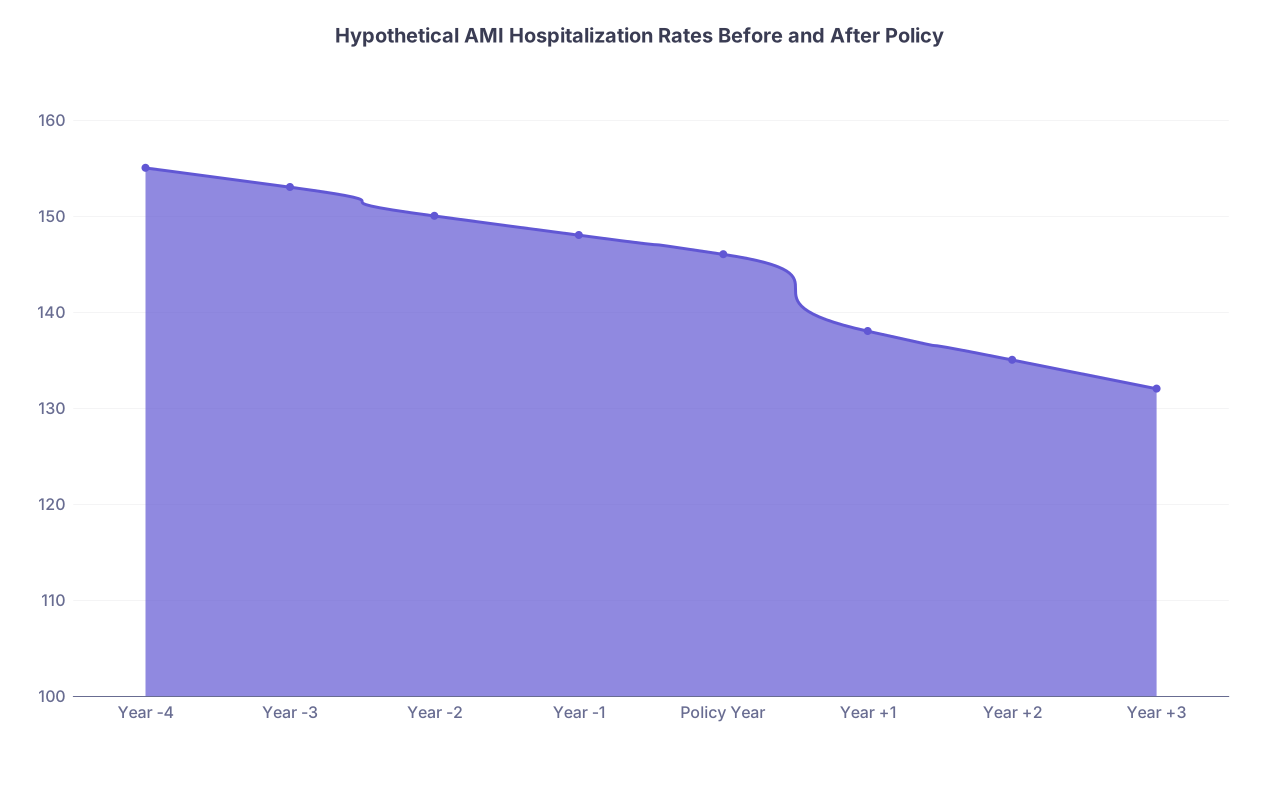
| Category | Value |
|---|---|
| Year -4 | 155 |
| Year -3 | 153 |
| Year -2 | 150 |
| Year -1 | 148 |
| Policy Year | 146 |
| Year +1 | 138 |
| Year +2 | 135 |
| Year +3 | 132 |
The key question: does the post‑policy slope or level deviate meaningfully from the pre‑policy trajectory, compared with regions without the policy?
4.2 Diagnostic specificity
If you only track “all‑cause admissions,” the signal from tobacco policies gets lost in the noise. Death and hospitalization have many determinants.
Better:
- Focus on AMI, unstable angina, stroke, COPD exacerbations, asthma.
- Sometimes also low birth weight and preterm birth when secondhand smoke reduction is relevant.
When you see a broad “all‑cause” reduction purportedly tied directly to one tobacco law, assume someone is telling a political story, not a clinical one.
4.3 Lag structure
The biological lag is different for each outcome:
- AMI and stroke risk from secondhand smoke can fall quickly (weeks to months) because thrombosis and endothelial dysfunction respond rapidly.
- COPD exacerbations also respond relatively quickly to reduced exposure.
- Lung cancer incidence? Measured in decades.
If a paper claims a measurable lung cancer hospitalization decline two years after a smoke‑free law, that contradicts basic natural history. The likely explanation is coding or broader secular trends, not the law itself.
5. E‑cigarettes, flavor bans, and the new complication
The earlier tobacco policy literature mostly dealt with combusted cigarettes. The last decade introduced e‑cigarettes and product‑substitution dynamics. That complicates interpretation.
What happens when you tighten one part of the tobacco environment (say, flavor bans), while another (nicotine vapes) expands or contracts?
The data so far are mixed and early, but a few patterns are emerging:
- Youth vaping bans or flavor restrictions sometimes reduce e‑cigarette use but increase cigarette smoking among certain subgroups, at least short term.
- Hospitalizations for EVALI‑like conditions spike with specific product issues (e.g., vitamin E acetate in illicit THC vapes) rather than general policy changes.
For hospitalizations, we simply do not yet have the same level of robust, long‑term quasi‑experimental data on e‑cigarette policy that we have for smoke‑free laws. Anyone claiming otherwise is over‑selling.
From an ethical perspective, that uncertainty matters. The net effect of certain vaping restrictions on cardiopulmonary hospitalizations could be positive or negative depending on how much substitution between cigarettes and e‑cigarettes occurs.
You are allowed, as a clinician, to say: “For cigarettes and secondhand smoke, the evidence is strong. For vaping policy and hospital outcomes, the jury is still out.” That is an honest, data‑aligned stance.
6. Interpreting evidence as a clinician: where ethics meets numbers
Here is where “personal development and medical ethics” actually intersect with statistics.
If you interpret weak evidence as strong, you risk supporting policies that:
- Do little good,
- Waste public resources, and
- Undermine trust when promised benefits fail to appear.
If you underplay strong evidence because it feels “political,” you collude (in effect) with preventable harm.
So what should your internal checklist look like when you read a study or hear a policy claim?
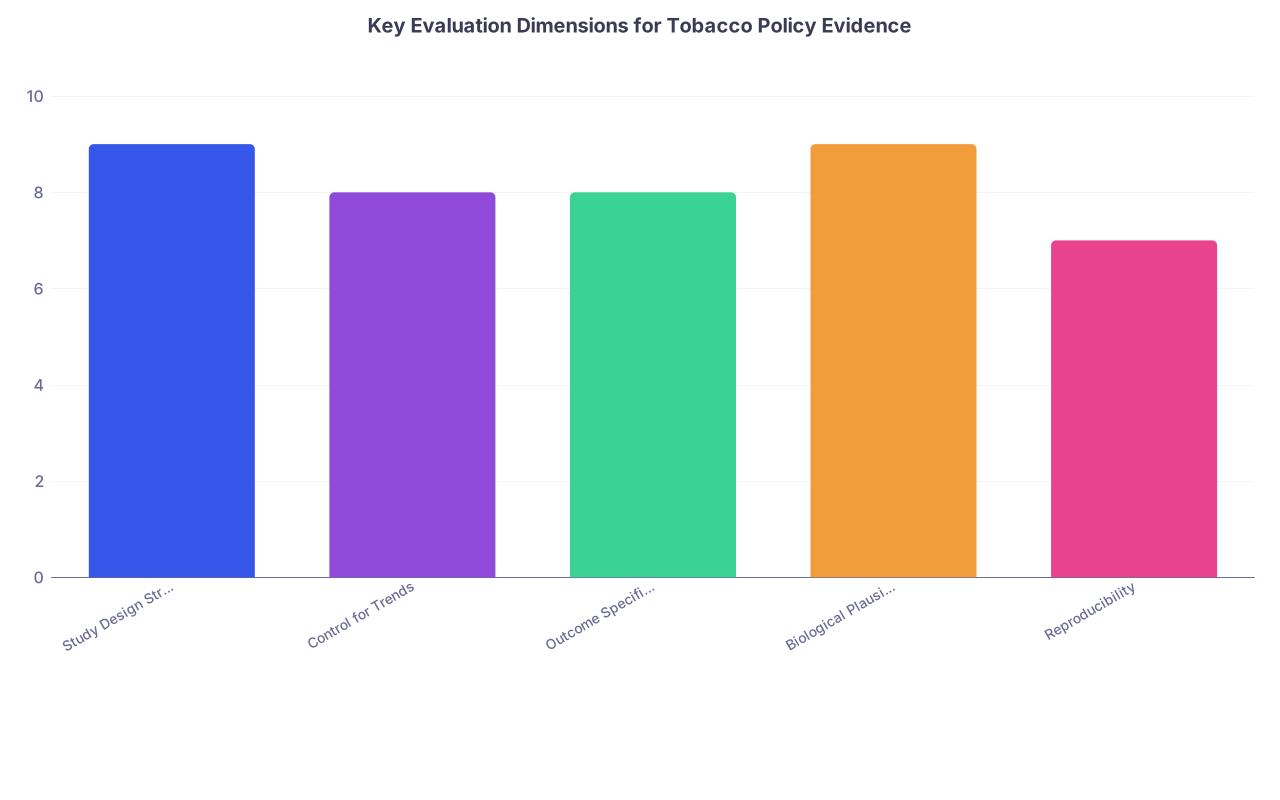
| Category | Value |
|---|---|
| Study Design Strength | 9 |
| Control for Trends | 8 |
| Outcome Specificity | 8 |
| Biological Plausibility | 9 |
| Reproducibility | 7 |
Treat each dimension as a filter.
6.1 Study design strength
Randomized trials: nonexistent here.
Next best:
- Multi‑year DiD with clear pre‑trends and robust controls.
- ITS with a long pre‑period, proper adjustment, and control outcomes.
- Synthetic controls with tight pre‑policy fit.
Cross‑sectional “law vs. no‑law” comparisons without time are basically background noise.
6.2 Control for underlying trends
Ask:
- Did AMI admissions already fall 10% in the 3 years before the law?
- Were similar declines seen in neighboring regions without a law?
- Did coding changes happen around the same time?
Studies that just compare the six months before and after a ban without any context are not trustworthy, no matter how impressive the p‑values look.
6.3 Outcome specificity and plausibility
If:
- Cardiovascular and respiratory admissions fall;
- Appendicitis, fractures, and gallstones stay flat; and
- The timing matches what you expect physiologically,
the causal story holds water.
If everything drops, all at once, right after a law, you are almost certainly seeing either method artifacts or a broader healthcare system change misattributed to tobacco policy.
6.4 Reproducibility across settings
One dazzling study is a starting point, not a conclusion.
When meta‑analyses of dozens of jurisdictions point in the same direction with moderate effect sizes, you can move tobacco policy out of the “interesting hypothesis” category and into “established driver of population‑level cardiovascular and respiratory burden.”
7. Your role: clinician, advocate, or skeptic?
I have sat in rooms where hospital administrators claim, with straight faces, that smoking bans in their city produced “30% drops in admissions within a year.” The data from their own EHR system did not support that. Cardio admissions were down ~8%; respiratory ~10%; overall volume essentially unchanged.
They overstated because it sounded more impressive in a press release.
You will be put in similar positions, explicitly or implicitly.
Some practical, ethically grounded stances:
- Support strong tobacco control, but be precise about expected health gains. Saying “We expect about a 10–15% reduction in acute cardiac and respiratory admissions over a few years” is powerful and honest.
- Push back when colleagues or advocates over‑claim. “The best available data do not support such a large effect size” is a responsible thing to say.
- When evidence is weak or emerging (e.g., certain vape restrictions), admit uncertainty instead of pretending the data are settled.
And remember: the ethical question is not “policy or no policy.” It is “which package of policies, with which trade‑offs, supported by what level of evidence, are we willing to back?”
8. A concise mental model
If you want a quick way to think about it when someone throws a policy claim at you, it is this:

| Step | Description |
|---|---|
| Step 1 | Tobacco Policy |
| Step 2 | Changes in Price and Access |
| Step 3 | Changes in Smoking and Exposure |
| Step 4 | Short Term Risk Change |
| Step 5 | Hospitalization Rates |
| Step 6 | Observed Data and Analysis |
Interpreting the evidence is about checking each link:
- Was the policy actually implemented and enforced?
- Did smoking prevalence, consumption, or secondhand exposure change measurably?
- Are the observed hospitalization changes compatible with known biology and prior evidence?
- Is the analysis strong enough to separate policy effects from background noise and co‑interventions?
When all those answers lean “yes,” you are standing on firm ground.
Key takeaways
- The data across dozens of quasi‑experimental studies converge: strong, comprehensive tobacco control policies produce modest but real reductions (roughly 10–15%) in acute cardiac and respiratory hospitalizations over a few years.
- The quality of evidence hinges on design details—pre‑trends, controls, outcome specificity. You have a professional and ethical obligation not to ignore those details when you form or voice an opinion.
- Being pro‑policy does not mean suspending skepticism. The most credible advocates are the ones who can say, with equal confidence, “the effect here is real and moderate” and “this other claimed effect is not supported by the data.”