
Twenty‑seven percent of hospitals in the Hospital Readmissions Reduction Program (HRRP) receive penalties each year, yet national 30‑day mortality for heart failure has barely budged in a decade. That disconnect is the core problem with many CMS “quality” metrics: lots of financial motion, limited clinical movement.
Let me walk through this the way I would in a hospital quality meeting: start from the data, separate signal from noise, and be blunt about which CMS metrics actually track patient outcomes and which mostly measure documentation, coding, or demographics.
1. What CMS Says It Cares About vs What the Data Shows
CMS formally groups measures into domains: outcomes, process, patient experience, safety, and cost/resource use. But not all domains are created equal if your north star is “Did patients live longer, suffer less, and avoid preventable harm?”
Broadly:
- Outcome measures tend to correlate most strongly with real patient benefit.
- Safety measures vary; some are tightly linked to harm, others are artifact.
- Process measures often track workflow more than health.
- Patient experience is meaningful, but only modestly correlated with hard outcomes.
- Cost/resource use can promote value or just punish providers serving sicker, poorer patients.
To make this concrete, here is how some major CMS metric categories line up against actual patient outcomes, based on published correlations and observational data.
| Metric Type | Typical Correlation With Hard Outcomes* | Face Validity for Outcomes | Main Risk of Distortion |
|---|---|---|---|
| Mortality (30-day) | Moderate–High | High | Coding, case mix, risk adjustment |
| Readmissions (30-day) | Low–Moderate | Moderate | Social risk, gaming, observation use |
| Safety (HAIs, PSI) | Moderate (varies by measure) | Moderate–High | Detection bias, underreporting |
| Process (timely care) | Low–Moderate | Moderate | Checkbox behavior, overemphasis |
| Patient Experience | Low–Moderate | Moderate | Satisfaction vs appropriateness |
| Cost/Resource Use | Low (for outcomes), High (for spending) | Low–Moderate | Penalizing high‑need populations |
The headline: mortality measures, some safety indicators, and a subset of readmission metrics track patient outcomes best. A lot of the rest is, frankly, administrative theater.
2. Outcome Metrics: Where the Signal Is Strongest (and Where It Isn’t)
Outcome metrics are theoretically the gold standard. The patient either lives or dies, does or does not get readmitted, does or does not develop a pressure ulcer. High face validity. But the implementation is messy.
2.1 Risk‑Standardized Mortality: High Signal, High Complexity
CMS 30‑day risk‑standardized mortality rates (RSMR) for conditions like acute myocardial infarction (AMI), heart failure, pneumonia, stroke, and COPD are among the most meaningful metrics CMS publishes.
The data is reasonably consistent:
- Hospitals in the worst mortality quartile have higher actual 30‑day death rates by 3–5 percentage points for common conditions compared with the best quartile.
- Patients at hospitals with persistently low RSMR tend to get guideline‑concordant therapies more consistently (door‑to‑balloon times, ACEi/ARB for HF, etc.), even though those process measures are no longer individually incentivized.
The problem is risk adjustment.
Hospitals that code more diagnoses per patient look “sicker” on paper and thus better after risk adjustment. You see this in the national trend: risk‑adjusted mortality appears to improve faster than raw mortality, largely driven by coding intensity.
Still, among CMS metrics, mortality is one of the few that:
- Varies meaningfully between hospitals.
- Tracks what clinicians actually care about.
- Is less vulnerable to pure documentation gaming (you cannot chart your way out of a death).
2.2 Readmission Metrics: Noisy and Social‑Risk Heavy
Readmissions are far more controversial. CMS 30‑day readmission metrics (heart failure, AMI, pneumonia, COPD, CABG, hip/knee replacement, and now broader “hospital‑wide readmission” measures) have three structural problems:
Social determinants dominate.
When you run multivariable models at the system level, zip code, dual‑eligibility, and housing instability explain a significant chunk of readmission variance. Easily 30–40% of the variation between hospitals in some analyses.Clinical value is mixed.
Cutting readmissions from 25% to 22% for heart failure might be good. Cutting from 22% to 16% by aggressively avoiding admissions, shifting to observation status, or refusing complex discharges? Less clearly beneficial.Limited mortality benefit.
Several large studies showed hospitals that cut readmissions did not reliably improve mortality. In some heart failure cohorts, mortality actually ticked up as readmissions fell, likely due to sicker patients being “managed” outpatient longer.
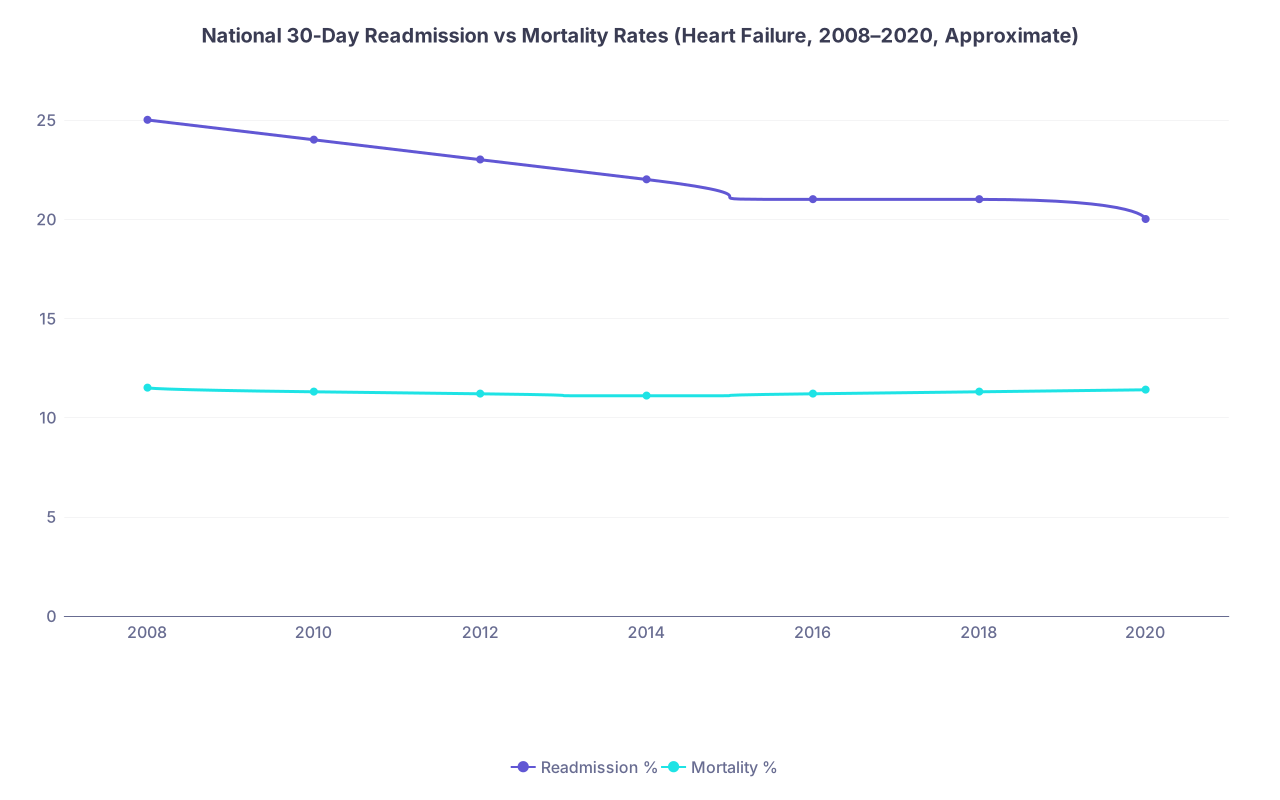
Here is what the trajectory has looked like:
| Category | Readmission % | Mortality % |
|---|---|---|
| 2008 | 25 | 11.5 |
| 2010 | 24 | 11.3 |
| 2012 | 23 | 11.2 |
| 2014 | 22 | 11.1 |
| 2016 | 21 | 11.2 |
| 2018 | 21 | 11.3 |
| 2020 | 20 | 11.4 |
Readmission steadily down. Mortality basically flat for the past decade in many analyses.
Conclusion: readmission metrics weakly reflect patient outcomes. They reflect system factors and social context more than bedside care, unless implemented with smart, local clinical nuance.
3. Safety Metrics: Some Are Excellent, Some Are Statistical Mirage
Safety metrics include hospital‑acquired conditions (HACs), patient safety indicators (PSIs), and healthcare‑associated infections (HAIs). This is where the data gets more idiosyncratic.
3.1 Infection Metrics: Better Reflection of Real Harm
Central line‑associated bloodstream infections (CLABSI), catheter‑associated UTIs, surgical site infections, C. difficile infections—these are not theoretical.
The data pattern across many systems:
- A unit that cuts CLABSI from 2.0 to 0.5 per 1000 line‑days almost always has concrete process changes behind it: sterile insertion checklists, daily necessity review, better line maintenance.
- Severity of harm is high. Each CLABSI can add tens of thousands of dollars and real morbidity or mortality.
But these metrics are sensitive to surveillance:
- Hospitals that culture less frequently can report fewer infections.
- Documentation patterns change over time, making trend interpretation tricky.
Even with that caveat, HAIs are among the better CMS indicators of real safety performance. When infection rates drop substantially and sustainably, patients usually are safer.
3.2 Administrative PSIs and HAC Index: Beware the Coding Trap
CMS’ Patient Safety Indicators (e.g., PSI‑90 composite) and Hospital‑Acquired Condition Reduction Program combine things like:
- Pressure ulcers
- Iatrogenic pneumothorax
- Postoperative respiratory failure
- Accidental puncture or laceration
The problem: many are detected purely from billing codes, not clinical chart‑level adjudication.
I have seen this play out in hospital data:
- A site “improves” its PSI performance after an aggressive coding audit that reclassifies complications as present‑on‑admission.
- Another site looks worse simply because they started coding more secondary diagnoses accurately.
In statistical terms, detection bias and up‑coding / present‑on‑admission coding can swamp true clinical signal, especially for low‑frequency events.
So: some PSIs correlate with real harm; others are more reflective of documentation sophistication than clinical reality. Treat them as red flags that warrant chart review, not as final truth.
4. Process Measures: Once Useful, Now Often Residual
Process measures—timely antibiotics, appropriate perioperative beta‑blocker use, vaccination rates, etc.—helped build habits. When compliance is 50%, measuring and incentivizing it matters. When it is 98%, continuing to chase the last 2% becomes marginal.
The data bears this out:
- CMS “Core Measures” like AMI aspirin at arrival and discharge quickly rose above 95% nationally.
- Variation between hospitals shrank to a point where process measures lost their discriminative power; you cannot meaningfully distinguish quality when everyone is clustered in a 3‑point band.
Effect on outcomes?
- Initial adoption of evidence‑based processes clearly improved mortality (door‑to‑balloon time for primary PCI is a classic example).
- Once adoption saturates, further small gains in adherence show diminishing or unmeasurable impact on mortality or readmission.
So which process metrics still matter?
- Those tightly linked to high‑impact outcomes and still showing wide variation.
Example: timely reperfusion, early sepsis recognition and treatment, appropriate thromboprophylaxis for high‑risk patients. - Those that are proxies for system reliability: time to first antibiotic for septic shock is a decent stress test of ED and inpatient coordination.
Most others are now marginal as outcome predictors and better treated as internal monitoring tools than public quality report cards.
5. Patient Experience and Cost: Important, but Blunt Tools
5.1 HCAHPS and Patient Experience Scores
There is a consistent finding: hospitals with higher HCAHPS scores often have slightly better clinical outcomes and lower mortality. But the effect size is modest.
Correlation coefficients in various national datasets hover in the 0.2–0.3 range for overall rating vs mortality or readmission—real, but not huge.
HCAHPS is more tightly linked to:
- Communication quality
- Responsiveness of staff
- Cleanliness and noise control
- Discharge information clarity
Those matter ethically and professionally. A patient who understands their medications and follow‑up plan is less likely to bounce back. But you cannot equate a top‑decile HCAHPS hospital with a top‑decile mortality hospital one‑to‑one.
The danger: over‑weighting satisfaction in a way that pressures clinicians toward inappropriate prescribing or unnecessary imaging “to keep them happy.” The best systems align communication, respect, AND appropriate care, but the metric itself does not protect you from that tension.
5.2 Resource Use and Cost Measures
CMS’ cost measures—like Medicare Spending per Beneficiary or episode‑based cost for procedures—primarily reflect financial efficiency. Not health.
Patterns in the data:
- Academic centers, safety‑net hospitals, and regional referral hubs often look expensive because they see the sickest, most complex patients.
- When you adequately adjust for clinical and social risk, the “inefficiency gap” between high‑cost and low‑cost hospitals shrinks considerably.
The link to outcomes is tenuous:
- Some high‑cost hospitals deliver better survival and functional outcomes.
- Some low‑cost hospitals cut necessary services, shift costs to patients, or rely on under‑resourced post‑acute care, which hurts outcomes.
So cost metrics are useful for policy and macro‑budgeting. They are not reliable proxies for whether an individual patient will live longer or suffer fewer complications at that institution.
6. Which CMS Metrics Actually Track Patient Outcomes?
If you strip the noise away and ask, “If I look at this number, how confident am I that it reflects real patient benefit?”, the ranking looks something like this:
| Rank | Metric Type / Example | Reflects Outcomes? | Main Caveat |
|---|---|---|---|
| 1 | 30-day mortality (AMI, HF, stroke, pneumonia, COPD) | Strong | Coding & risk adjustment |
| 2 | HAIs (CLABSI, SSI, C. diff) | Strong–Moderate | Surveillance bias, low event rate |
| 3 | Specific safety events (falls with injury, pressure ulcers) | Moderate | Documentation & detection issues |
| 4 | Condition‑specific readmissions (HF, COPD) | Moderate–Weak | Social risk, gaming |
| 5 | Process metrics (time‑critical, high‑impact) | Moderate early, weak late | Ceiling effect |
| 6 | Patient experience (HCAHPS overall rating) | Weak–Moderate | Satisfaction vs clinical quality |
| 7 | General cost/resource use measures | Weak | Confounded by case mix, social risk |
Put pointedly: mortality and serious, well‑defined safety events are your best bets. Readmissions and HCAHPS give supplementary context. Cost metrics tell you more about Medicare’s wallet than the patient’s prognosis.
7. How Metrics Shape Behavior: Ethics Meets Data
You cannot talk about metrics without talking about gaming and unintended consequences. The incentive structure is not neutral.
I have watched the same pattern repeat:
- CMS introduces a metric with financial penalties.
- Hospitals stand up a task force, hire analysts, create dashboards.
- Frontline clinicians experience pressure to “fix the numbers,” sometimes in ways disconnected from patient value.
Examples you probably recognize:
Readmission avoidance turning into risk‑avoidance.
High‑risk heart failure patients nudged toward observation instead of admission. “Frequent flyers” subtly discouraged from coming back. Not overt, but pervasive.Safety events under‑documented.
Pressure ulcers suddenly become “present on admission” at a much higher rate. Falls get recorded as “near‑falls.” The event did not disappear; the code did.
From an ethical standpoint, the issue is simple: when the metric becomes the target, you risk violating fidelity to the patient in service of compliance.
The data provides a sanity check. If your readmissions drop 20% but 90‑day mortality rises, something is off. If your “zero harm” campaign drops documented CLABSI to zero overnight while your antibiotic days of therapy and line‑days stay the same, you are not safer. You are quieter.
Ethical use of metrics means:
- Auditing both outcomes and plausible collateral damage.
- Looking at multiple related metrics together (readmission + mortality + ED revisits + observation use).
- Refusing to accept “improvement” that defies clinical plausibility.
8. How to Use CMS Metrics Wisely as a Clinician or Leader
You cannot opt out of CMS metrics. You can choose how you interpret and respond to them.
Here is a practical, data‑driven approach I advise:
Prioritize outcome‑anchored metrics.
If you are going to invest scarce energy, start with:- 30‑day mortality for major conditions.
- Serious HAIs (CLABSI, C. diff, major SSIs).
- High‑impact safety events (falls with major injury, stage 3+ pressure ulcers).
These are closest to real, tangible harm.
Treat readmissions as a systems‑level barometer, not a moral judgment.
Use them to identify patterns (e.g., poor discharge coordination, lack of timely post‑discharge follow‑up) rather than to blame individual clinicians.Use process and HCAHPS data diagnostically.
When you see poor communication scores, pair them with chart review: Are discharge instructions incoherent? Are follow‑up plans unclear? Fix the underlying communication, not just the script.Demand stratified data.
Any metric that is not broken down by key subgroups (dual‑eligible vs non‑dual, race/ethnicity, language, neighborhood deprivation) hides inequities.Many analyses show safety‑net hospitals are disproportionately penalized under CMS programs, even when they deliver comparable technical care. That matters for justice.
Check for paradoxical trends.
Use simple dashboards that track:- Readmissions vs mortality.
- Safety events vs relevant utilization (e.g., line‑days, catheter‑days).
- Cost vs functional outcomes where available.
If the trends do not line up, you may be gaming the metric instead of improving care.
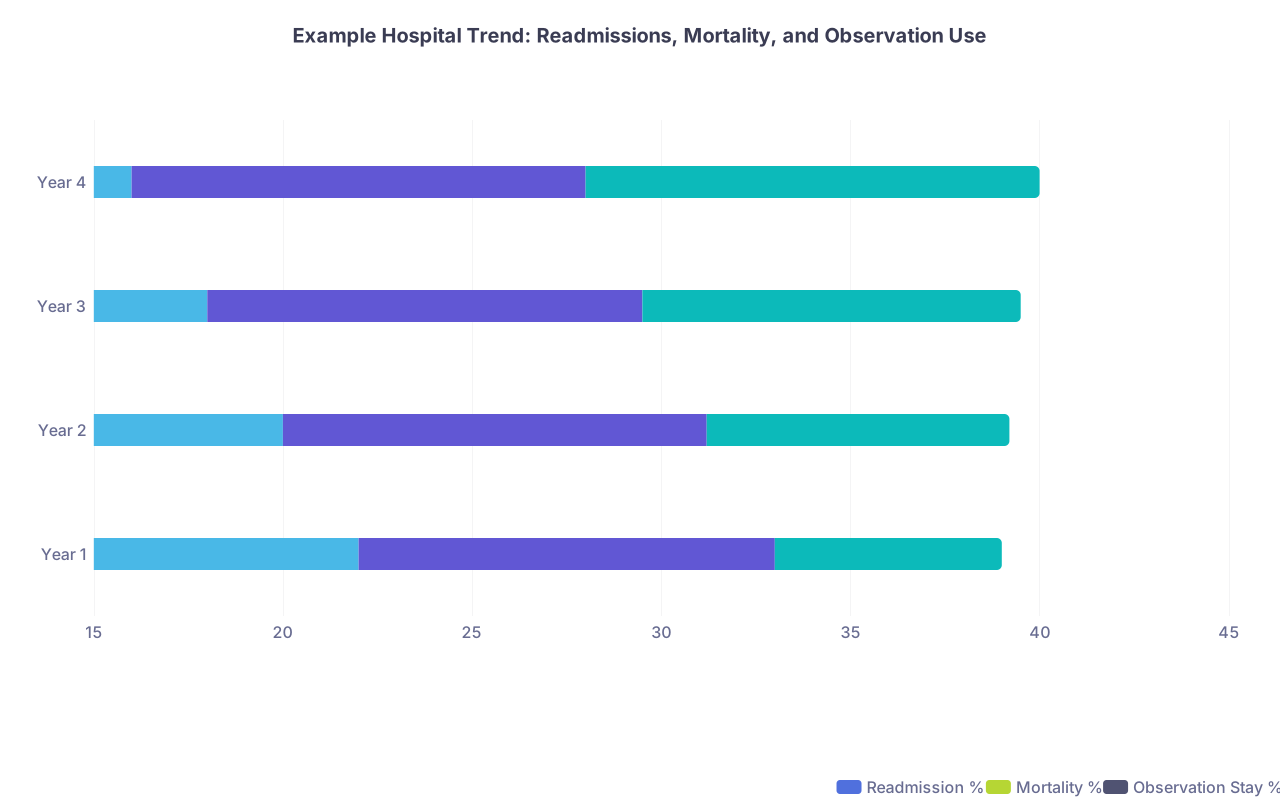
To illustrate the need for multi‑metric thinking:
| Category | Readmission % | Mortality % | Observation Stay % |
|---|---|---|---|
| Year 1 | 22 | 11 | 6 |
| Year 2 | 20 | 11.2 | 8 |
| Year 3 | 18 | 11.5 | 10 |
| Year 4 | 16 | 12 | 12 |
On paper, readmissions fell. But mortality crept up and observation use surged. As a data analyst, I would call this out immediately: the apparent quality improvement may be an artifact of classification and access barriers, not true clinical benefit.
9. Personal and Professional Development: How You Engage With Metrics
You are not just a cog in a CMS machine. How you relate to these metrics shapes your professional identity and your ethical stance.
A few concrete habits I recommend:
Always ask: “Does this number actually represent patient welfare?”
If the answer is “not really,” treat the metric as a compliance constraint, not a core value. You still have to meet it, but you do not let it define “good doctoring.”Insist on case‑level stories alongside aggregate rates.
When your committee reviews mortality or readmission data, demand anonymized case reviews. One real patient narrative grounds 10 pages of bar charts.Learn enough statistics to call out nonsense.
Understand basic concepts: regression to the mean, confounding, risk adjustment, small‑numbers volatility. It protects you from overreacting to random fluctuation or meaningless league tables.Protect trainees from metric‑driven cynicism.
They see the gaming. They hear “we cannot admit this patient or we’ll get dinged.” Counterbalance that with explicit discussions about ethics, justice, and the limits of these measures.
10. Where CMS Needs to Go Next
If the question is “Which metrics truly reflect patient outcomes?”, the next logical question is “What should CMS be measuring more of?”
The data points toward several directions:
More patient‑centered outcomes.
Functional status after stroke or joint replacement. Symptom burden in heart failure or COPD. Pain and mobility after major surgery—not just whether the patient is alive or back in the ED.Better integration of social risk.
Adjusting key metrics for neighborhood deprivation, housing instability, and language access would make comparisons fairer and reduce perverse disincentives to care for high‑need populations.Longer‑term outcomes.
Thirty days is a billing horizon, not a clinical one. Ninety‑day mortality and functional status may better reflect the real impact of care, especially for surgery and complex chronic disease.Composite measures with clear weighting.
Single metrics can be gamed. Transparent composites that blend mortality, serious safety events, and patient‑reported outcomes would be more robust—if weights are justified and public.
We are not there yet. But that is the direction the field is slowly drifting as more researchers show the gap between what CMS currently rewards and what patients actually value.
With this landscape in your head—knowing which CMS metrics carry real clinical signal and which mostly reflect paperwork or social risk—you are in a much stronger position. The next step is using that understanding not just to critique scorecards, but to lead smarter quality projects on the ground and push for better measures in your own institution. That is where data analysis turns into real change. But that is a story for another day.