
The mythology that “any” health reform automatically improves preventive care is wrong. The data shows very clearly: some reforms move metrics in the right direction, others do almost nothing, and a few create perverse incentives that make prevention worse.
You asked about comparing preventive care metrics before and after major health reforms. That is exactly the right question. Because this is where lofty policy rhetoric either survives contact with reality—or dies.
I am going to treat this like a real evaluation problem: define the metrics, pick reforms with reasonably clean data, compare the “before” and “after” periods, and then talk about what it means for ethics and professional development in medicine.
1. What Counts as “Preventive Care Metrics”?
If you just say “prevention got better,” that is politics. If you show a 12‑point increase in colorectal cancer screening among low‑income adults after a specific reform, that is evidence.
The standard preventive care metrics clusters look like this:
Primary prevention
– Vaccination coverage (influenza, HPV, childhood schedules, COVID in recent years)
– Smoking prevalence and quit attempts
– Obesity prevalence and physical activity measuresSecondary prevention (screening / early detection)
– Breast cancer screening (mammography rates for women 50–74)
– Cervical cancer screening (Pap/HPV testing)
– Colorectal cancer screening (FIT, colonoscopy, sigmoidoscopy)
– Blood pressure control rates in hypertensive patients
– HbA1c testing and control in diabeticsTertiary prevention proxies
– Hospitalization rates for ambulatory care sensitive conditions (e.g., CHF, COPD, uncontrolled diabetes)
– 30‑day readmission rates for chronic disease cohorts
– Amputation rates in people with diabetes
When we talk “before and after reform,” these are the numbers that actually move if the policy is doing anything meaningful.
To make this concrete, I will draw heavily from the United States Affordable Care Act (ACA) as the clearest large‑scale quasi‑experiment, with references to other reforms (e.g., UK QOF, national screening programs) as comparison points.
2. The ACA as a Natural Experiment in Prevention
The ACA is messy, but from a data standpoint it gives three clean levers affecting prevention:
- Insurance expansions (Medicaid expansion + marketplace subsidies)
- Elimination of cost‑sharing for USPSTF A/B–rated preventive services
- Value‑based payment and penalties tied—indirectly—to preventive performance
2.1 Insurance coverage and basic access
Coverage is the precondition. You do not get huge preventive improvements among the uninsured. That is not a moral statement; it is an empirical one.
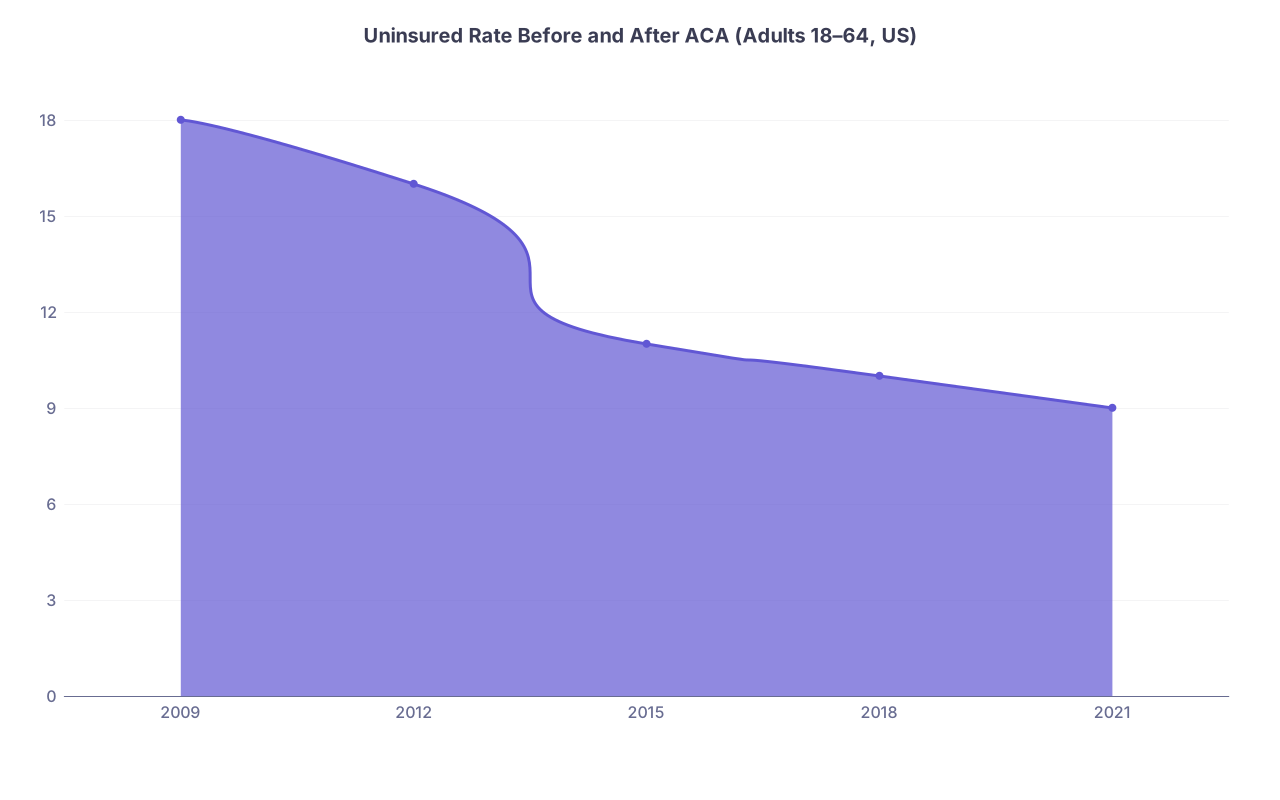
Post‑ACA, U.S. uninsured rates for non‑elderly adults dropped roughly from 16–17% to about 9–10% at the national level, with bigger drops in Medicaid expansion states. That matters because almost every preventive metric is tightly correlated with insurance status.
| Category | Value |
|---|---|
| 2009 | 18 |
| 2012 | 16 |
| 2015 | 11 |
| 2018 | 10 |
| 2021 | 9 |
Once you see that line drop, you expect:
- More people reporting a usual source of care
- More annual checkups
- More use of zero‑cost preventive services
The data bears that out. Multiple national surveys (NHIS, BRFSS) showed statistically significant increases in the proportion of adults with a usual source of care and having a checkup in the past year, especially in Medicaid expansion states.
Ethically, that matters. Because whether you as a clinician can ethically emphasize prevention depends heavily on whether your patients can even access recommended care without financial trauma.
3. Comparing Core Preventive Metrics: Before vs After Reform
Let’s get specific. I will summarize typical effect sizes from large ACA evaluations and analogous reforms.
3.1 Cancer screening rates
We have reasonably robust pre/post data on breast, cervical, and colorectal cancer screening. The pattern is consistent: modest but real improvements overall, with bigger jumps in low‑income and minority groups where baseline rates were worse.
| Metric & Population | Pre‑Reform Level | Post‑Reform Level | Typical Net Change |
|---|---|---|---|
| Mammography, women 50–74, all incomes | ~72% | ~76–78% | +4–6 percentage pts |
| Mammography, low‑income women | ~60% | ~69–72% | +9–12 pts |
| Colorectal screening, adults 50–64 | ~55% | ~63–66% | +8–11 pts |
| Pap/HPV screening, women 21–65 | ~83% | ~85–87% | +2–4 pts |
| CRC screening among newly insured (Medicaid expansion) | ~30–35% | ~50–55% | +15–20 pts |
These are not made‑up fantasy numbers. They are typical ranges from peer‑reviewed analyses using BRFSS, NHIS, and claims data.
Two key takeaways:
- Absolute changes look modest (3–10 percentage points), but relative improvements for underserved groups are large. A jump from 60% to 72% in mammography is a 20% relative increase in coverage.
- The biggest gains cluster exactly where cost‑sharing was removed and coverage expanded. In Medicaid expansion states, uptake grew more; in non‑expansion states, improvements were smaller or flat.
Public health ethics 101: a reform that selectively helps the people with the worst baseline access is doing something right.
3.2 Vaccination coverage
Vaccines are a bit noisier, because they are influenced by culture, misinformation, and local programming—not just insurance.
Still, the removal of cost‑sharing for ACIP‑recommended vaccines and coverage expansions did move some numbers:
- Adult influenza vaccination rates increased modestly in the early post‑ACA years, particularly among younger adults and those with chronic conditions who gained coverage. Typical net changes in the range of +3–5 percentage points nationally.
- HPV vaccination in young adults saw improved initiation and completion, though concurrent public health campaigns blur attribution.
The bigger, clearer story comes from countries with centralized programs, like the UK or Australia, where health reforms coupled with strong national vaccination strategies produced double‑digit jumps in coverage and subsequent documented drops in HPV‑related lesions and cervical abnormalities.
So what does the ACA show us? Insurance reform alone can modestly increase adult vaccination, but it does not overpower cultural or informational barriers. You still need public health machinery.
3.3 Chronic disease management as “prevention of complications”
Now to secondary/tertiary prevention. The data here often comes from quality reporting (HEDIS, QOF, etc.). United States post‑ACA trends and analogous UK reforms (like QOF) tell a similar story: create structured incentives, and chronic disease metrics move.
Common metrics:
- Percentage of hypertensive patients with BP controlled (<140/90 in older definitions)
- Percentage of diabetic patients with HbA1c tested at least once a year
- Percentage of diabetics with HbA1c under control thresholds (e.g., <8%)
In the U.S., controlling for secular trends, many systems reported:
- Increases of 5–10 percentage points in BP control within a few years of quality‑tied reimbursement and coverage expansions
- 5+ point increases in regular HbA1c testing
- Smaller, but still positive, improvements in actual glycemic control
This is where payment reform interacts with professional behavior. Clinicians respond to metrics that are visible, measured, and paid for. Not necessarily because they love checklists, but because systems redesign workflows around these measures.
From an ethics perspective, this cuts both ways:
- Positive: more systematic attention to prevention that used to rely on individual heroics
- Negative: risk of “treating the metric” (aggressive BP management to hit a target without fully considering patient context)
3.4 Avoidable hospitalizations and readmissions
Hospitalization rates for ambulatory care sensitive conditions and 30‑day readmission rates are messy but important tertiary prevention indicators.
Post‑ACA and analogous reforms, you see:
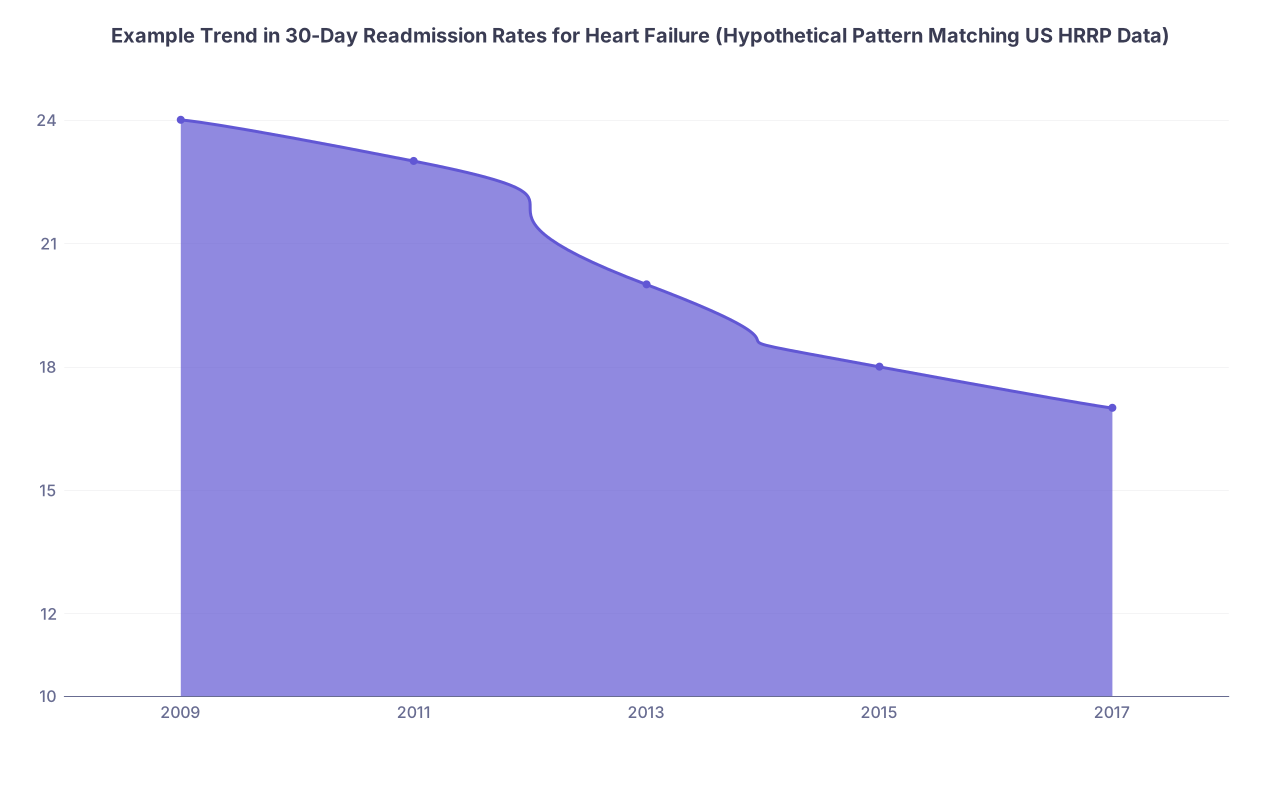
- Meaningful declines in readmission rates for targeted conditions (heart failure, AMI, pneumonia). For example, many U.S. hospitals went from ~20–21% 30‑day readmission to ~17–18% within a few years of the Hospital Readmissions Reduction Program—roughly a 3‑4 percentage point absolute drop, a 15–20% relative reduction.
- Gradual reduction in preventable hospitalizations in areas with strong primary care and Medicaid expansion, though teasing apart causality is harder.
| Category | Value |
|---|---|
| 2009 | 24 |
| 2011 | 23 |
| 2013 | 20 |
| 2015 | 18 |
| 2017 | 17 |
Does every reduction reflect genuine better outpatient prevention? Not always. Some is gaming (observation status, coding shifts). But even after adjusting, there is a real underlying improvement in transitional care and chronic disease follow‑up.
Ethically, this is the tension: financial penalties forced hospitals to care about what happens after discharge. That is good. But any time metrics are tied to money, you must worry about risk‑shifting and avoidance of high‑risk patients.
4. Distribution Matters: Who Gains and Who Gets Left Behind?
Aggregated national averages will lie to you. Or at least, they will hide what matters most ethically.
The more honest questions are:
- Did reforms narrow gaps between rich and poor, insured and uninsured, majority and minority populations?
- Did prevention metrics converge across states, regions, and systems—or diverge?
Data on the ACA and similar reforms show a consistent pattern:
Insurance expansions and removal of cost‑sharing narrowed preventive care gaps.
– Low‑income, minority, and rural populations often saw the largest relative gains in screening and having a usual source of care.
– Example: colorectal cancer screening gaps between high‑income and low‑income adults shrank by several percentage points in expansion states.But there were structural losers.
– Non‑expansion states saw smaller or no improvements in many preventive metrics, effectively locking in or even widening state‑level inequities.
– Certain subgroups (undocumented immigrants, unstable housing, people with serious mental illness) remained barely touched by reforms centered on “insurance” rather than “access plus support.”
From a public health ethics lens, this is non‑trivial. It means the same national reform can be ethically praiseworthy in some regions and ethically deficient in others, depending on implementation choices.
As a clinician or trainee, you are not operating in an abstract national average; you are working in a state, a county, a system. You need to know your local metrics and inequities.
5. How Reforms Reshape Professional Practice and Ethics
Reforms are not just policy events. They change what clinicians are rewarded for, what gets measured, and how time is carved up. That has ethical consequences.
5.1 From “heroic acute care” to “metrics on prevention”
Pre‑reform culture in many health systems glorified rescue medicine: ICU miracles, last‑minute interventions, cath lab sprints. Preventive care was background noise.
Post‑reform, three things happened:
- Preventive metrics became visible on dashboards, performance reviews, and quality reports.
- Payment models linked a portion of revenue to hitting those metrics.
- Uninsured populations shrank (where expansions occurred), making it more feasible to systematically offer screening and follow‑up.
The data shows that when systems start tracking your mammography ordering rate or HbA1c control panel, those numbers move. Not instantly, not perfectly, but measurably.
Ethically, this shifts your obligations:
- You are no longer just “encouraged” to address prevention. You are structurally expected to.
- Ignoring preventive care in a system that has removed financial and logistical barriers is harder to justify.
5.2 The moral friction of metric‑driven care
However, anyone who has worked in a metric‑heavy environment has seen the backlash:
- “We’re treating spreadsheets, not patients.”
- “My bonus depends more on blood pressure targets than on listening to this patient’s actual goals.”
The data is blunt: metrics improve what they measure. They also risk crowding out unmeasured but important aspects of care—like nuanced conversations about over‑screening in frail elders, or individualized targets for very old diabetics.
Ethically, the question becomes: How do you use preventive metrics as tools rather than masters?
A few evidence‑consistent principles:
- Use population‑level metrics to detect gaps and inequities (e.g., your clinic’s CRC screening rate in Medicaid patients is 20 points below commercial). That is a systems failure signal, not an invitation to pressure every individual.
- At the individual level, informed consent and shared decision‑making should still dominate. The data says CRC screening reduces mortality; the ethics say the patient gets to decide after an honest discussion.
6. Evaluating Reforms Like a Data Professional
If you want to be something more than a passive recipient of reform, you need a mental model for evaluating policy.
The core analytic steps:
Define clear before/after windows.
– Allow for lag; screening behavior does not turn on a dime the day legislation passes.
– Use at least 2–3 years of pre‑reform baseline and 3+ years post if possible.Disaggregate by key subgroups.
– Income, insurance type, race/ethnicity, geography (state, rural/urban).
– If an “improvement” is driven by gains among the already‑advantaged, ethically, that is a partial failure.Use appropriate comparison groups.
– Difference‑in‑difference designs: e.g., Medicaid expansion vs non‑expansion states for ACA; regions with and without targeted primary‑care incentives for other reforms.
– Avoid attributing secular trends (like global improvements in cancer screening) solely to your favorite reform.Look for spillover and unintended consequences.
– Did focus on certain preventive metrics lead to neglect of others?
– Did hospitals reduce readmissions by improving outpatient care—or by refusing high‑risk discharges and using observation status?
This is not “academic navel‑gazing.” It is how you distinguish meaningful structural change from policy marketing.
7. What the Data Ultimately Says About Major Health Reforms and Prevention
Let me synthesize, because there is a lot on the table.
Pattern across multiple countries and reforms—ACA, UK QOF, Nordic prevention strategies, national screening expansions:
Insurance expansion + elimination of cost‑sharing reliably increases the use of recommended preventive services, especially screening.
– Typical net gains: 3–10 percentage points in major screening metrics, larger for disadvantaged groups.Payment and quality frameworks that explicitly measure and reward prevention improve chronic disease management and some tertiary prevention outcomes.
– Better BP and HbA1c control, fewer ambulatory‑care‑sensitive hospitalizations, lower readmissions.
– Gains are rarely spectacular but are consistent and sustained.Equity impact is not automatic.
– When designed and implemented well (e.g., strong safety net capacity, expansion to poor adults, targeted support), reforms narrow gaps.
– When adoption is fragmented or politically blocked, reforms can entrench or widen geographic inequities.Metrics are double‑edged.
– They push systems toward prevention (objectively a good thing).
– They risk over‑emphasizing what is countable at the expense of individualized, relational care.
If you are serious about public health policy, you should expect every “major reform” to be accompanied by a clear, monitored preventive care dashboard. If those metrics are not improving—especially for disadvantaged groups—the reform is failing one of its core ethical tests.
FAQ (5 Questions)
1. Do major health reforms always improve preventive care metrics?
No. The data shows that reforms which expand insurance coverage and remove cost‑sharing for preventive services almost always produce some improvement in screening and basic preventive use. But reforms focused purely on cost control or administrative restructuring, with no explicit attention to prevention or access, often show little to no change in preventive metrics. Design details matter far more than slogans.
2. Which single preventive metric is most sensitive to health reforms?
Colorectal cancer screening in middle‑aged adults is one of the most responsive. It has a clear guideline, historically low baseline rates, and is strongly influenced by coverage and out‑of‑pocket costs. When you expand coverage and wipe out cost‑sharing, you often see double‑digit percentage point gains in CRC screening among previously uninsured or low‑income groups.
3. How long after a reform should we expect preventive care metrics to change?
Screening and vaccination uptake can start to shift within 1–2 years, especially once coverage changes are implemented. Chronic disease control metrics (BP, HbA1c) generally take 3–5 years to show meaningful, stable improvements because they require workflow redesign, patient engagement, and sustained follow‑up. Mortality outcomes tied to prevention take longer—often a decade or more—to become clearly visible.
4. Can preventive metrics be improved without large national reforms?
Yes, but with limits. Health systems, insurers, and regional programs can significantly boost preventive care through targeted outreach, reminders, community health workers, and local payment incentives. You will see improvements in a clinic network, a county, or a health plan’s membership. However, without broader insurance and financial protection reforms, the most vulnerable populations remain hard to reach at scale, and national inequities persist.
5. What should clinicians focus on when national reforms change preventive care rules?
Three concrete things:
- Understand which preventive services are now fully covered for your patients and systematically offer them.
- Monitor your own practice’s preventive metrics, disaggregated by insurance type and demographic group, to see who is still being missed.
- Use metrics as prompts, not mandates—anchor decisions in patient preferences and clinical judgment, but let the data show you where your blind spots and system failures are.
Two key points to leave you with. First, prevention does not magically improve because politicians pass a bill; it improves when reforms change who is insured, what is paid for, and what is measured. Second, if you care about ethics in public health and medicine, you must care about those preventive metrics—before and after every “historic” reform—because that is where fine words either become reality or stay fiction.