
You refresh your email. Nothing. You check the spreadsheet. Someone on Reddit says a program sent invites at 6:12 a.m. Eastern. Another person swears the whole season is basically over by Halloween. That is nonsense.
Let me tell you what really happens.
Programs do not send interview invites in some clean, orderly, transparent sequence. They don't review every application the day it arrives, then steadily issue invites one by one like a rational assembly line. The public story is tidy. The real story is committee schedules, faculty bottlenecks, specialty-specific habits, score filters, dean pressure, away rotation politics, and coordinators trying to get 40 people into a calendar before the chair disappears to a national meeting.
And that's why applicants misread the timeline every year.
The biggest mistake I see? People assume silence means rejection. Usually, it means the machine hasn't moved yet. Or it moved for one tiny first wave and you weren't in it. Those are very different things. If you understand the actual pattern, your stress level drops and your strategy gets smarter.
The Waiting Game Begins: What the Timeline Actually Looks Like
The official line from many residency programs is some variation of: "We review applications holistically and send invites on a rolling basis." Sounds fair. Sounds continuous. Sounds like if you submitted on day one, they're probably already deep into your file by the end of that week.
That is not how this goes.
Most programs do not send invites in a smooth rolling stream. They send them in clumps. Big clumps. Usually after a review meeting, after a filter run, after the PD gets through a protected afternoon, or after the coordinator confirms available dates. The result is a season that feels random from the applicant side but is actually highly patterned from the program side.
Here's the pattern applicants need to understand: there is almost always a first wave, then a larger main wave, then a long tail of redistribution.
The first wave is smaller than people think. It often goes to the most obvious yeses: home students, sub-Is the faculty already knows, exceptional applicants who clear every screen instantly, and candidates with some institutional connection that makes the decision easy. In competitive specialties, that first wave can go out quite early because programs are terrified of losing top candidates to their peer institutions. They front-load to signal strength and lock in calendars.
Then comes the second reality applicants miss: the bulk of invites are usually not sent immediately. They come after enough applications have been screened to compare people side by side. Programs don't just want "good" applicants. They want a balanced interview pool. Different geographies. Different schools. Different applicant types. They often wait until they can see the pile, not just the first few files on top of it.
That's why invites are not evenly distributed across the season. There's usually a sharp early pulse, then a heavier release period in late October through November, and then smaller bursts in December as cancellations, declines, and second-pass review decisions create new openings.
Specialty culture drives whether invites are front-loaded or back-loaded. Competitive surgical and procedural specialties often move earlier because everyone is chasing the same limited set of applicants. Delay can cost them. Primary care fields, larger internal medicine programs, and programs with huge application volumes may spread invitations more broadly because they're triaging thousands of files and can afford to move more slowly. Some are also waiting on later-arriving letters, MSPE timing, or Step 2 CK score reporting.
And yes, there's another ugly truth: a lot of "rolling" systems aren't truly rolling at all. They're batch processing under a nicer name.
I've watched this happen from the inside. The coordinator tells applicants review is ongoing. Meanwhile, the actual interview list for the first three dates was decided in a Thursday faculty meeting, uploaded Friday, and scheduled to send Monday morning because nobody wanted the chaos of same-day booking during clinic hours. Publicly: "ongoing holistic review." Privately: "we already know half the pool."
That doesn't mean the season is over if you miss the first drop. Far from it. It means you need to stop treating every early spreadsheet update like a final verdict. Most of the movement comes later than anxious applicants think.
Breaking Down the Data by Specialty and Region
By specialty, the data pattern is brutally consistent: the more competitive the specialty, the earlier the first meaningful invite wave tends to hit.
Dermatology and orthopedic surgery are classic examples. Programs in these fields often move fast because they know their top-tier applicants will fill calendars immediately. If they wait, they lose leverage. A November invite in a hypercompetitive specialty can already feel late because the strongest candidates may be overscheduled by then. That's why these specialties often cluster first-wave invites in mid-to-late October, sometimes even earlier depending on the cycle's rules and release structure.
Internal medicine is a different animal. Large applicant volumes. Broad applicant range. More interview slots. More institutional variation. Many IM programs start earlier than applicants realize, but the full mass of invites often stretches into November. Pediatrics behaves similarly, though often with slightly different regional pacing and a little less frenzy than the surgical arms race. Family medicine tends to be even more distributed, with many programs sending invites well into November and sometimes December.
Region matters too. Northeast academic centers often move in noticeable waves tied to committee meetings and faculty-heavy review structures. Southern and Midwestern community-based programs can sometimes move earlier in a practical, less ceremonial way if the PD has more discretion. West Coast programs, especially at larger academic institutions, can lag simply because everything takes longer administratively. Not always. But often enough that I'd bet on it.
Then there's Step 2 CK. Applicants love to underestimate how much score release timing affects invite timing. Programs may say they review holistically, and many do. But if your specialty or target program leans on Step 2 as a screen or comparison point, delayed score availability absolutely changes when your file gets serious attention. I've seen programs hold hundreds of applications in a "review later" bucket because they wanted a complete data set before making the first broad cuts.
And why do some programs wait until December even when applications were reviewed weeks earlier? Because reviewed does not mean finalized. Sometimes the interview dates are already near capacity and the program is waiting to see yield. Sometimes the chair wants another pass through candidates from a particular region or school. Sometimes the first invite wave had a lower decline rate than expected, so there's no reason to release more spots yet. Programs are managing acceptance behavior, not just evaluating merit.
That's the part applicants rarely grasp. Invite timing is not just about whether you're good enough. It's about when the program needs you.
What Program Directors Actually Tell Each Other (The Insider Secrets)
Here's one of the biggest myths in this whole process: "rolling admissions" means programs are constantly making fresh decisions as applications trickle in.
No. Most of the time, "rolling" means programs want the flexibility to adjust their interview pool after watching who accepts, who declines, and where their yield is weak. It's a calendar management strategy disguised as an admissions philosophy.
Programs talk about yield constantly. Quietly, of course. Not in the polished webinar version. They ask: Are we getting too many applicants from one region? Did our first wave overperform? Are we wasting invites on people who clearly won't rank us? Did we underinvite from our own state? Are too many dates stacked with ultra-competitive applicants who will never come here? These are not abstract concerns. They directly affect when the next invites are released.
Holistic review has made timing messier, not cleaner. That surprises applicants. They assume holistic review means everyone gets a careful, equal look right away. In reality, it often slows the process because now a program that once used a straightforward score screen may insist on committee discussion for borderline files, nontraditional applicants, couples match applicants, home institution politics, and applicants with standout life experiences. Good for fairness in theory. Slower in practice. Much slower.
And about that lovely status message: "under review."
Sometimes it's true. Sometimes it's theater.
I've seen applications marked "under review" long after a candidate was effectively out of contention. Not because anyone was being malicious, but because nobody wanted to trigger a flood of panicked emails or formally close the file before all interview dates were allocated. I've also seen the opposite: a strong applicant left in "under review" status even after the faculty had already agreed, "If there's a cancellation, send this one immediately." The status often reflects workflow inertia, not live decision-making.
The hidden driver, more than applicants realize, is meeting cadence. If the committee meets every Tuesday at noon, nothing meaningful happens Monday night just because you updated your CV. If the PD is on service for two weeks, your file may sit despite being perfectly strong. If the department chair insists on approving the final list, invites may wait until after a monthly leadership meeting. Bureaucracy beats urgency all the time.
This is why you'll see bizarre invite bursts. Fifty invites at 9 p.m. on a Wednesday. Another wave three weeks later. Silence in between. Not random. That's just the machinery creaking forward.
And yes, faculty compare notes across institutions more than applicants think. Not in some sinister blacklist way. More casually. "How quickly are you moving?" "Have your dates filled?" "Are you seeing the same applicant overload?" Programs absolutely have a feel for the market. They know when they're early, on time, or behind. They're adjusting based on each other whether they admit it or not.
So when a program says, "We're still reviewing applications," translate it properly: they may be. They also may be waiting for the next internal checkpoint that has nothing to do with you.
The Week-by-Week Reality: When to Expect Movement
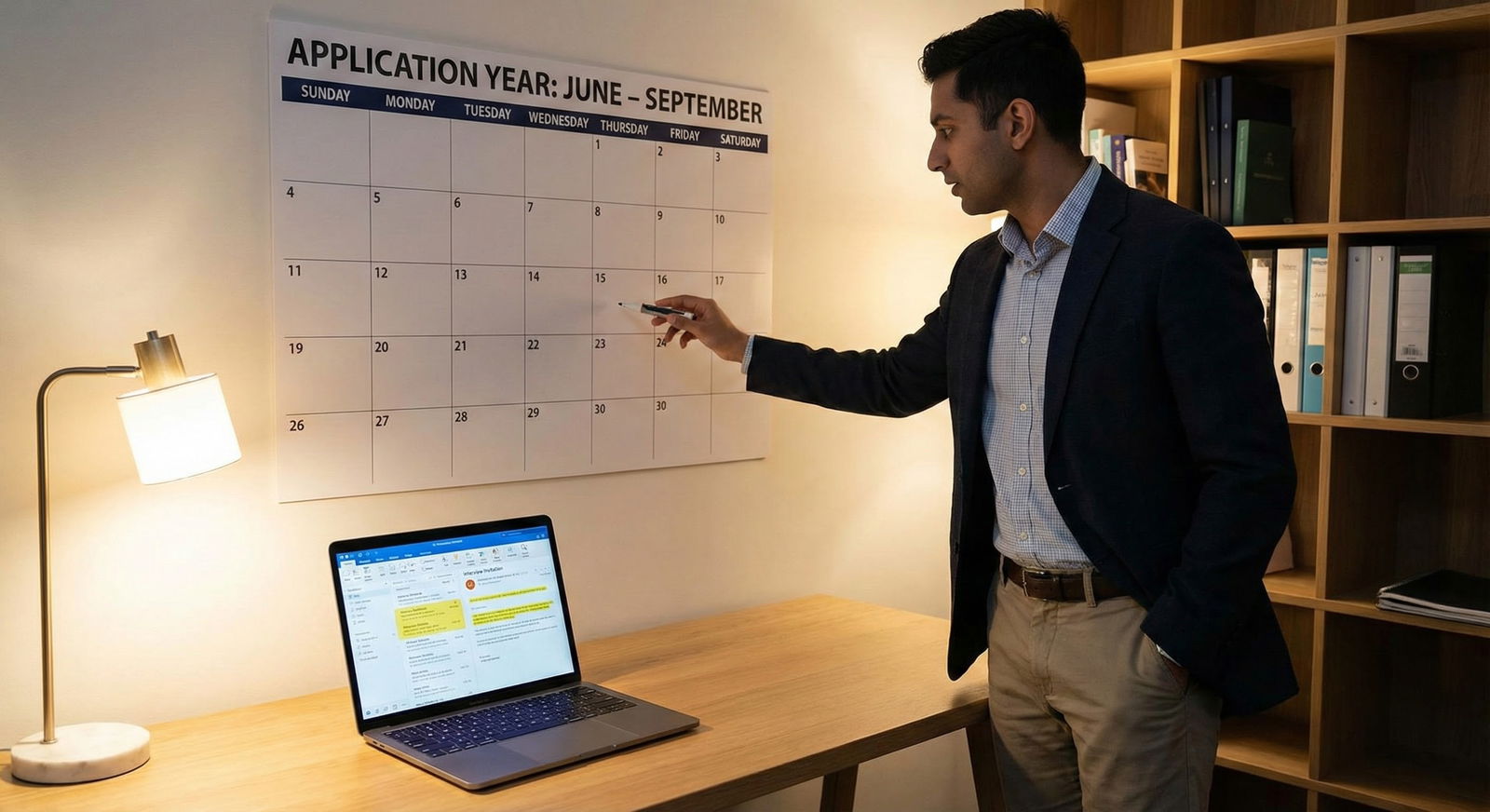
Early October is where the mythology starts. This is the first-wave zone. If you get invites here, you're usually in one of a few buckets: obvious standout, strong fit, known quantity, home applicant, sub-I favorite, or someone whose metrics made screening easy. Good sign? Absolutely. But missing this wave is not the disaster people make it out to be.
Late October through November is the real engine of the season. This is where the majority of applicants see meaningful movement. Programs have run first screens, held at least one committee meeting, and started seeing how quickly their dates fill. This is when broad invite distribution happens. It's less glamorous than the first wave, but far more important.
December is where strategy becomes visible. Programs start patching gaps. Maybe one interview day had too many declines. Maybe the first wave overestimated interest. Maybe a faculty subgroup pushed for a second look at applicants with unusual backgrounds or regional ties. This is when quiet waitlist movement starts helping people who stayed organized and responsive.
January surprises applicants every year. "Why are there still open interview dates?" Because real life happens. Faculty schedules implode. Applicants cancel after reaching their comfort number. Weather, travel preferences, and rank strategy all create movement. Some programs also deliberately keep a little slack in the schedule because they know no-show risk rises late in the season.
So the week-by-week reality is simple: the season is front-signaled but middle-weighted. The noise is early. The substance is later.
Maximizing Your Chances: What Actually Works
Let's kill another bad idea: submitting at 9:01 a.m. versus 2:00 p.m. on opening day is rarely what changes your season. Being complete matters. Being strong matters. Being easy to review matters. But the fantasy that minute-level submission timing determines your future? Ridiculous.
Programs usually don't start broad review the instant applications open anyway. They wait for batches. They wait for letters. They wait for meetings. So yes, submit on time. Don't be sloppy. But stop acting like a 24-hour difference is life or death unless your specialty has an explicit reason for extreme early review.
What actually works is positioning yourself for every phase of the cycle. That means having a complete file, making sure letters are in, updating meaningful accomplishments if a program accepts updates, and staying available for waitlist movement. If a coordinator emails you about an opening and you take two days to respond, you're done. Those spots go to the applicant who replies in ten minutes with a clear yes.
"Demonstrated interest" is wildly overrated unless a program specifically invites it. Most generic emails are deleted, skimmed, or filed mentally under applicant anxiety. Harsh, but true. A thoughtful note can matter in narrow situations: geographic ties, couples match explanation, true top-choice fit, post-sub-I relationship. But blasting vague "I remain very interested" messages to 40 programs is just making yourself feel busy.
What should you do between invite dates? Prepare like someone who expects the phone to ring. Refine your interview answers. Know your application cold. Build a scheduling system so you can respond fast. Keep a clean spreadsheet. Have a professional email template ready. If your specialty allows updates and you genuinely have one, send it cleanly and once. Not three times. Not with desperation leaking through every sentence.
And if you're on the edge, waitlist movement is where discipline wins. Programs often need replacements quickly. The applicants who benefit are the ones who are organized, reachable, and not emotionally melting down every weekend over silence.
That's not glamorous advice. It's just the advice that works.
Conclusion: Your Strategic Action Plan
Most applicants panic too early. That's the first thing you need to fix.
If it's October and you're staring at silence, you are not automatically in trouble. The data and the real-world workflow both say the same thing: most meaningful invite activity happens later than applicant group chats suggest. Early noise is not the whole season.
Build your strategy around your specialty's actual rhythm, not rumor. If you're aiming at a competitive field, expect earlier signaling and tighter first-wave behavior. If you're in a broader specialty, understand that November and even December still matter. A lot. Shape your expectations accordingly.
Use the waiting period intelligently. Get interview-ready before the invites arrive. Keep your application complete. Stay responsive. Don't waste energy sending performative emails to programs that don't want them. Save your focus for the moments that actually move outcomes.
You do not control when a committee meets. You do not control whether a coordinator sends invites at sunrise or midnight. You do control whether you're prepared when the opportunity opens.
That's the whole game, really. Not perfect timing. Readiness.