
You are not “doomed” in November unless you sit still and do nothing.
If you have few or zero residency interview invitations by early–mid November, you are in a salvage situation. That is not fatal. But it does mean you need to stop hoping and start running a process.
This is that process.
This is not hand‑holding, and it is not “manifest good vibes and they will come.” It is a stepwise, time‑sensitive playbook built from what actually works for applicants who turn a quiet November into a decent January.
Use it like a protocol. Go through the steps in order. No magical thinking. No pride.
Step 1: Get Clear On Where You Actually Stand
You cannot fix what you refuse to measure. Before emailing anyone, you need a sober snapshot of your application and the current landscape.
1.1. Define “Few Interviews” Precisely
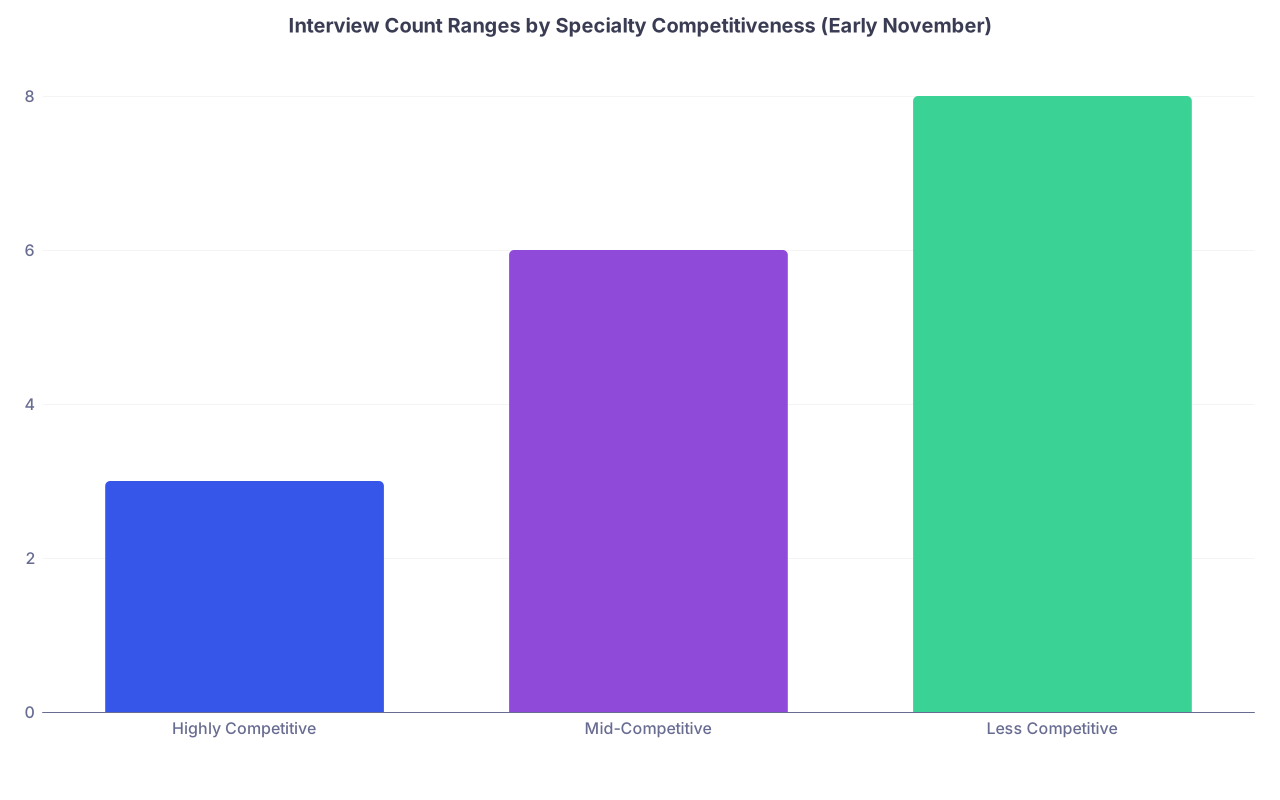
By early–mid November (after most programs have sent at least one wave of invites), rough ballpark:
- Competitive specialties (Derm, Ortho, ENT, Plastics, etc.):
- 0–2 invites = serious problem
- 3–5 = borderline, still concerning
- Mid‑competitive (EM, Anesthesia, OB/GYN, Gen Surg at mid‑tier places):
- 0–3 = serious problem
- 4–6 = borderline
- Less competitive (FM, Psych, Peds, IM community programs):
- 0–4 = serious problem
- 5–8 = borderline
If you are below those ranges for your specialty by November, you are in salvage territory. Accept that. It gives you permission to be aggressive.
| Category | Value |
|---|---|
| Highly Competitive | 3 |
| Mid-Competitive | 6 |
| Less Competitive | 8 |
The values above are rough “you should at least be around here” numbers, not strict rules. You get the idea.
1.2. Rapid Application Audit (30–45 minutes, no excuses)
Print your ERAS application and personal statement, or at least open them full‑screen. Go through with a pen / track changes and ask:
-
- Any failed / repeated courses or Step failures?
- Any gaps with no explanation?
- Disciplinary actions?
Board scores / Exams
- Step 1: Pass/Fail now, so mostly background.
- Step 2 CK:
- < 215: Often problematic for most ACGME programs.
- 215–225: Below many program filters for competitive fields.
- 230–245: Solid but not stellar.
250: Strength, unless everything else is weak.
-
- Any Honors / High Pass in core rotations?
- Any narrative comments that are lukewarm or concerning?
Letters of recommendation
- Do you actually have specialty‑specific letters from people who know you?
- Or generic “X was a student here” fluff?
Personal statement
- Does it sound like a generic template anyone could write?
- Any actual story, or just “I like working with people and problem‑solving”?
Program list
- How many total programs?
- How many “reach” vs “safety” vs true peers?
- Did you avoid community programs out of pride?
Now be blunt: what are your 2–3 biggest weaknesses that a PD would see in 10 seconds? Write them down. Those will shape your salvage tactics.
Step 2: Stop Bleeding Time – Fix the Big Structural Mistakes
Most people in trouble in November have the same few problems. I keep seeing them, year after year. You might recognize yourself.
2.1. You Did Not Apply Broadly Enough
If you applied to 25 Gen Surg programs as an average candidate, this is not “bad luck.” It is poor strategy.
Minimums I recommend for all but the strongest applicants:
| Specialty Tier | Typical Minimum # Programs |
|---|---|
| Highly Competitive | 60–80 |
| Mid-Competitive | 40–60 |
| Less Competitive | 25–40 |
If your numbers are way below this, rectifying it is priority one (details on how in Step 3).
2.2. Your Program Mix Is Wrong
Common pattern: 70% of your list is academic, desirable location, or “top‑tier” and you threw in a handful of community programs as an afterthought.
That works if you are a stellar candidate. It fails hard for everyone else.
You want something closer to:
- 20–30% “reach” programs
- 40–50% realistic “target” programs
- 20–40% safety / community / less desirable location programs
If your current list is 80% reach, you are not unlucky. You are miscalibrated.
2.3. Your Application Documents Are Bland or Sloppy
I see this every cycle:
- Personal statement: 900+ words, reads like a college essay, takes 3 paragraphs to say “I like teamwork.”
- Experiences: bullet points are job descriptions, not impact (“Assisted with patient care” x 10).
- No clear hook: no sense of “what this person brings to my program.”
You cannot rewrite your entire life in November. But you can tighten and sharpen the way you present it, and you must fix obvious sloppiness before you start emailing PDs and begging for a look.
Step 3: Expand and Rebalance Your Program List (Time‑Critical)
Salvage step number one is getting yourself in front of more programs that might actually consider you.
3.1. Identify Undersubscribed or Overlooked Programs
You are not trying to land your dream coastal academic spot right now. You are trying to match somewhere safe and sane.
Do this:
- Go to FREIDA and filter for:
- Your specialty
- “Accepts IMGs” (even if you are not an IMG; these are usually more flexible)
- No Step 2 minimum filter listed, or relatively low minimum
- Sort by:
- Smaller cities
- Newer programs (last 5–10 years)
- Community‑based, non‑university hospitals
These are the programs that tend to still have openings later and are more likely to look at a late applicant or respond to a targeted email.
- Check state‑specific patterns:
- Your home state and neighboring states
- States with many community hospitals (Ohio, Michigan, Texas, Florida, etc.)
3.2. Decide If You Need a “Parallel Plan”
Harsh reality: some specialties will not be salvaged this cycle if you are far below their usual metrics and already have no bites in November.
Examples:
- Step 2 CK 215, applying Ortho with no home program and zero interviews by mid‑November? You are essentially out this cycle for Ortho.
- Similar for Derm, ENT, Plastics, increasingly for Radiology and Anesthesia in some regions.
In that case, you have two paths:
Parallel apply this cycle
- Add a less competitive specialty (FM, Psych, IM, Peds) now.
- Sharpen a second personal statement specifically tailored.
- Get at least one letter from that field if at all possible, even if a bit late.
Salvage for next cycle instead of forcing this one
- Prelim year (IM or Surgery) with the explicit plan to reapply.
- Or research year, especially if you are serious about a surgical subspecialty or Derm.
I am not telling you to abandon your dream specialty lightly. I am telling you the reality: if no one has sniffed around by November and your CV is below the usual bar, your energy is better spent getting some accredited training spot rather than rolling the dice on a complete shut‑out.
Step 4: Strategic, Not Desperate, Outreach to Programs
This is where most applicants in trouble either shine or embarrass themselves.
No, you do not mass‑email 200 programs with “Dear Program Director, I am very interested in your program” and a 3‑paragraph wall of text. That gets you filtered or ignored.
4.1. Who You Should Email
You focus on:
- Programs with:
- No explicit Step 2 cutoff
- History of interviewing similar candidates (use your school’s data or talk to seniors)
- Geographic or personal connection (where you grew up, family nearby, etc.)
- Programs that:
- Have recently increased resident positions
- Are new or community‑based
- “IMG‑friendly” (proxy for being flexible and open)
Total target list: usually 25–60 programs, not 200.
4.2. When You Should Email
Best times:
- Early November: First outreach wave
- Late November / Early December: Second “check‑in” wave if there is movement or new info (e.g., Step 2 score improved, new letter uploaded)
Avoid sending emails on Friday evenings or major holidays. They disappear into the void.
4.3. What Your Email Should Actually Look Like
Keep it short. Targeted. And with a specific reason their program makes sense for you, not fluff.
Template skeleton (edit for your situation):
Subject: [Specialty] Applicant – Strong Interest in [Program Name]
Dear Dr. [PD Last Name] and [PC First Name],
My name is [Full Name], a [MS4/IMG, medical school, grad year] applying to [Specialty]. I wanted to briefly express my strong interest in [Program Name].
A few points about my background:
- Step 2 CK: [Score] (Step 1: Pass)
- Clinical: [Honors in key rotations / strong evaluations in X]
- Ties to your area: [Grew up in / family in / previously worked in region, if applicable]
I am particularly drawn to your program because of [1–2 specific, real reasons: underserved population focus, strong training in X, community‑based with high autonomy, etc.]. Given the quieter market for interviews right now, I wanted to ask if my application could be reviewed for potential interview consideration.
ERAS AAMC ID: [ID]
Thank you for your time and consideration.
Sincerely,
[Name]
[Contact info]
Key rules:
- No apologizing paragraph about your weaknesses. They can see your application.
- No begging. Just clear interest + concise highlight of strengths.
- No attachments. They have ERAS.
If you genuinely have a red flag but also a strong narrative around it (e.g., one failed exam due to illness, since fully remediated with strong Step 2), you can add one short line:
I am aware my [X] is a concern; since then, [evidence of improvement] and I have focused on [Y].
One line. Not an essay.
Step 5: Use Your Network Without Being Annoying
If you are sitting in November with few invites and you have not asked a single attending or advisor to vouch for you directly, you are leaving value on the table.
5.1. Identify Soft and Hard Connections
You are looking for:
- Attendings in your specialty who:
- Trained at other programs
- Have colleagues or co‑residents elsewhere
- Program leadership at your home institution
- PD or APD in your field
- Clerkship directors
- Recent graduates from your school in residency now
Map this:
- Open a notepad.
- List the programs where:
- Someone you know trained,
- Someone you worked closely with has a contact,
- Or a recent graduate matched.
That is your network‑leverage list.
5.2. Ask for Targeted Help, Not Vague “Support”
You do not email an attending with “Can you help me with my application?” Vague requests get ignored.
Instead:
Dear Dr. [Name],
I hope you are well. I am applying in [Specialty] and, as of early November, have had fewer interviews than expected. I remain very interested in matching this cycle and would appreciate any specific help you might be comfortable offering.
In particular, I am interested in [Program A, Program B, Program C], where I understand you have connections. If you feel comfortable doing so, would you be willing to send a brief email on my behalf to the PD or a faculty member there to flag my application for review?
I would be happy to send a short summary of my application and my ERAS ID if that would be helpful.
Thank you again for your mentorship.
Best,
[Name]
You are not asking them to “get you in.” You are asking them to help your application get read. That is actually realistic.
This kind of targeted nudge, from the right person, can absolutely convert to an interview—especially in community or mid‑tier programs where PDs actually know each other.
Step 6: Patch Application Weak Spots You Can Still Fix
You cannot invent a publication or change a Step score in November. But you can clean up presentation and fix some commonly neglected areas.
6.1. Tighten Your Personal Statement (One Good Page, Not Two)
Goal: one page, skimmable, with a hook.
Basic structure:
- Opening: 2–3 sentences, short story / vignette that actually happened, not a fake “ever since I was five” line.
- Middle: 2–3 short paragraphs connecting:
- Why this specialty fits your skills and temperament.
- Concrete experiences that show you understand the day‑to‑day reality.
- Closing: 1 paragraph about what you are looking for in a program and what you bring.
If your current statement is over 750–800 words, cut.
Never forget: PDs skim. They remember one or two things at most. Give them one or two things worth remembering.
6.2. Rework Experience Descriptions for Impact
Example of bad bullets:
- “Assisted with patient care on the wards.”
- “Participated in research in cardiology lab.”
Better bullets:
- “Managed 8–10 patients daily on internal medicine wards, presenting concise plans and adjusting management with resident feedback.”
- “Led data collection and preliminary analysis for 120‑patient retrospective study on [topic]; abstract accepted to [regional/national] conference.”
Goal: show responsibility, ownership, initiative. This matters more than sounding “academic.”
6.3. Upgrade Letters Where Possible
You do not have time to chase totally new letters from scratch in many cases, but you do have time to:
- Ask a strong clinical mentor to update a slightly older letter
- Ask a subspecialist who knows you well to upload a letter late November. Many programs will still review new letters later in the cycle, especially mid‑tier or community sites.
Do NOT chase letters from “big names” who barely know you. A specific, detailed letter from a mid‑tier attending beats a generic name‑brand letter every time.
Step 7: Real‑Time Monitoring and Adjustments (November–January)
You are not running a one‑and‑done play here. You are running a salvage campaign over several weeks. You need to track.
7.1. Build a Simple Tracking Sheet
Create something like this (spreadsheet, not a beautiful work of art, just functional):
| Program | Type (A/community) | Email Sent | Response | Interview? |
|---|---|---|---|---|
| Program A | Community | 11/5 | No reply | No |
| Program B | Academic | 11/7 | Declined | No |
| Program C | Community | 11/9 | Positive | Yes |
| Program D | New | 11/10 | Pending | No |
Track:
- Date of email
- Any response
- Invitations received
- Whether a contact / attending reached out
Patterns will emerge. Maybe community programs in certain states are more responsive. Maybe academic centers are dead quiet for you. Adjust your outreach accordingly.
7.2. Understand the Rhythm of the Season
Rough sense (varies by specialty, but the pattern holds):

| Step | Description |
|---|---|
| Step 1 | Applications Submitted |
| Step 2 | Oct: First Wave Invites |
| Step 3 | Nov: Second Wave & Waitlist Movement |
| Step 4 | Dec: Late Invites & Cancellations |
| Step 5 | Jan: Final Spots Filled |
- October: First wave, mostly pre‑screened.
- November: Second wave + some waitlist movement.
- December: Late invites as people cancel, no‑show, or over‑book.
- Early January: Last‑minute filling of empty interview days.
This is why a steady outreach process in November and December matters. Programs frequently pull from late applicants or email‑reminded candidates when someone cancels.
Step 8: If You Are Truly at Risk of Not Matching, Build a Parallel Safety Net
Here is the part nobody likes to talk about in polite advisor meetings.
If, by late December, you still have very few or zero interviews (for U.S. MD/DO that usually means < 5 total; for IMGs it depends but < 3 is scary), you must assume you are now preparing for two things at once:
- Doing your absolute best with the interviews you have.
- Not matching and needing a structured backup.
8.1. Strengthen What You Can Before SOAP
If you end up in SOAP in March, programs will look at:
- New Step 2 scores (if late)
- Any new clinical experiences
- How your dean’s letter / MSPE frames you
- Any updated letters
So between January and March:
- Take on heavier clinical responsibilities where possible (sub‑I, acting internship, hospitalist scribe, etc.).
- Ask for one more strong letter if you have improved a lot clinically.
- Stay in good standing. No last‑minute professionalism issues, no absences.
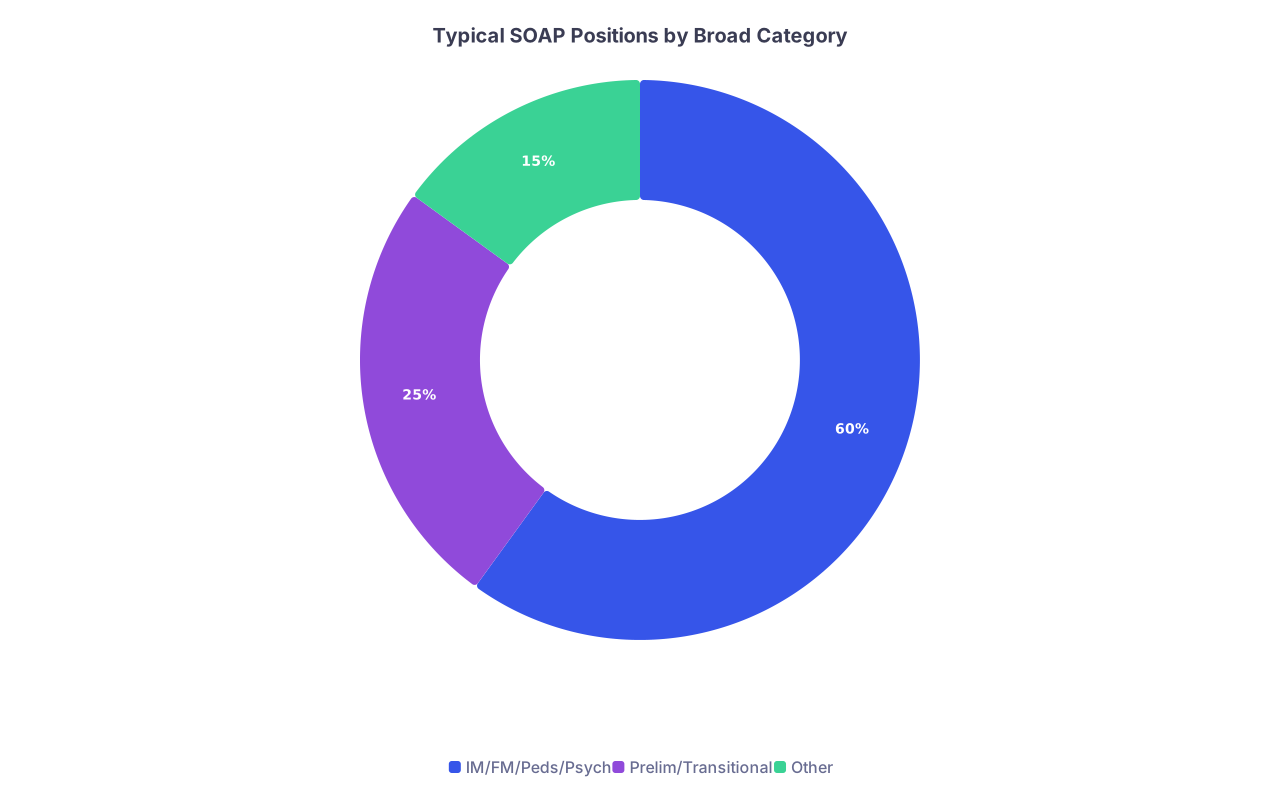
8.2. Know Which Specialties Actually Have SOAP Spots
Historically, SOAP is not generous to highly competitive fields. The bulk of SOAP positions are:
- Internal Medicine (often community)
- Family Medicine
- Pediatrics
- Psychiatry
- Transitional / preliminary year spots
- Some Surgery prelims
| Category | Value |
|---|---|
| IM/FM/Peds/Psych | 60 |
| Prelim/Transitional | 25 |
| Other | 15 |
So if you land in SOAP and you are dead‑set on Neurosurgery or Ortho, your realistic immediate pathway is:
- Prelim IM or Surgery
- Then reapply with stronger clinical evaluations, maybe research
8.3. Emotional Management (Yes, That Matters)
People blow their chances more by panic than by weakness. I have watched applicants:
- Fire off angry or pleading emails to PDs.
- Cancel interviews impulsively because “I only want X city.”
- Check out mentally from clinical rotations and earn bad end‑of‑year comments.
You cannot afford any of that.
Practical moves:
- Designate one friend / family member as your “panic sink” where you vent so you do not do it to a PD or attending.
- Limit checking email to set intervals (e.g., every hour, not every 5 minutes).
- Keep showing up strong on rotations. PDs do call each other in February and March.
Step 9: Next‑Cycle Contingency – If This Year Truly Fails
I hope you do not need this part. Some people will. If you go through all of this and still do not match, you want to be the person who already has a plan, not the one shell‑shocked in April.
You ask yourself three questions:
- Was the main issue numbers (scores, failed courses)?
- Was it strategy (too few programs, poor list, weak documents)?
- Was it timing (late exam, late application)?
Depending on the answer:
Numbers problem
- Consider a strong preliminary year with good evaluations.
- Consider research year only if it directly and clearly strengthens your reapplication in a competitive specialty.
Strategy problem
- Fix program list size and balance.
- Overhaul personal statement and experiences with real PD / advisor input.
- Plan for earlier submission next cycle.
Timing problem
- Get Step scores in early.
- Arrange for letters early and pipeline them.
- Have PS and ERAS almost ready by opening day.
One thing you do not do: repeat the same exact approach and pray.
A Quick Visual: The Salvage Playbook at 10,000 Feet

| Step | Description |
|---|---|
| Step 1 | Few Interviews in November |
| Step 2 | Audit Application & Program List |
| Step 3 | Expand & Rebalance Programs |
| Step 4 | Targeted Program Outreach |
| Step 5 | Leverage Faculty & Alumni Network |
| Step 6 | Refine PS & Experiences |
| Step 7 | Track Responses & Adjust |
| Step 8 | Focus on Interview Performance |
| Step 9 | Plan SOAP & Next-Cycle Strategy |
| Step 10 | Interviews Increase? |
The Bottom Line: What Actually Saves a Weak November
Cut the noise. Three moves matter most if you are sitting on few invites in November:
Fix the structural errors fast
- Expand and rebalance your program list toward realistic and safety programs.
- Adjust specialty strategy if your numbers make your current target nearly impossible this cycle.
Run a disciplined outreach campaign
- Short, targeted emails to a curated list of programs.
- Ask specific attendings and alumni to vouch for you where they have pull.
- Do it in waves through November and December, tracking responses.
Sharpen what is still under your control
- Cleaner personal statement, stronger experience descriptions, late but specific letters.
- Solid clinical performance and professionalism in late rotations, to help both this cycle and any future ones.
You are not out until the Match results post. Run the playbook. Then, whatever happens, you know you actually played the game, instead of just watching your inbox and hoping.