
The Step 1 pass/fail era did not make things easier. It just moved the pressure to Step 2 and everything else you do.
If you are reading this, you probably have:
- Step 1: Pass (no numeric score)
- Step 2 CK: Borderline for your target specialty (or at least lower than you wanted)
And now you are wondering: Am I dead in the water? No. But you also do not have the margin for sloppy decisions.
I will walk you through how to:
- Judge how “bad” your Step 2 really is—for your specific specialty
- Decide what to fix vs what to feature
- Build an application that makes programs say: “We should at least talk to this person”
- Avoid common self-sabotage moves I see every year
This is not about vibes and “staying positive.” This is about tactics.
1. Reality Check: How Borderline Is Your Step 2 For Your Specialty?
First thing: stop thinking about your Step 2 in isolation. Scores only matter relative to the specialty and the programs you are targeting.
Step 2 in the pass/fail Step 1 world
With Step 1 pass/fail, most programs did exactly what everyone expected: they just shifted the filter to Step 2 CK.
Program directors are doing roughly this:
- Hard screens:
- Auto-reject below certain Step 2 cutoffs
- Auto-review above another band
- In-between: look at context (school, clinical grades, letters, red flags)
If your Step 2 is “borderline,” it usually means one of these:
- You are within ~5–10 points of the median matched score for your desired specialty
- Or you are above the national mean but below your specialty’s typical range
- Or your score is decent but you are aiming at very competitive academic programs
To make it concrete, here’s a rough comparison.
| Specialty Tier | Examples | Typical Competitive Step 2 Range* |
|---|---|---|
| Hyper-competitive | Derm, Plastics, Ortho, ENT | 250+ |
| Competitive | EM, Gen Surg, Anesth, Radiology | 245+ |
| Moderate | IM, OB/GYN, Peds | 235–245 |
| Less competitive | FM, Psych, Neuro | 225–235+ |
*These are broad generalizations. Exact ranges change year to year and by program type.
So if you:
- Want Derm with a 232? That is not “borderline.” That is “you need a radically adjusted plan.”
- Want IM with a 234? That is legitimately borderline for strong academic programs but usable with strategy.
- Want FM/Psych with a 225–230? You are still in the fight.
Step 2 vs everything else: how programs actually weigh it
Program directors look at:
- Step 2 CK
- Clinical grades (esp. core clerkships + sub-I)
- Letters of recommendation (especially from their own faculty or known names)
- Class rank / AOA / school reputation
- Research (for some specialties)
- Personal statement and MSPE narrative (more than applicants think)
Your score is one loud data point, but it is not the only one. If everything else is “fine” and Step 2 is your only soft spot, this is fixable.
2. Diagnose Your Position: A Simple Triage Protocol
You need a structured way to decide what to do next. Use this quick triage.
Step 1: Place your score into a risk bucket
Compare your Step 2 number against your specialty’s typical matched range.
- Green zone (low risk):
- You are at or above the median matched Step 2 for your specialty
- Step 2 ≥ ~240 for IM / OB / Peds, ≥245–250+ for more competitive fields
- Yellow zone (borderline):
- Within ~5–10 points below the typical competitive range
- You will not be auto-rejected everywhere, but you may be filtered out at top programs
- Red zone (high risk):
- 10+ points below competitive range for your specialty
- Or below 220 in almost any field
If you are reading this, you are probably in yellow or low-red.
Step 2: Check the rest of your application for “anchors”
Anchors are things that drag your application down:
- Multiple clerkship failures or marginal passes
- Professionalism issues
- Leave of absence with a vague explanation
- Failed Step 1 (even if later passed)
- Significant gap with no explanation
If you have both a borderline Step 2 and anchors, you need to overcorrect with volume (more programs) and strength (better letters, targeted strategy).
If you have a borderline Step 2 but no anchors and decent clinical performance, your job is mostly reframing and smart targeting.
3. Application Strategy: Where and How Many Programs to Apply To
You cannot “manifest” interviews. You have to buy them with volume and smart selection.
Step 2 vs number of programs: what I actually recommend
Here is the rough volume guidance I give students with a pass Step 1 and borderline Step 2, assuming no catastrophic red flags.
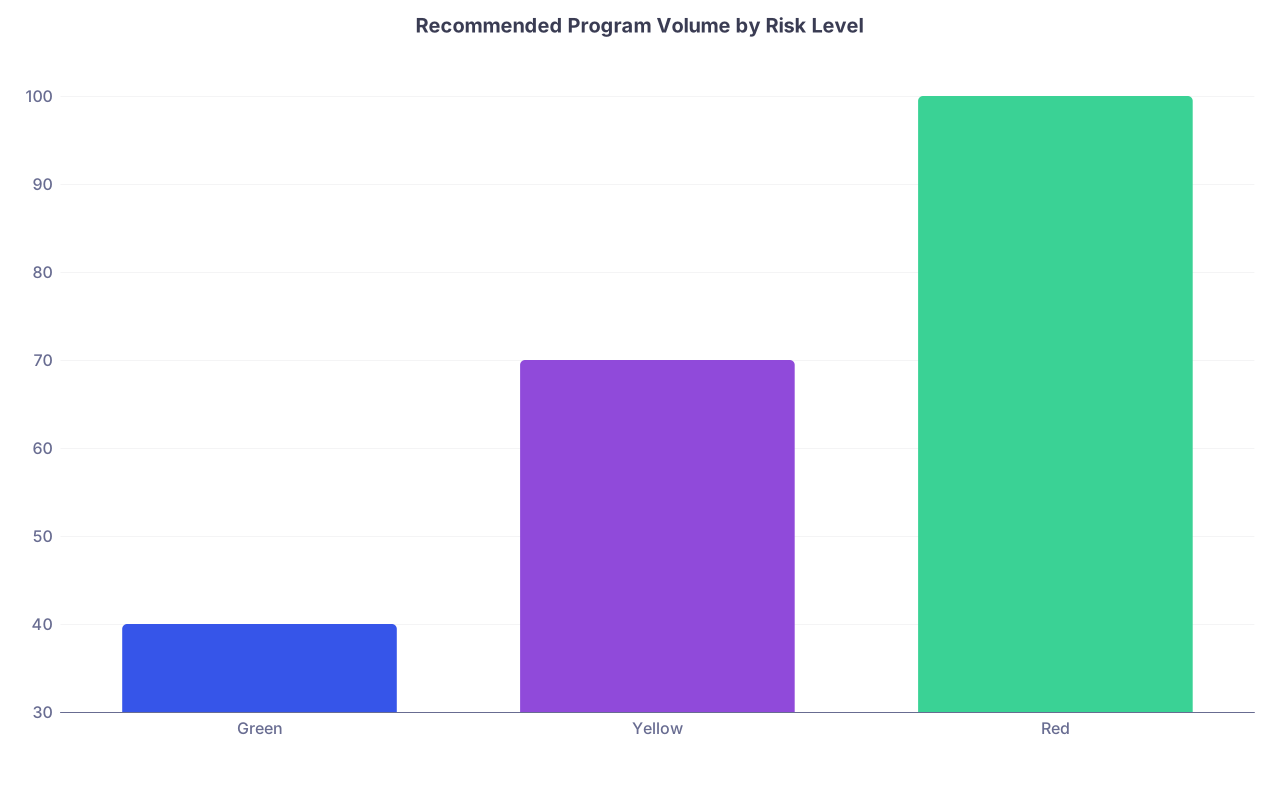
| Category | Value |
|---|---|
| Green | 40 |
| Yellow | 70 |
| Red | 100 |
Interpretation:
- Green zone: 25–40 programs (for less competitive) / 40–60 (for more competitive)
- Yellow zone (you):
- Less competitive specialties (FM, Psych, Neuro): 40–60 programs
- Moderate specialties (IM, OB, Peds, Anesth, EM): 60–80 programs
- Highly competitive specialty: Usually you either:
- Pivot to a less competitive backup, or
- Apply 80–100+ programs and accept significant risk
- Red zone: 80–120+ programs or serious re-strategizing / backup specialty
Program selection: do not waste applications on pure reach
If you are borderline, your target mix should be:
- 10–20% reach
- 50–70% realistic
- 20–30% safer
What “reach” means with your score:
- Academic powerhouses in major cities
- Programs with strong research reputations
- Programs that historically match students with much higher Step 2s
Your realistic / safer tier:
- University affiliates that are not flagship campus
- Strong community programs
- Mid-tier academic programs not in oversaturated cities
Concrete tactic: use program websites, NRMP Charting Outcomes, and your school’s match data to mark each potential program as R (reach), T (target), or S (safety). If more than 25% of your list is R, you are living in fantasy land.
4. Letters of Recommendation: Your Most Powerful Counterweight
A borderline Step 2 can be cushioned—sometimes completely—by outstanding letters. I have seen applicants with average scores get interviews at elite places because a well-known attending wrote, “This is one of the top 5 students I have worked with in the last decade.”
Who to get letters from
Ideal letters, in this priority order:
- Specialty-specific faculty who worked closely with you
- Sub-internship / acting internship attendings
- Program or clerkship directors
- Research mentors (if they know your clinical abilities too)
- Non-specialty clinicians only if they can write a powerful narrative
If you have a borderline score, you cannot afford generic letters. You need at least one letter that:
- States you are better than your score suggests
- Describes specific clinical behaviors (ownership, reliability, work ethic)
- Highlights improvement over time (this matters a lot if your score is low-ish)
How to get stronger letters (yes, you can influence this)
Do not just say, “Can you write me a letter?” Say:
“Given my Step 2 score is [X] and I am applying to [specialty], I am trying to make sure my letters really reflect how I work on the wards. Do you feel you can write a strong letter for me?”
If they hesitate or soften it (“Yeah, I can write a letter”), pivot. You want the people who immediately say, “Absolutely. You worked your tail off. I’d be happy to.”
Then give them:
- Your CV
- A short “brag sheet” with 3–5 cases or examples of times you:
- Took ownership of patients
- Went above expectations
- Showed good judgment under stress
- Your draft personal statement (if ready)
You are not scripting them. You are giving them material so they can write specific, credible praise rather than vague filler.
5. Personal Statement and MSPE: Controlling the Narrative
If Step 2 is not a selling point, do not pretend it is. But do not let it float in the air unsupervised either.
When to address the score directly
You should consider a brief, direct mention if:
- Step 2 is significantly lower than expected based on your academic history
- There was a real, concrete reason: illness, family crisis, exam-day disaster
- Your subsequent performance clearly contradicts the implication of that score
You should not bring it up if:
- You just underperformed and have no clear explanation
- The score is only slightly below average for your specialty
- You have no clear “comeback” story yet
If you address it, do it once, briefly, and with ownership. Example:
“My Step 2 score does not reflect my usual academic performance. During the exam period, I was managing a significant family emergency that limited my preparation. Since that time, my clinical evaluations and sub-internship performance at [Hospital] have been much more consistent with my capabilities, and I have taken deliberate steps to strengthen my medical knowledge and clinical judgment.”
No excuses. Just context + evidence of growth.
Use the personal statement where you actually have leverage
Your personal statement should:
- Show clear, specific motivation for the specialty (not generic “I like helping people” fluff)
- Convey maturity, reliability, and self-awareness
- Provide 1–2 concrete stories that show how you function clinically
If program directors read it and think, “This is someone I would not mind at 3 am,” you have won.
6. Strategic Use of Rotations and Sub-Is
If you are still early enough in the timeline, you can use rotations to compensate for a softer Step 2.
Away rotations (auditions): when they help
They help when:
- You are applying to a moderately or highly competitive specialty
- You can realistically impress on rotation (good work habits, team player)
- The program actually uses aways heavily in selection (many do)
They do not help much when:
- You treat them like tourism instead of a month-long job interview
- You do not actively seek feedback and stretch tasks
- You pick pure reach programs where your Step 2 will still block you
On aways or subs, your goal is simple:
- Work harder than the average student
- Be early, be prepared, be nice to absolutely everyone
- Tell the program director / clerkship director: “I am very interested in your program and would be honored to train here.”
Then, ideally, have someone there write you a letter and advocate for an interview.
7. Concrete Tactics to Offset a Borderline Step 2
Now the core. Here are specific, practical moves that actually change outcomes.
1. Apply earlier than everyone else
Borderline applicants have a smaller safety margin for delays.
Your target:
- ERAS submitted and certified on day 1
- Letters requested at least 4–6 weeks before ERAS opens
- Personal statement and CV polished at least 2–3 weeks before
Programs that screen early may send out interview invites before they have the entire applicant pool. Early, complete applications sometimes get a look that late ones do not.
2. Over-invest in your ERAS application details
Borderline score means your “soft” pieces have to be sharper than average.
Do this:
- Rewrite your experiences:
- Use concrete outcomes:
- “Led a QI project that reduced central line infections by 30%”
- “Precepted 5 first-year students in physical exam skills”
- Avoid buzzword salad: “demonstrated leadership, teamwork, communication”
- Use concrete outcomes:
- Use all relevant sections:
- Meaningful experiences
- Leadership
- Research (if present)
- Teaching and service
You want someone reading it to think, “This person has done quite a bit for a med student.”
3. Strategic signaling and communication
Some specialties have signaling tokens (e.g., preference signaling). If yours does:
- Do NOT waste signals on programs that will 99% auto-screen you out based on score
- Prioritize:
- Programs at your home institution
- Places where you rotated
- Realistic academic or solid community programs where you would truly go
You can also send brief, targeted emails:
- After submitting ERAS
- After rotating at a place
- When you have a real update (new publication, honor, distinction)
Email approach for a borderline applicant:
Subject: Application to [Program Name] – [Your Name], MS4 at [School]
Dear Dr. [PD Name],
I recently submitted my ERAS application to [Program Name] in [specialty]. I wanted to express my strong interest in your program, particularly [1–2 specific aspects of program, not geography alone].
While my Step 2 score is [X], my clinical evaluations and sub-internship performance at [hospital(s)] have been much stronger indicators of how I function on the wards. I would be grateful for the opportunity to interview and further demonstrate my fit for your residency.
Thank you for your consideration,
[Name]
AAMC ID: [XXXX]
Short. Respectful. Not desperate.
4. Build and use your network
Yes, connections matter. Pretending they do not is naive.
Use:
- Home institution faculty who like you
- Mentors from research or QI projects
- Sub-I attendings from target programs
- Alumni from your school who are now residents at places you want
Ask specifically:
“Would you feel comfortable reaching out to [PD/APD at X program] to let them know you worked with me and think I would be a good fit for their program?”
Not everyone will. Some will. You only need a few.
8. Do You Need to Delay Graduation or Retake Step 2?
This is where people make panicked, bad decisions.
Retaking Step 2: almost never the right move
Programs see all attempts. A retake is only helpful if:
- Your current score is extremely low (borderline failing or barely above)
- You had a one-time catastrophe and are truly capable of jumping 15–20+ points
- You have at least 6–9 months to study properly before the retake
If your current score is just “meh,” and you retake and go up by 5 points, you gained almost nothing and now look like you struggled.
In most cases, you are better off:
- Improving everything else in your file
- Adjusting your target specialty or program mix
- Considering a research year only if it is actually structured and productive
Taking a research or gap year
Helpful if:
- You are heading toward a competitive field and add real output:
- Publications
- Posters
- Strong letters from known faculty
- You are at an institution with high-visibility mentors who will advocate for you
Not helpful if:
- It is poorly organized, with no clear mentor or project
- You end up with “ongoing project” bullet points and no tangible products
- You are just running away from discomfort about your current chances
For most mid-tier fields with a borderline score, you do not need a gap year. You need a better list, better letters, and a tighter narrative.
9. Interview Season: How to Talk About Your Score Without Digging a Deeper Hole
If the score comes up in interviews, your job is to:
- Own it
- Contextualize it
- Move on
Sample script:
“I was disappointed in my Step 2 score. I think I under-estimated how much the exam would emphasize [X area], and I did not allocate my study time as effectively as I should have. Since then, I have focused on applying that feedback: I have been more systematic with question banks, sought more feedback on my clinical reasoning, and in my sub-internships my attendings have commented on my thoroughness and reliability. I feel my clinical performance now reflects my capabilities more accurately than that one test day.”
You are telling them:
- You take responsibility
- You learned from it
- You translated that into better habits and performance
Then answer the next question. Do not keep circling back to it.
10. Backup Planning Without Quitting
If your Step 2 is truly far below your target specialty’s norms, you should consider explicit backup strategy.
That does not mean giving up on your preferred specialty completely. It means adult-level risk management.

| Step | Description |
|---|---|
| Step 1 | Borderline Step 2 |
| Step 2 | Apply broadly within specialty |
| Step 3 | Apply 80-100+ programs, strong backup list |
| Step 4 | Choose less competitive backup specialty |
| Step 5 | Strengthen letters & narrative |
| Step 6 | Score close to specialty norm? |
| Step 7 | Willing to take high risk? |
Reasonable backups by specialty type:
- If aiming for:
- Ortho / ENT / Urology / Derm:
- Backup: General surgery, IM, medicine prelim + later fellowship, or even EM depending on your actual interests
- Anesthesia / Radiology:
- Backup: IM, prelim + transitional year, FM
- EM:
- Backup: IM, FM, prelim + later transfer (rare but possible)
- Ortho / ENT / Urology / Derm:
Dual-apply if:
- Your Step 2 is clearly out of range for your reach specialty
- You would genuinely be willing to train and practice in the backup field
Do not dual-apply to a backup you would hate. That is how you burn out by PGY-2.
FAQ (Exactly 3 Questions)
1. My Step 2 is below my specialty’s average, but my clinical grades and letters are excellent. Do I still have a realistic shot?
Yes, especially in moderate-competitiveness fields. Strong clinical evaluations and letters can absolutely counterbalance a borderline score, particularly if the letters explicitly describe you as one of the best students the writer has worked with. Your key moves: apply early, apply broadly (with a realistic list), secure the strongest possible specialty-specific letters, and use your personal statement and MSPE narrative to reinforce that your clinical performance outstrips your test score.
2. Should I mention my Step 2 score directly in my personal statement?
Only if you have a concrete, credible reason and a clear comeback story. If your Step 2 was affected by a specific, time-limited event (illness, family emergency) and your performance before and after the exam is stronger, a brief explanation can help. Keep it to 2–3 sentences, take responsibility where appropriate, and then pivot to evidence of improvement. If you just underperformed without a good explanation and the score is not catastrophic, do not spotlight it in your statement.
3. Is a research year worth it for a borderline Step 2 applicant?
Sometimes, but far less often than students think. A research year only makes real sense if: (1) you are targeting a highly competitive specialty, (2) you have access to productive mentors and projects likely to lead to publications or strong letters, and (3) you are willing to delay graduation knowing it still does not guarantee success. For IM, FM, Peds, Psych, and even many EM/OB/GYN applicants with borderline scores, you will usually get more mileage from a targeted, broad application strategy, strong letters, and smart program selection than from a loosely structured research year that produces little on paper.
Key takeaways:
- A borderline Step 2 in the pass/fail Step 1 era is a problem to be managed, not a death sentence.
- Your leverage comes from smart program selection, outstanding letters, tight narrative control, and early, complete applications.
- Do not fixate on retakes and gap years unless your score is truly out of range; fix your list, your letters, and your execution first.