You are here
You just saw it.
Maybe a program coordinator quietly forwarded it to you. Maybe a PD mentioned a line during an interview. Or your dean’s office finally released the MSPE (Dean’s Letter) to you and you read it with that slow, sinking feeling.
The tone is… muted. Faint praise. Strange emphasis on minor issues. Your strongest rotations barely mentioned. That one hiccup on surgery suddenly looks like the defining feature of your clinical life.
And you are thinking: This might actually hurt me.
Here is the good news: an underwhelming or subtly negative MSPE is not the end of your match cycle. But you do need a plan. Fast. And it needs to be deliberate, not panicked.
I am going to walk you through exactly what to do—step by step—to contain the damage, counterbalance the narrative, and give yourself the best chance to match despite a Dean’s Letter that undersells you.
Step 1: Diagnose the Problem Precisely (Not Emotionally)
First thing: stop catastrophizing and get specific.
Print your MSPE. Grab a pen. Read it like a skeptical program director.
Mark it up under four headings:
Omissions
Things that should be there but are missing:- No mention of honors in core rotations
- Understated research or leadership roles
- Generic comments where others get detailed praise
Tone Problems
Phrases that are technically “neutral” but send a weak signal:- “She completed her clinical rotations” (vs “excelled,” “stood out”)
- “He met expectations” (code for “average at best”)
- “She approached her rotations with diligence” (sounds like low ceiling)
Red Flags or Soft Criticism
Anything that might trigger concern:- “He required additional feedback to complete documentation accurately”
- “There were some concerns about punctuality early in the year”
- “Her performance improved over time” (often implies a rough start)
- Explicit mention of professionalism or remediation
Comparative Weakness
This is where your school’s context matters. Some schools never use superlatives. Others throw around “outstanding” like confetti. If you can, compare your letter to:- A friend’s MSPE in your class (ideally same specialty)
- A past student’s MSPE if they shared it with you
You are answering two questions:
- Is this letter truly weaker than your actual record?
- If I were a PD reading 50 MSPEs in a row, what story would I think this tells about you?
Once you have this, then you decide how hard you need to hit back with the rest of your application.
Step 2: Decide If You Can Still Fix It at the Source
If the MSPE is already released to programs, major changes are unlikely. But small corrections? Sometimes still possible.
2.1. If the MSPE is not yet released
You have the most leverage here. Do not waste it.
Email your student affairs dean (or whoever owns the MSPE) something like this:
Subject: Request for MSPE Review and Clarification
Dear Dr. [Name],
Thank you for preparing my MSPE. After reviewing the draft, I had a few concerns that I am worried may not fully reflect my performance, particularly in [Internal Medicine / Pediatrics / etc.].
Specifically:
• The letter states I “met expectations” on my Internal Medicine rotation, but my evaluation narrative and grade summary indicate honors level performance with comments such as “[quote 1]” and “[quote 2].”
• My role in [research project / leadership position] is not mentioned, although it is an ongoing commitment with [X outcome].Would it be possible to update the MSPE to include these elements or adjust the phrasing to better align with the documented evaluations? I would greatly appreciate a brief meeting or email clarification.
Sincerely,
[Your Name]
You are not attacking. You are aligning the MSPE with documented facts.
Be specific, polite, and anchored in written evaluations and grades, not feelings.
Possible outcomes:
- Minor revisions to add missing honors or leadership → huge win
- Slightly stronger wording on a key rotation → still a win
- “We cannot revise further” → then you shift to damage control elsewhere
2.2. If the MSPE is already released
Changes are tougher but not impossible.
Still worth an email, but set expectations LOWER. Focus on factual errors, not tone.
Examples:
- Wrong grade listed
- Omission of an honor or award that predated the MSPE
- Misstatement of a professionalism issue you successfully remediated
If a correction is made, your school can upload a revised MSPE to ERAS. Programs are not always great about re-downloading, but some will.
Do not burn relationships over this. You cannot win a tone fight with a dean once it is public. Move on to what you can control.
Step 3: Overwrite the Narrative Everywhere Else
Your MSPE is one piece of the puzzle. Programs weigh:
- MSPE
- LORs
- Step scores
- Transcript / grades
- Personal statement
- Experiences section
- Interviews
If one piece is weak, your job is to make all the others so strong and so consistent that the MSPE looks like the outlier, not the “truth.”
3.1. Letters of Recommendation: Your Primary Counterweapon
You want at least two letters that clearly contradict the under-selling tone—without ever mentioning it explicitly.
Pick writers who:
- Directly supervised you clinically
- Actually remember you well
- Are willing to be enthusiastic, not just polite
When you ask for the letter, do not send a bland “Can you write me a strong letter?” email. Do this instead:
- Ask in person or via video/phone if possible.
- Say this, roughly:
“I am a bit concerned that my MSPE did not highlight my strengths on [your service] as much as I had hoped. Your rotation was a turning point for me in terms of clinical growth. Would you feel comfortable writing a strong letter that reflects my performance and potential for [specialty]?”
- Send them:
- Your CV
- Your draft personal statement
- A 1-page “brag sheet” with:
- 3–5 specific patient cases you handled well
- Any feedback they gave you at the time
- Concrete examples: notes you wrote, teaching you did, procedures you performed
Letters that help you most do a few things:
- Use unambiguous positive language (“outstanding,” “top 10% of students I have worked with”)
- Give specific, memorable stories
- Comment directly on work ethic, professionalism, and clinical reasoning
You want a PD to think: “Whatever this MSPE is implying, the people who actually worked with this applicant clinically seem pretty impressed.”

3.2. Personal Statement: Quiet Reframing, Not Open Warfare
Do not mention the MSPE. Do not complain about your school. That is suicide with PDs.
But you can subtly reframe specific concerns.
Example: The MSPE implies you were slow to adapt on early rotations.
Your personal statement can lean into:
- A clear arc of growth: early struggles with efficiency, then deliberate improvement
- Concrete steps you took: extra reading, staying late to see your own follow-ups, seeking feedback
- Where you are now: confident, reliable, able to manage a heavy census
Sample framing:
“Early in my clinical training, I was slower than I wanted to be at synthesizing complex patients. On my second rotation, caring for a panel of medically and socially complex patients forced me to tighten my thinking and communication. I started precharting the night before, pre-writing problem lists, and checking in with my interns for rapid feedback after presentations. Over that month, I learned how to walk into a room with a plan, not just a stethoscope. Since then, I have consistently sought out high-acuity teams because I know I grow fastest when the bar is highest.”
You acknowledged reality and then crushed it with growth, reflection, and current competence.
3.3. ERAS Experiences Section: Show, Do Not Beg
Use your activities to build a strong picture of:
- Responsibility
- Longitudinal commitment
- Leadership
- Trust from supervisors
Bad entry:
“Tutored first-year students in anatomy and physiology.”
Better:
“Selected by course director as one of 4 upperclass tutors to run weekly review sessions for 30+ first-year students; created problem sets, fielded board-style questions, and coordinated review sessions before exams. Received direct feedback from multiple students who later improved from borderline to passing performance.”
You want the reader thinking: “This person clearly is more capable than this generic MSPE suggests.”
Step 4: Targeted Specialty-Specific Damage Control
Not all specialties react the same way to a weak MSPE.
| Specialty | Sensitivity to MSPE | What Matters More If MSPE is Weak |
|---|---|---|
| Internal Medicine | Moderate | Strong IM letters, Step 2, sub-I |
| General Surgery | High | Home/away surgery letters, sub-I |
| Pediatrics | Moderate | Narrative letters, fit, interviews |
| EM | High | SLOEs, rotation performance |
| Psych | Low–Moderate | Fit, interviews, narrative letters |
If you are in:
- IM / Pediatrics / Psych: a strong sub-I, solid Step 2, and glowing letters can largely override a lukewarm MSPE.
- Surgery / EM: you absolutely must have powerhouse letters (SLOEs for EM, surgery attendings for surgery) because these fields read evaluations with a fine-tooth comb.
Concrete moves:
Do a sub-I where you can shine now
Then get a letter fast. Ask your dean’s office about uploading late letters—many programs will still read them.Away rotations (for EM, Ortho, ENT, etc.)
If your home MSPE is underwhelming, an away rotation where you crush it is sometimes your lifeline.Step 2
If you have not taken it yet and your MSPE is weak, Step 2 just became non-negotiable. You need a solid or strong score to show competence.
Step 5: How to Address It During Interviews (Without Sounding Defensive)
This is where many applicants fumble. They either:
- Over-explain and sound guilty, or
- Freeze up when a PD quotes a line from the MSPE
You need 1–2 pre-rehearsed, calm responses for likely angles.
5.1. If asked directly about a negative line
PD: “Your MSPE mentions some concerns about punctuality early in third year. Can you tell me about that?”
Your response framework:
- Brief factual acknowledgment
- Ownership
- Specific changes you made
- Evidence of sustained improvement
Example:
“On my first clerkship, I misjudged how early I needed to arrive to be fully prepared, and I ended up cutting it close a few times. My senior pointed it out, and they were right. I started arriving 30–45 minutes earlier, precharting at home, and building in extra time for sign-out. Since then, I have consistently been on time or early; my later rotation evaluations and sub-I comments reflect that. It was an early wake-up call about how high the standard is in clinical training.”
Calm. Owned. Fixed. Moved on.
5.2. If they vaguely reference “concerns” or “growth”
PD: “Your Dean’s Letter says you improved a lot over the year. What changed?”
You:
“I came into third year strong academically but less efficient clinically. On my [IM / surgery] rotation, my attending pulled me aside and said, ‘Your thinking is solid, but your presentations are too long and your notes read like essays.’ I took that seriously. I started using problem-based notes, practiced 2–3 sentence patient summaries, and asked for end-of-week feedback. Over the next few rotations, that became a strength. Now on my sub-I, my senior often has me present first because I am concise and organized.”
You are turning “improved over the year” from a euphemism for “bad at the beginning” into a strength: coachability, growth, resilience.
5.3. If never asked
Do not bring it up. Do not apologize preemptively.
Your job then is to:
- Be sharp, on time, interested, and kind on interview day
- Let your letters and Step 2 behind the scenes do the quiet rebuttal

Step 6: If You Suspect Bias or Systemic Underselling
Sometimes the problem is not you. It is your school.
I have seen:
- Entire classes where MSPEs are bland, formulaic, and undersell everyone
- Systemic patterns: underrepresented or international students described with more “concern” language despite similar grades
- A dean’s office that reflexively soft-pedals praise
If you notice a pattern:
- Compare letters across peer groups (with permission).
- Talk privately with a trusted faculty mentor who knows how the sausage is made.
Your strategies then shift:
Lean on external validation
- Away rotations
- External research mentors
- National presentations or awards
Those carry more weight when your home institution writes weak letters across the board.
Strategic signaling in your program list
If your MSPE is weak and your Step 2 is fine, you should:
- Broaden the number and range of programs
- Include more mid-tier and community programs that place heavier weight on Step 2 and letters
- Avoid building a list that is top-heavy with hyper-competitive academic places who live and die by nuanced narratives
Timing for backup plans
If you are applying in a competitive specialty with:
- Meh MSPE
- No standout letters
- Mediocre Step 2
You should quietly craft a parallel strategy (prelim year, SOAP, or re-application with a research year) now, not in March.
I am not telling you to give up. I am telling you to be mathematically honest about your odds and prepare contingencies.
Step 7: If You Are Early in Training (M1/M2 or Early M3)
If you are reading this before your MSPE is written, you are in a much better position.
Here is how you prevent an underselling letter in the first place.
7.1. Stack the record with documented excellence
Your dean can only work with what is in the chart. So you make sure the chart looks like this:
- Honors (or equivalent) in multiple core rotations
- Narrative comments that use clear superlatives or comparisons
- “One of the best students I have worked with this year”
- “Functions at the level of a sub-intern”
- Concrete professionalism comments (in a good way)
- “Always early, highly reliable, excellent team member”
You get those comments by:
- Asking for mid-rotation feedback and adjusting
- Telling your residents you care about your written evals and asking if there is anything you can improve before the end
- Taking ownership of patient follow-up, notes, and presentations
7.2. Build relationships with future advocates
If your dean undersells you, but the IM clerkship director, surgery site director, and one research mentor all think you are outstanding and say so in writing, most PDs will believe them more.
Identify:
- 2–3 attendings early on who treat you as more than a body on rounds
- 1–2 faculty in your chosen specialty who see your work longitudinally
Work with them. Show up. Ask for honest feedback. Then later, ask them for letters.

Step 8: Absolute Don’ts That Will Make This Worse
Let me be blunt. People do dumb things when they feel unfairly judged. Avoid these.
Do not attack your school or dean in any context.
Not in interviews. Not in emails. Not in “anonymous” feedback. PDs smell bitterness and drama a mile away, and they do not want it in their program.Do not write an addendum in ERAS explaining your MSPE.
There is no “rebuttal” section. If you try to shoehorn one into another document, it looks defensive and weird. You address specific issues, not the letter itself.Do not obsessively ask programs if they have “seen the updated version” of your MSPE.
If a correction was made, fine. Programs that care will find it. Pestering coordinators makes you memorable for the wrong reasons.Do not let this letter live rent-free in your head on interview days.
If you walk into an interview radiating insecurity, your performance will match it. Prepare your talking points and then, mentally, move on.
Step 9: When the Cycle Ends: Post-Match Reality Check
If you match:
You won. The MSPE is now irrelevant. PDs care about your intern performance, not that one slightly lukewarm line about your M3 surgery clerkship. Let it die.
If you do not match and your MSPE was clearly weak:
Get the unvarnished truth from someone who knows
Sit down with a trusted program director or faculty mentor. Ask:- “Reading my entire application, including my MSPE, how would you rank my weaknesses?”
They may say: - Underwhelming MSPE
- Mediocre Step 2
- Generic letters
- Poor specialty fit
Or something else. You need that list.
- “Reading my entire application, including my MSPE, how would you rank my weaknesses?”
Decide your re-application fix strategy
Depending on specialty and your situation:
- Research year with clinical exposure and new letters
- Preliminary year in IM/surgery with strong PD letter
- Switch to a less competitive specialty where your record is sufficient
Fix what the MSPE hinted at
If the MSPE called out your:
- Professionalism
- Work habits
- Communication
Then your next year of work must generate hard counter-evidence:
- PD letter: “In a busy ICU, she was consistently early, reliable, and a stabilizing presence for the team.”
- Faculty emails: “He is the most dependable preliminary resident I have worked with.”
You are not just rebounding. You are rewriting your narrative.
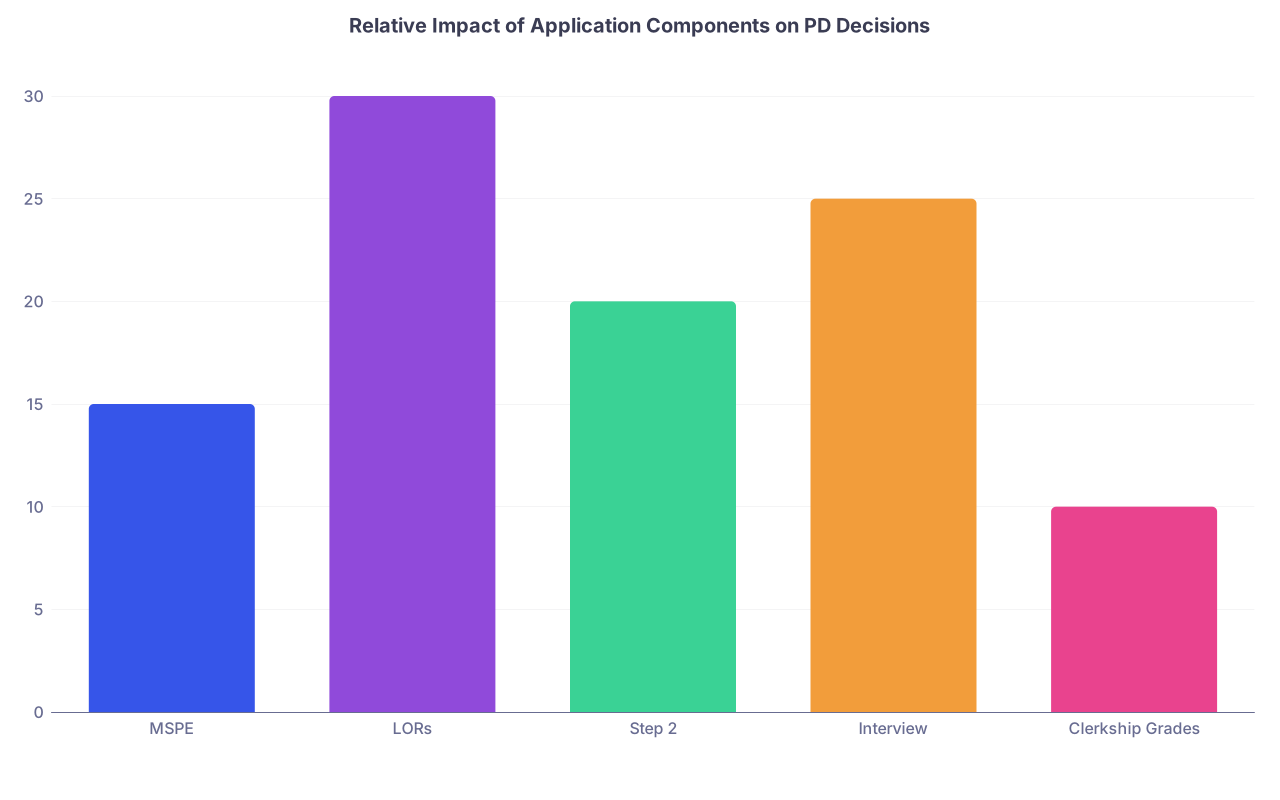
| Category | Value |
|---|---|
| MSPE | 15 |
| LORs | 30 |
| Step 2 | 20 |
| Interview | 25 |
| Clerkship Grades | 10 |
Key Takeaways
Pinpoint the problem, do not just panic.
Identify exactly how your MSPE undersells you—omissions, tone, or specific criticisms—then see if any factual corrections are still possible.Overpower a weak MSPE with the rest of your file.
Strong, specific letters; a thoughtful personal statement that shows growth; and concrete performance (sub-Is, Step 2, away rotations) can absolutely override a muted Dean’s Letter.Control the narrative in person.
Prepare calm, concise responses to any MSPE-related questions, own your growth, and never attack your school. You are there to show who you are now, not argue about a document written months ago.