
The way most applicants use Supplemental ERAS is a waste of an opportunity.
They treat it like a formality. Copy-paste vibes, vague answers, generic “I love your program” language. Then they act surprised when their application gaps sink their interview chances.
You can do better. And you do it by treating Supplemental ERAS as a surgical tool: something you use deliberately to patch weaknesses, redirect attention, and make programs see your strengths first, not your flaws.
Here is how you fix it.
Step 1: Diagnose Your Real Application Gaps
You cannot “patch” anything until you are brutally honest about what is broken.
Your application probably has one or more of these issues:
- Below-average Step 2 or COMLEX score
- No Step 1 score (pass/fail era) and not much else that screams “strong”
- Low or inconsistent clinical grades
- Late exam or late application submission
- Limited or no research in a research-heavy specialty
- Weak or generic letters of recommendation
- Red flags: LOA, remediation, professionalism concern
- Non-traditional path, gap years, career change
- Switching specialties late (rebranded application)
- IMG/DO applying to historically competitive or MD-heavy programs
Do not handwave this. I recommend a simple, ruthless exercise.
- Open your ERAS PDF and your CV.
- Pretend you are a PD with 3 minutes per application.
- Answer, very literally:
- What looks below average?
- What raises a question or concern?
- What is missing for this specialty?
- Do I look generic?
Then categorize your gaps:
| Gap Type | Primary Patch via Supplemental ERAS |
|---|---|
| Low Step 2 / COMLEX | Context + clinical strength emphasis |
| Limited research | Fit narrative + other strengths |
| Late specialty switch | Targeted program signaling + story |
| IMG/DO status | Geography + commitment + maturity |
| Red flags | Concise, direct explanation |
| Generic application | Hyper-specific interest statements |
The rest of this article is how to do that patching in each part of Supplemental ERAS.
Step 2: Understand What Supplemental ERAS Actually Does For You
The supplemental application is not magic. It does three main things:
- Program Signaling – You tell certain programs: “You are a top choice.”
- Geographic & Program Preference – You explain where and how you want to train.
- Written Responses / Experiences – You shape how they interpret your background.
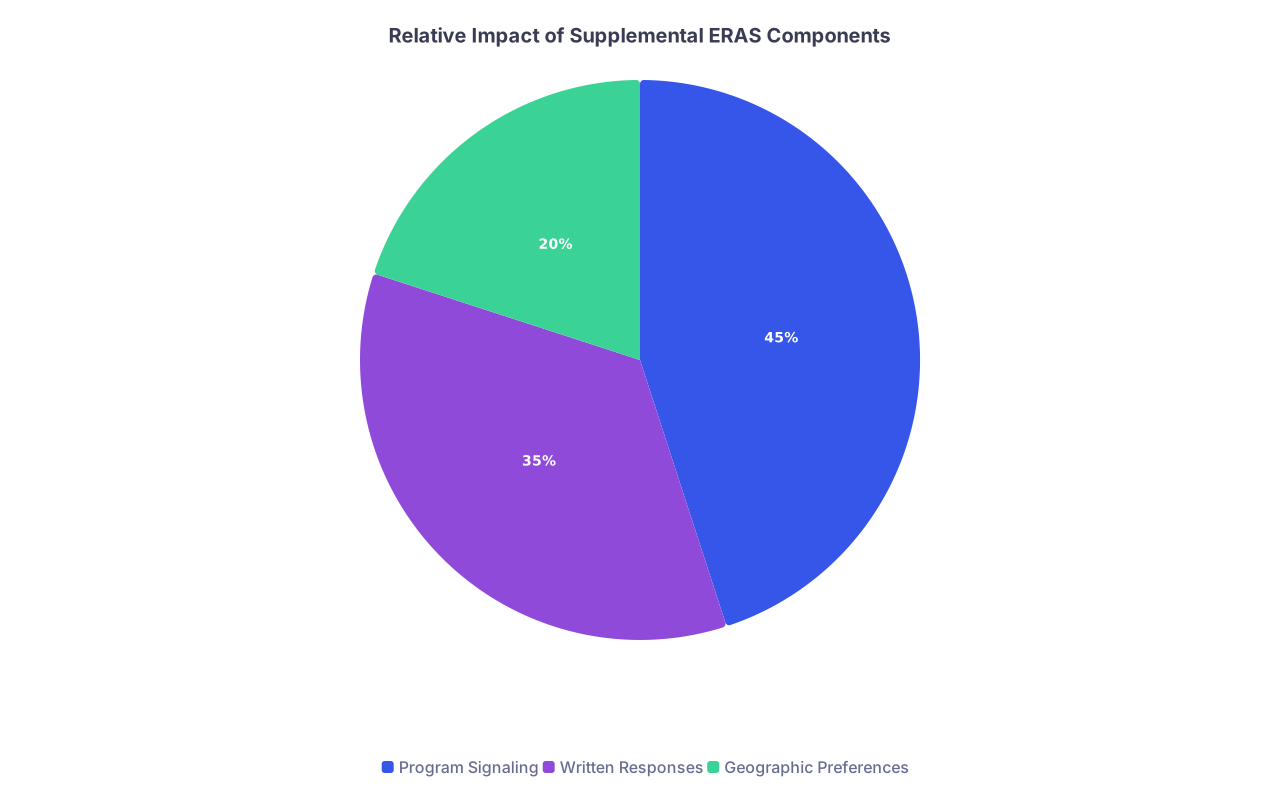
| Category | Value |
|---|---|
| Program Signaling | 45 |
| Written Responses | 35 |
| Geographic Preferences | 20 |
If you use each of those intentionally, you can:
- Pull attention away from weak metrics
- Amplify specific strengths (clinical performance, life experience, niche interests)
- Reassure programs that your “risk factors” are understood and handled
- Make yourself memorable in a sea of identical-sounding applicants
Now we get tactical.
Step 3: Use Program Signaling to Offset Weaknesses, Not Just Chase Famous Names
Most applicants misuse program signals. They treat them as lottery tickets for “dream” programs instead of tools to reliably increase interview odds at realistic targets.
If you have any gap, your signals matter even more.
3.1 How to choose where to signal
Stop thinking: “Which places would be cool?”
Start thinking: “Where does a signal actually move the needle for someone like me?”
You need three buckets:
- High-yield realistic – Programs where your stats are a bit below average but within range, and your story fits.
- Safety-but-not-guaranteed – Places that might otherwise screen you out because of DO/IMG, low Step 2, or no research.
- One or two aspirational – Only if they are actually aligned with your story (e.g., your home region, your school sends residents there, or you have a strong connection).
Avoid spraying signals at ultra-competitive brands if your profile is clearly below their usual range. That is wishful thinking, not strategy.
3.2 Patching specific gaps with signals
Low Step 2 / COMLEX
Use signals for programs that:- Care more about clinical performance than raw scores
- Are community-based or university-affiliated but not top-tier
- Have a track record with your school or DOs/IMGs
Limited research in a research-heavy specialty (derm, rad onc, ortho, etc.)
Signal:- Mid-tier academic programs with more clinically oriented reputations
- Programs known for strong teaching rather than only NIH funding
IMG / DO applicants
Signal:- Programs with multiple current DO/IMG residents
- Your home region or places you can credibly explain you will stay
Late specialty switch
Signal:- Programs with a reputation for being supportive/educational
- Programs where your prior path is an asset (e.g., switching to psych from IM with strong internal medicine exposure)
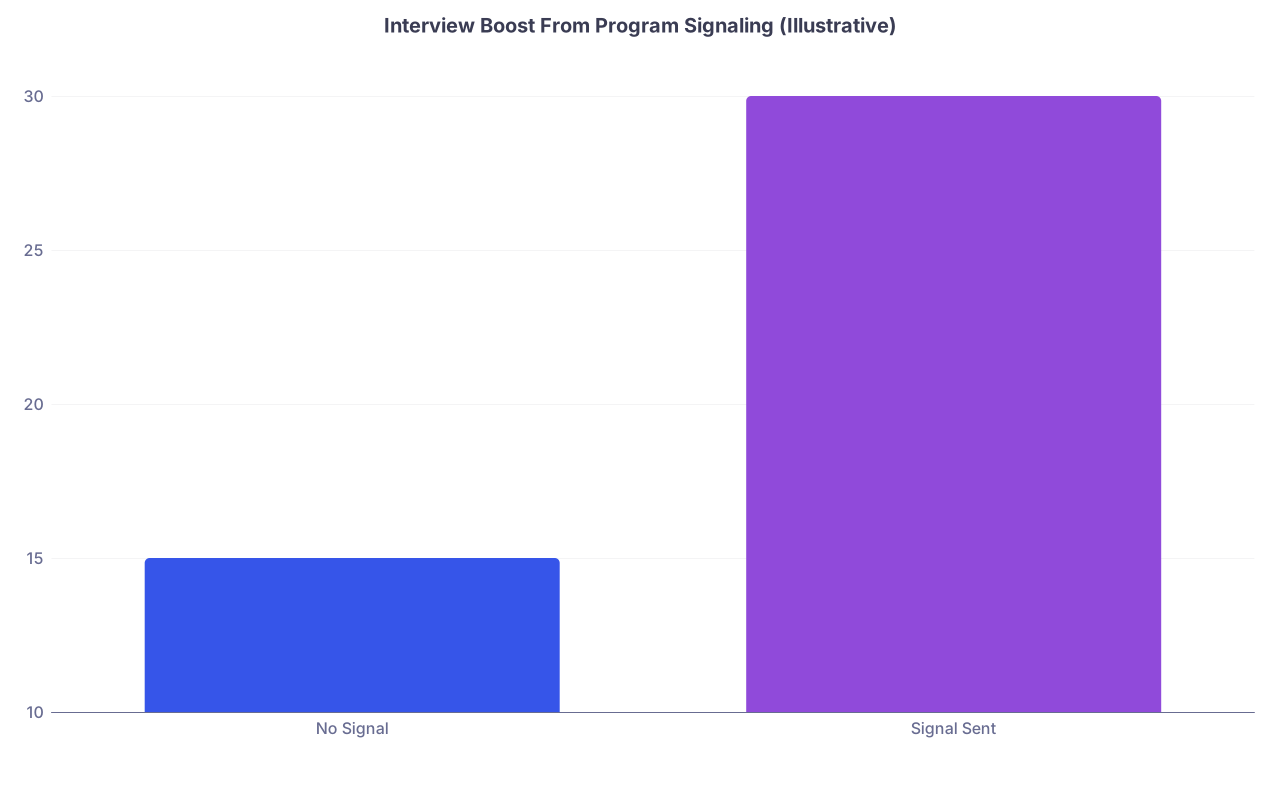
| Category | Value |
|---|---|
| No Signal | 15 |
| Signal Sent | 30 |
The numbers above are made up, but the pattern is real: for borderline applicants, signals can double your odds of being seen.
Step 4: Geographic Preferences – Quietly Fix the “Why Here?” Problem
Program directors are paranoid about one thing: wasting interview spots on people who will never rank them highly.
If your application looks geographically random, they often assume you are not serious. Supplemental ERAS is your chance to correct that.
4.1 When geography is your hidden weakness
You are at higher risk if:
- You are an IMG without clear ties to the region
- You attend med school in one part of the country but apply heavily somewhere else
- You are applying in a competitive city (NYC, Boston, LA, San Francisco, Chicago) without obvious connections
- Your CV shows you moved around constantly without a clear base
Your goal: make your geographic signal say, “I am likely to stay and rank you.”
4.2 How to choose geographic preferences strategically
You typically get to:
- Select preferred regions
- Sometimes rank or highlight most preferred locations
- Occasionally explain why
Use this to patch doubts:
- If you have a low Step 2 or red flags:
Emphasize regions where you have:- Family
- Long-term residence
- Partner’s job or school
- Prior training or undergrad
Programs are more willing to “take a chance” on someone they believe will actually stay.
- If you are switching specialties:
Pick fewer regions and double down. It makes you look serious and focused rather than “panic applying nationally.”
Step 5: Rewrite Your Experiences With a Gap-Oriented Lens
The supplemental application often asks you to highlight a few most meaningful experiences and sometimes to answer short prompts.
This is where most people fall flat. They write tiny personal statements. Flowery, vague, useless.
You are going to use those slots to steer how they interpret your entire file.
5.1 Decide your “thesis” for each gap
For each major weakness, define the one sentence you want a PD to believe after reading your supplemental responses.
Examples:
Low Step 2:
“Despite a modest test score, this applicant is clinically strong, reliable, and already functioning at intern level.”Limited research in a research-heavy specialty:
“This applicant may not be a future R01 machine, but they will be a workhorse clinician who actually loves patient care in this field.”IMG with older graduation year:
“This applicant is mature, persistent, and has used the extra time to gain real-world experience that will help them day one.”
Then you choose experiences that prove that thesis.
5.2 How to structure “most meaningful experiences”
For each meaningful experience, use a very simple structure:
- One-line context – What is this, in plain English?
- What you actually did – Concrete actions, not titles.
- What changed because you were there – Impact.
- What it says about you as a resident – Explicit connection.
Example for someone with weak test scores but strong clinical performance:
Experience: Sub-internship in General Internal Medicine
I completed a four-week sub-internship on a busy academic internal medicine service, taking near-intern-level responsibility for 6–8 patients daily.
I independently pre-rounded, wrote daily notes, placed orders under supervision, and led presentations on new admissions. I frequently stayed late to help with cross-cover, handoffs, and difficult family conversations.
My attending commented that my clinical reasoning and reliability were “at or beyond the level of our incoming interns.” That experience confirmed that while my standardized test scores are modest, I excel in real clinical environments, which is ultimately the core of residency.
See the move? You have named the gap and reframed it as “scores modest, but clinically strong,” and you did it inside a credibility-building story rather than a defensive excuse.
5.3 Align experiences with the specialty’s pain points
Every specialty has things PDs secretly worry about. Use your experiences to say: “I will not be your problem in that area.”
- EM / Surgery – Work ethic, resilience, team function, ability to handle stress.
- Psych – Communication, empathy, professionalism, complex patient dynamics.
- IM / FM – Breadth, continuity, organization, follow-through.
- Radiology / Pathology – Attention to detail, systems thinking, comfort with long focused work.
- OB/GYN – Emotional stamina, comfort with acute situations, patient advocacy.
Pick experiences that show you already live in that world, even if your metrics are not perfect.
Step 6: Short Answers and “Why This Specialty” – Patch Inconsistencies
Some supplemental forms ask:
- Why this specialty?
- What are your future career goals?
- What are your most important values in a residency?
If your application has inconsistencies (late switch, mismatched research, prior career), this is where you lock the story into place.
6.1 If you switched specialties late
Bad version:
“I realized during third year that I loved psychiatry, especially talking to patients and hearing their stories.”
Nobody believes you. Or worse, they believe you are just chasing lifestyle.
Better version:
“I entered medical school set on internal medicine and completed multiple IM electives, a sub-I, and related research. By the end of third year, I realized the moments I found most meaningful involved longitudinal relationships, complex psychosocial dynamics, and helping patients make sense of their experiences.
During my psychiatry rotation, that preference became obvious. I recognized that what I had enjoyed in internal medicine was actually the psychiatric dimension of care—motivational interviewing, navigating ambivalence, and working with multidisciplinary teams. I redirected my application to psychiatry later in the year, but the foundation I built in internal medicine continues to shape how I think about comprehensive patient care.”
You are not random. You are evolving. There is a through-line.
6.2 If your research does not match your chosen field
You do not “hide” it. You interpret it.
“Most of my research has been in cardiology, reflecting opportunities available early in medical school. That work taught me how to ask questions systematically, manage data, and work reliably in a team—all of which I bring to my current interest in anesthesiology.
As I gained more clinical exposure, I realized I was more drawn to acute physiology, procedural work, and the operating room environment. I have pursued anesthesia-specific reading, mentorship, and a dedicated sub-I to align my training path with that interest, even though my research history reflects an earlier focus.”
Again: control the narrative.
Step 7: Handling Red Flags in Supplemental ERAS Without Shooting Yourself in the Foot
Some of you have real landmines:
- LOA or repeat year
- Professionalism concerns
- Step failures
- Big gaps in training
You have two jobs:
- Briefly explain what happened.
- Make it crystal clear why it will not happen again.
No drama. No oversharing. No defensiveness.
7.1 A simple template that works
Use this 4-part structure:
- The event in one sentence
- Contributing factors (owned, not blamed)
- Concrete steps you took
- Evidence of sustained improvement
Example: Step 1 failure, later pass, and decent Step 2.
“I failed Step 1 on my first attempt in 2021. This occurred during a period when I significantly underestimated the volume of material and did not seek help early when my practice scores were low.
After failing, I worked with my school’s learning specialist to rebuild my study approach from the ground up, including structured weekly schedules, question-based learning, and formal accountability with a faculty mentor. I passed Step 1 on my second attempt and scored a 235 on Step 2.
Since then I have consistently passed all clerkships and shelf exams and have not had further academic issues. The experience forced me to confront and change ineffective habits, which has made me more disciplined and realistic about my limits.”
Direct. Specific. Shows durable change.
7.2 What will get you quietly screened out
- Long emotional backstory without a clear turning point or fix
- Blaming other people or “the system”
- Vague language (“I learned a lot from this experience”) without details
- Not mentioning it at all when it is already in your MSPE or transcript
If the red flag is obvious in your file, Supplemental ERAS is where you preempt the worst assumptions.
Step 8: Program-Specific Interests – Turning “Generic Applicant” into “We Remember This One”
Some specialties and seasons have short prompts like:
- “Why are you interested in our program?”
- “What kind of training environment are you looking for?”
Most people recycle the same fluff. You will not.
You will do targeted, minimal research and give 2–3 sharp, specific reasons that line up with your gaps and strengths.
8.1 A 10-minute research protocol per program
For each signaled or priority program, skim:
- Program website: rotations, unique tracks, resident interests
- Current residents: backgrounds, DO/IMG presence, career goals
- Any public info: trauma center status, patient population, affiliated VA, etc.
Then answer in 3–4 sentences:
- One specific feature of training you genuinely like
- How that connects to your past experiences or your gap-repair narrative
- How you see yourself contributing
Example for someone with limited research but strong clinical work, applying to a clinically heavy program:
“I am particularly interested in your program’s strong county hospital presence and the opportunity to care for a diverse, underserved population. During my third-year clerkships, I thrived in safety-net settings where resourcefulness and patient advocacy were essential.
I am looking for a residency that will push me clinically and prepare me to function independently in complex situations. Your curriculum’s emphasis on early responsibility with close attending support aligns well with the way I learn best, and I would bring a strong work ethic and team-first mentality to your services.”
That reads like someone who knows exactly why they are applying there. Not copy-paste.
Step 9: Coordinate Supplemental ERAS With Your Main ERAS and Letters
A common mistake: the personal statement, ERAS experiences, and supplemental responses sound like three different people wrote them.
You want a coherent message across all materials.
9.1 Build a simple “application message map”
Write this down on a one-page doc:
- Top 3 strengths I want programs to remember
- Top 2 weaknesses I need to neutralize
- One-sentence story of how I got to this specialty
- One-sentence description of the kind of resident I will be
Example:
Strengths:
- Very strong clinical feedback and work ethic
- Mature, prior career in another field
- Clear commitment to underserved care
Weaknesses:
- Step 2 score below average for specialty
- Late specialty switch from surgery to EM
Story: “Former teacher turned physician who realized I belong in high-acuity, team-based emergency care while working in safety-net hospitals.”
Resident description: “Reliable, low-ego, high-workload team player who shows up and gets things done.”
Now:
- Personal statement: broad narrative + story
- ERAS experiences: show your strengths in action
- Supplemental ERAS: directly patch weaknesses while reinforcing those same strengths with more precision

| Step | Description |
|---|---|
| Step 1 | Message Map |
| Step 2 | Personal Statement |
| Step 3 | ERAS Experiences |
| Step 4 | Supplemental ERAS |
| Step 5 | Letters Emphasis |
If your letters are not written yet, you can subtly nudge writers to highlight the same themes: clinical strength, reliability, growth after a setback, etc.
Step 10: A Practical Workflow to Actually Do This Right (In Limited Time)
You do not need 6 weeks to optimize Supplemental ERAS. You need focused time and a plan.
Here is a realistic approach.
10.1 3–4 day focused sprint
Day 1: Diagnose and Map
- Print or open your ERAS PDF.
- Identify your 2–3 biggest gaps.
- Draft your “message map” (strengths, weaknesses, story).
- List 10–15 target programs you are likely to signal / prioritize.
Day 2: Signals and Geography
- Choose your program signals using realistic yield thinking, not fantasy thinking.
- Set your geographic preferences and write 1–2 brief sentences (if allowed) connecting you to those regions.
- Cross-check: do chosen regions make sense with your life story?
Day 3: Experiences and Short Answers
- Select 2–3 meaningful experiences that directly support your message map and help offset your weaknesses.
- Draft each using the 4-part structure (context, actions, impact, what it shows).
- Write short answers for “Why this specialty / goals / values” that fix inconsistencies (late switch, mismatched research, etc.).
Day 4: Red Flags and Fine-Tuning
- Draft red-flag explanations using the 4-step template.
- Edit everything for:
- Specificity > vagueness
- Directness > defensive tone
- Coherence with your personal statement and ERAS
- Have one trusted person (advisor, resident, or pragmatic friend) read for clarity and tone.

Step 11: What To Absolutely Avoid in Supplemental ERAS
A few patterns I see over and over that quietly kill applications:
- Overly emotional essays about burnout, depression, or personal trauma without clear recovery and stability. You are applying for a job, not therapy.
- Trying to “spin” every weakness as a secret strength. Some weaknesses are just weaknesses. Own, fix, move on.
- Buzzword salads: “I am passionate about innovation, leadership, and lifelong learning.” Nobody remembers that.
- Copy-paste “Why our program” answers with the program name swapped. PDs can smell it immediately.
- Pretending geography or life constraints do not exist when your CV screams otherwise. You are better off stating them clearly and aligning with programs that actually fit.

Step 12: Example Before/After Transformations
Two quick comparisons to lock in what “patching” looks like.
12.1 Low Step, strong clinicals – experience description
Before:
“Internal Medicine Sub-I
I was responsible for caring for patients on the medicine service, presenting on rounds, and working with the team. I learned how to manage complex patients and enjoyed working with residents and attendings.”
Generic. Anyone could have written that.
After:
“Internal Medicine Sub-I, County Hospital
Managed 6–8 complex patients daily on a high-acuity teaching service, writing notes, placing orders under supervision, and coordinating discharge planning with case management.I routinely stayed late to help with cross-cover and handoffs, and my attending commented that I functioned at the level of our current interns. This experience reinforced that while my standardized exam scores are modest, I perform strongly in demanding clinical environments and thrive in team-based patient care.”
Now the weak scores are contextualized and partially neutralized.
12.2 Late switch – “Why this specialty”
Before (late switch to EM):
“I am interested in Emergency Medicine because I enjoy fast-paced environments and working with a variety of patients. I also value teamwork and quick thinking.”
Reads like a half-hearted cliché.
After:
“I spent the first half of medical school preparing for a career in general surgery, drawn to acute care and procedural work. During my third-year EM rotation at a safety-net hospital, I realized that what I enjoyed most was the initial resuscitation, complex decision-making with limited information, and the opportunity to care for any patient who walked in, regardless of background or insurance.
I decided to change course to Emergency Medicine later than many of my peers, but I bring with me the discipline, procedural foundation, and OR experience from surgery, along with a clear commitment to serving high-need populations. I am looking for a residency that will make full use of that background while training me to be a dependable, high-volume EM physician.”
That sounds like a deliberate shift, not flailing.

Final Takeaways
Use Supplemental ERAS as a weapon, not a formality.
Three core points:
- Name your gaps and design your supplemental responses to directly counter them—through program signaling, geographic clarity, and carefully chosen experiences.
- Be specific, direct, and consistent—your personal statement, ERAS, and supplemental app should all tell the same story about who you are and how you will function as a resident.
- Explain weaknesses briefly and concretely, then move on—show the fix and the sustained improvement, and spend most of your word count proving your strengths in real, clinical terms.
Do this, and you stop being the “borderline” applicant who quietly disappears in the pile. You become the calculated risk worth interviewing.