
You are sitting in front of your inbox. The last “We regret to inform you…” email just came in. No more pending applications. No more “on hold” status. Match Week is over, SOAP is done, and you are officially unmatched or partially matched into something you do not want.
Everybody else is posting “Matched!!!” photos in their new hospital swag. You are staring at an empty July schedule and a massive question: Now what?
Let me be blunt. You have two choices:
- Flail around for a year doing random things that “seem helpful”.
- Run a structured, ruthless, 12‑month rebuild of your residency application with a clear strategy and metrics.
You are here for option 2. Good.
This is how to use one year to rebuild your residency application so that next cycle you are not the same applicant with a different date.
Step 1: Diagnose Why You Did Not Match (First 2–3 Weeks)
Do not start fixing things before you know what broke. I see people do this constantly. They start another research project or pay for another $2,000 course without understanding the core issue.
There are 5 main levers programs judge you on:
- Academic metrics (USMLE/COMLEX, class rank, failures)
- Clinical performance (MS3/MS4 evals, rotations, letters)
- Specialty fit and commitment
- Professionalism / red flags
- Application execution (ERAS, personal statement, program list, interview skills)
You need a brutally honest audit of each.
1.1 Get external eyes on your file
Do this in the first 2–3 weeks after you realize you are reapplying.
Who to ask:
- Your home program director or APD in the specialty (if you have one)
- A trusted faculty advisor who actually participates in selection
- A former chief resident in your desired specialty
- If IMG / no home program: a structured advising service or faculty in a related field
Send them:
- Your full ERAS from last cycle
- Personal statement
- CV
- List of programs you applied to
- Your interview count and where
Then ask specific questions, not “What did I do wrong?”:
- “Based on this file, would you interview me for your program? Why or why not?”
- “If I were your advisee, what top 3 things would you tell me must change in 12 months to be interview‑ready?”
- “Does my program list make sense for my profile? Where was I unrealistic? Where was I too conservative?”
Write their answers down in a document. If they are vague, push: “I need you to be direct. Pretend I am not going to be offended.”
1.2 Self‑audit using actual numbers
You also need your own cold analysis.
Create four sections in a document:
- Metrics
- Clinical / Letters
- Specialty Fit
- Application Execution
Under each, write what is objectively true. No stories. No excuses.
Examples:
Metrics:
- Step 1: Pass on second attempt
- Step 2 CK: 223, no retake
- COMLEX 1: 470
- No AOA, middle‑third class rank
Clinical / Letters:
- 2 letters from non‑specialty faculty
- 1 form letter from community attending
- No home department letter
- No specialty‑specific sub‑I at an academic program
Specialty Fit:
- 1 case report in specialty
- No specialty interest group leadership
- No longitudinal specialty mentor
- Only 1 elective rotation in that field
Application Execution:
- Applied to 35 programs in a competitive specialty as an average IMG
- Personal statement generic, no clear story
- Submitted ERAS mid‑October
- 2 interviews, both at low‑to‑mid tier community programs
You should end this with 2–4 primary reasons why you did not match. Not 12. Not “everything.” The big ones.
For example:
- Weak Step 2 CK + late application + too few programs.
- No strong letters in specialty + no home program support.
- Switching specialties this cycle with no real track record in the new field.
- Major professionalism flag (leave of absence, remediation) not adequately explained.
That list becomes your blueprint.
Step 2: Choose a Strategy, Not Just “Try Again Harder”
Now decide what you are actually doing next cycle. Reapplying is not automatically the right move.
There are four main paths:
- Reapply same specialty, stronger application
- Switch to a less competitive specialty
- Transition to a categorical prelim / transitional year to re‑enter later
- Step off clinical path (research degree, industry, non‑clinical)
You are reading this because you want option 1 or 2. Let us make that explicit and rational.
2.1 Reality check: are you still competitive in your target specialty?
Use this table as a sanity check. These are generalized patterns, not rules, but they are painfully similar to how PDs think.
| Specialty Tier | Typical Metrics | Realistic Reapplication If... |
|---|---|---|
| Ultra-competitive (Derm, Ortho, Plastics, ENT, Ortho, Neurosurg) | Top exam scores, strong research, home support, honors | Only if you had interviews and narrowly missed matching, and you can significantly improve letters/research/support |
| Competitive (EM, Anes, Rad, Gen Surg, Psych at big-name places) | Solid scores, strong clinicals, some research, solid letters | Reasonable if you shore up weaker areas and broaden list, especially to community and mid-tier |
| Moderate (IM, Peds, FM, Psych at community) | Passing scores, decent clinicals, OK letters | Very realistic to improve with a focused year and better strategy |
| Safety nets (Prelim/TY, less desirable locations) | Passing scores, no major red flags | Very realistic provided you fix major professionalism or timing issues |
If you had:
- No interviews
- Multiple exam failures
- No realistic route to stronger letters or metrics
…for an ultra‑competitive specialty, you are not “one stronger year” away. You are in “switch or accept a very long, painful road” territory.
Be honest: you are not trying to impress me. You are trying to avoid wasting 3–5 years.
2.2 Decide specialty and level of competitiveness
Answer these in writing:
- Am I willing to switch to a less competitive specialty to get into residency faster?
- If yes, what are the top 2 alternative specialties that fit my skills and story?
- If no, what concrete improvements can I make in 12 months that a PD would actually care about?
Do not leave this vague. You should end this week with:
- Primary target specialty
- Backup specialty (or prelim year strategy)
- A rough list: “I will aim for community‑heavy / mid‑tier programs in X regions.”
You can adjust later, but you need a working target.
Step 3: Build a 12‑Month Rebuild Plan (Not a Vibe)
You have 1 cycle. That is roughly 12 months if you start right after Match Week. You need a timeline, not just tasks.
Let us break the year into phases.
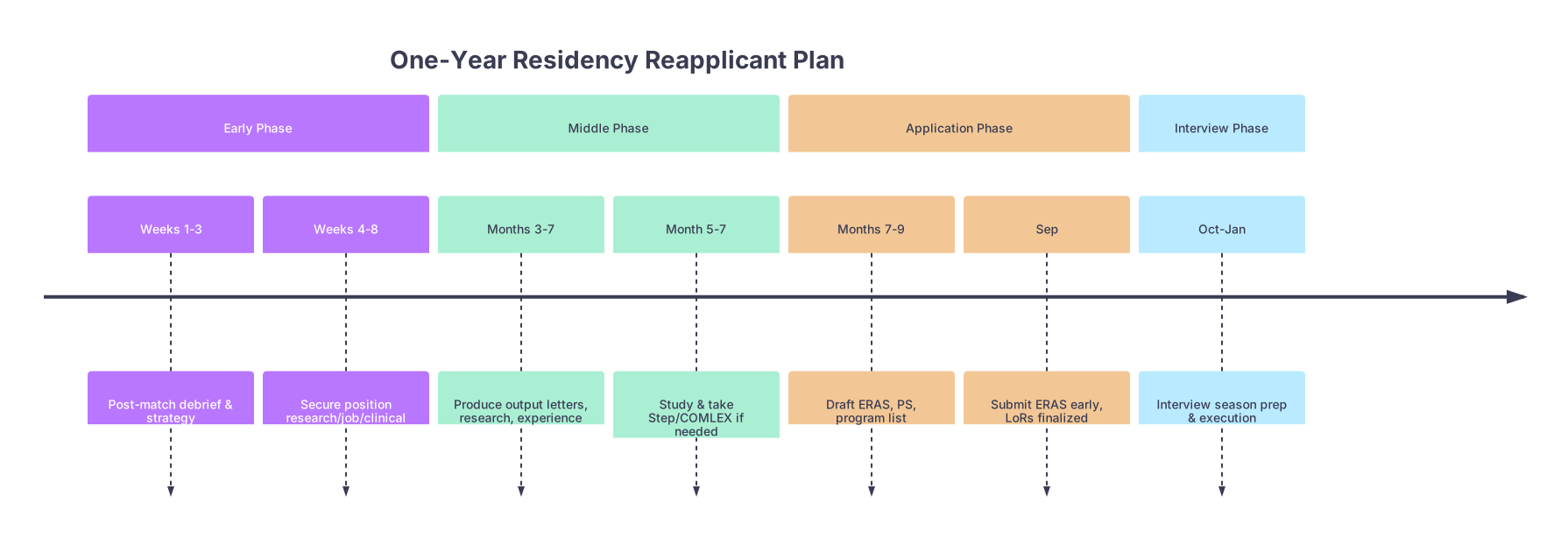
| Period | Event |
|---|---|
| Early Phase - Weeks 1-3 | Post-match debrief & strategy |
| Early Phase - Weeks 4-8 | Secure position research/job/clinical |
| Middle Phase - Months 3-7 | Produce output letters, research, experience |
| Middle Phase - Month 5-7 | Study & take Step/COMLEX if needed |
| Application Phase - Months 7-9 | Draft ERAS, PS, program list |
| Application Phase - Sep | Submit ERAS early, LoRs finalized |
| Interview Phase - Oct-Jan | Interview season prep & execution |
Now, fill this timeline with the right kind of work.
Step 4: Secure the Right Position for Your Gap Year
Your gap year job is not just “to keep busy.” It is your primary engine to:
- Generate strong letters
- Demonstrate commitment to a specialty
- Fix narrative problems (like “Why were you not doing anything clinical?”)
- Potentially produce research or teach
Put simply: your next job should be designed to create the exact things your application was missing.
4.1 Best options by goal
Here is how I rank typical options.
| Role | Best For | Relative Impact |
|---|---|---|
| Research fellow in specialty dept | Academic specialties, letter from PI, publications | High (especially at academic centers) |
| Clinical research coordinator in target field | Showing clinical + research engagement | Moderate–High |
| Full-time clinical job (hospitalist scribe, APP assistant, clinical associate) | Demonstrating clinical work, US experience (for IMGs) | Moderate |
| Prelim/TY year (if obtained via SOAP) | Keeping clinical trajectory, strong PD letter | Very High |
| Non-clinical industry/lab work unrelated to medicine | Income but weak application value | Low |
If you can:
- Get a research or clinical position inside the department of your target specialty. That is gold. I have seen this singlehandedly rescue otherwise mediocre applications, especially with a supportive PD.
If you cannot:
- Get any hospital‑based role that gives you access to attendings in your specialty for shadowing, QI, and letters.
4.2 How to get one of these roles quickly
Stop sending blind CVs into hospital HR portals. That is how you wait 4 months to hear “position closed.”
Do this instead in the first 4–8 weeks:
List every hospital and academic center within a radius you can realistically move to.
For each, identify:
- Department administrator for your specialty
- Program coordinator for the residency
- Researchers (via PubMed or department website)
Send a very short email (not an essay):
- Who you are
- That you are a reapplicant in their specialty
- Exactly what you want: “research fellow”, “observer”, “volunteer on QI projects”, “graduated MD seeking full-time research/clinical work with the department”
Offer value:
- “I can commit 1 year full‑time.”
- “I have prior data/statistical experience in X.”
- “I am comfortable with patient interaction / chart review / REDCap / IRB submissions.”
Attach:
- 1‑page CV
- USMLE/COMLEX transcript
- 2–3 line summary of your unmatched status (optional, but honest: “Graduated in 2024, applied to IM; unmatched, now spending a full year to strengthen my application.”)
Aim for volume: 50+ targeted, personal emails across institutions is normal. You are not bothering them. You are looking for the one person who needs a hungry, available graduate.
Step 5: Fix the Big Deficits One by One
Your audit from Step 1 should have identified your top 2–4 problems. Now you attack each with a concrete plan.
5.1 If your exam scores are the main problem
You cannot magically erase a 205 Step 2 CK. But you can:
- Crush Step 3 (if allowed by your context), or
- Retake COMLEX if timing and rules permit, or
- Build such a solid clinical and letter profile that your low score is a concern but not a deal‑breaker.
If you are eligible to take Step 3:
- Timeline it: start focused prep around Month 3–4, take by Month 5–7 so score is back before ERAS.
- Use a structured plan:
- 1–2 Qbanks (UWorld + one more)
- Daily questions with strict review
- Weekend blocks simulating exam timing
Programs like seeing Step 3 done, especially for IMGs and reapplicants. It telegraphs: “You are less of a risk to fail later.”
If retaking is not an option:
- Then your strategy is: emphasize reliability and performance in real clinical environments: strong sub‑I evaluations, research productivity, and a PD letter that explicitly says “Do not worry about the score. They function at resident level.”
5.2 If your letters of recommendation were weak or generic
This is fixable. But it requires deliberate work and time.
In your new role (research fellow, clinical associate, scribe, etc.):
- Identify 2–3 potential letter writers early:
- One should be in your target specialty
- One ideally a PD or APD (even if not in your specialty)
- One from your direct supervisor where you work
For each letter writer, over 4–6 months you want to:
- Show up consistently, on time, prepared
- Take on unglamorous tasks and do them well
- Ask for feedback and implement it without ego
- Gradually increase responsibility (lead a QI project, help write an abstract, coordinate a clinic project)
Then, when it is time to ask for a letter (around June–July):
Ask like this, in person if possible:
“Dr. X, I am reapplying to residency in [specialty] this year. I respect your opinion a lot. Do you feel you know my work well enough to write a strong, supportive letter on my behalf?”
You want them to either say yes confidently or to hesitate (in which case, do not use them). “Strong” is the keyword. Do not skip it.
5.3 If you looked like a poor specialty fit
This is common for switchers and late converts.
You fix “specialty commitment” with:
Consistent involvement:
- Attend department conferences regularly
- Join specialty society memberships
- Present a poster at a regional or national meeting in that field
Concrete output:
- One or more case reports, reviews, or QI projects in the specialty
- Help with chart reviews or retrospective studies for attendings in that field
Mentorship:
- Monthly or bimonthly check‑ins with a faculty mentor in the specialty who knows you and can vouch for your long-term interest
You are building a story that sounds like:
“I committed to [specialty] a bit later, but in the last year I have done A, B, C, and D in this field. Here are my concrete contributions. Here are my mentors.”
Not:
“I just realized I like this specialty and I am applying because it seems interesting.”
5.4 If your application execution was bad
This part annoys me because it is preventable:
- You applied too late (after October 1)
- You applied too narrowly (25 dreamy programs, no safeties)
- Your personal statement and experiences read like generic sludge
- Your CV had gaps or poorly explained issues
- Your interviews were awkward or defensive
Here is how you fix that.
5.4.1 Timing and volume
Non-negotiables this time:
- ERAS submitted on or immediately after opening day (late September, exact date varies by year)
- Letters finalized by that date (or very soon after)
- Program list:
- Primary specialty: often 70–120 programs depending on competitiveness and your risk profile
- IMGs / low scores: 120+ is not crazy in some fields, with a heavy emphasis on community and IMG‑friendly programs
You tailor this based on your stats and budget, but you must not under‑apply again out of pride or poor guidance.
5.4.2 Personal statement and experiences
No generic “ever since I was little” nonsense. PDs skim PS for:
- Clear reason you chose this specialty
- Evidence you understand the work
- Signs you are not a future professionalism nightmare
- A coherent explanation of red flags if needed
Draft process:
- Version 1: Brain dump your real story, including why you did not match and what you did this year.
- Version 2: Strip out self‑pity and over‑sharing. Keep concrete actions and growth.
- Version 3: Have 1–2 people who read applications (not just friends) review it. Listen when they say something sounds defensive or confusing.
For experiences:
- Focus bullets on impact, not tasks:
- Bad: “Assisted with data collection for QI project.”
- Better: “Led data collection and analysis for QI project that reduced ED wait times for psych patients by 18% over 6 months.”
You are not just showing that you were busy. You are showing that you move needles.
5.4.3 Interview skills
If you had interviews but no match, this might be your main problem.
Fix:
- Do at least 5–10 mock interviews with:
- Faculty
- Senior residents
- Advisors or paid coaches if needed
Focus on:
- Clean, non‑rambling answers to:
- “Tell me about yourself.”
- “Why this specialty?”
- “Tell me about a time you failed.”
- “Why did you not match last year?” (Yes, this will come up.)
For the “unmatched” question, your answer should sound like:
“Last year, my application had two major weaknesses: [X and Y]. I took a step back, got clear feedback from mentors, and I spent the year doing [concrete actions] to address them. As a result, I now have [specific improvements – stronger letters, research, clinical experience, Step 3], and I feel much better prepared to start residency.”
Short, accountable, no excuses.
Step 6: Control the Narrative as a Reapplicant
Being a reapplicant is not fatal. But leaving it unexplained is.
You need a consistent narrative across:
- Personal statement
- ERAS experiences
- Interview answers
- Letters (ideally)
The core elements:
Ownership
- You acknowledge that you did not match without blaming “the system” or “bad luck” for everything.
Insight
- You show that you understood the specific weaknesses of your prior application.
Action
- You describe concrete steps you took to address those weaknesses.
Trajectory
- You demonstrate that your year was not just damage control, but actual growth into someone more prepared for residency.
What you do not do:
- Overconfess every insecurity.
- Blame your school, advisors, or one bad attending eval.
- Sound bitter about others matching with “worse stats.”
Programs are reading between the lines: “When this person hits stress as a resident, do they melt down and blame everyone, or do they regroup and improve?”
Your reapplicant year is your chance to demonstrate the latter.
Step 7: Program List and Targeting – Stop Playing Fantasy Football
People sabotage themselves right here. They apply like fans, not like strategists.
You need three tiers of programs:
- Tier 1 (Reach) – dream programs where you are a bit below their usual metrics but not ridiculous.
- Tier 2 (Realistic) – where your stats are at or slightly below their average, but your year of growth + letters could push you in.
- Tier 3 (Safety/IMG‑friendly/community) – programs known to take people from your school/profile or with lower scores.
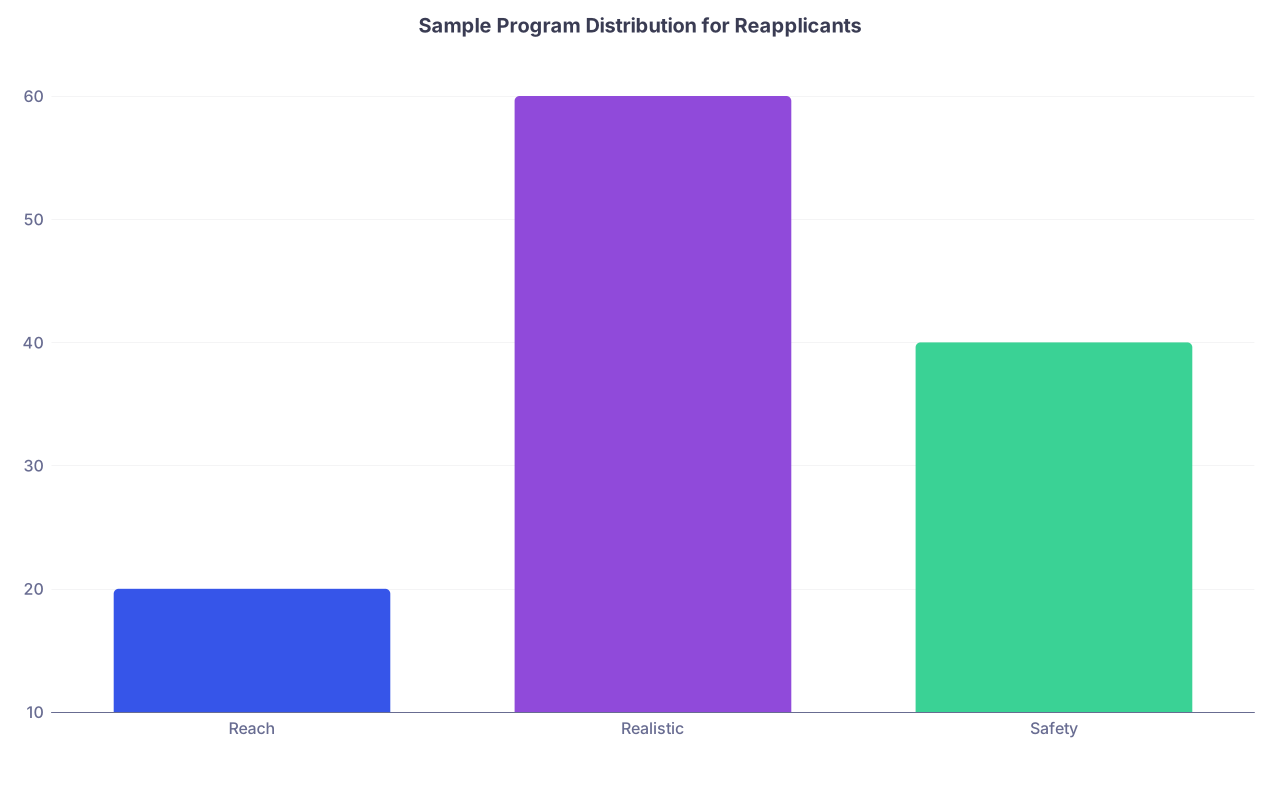
| Category | Value |
|---|---|
| Reach | 20 |
| Realistic | 60 |
| Safety | 40 |
Rough structure for many reapplicants (adjust by specialty):
- 15–25 Reach
- 40–70 Realistic
- 30–50 Safety / IMG‑friendly
Target based on:
- Historical interview invites to your school or similar profiles
- NRMP Charting Outcomes data (for US grads)
- Word‑of‑mouth from your school’s grads or IMG forums (careful, but can help)
What you should not do:
- 80% of your list in one big coastal city because you “really want to live there.”
- 40 applications total in a competitive field as a reapplicant with red flags.
You lost the luxury of being location‑picky. Once you are a board‑certified attending, you can move basically wherever you want. For now, get in the door.
Step 8: Monthly Checkpoints – Keep Yourself Honest
A year sounds long. It is not. People drift, then wake up in July with nothing concrete done.
Set up a simple monthly check‑in document with headings like:
- Clinical / job performance
- Letters progress
- Research / QI outputs
- Exam prep (if applicable)
- Networking and mentorship
- Application documents
Each month, answer:
- What did I actually complete this month?
- What is scheduled for next month?
- Am I on track for:
- 2–3 strong letters by July
- At least 1–2 concrete CV additions (paper, abstract, poster, QI)
- Clean explanation of gaps and red flags
If you are consistently “planning” but not finishing things, fix that now. PDs care about completed projects and sustained work, not 10 half‑started data sets.
Step 9: Handle Money, Visas, and Practical Realities
This part is not glamorous, but it will quietly wreck everything if you ignore it.
Finances:
- Budget for ERAS fees, NRMP, exam fees, travel (if in‑person interviews return), rent.
- If your gap job pays poorly, take something else in parallel that keeps you solvent. Programs do not care if you DoorDash on weekends.
Visas (for IMGs):
- Make sure your US visa status will cover the entire gap year and leave flexibility for residency start.
- Know which programs sponsor which visas (J‑1 vs H‑1B) and adjust your list accordingly.
Licensure / Certifications:
- If you can get limited licensure, an externship license, or any certification (BLS/ACLS renewal, etc.), get it done early.
Logistics derail more reapplications than people admit.
Step 10: One Clear Action to Take Today
You do not fix an unmatched year by reading another long guide and then going back to scrolling.
Do this today, before you close this window:
Open a blank document. Title it: “Reapplication 12‑Month Plan.”
Create these sections:
- Why I did not match (top 3 reasons)
- Target specialty + backup plan
- Gap year goal (job/position target)
- Big 4 fixes (exam, letters, specialty fit, application execution)
- Monthly checkpoints (March–September or whatever months apply to you)
Spend 30–45 minutes filling it with your best current thinking. It will not be perfect. That is fine.
By the end of an hour, you will have a rough but real plan instead of a vague nightmare.
Then tomorrow, send at least 5 targeted emails to departments or potential mentors about a gap‑year role. Not 1. Not “sometime later.” Five.
You have one year. Use it like it matters. Because it does.