The worst thing you can do after a bad residency interview is nothing.
Most applicants freeze. They stew. They replay answers in the shower and complain in group chats. And they lose any chance to drag that interview from “red flag” to “neutral.” That is a fixable mistake.
You are not going to magically turn a disastrous interview into an automatic rank-to-match. But you can absolutely move yourself from the “probably not” pile into the “eh, fine” pile. And for competitive specialties or smaller programs, that shift can be the difference between matching and scrambling.
Here is your post-visit action plan—step-by-step, no fluff—to salvage a bad interview as much as reality allows.
Step 1: Diagnose What Actually Went Wrong (Same Day)
You cannot fix what you refuse to define. “It just felt bad” is not a diagnosis. It is an emotional summary.
You need a cold, clinical debrief. Within 2–4 hours of the interview, not next week.
A. Do a 15-Minute Brain Dump
Sit down somewhere quiet: hotel desk, airport gate, your car. Set a timer for 15 minutes and write everything you can remember:
- Questions you stumbled on
- Any awkward moments (bad joke, poor answer, weird silence)
- Times you contradicted yourself or gave confusing answers
- Questions you wish you had answered differently
- Any concerning reactions from interviewers (raised eyebrow, long pause, “hmm…”)
- Technical issues or external problems (Zoom froze, audio echo, late arrival, background noise)
Do not edit. Do not sugarcoat. This is for you.
I have seen people misremember interviews 48 hours later as “probably fine” because they do not want to think about it. That is how you miss your chance to fix it.
B. Sort Problems Into 3 Buckets
Now go through that brain dump and categorize:
Content Problems – what you actually said
- Inconsistent story (“I’m undecided on academic vs community” after saying “100% I want an academic career”)
- Weak or vague answers (“I like helping people” as your reason for the specialty)
- Missing key details (no concrete example of teamwork, no specific cases, etc.)
- Incorrect info (misstating research, dates, test scores, or program facts)
Behavior / Professionalism Problems – how you came across
- Came off as arrogant or defensive
- Spoke negatively about another program or institution
- Poor eye contact, distracted, checking phone
- Interrupting interviewers or rambling without stopping
Logistical / Technical Problems
- Late arrival
- Tech issues on virtual platform
- Dress code off (under- or overdressed compared to expectations)
- Sound/lighting issues for virtual
You handle each bucket differently. A clumsy answer about research is fixable. Being 15 minutes late without communication is harder. Calling another program “toxic” on camera is much worse.
Step 2: Decide If This Interview Is Salvageable
Not every disaster is fixable. Some are. Some are not. You need to be brutally honest.
Here is a rough classification to keep you sane:
| Scenario Type | Example | Salvage Potential |
|---|---|---|
| Mildly Awkward | One weak answer, small tech glitch | High |
| Moderately Concerning | Several shaky answers, low energy, nervous | Medium |
| Red-Flag Content | Dishonesty, bad-mouthing colleagues | Low |
| Major Professionalism | Very late, disrespectful, clearly unprepared | Very Low |
Be candid with yourself:
- If the interview was “mildly awkward” – you absolutely can push this to neutral or even slightly positive
- If it was “moderately concerning” – your goal now is to remove doubts and avoid being ranked at the bottom
- If it involved a true red flag (unprofessional behavior, dishonesty, obvious lack of interest) – your efforts may only barely move the needle, but you still execute a clean follow-up to prevent further damage
The point: you are deciding how hard to lean into repair, not whether to try at all. There is almost always some damage control you can do.
Step 3: Craft a Targeted, Professional Follow-Up Email
This is where most applicants mess up. They either:
- Do nothing
- Or send a long, anxious, over-explaining email that screams insecurity
You are going to do neither.
Your goal with a follow-up is simple:
Clarify 1–2 specific issues, demonstrate maturity and insight, and leave a cleaner impression in their inbox than you left in the room.
A. Who to Email
- Always send a brief thank-you email to your primary contact:
- Program coordinator or
- Program director (PD) if they explicitly invited direct follow-up
- If you had a particularly rough interaction with one interviewer but the rest were fine, you may send that interviewer a short, tailored note in addition to the main thank-you. Only if it makes sense.
Do not spam every interviewer with multi-paragraph essays.
B. Timing
- Ideal window: 12–36 hours after the interview
- Too soon (within 1–2 hours) looks impulsive and emotional
- Too late (>3–4 days) and they have already formed their impression and moved on
C. Structure of a Repair Email
You will keep it tight. Think 150–250 words. No rambling.
Basic structure:
- Thank them for the interview and their time
- Reference one or two specific elements of the day (shows you were engaged)
- Brief, concise clarification/correction of the problematic moment
- Reaffirm genuine interest in the program
- Close professionally
Here is a template you can adapt.
Example 1: Fixing a Bad or Incomplete Answer
Subject: Thank you for the interview – [Your Name]
Dear Dr. [Last Name],
Thank you for the opportunity to interview with [Program Name] yesterday and to learn more about your residents’ experiences on the [specific rotation / feature]. I appreciated your candor about the program’s strengths and areas of active growth.
On reflection, I realized that my answer to your question about handling conflict on the team was not as clear as I would have liked. A more accurate example is from my MICU rotation, when a miscommunication about cross-coverage led to a delayed order. I initiated a brief huddle with the resident and nurse, clarified expectations moving forward, and followed up the next day to ensure the plan was working. That experience reinforced my habit of closing the loop and confirming shared understanding in tense situations.
I remain very interested in [Program Name], particularly because of [specific feature: e.g., your structured coaching for interns and strong critical care exposure]. Thank you again for your time and consideration.
Sincerely,
[Your Full Name]
[AAMC ID or ERAS ID if desired]
Notice what it does not do:
- It does not apologize excessively (“I was so nervous, I’m usually better, please believe me”).
- It does not rewrite your entire personality.
- It fixes one concrete thing and adds a better example.
Example 2: Repairing Perceived Lack of Interest
Subject: Thank you for the interview – [Your Name]
Dear Dr. [Last Name],
Thank you for speaking with me during my interview day at [Program Name]. I especially enjoyed hearing about how your residents are involved in [specific project / QI initiative / curriculum].
I wanted to clarify one point from our conversation. When we discussed geographic preferences, I worry that I may have sounded less enthusiastic about training in [City]. In fact, [City] is one of my top preferred locations because [brief personal or professional reason], and I would be very excited to complete my residency at [Institution].
I appreciate the time you and the team invested in the interview day and remain genuinely interested in your program.
Sincerely,
[Your Name]
Short. Precise. Firm.
Step 4: Handle Serious Issues Directly but Calmly
Some situations require more deliberate repair. For example:
- You arrived late to the interview
- You had obvious technology problems
- You mistakenly misrepresented a detail (dates, number of publications, etc.)
You do not ignore those. You also do not write a guilt-soaked manifesto.
A. Late Arrival
If you were significantly late (10+ minutes) and it was your fault:
- Acknowledge it briefly
- Own it without excuses
- Demonstrate that it is not your typical pattern
Example:
“I also want to acknowledge that I arrived late to our Zoom meeting. I understand that this was disruptive to the day’s schedule. This is not reflective of my usual punctuality; I have since adjusted my calendar alert settings to prevent similar issues. I appreciate your understanding.”
You are not begging for forgiveness. You are signaling responsibility and course correction.
B. Tech Issues on Virtual Interviews
If your Wi-Fi dropped, audio lagged, or video froze:
“I apologize for the technical issues during our interview. I have since arranged a wired connection and alternate backup location for future interviews to avoid similar disruptions.”
That is it. Brief, concrete, solved.
C. Factual Error or Misstatement
This one matters. If you realize you misstated something factual—your role in a paper, number of pubs, duty hours, a statistic—correct it.
“I also wanted to correct one point. I mentioned that I was first author on two manuscripts; in fact, I am currently first author on one published manuscript and co-author on a second under review. I apologize for the confusion.”
Do not hope they did not notice. If they catch it later in your file, it looks like dishonesty. If you correct it yourself, it looks like integrity.
Step 5: Stop Bleeding: Fix What Caused the Bad Interview
You are not just triaging this one program. You are preventing the same mess from repeating itself at the next five interviews.
Here is where you get systematic.
A. Rehearse the Weak Spots You Exposed
From your debrief, identify the 3–5 questions you botched. Common culprits:
- “Tell me about yourself.”
- “Why this specialty?”
- “Why our program?”
- “Tell me about a time you had a conflict on the team.”
- “What is a weakness of yours?”
- “Explain this red flag in your application (low score, LOA, failed course).”
For each one:
- Write out a structured answer (bullet points, not full script).
- Include:
- Clear intro
- Concrete example(s)
- A reflection / what you learned / what changed
- Practice out loud 5–10 times. Not in your head. Actual spoken words.
Recording yourself on your phone helps. Cringe at it. Then fix it.
B. Get a Brutally Honest Mock Interview
Ask someone who will not sugarcoat:
- Senior resident in your specialty
- Faculty advisor
- Career office staff who have seen thousands of interviews
- Even a blunt co-applicant is better than no one
Give them your debrief and say explicitly:
“I had an interview where I came across as [too nervous / unfocused / low energy]. I want you to watch for that and interrupt me if you see it.”
Then listen when they do.

| Step | Description |
|---|---|
| Step 1 | Bad Interview |
| Step 2 | Same-Day Debrief |
| Step 3 | Classify Issues |
| Step 4 | Decide Salvage Level |
| Step 5 | Draft Targeted Email |
| Step 6 | Send within 12-36 hours |
| Step 7 | Fix Root Causes |
| Step 8 | Implement for Next Interviews |
Step 6: Use Thank-You and Signaling Strategically, Not Desperately
Some applicants think a long, emotional “you are my dream program” email will magically erase an awkward interview.
It will not. And in some specialties and institutions, that kind of email is quietly mocked.
You are playing for neutrality, not obsession.
A. Your Baseline Thank-You Formula
For most programs, you want something like this:
- 3–6 sentences
- Specific reference to the program (conference, culture, rotation, hospital system)
- One sentence that shows alignment with your goals
- Professional closing
Example:
“Speaking with you and the residents reinforced my sense that [Program] would be a strong fit for my interests in [X]. I was particularly impressed by [Y].”
This is enough. Stop there.
B. When (and How) to Signal Interest After a Rough Interview
If a program is genuinely among your top choices and the interview was mediocre, you may want to send a simple follow-up later in the season (December–January) reaffirming interest.
Keep it short:
“I remain very interested in [Program Name] and would be excited to train there, particularly given the [specific features]. Thank you again for the opportunity to interview.”
Do not:
- Re-litigate the bad answers
- Apologize again for old issues you already addressed
- Overpromise (“I will rank you #1” unless your specialty and region norms clearly support this and you mean it)
You want them thinking, “Solid candidate. Normal. Reasonable.” That is a win.
Step 7: Adjust Your Rank List Based on Reality, Not Ego
Sometimes a bad interview is a clue about fit, not just performance.
If:
- Multiple interviewers seemed disengaged
- You felt talked down to or dismissed
- The vibe was consistently off with residents and faculty
…then it may not just be that you performed poorly. It may be that you would not be happy there.
Your job now:
- Separate “I personally underperformed” from “this culture is not for me.”
- Use your notes from:
- Resident noon session
- Q&A with PD and APDs
- Informal social events
- Decide if this is a place you genuinely want on your list or you are only clinging to it from anxiety.
There is no heroism in ranking a program high where you felt miserable just to prove you can “overcome” a bad day. Residency is too long for ego-driven decisions.
Step 8: Stabilize Your Headspace Before the Next Interview
Here is what happens if you do not: you drag your bad-interview anxiety into the next one, overcorrect, and create a new set of problems.
You must reset.
A. Do a 30-Minute Postmortem, Then Put a Hard Stop
Give yourself:
- 30–45 minutes to debrief, write your repair email, and adjust your prep
- After that, no more replaying the day in full detail
If you catch yourself looping thoughts like:
- “They hated me”
- “I blew my entire season”
…you cut it off: “I executed my repair plan. That is all I control. Next.”
Not fluffy self-help. This is performance hygiene. Like washing your hands between cases.
B. Build a 10-Minute Pre-Interview Reset Ritual
Before the next interview:
- 3–4 deep, slow breaths
- Review 3 bullet points:
- Why this specialty
- Why this program
- One memorable patient story
- Remind yourself: “I have already answered these questions badly once. I know exactly how to answer them better now.”
You are not erasing the bad interview. You are weaponizing it.
Quick Reality Check: What This Plan Can and Cannot Do
Let me be blunt.
This post-visit action plan can:
- Turn a slightly negative impression into a neutral one
- Turn a neutral impression into a somewhat positive one
- Remove doubts about your honesty or insight
- Stop a minor glitch from ballooning into a perceived pattern
It cannot:
- Completely erase a core mismatch in values or communication style
- Reverse a true professionalism red flag in a single email
- Compensate for a chronically weak application in a hyper-competitive specialty
But the residency match is messy. Humans are inconsistent. Small nudges matter.
If your follow-up note moves you from “bottom 5” to “middle of the list,” that is a major victory. Neutral is powerful.
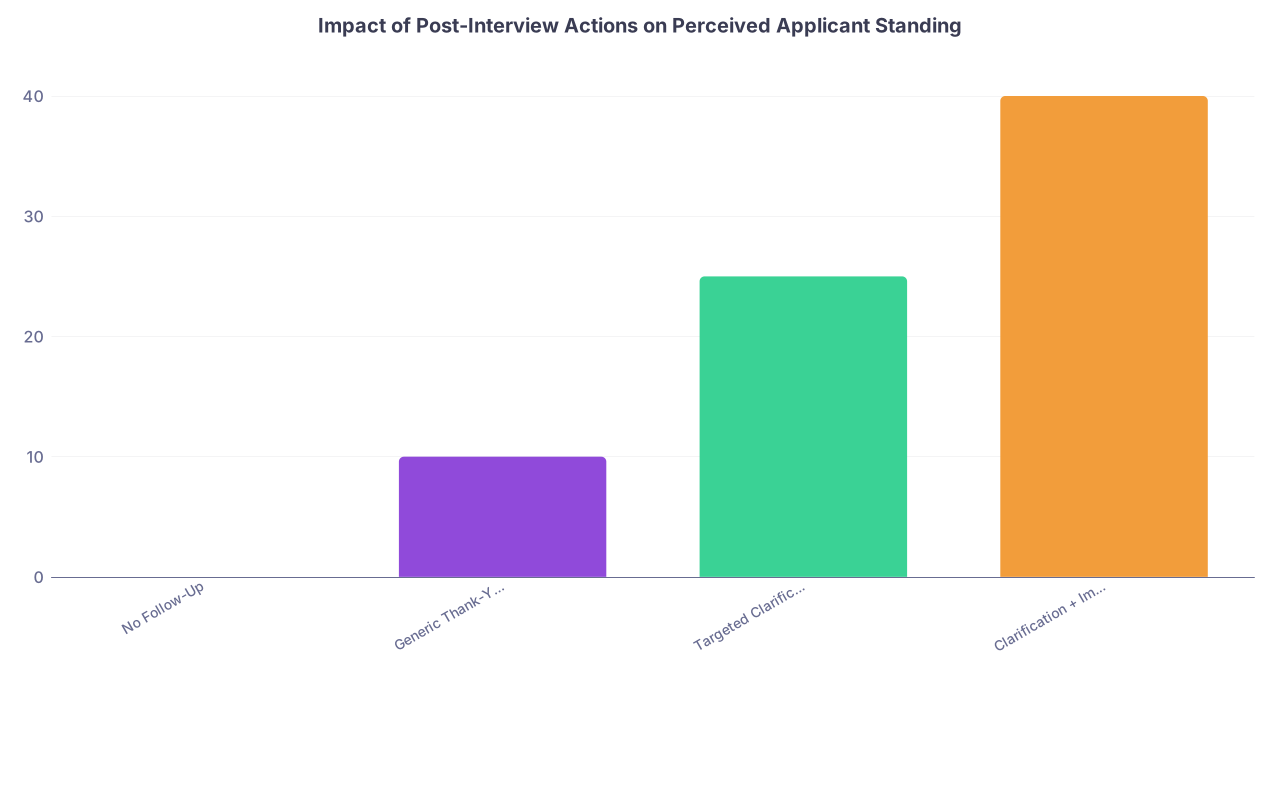
| Category | Value |
|---|---|
| No Follow-Up | 0 |
| Generic Thank-You | 10 |
| Targeted Clarification | 25 |
| Clarification + Improved Next Interviews | 40 |
(Interpret as relative influence, not exact percentages. You get the point.)
Common Scenarios and How to Handle Them Fast
Scenario 1: You Got Emotional or Teared Up
Do not panic. It happens more than programs admit.
If it was related to:
- A patient death
- Family illness
- Personal hardship
Then your follow-up email does not need to apologize for being human. You may briefly normalize it:
“I became a bit emotional when discussing [topic]. That experience had a profound impact on me and continues to shape how I approach patients and colleagues.”
Done. No drama.
Scenario 2: You Think You Came Across as Disinterested
Very common after virtual interviews, especially afternoon ones.
Repair:
- Brief email clarifying genuine interest (with 1–2 specific reasons).
- If there is a second look or optional event, attend and be fully engaged.
- When asked later in the season (if they reach out), give concise, energetic responses.
Scenario 3: You Forgot to Ask Any Good Questions
Annoying but fixable.
Follow-up tactic:
“After reflecting on our conversation, I realized I forgot to ask about X. Could you share a bit more about how your program approaches [specific aspect: mentorship pairings, global health opportunities, ICU training, etc.]?”
Shows delayed curiosity, which is far better than permanent silence.
Visualizing Your Season as a Whole
You are not judged on one interview alone. Programs:
- Compare notes from multiple interviewers
- Look at your file
- Consider how you interacted with residents
- Stack you against 200+ other imperfect humans
Your job is to make sure your overall trajectory is upward: each interview cleaner than the last.
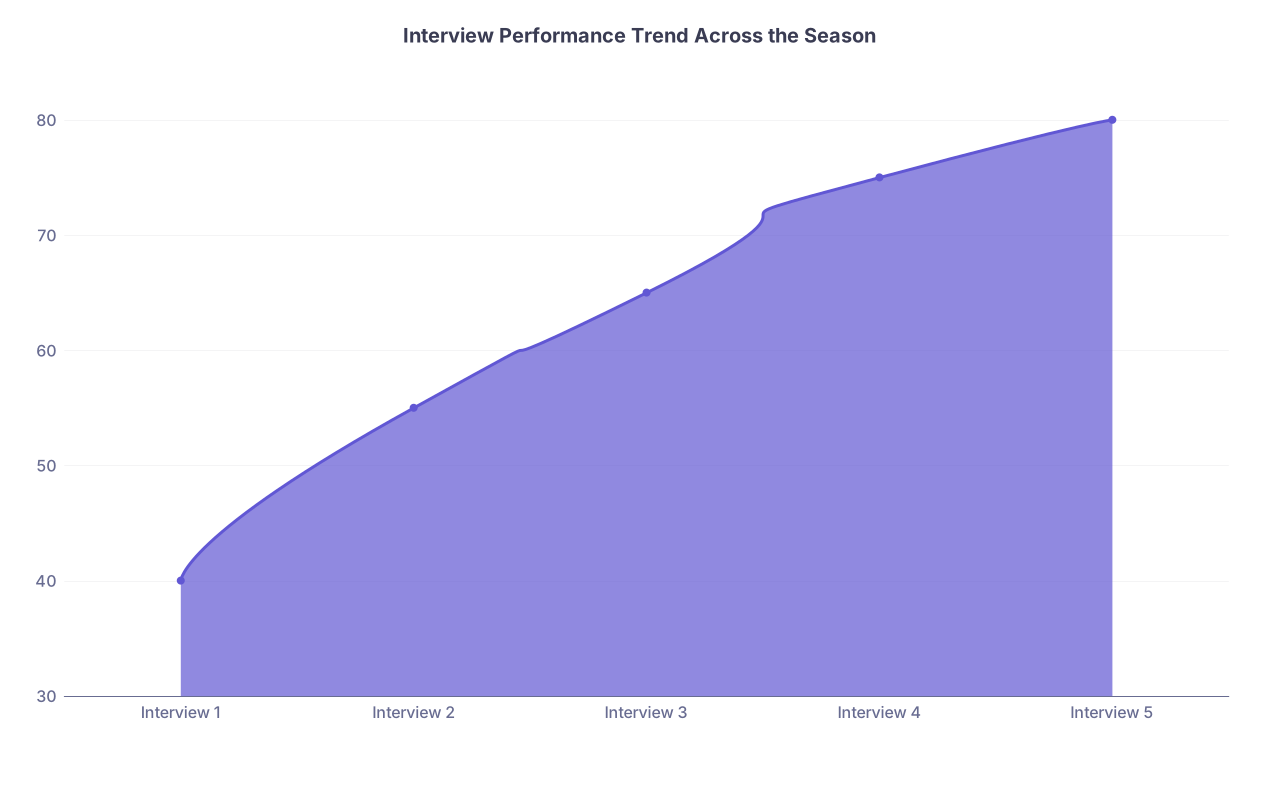
| Category | Value |
|---|---|
| Interview 1 | 40 |
| Interview 2 | 55 |
| Interview 3 | 65 |
| Interview 4 | 75 |
| Interview 5 | 80 |
You want the line headed up. A rough start is normal. Staying rough is optional.
FAQs
1. Should I apologize in my follow-up email if I think the interview went badly?
You can acknowledge specific issues (late arrival, tech problems, one confusing answer), but avoid broad, emotional apologies like “I was very nervous and did poorly.” Focus on clarity, not self-flagellation. One brief apology paired with a concrete fix is enough. Anything more starts to sound unstable and can harm your image more than the original issue.
2. Is it ever appropriate to ask for another chance to speak with an interviewer?
Almost never. Asking for a second interview or extra conversation to “redo” things usually signals anxiety, not professionalism. Exceptions are rare and usually revolve around serious technical failures (e.g., the call dropped repeatedly) or if the program suggests it. In most cases, your best move is a targeted follow-up email and then improving for future programs.
3. How do I know if a bad interview means I should drop the program from my rank list?
Ask yourself two questions:
- Was the interview “bad” because of your performance or because the culture felt wrong?
- If they ranked you to match, would you be disappointed or relieved?
If the culture felt condescending, dismissive, or misaligned with your values, and you would feel dread at matching there, it belongs low or off your list. If you liked the program but felt you personally underperformed, you can keep it at a reasonable position and apply this repair strategy.
4. Can a strong follow-up ever move me from a neutral interview to a top-ranked spot?
It is rare. Follow-up communication is more effective at preventing harm than creating massive benefit. Programs rank you primarily on the full application and live impression, not email prose. A sharp, professional email can tip you slightly upward, help distinguish you from similar candidates, or rescue you from a minor mistake. It almost never transforms you into their automatic top pick by itself. Your real leverage is improving the next interview using what this bad one exposed.
Key points to walk away with:
- Diagnose the interview clinically, then send a short, targeted repair email within 12–36 hours.
- Fix the root causes—weak answers, anxiety, poor tech—so the same problem does not ruin the next interview.
- Aim for neutrality, not perfection. Across a whole season, “neutral” can absolutely be enough to match.