A weak MS3 transcript will not kill your residency chances—unless you waste fourth year pretending it did not happen.
You are not going to “explain it away” with some poetic personal statement. Program directors read that stuff after they look at your transcript, not before. Your only real leverage is what you do now, before ERAS locks and interview invites go out.
Let me walk you through how to fix, buffer, and reframe a shaky third year in a way that actually moves the needle.
Step 1: Get Ruthlessly Clear on How Bad It Really Is
Do not panic based on vibes. Panic based on data.
Print your transcript and clerkship eval summaries. Then categorize reality.
| Rotation | Grade | Shelf Percentile | Comments |
|---|---|---|---|
| Internal Med | HP | 45th | Solid but not standout |
| Surgery | P | 25th | Struggled early, improved |
| Pediatrics | H | 80th | Great team feedback |
| OB/GYN | P | 30th | Shelf pulled grade down |
| Psych | HP | 60th | Above average |
| Family Med | P | 40th | Inconsistent performance |
You need to know:
Which rotations are weak?
- Multiple Passes in core clerkships?
- Any Fail / remediation?
- Any barely High Passes that could be turned into solid strengths via letters?
Where is the damage concentrated?
- Early in the year? (Often fixable, easy to explain.)
- Across the board? (Needs a stronger repair strategy.)
- In or out of your intended specialty?
What pattern would you assume if you were a PD looking at this in 20 seconds?
- “This student was shaky early but finished strong.”
- “This student is fine clinically, just had test issues.”
- “This student is inconsistent and risky.”
You are trying to define the story your transcript currently tells without any explanation. Because that is the story PDs read first.
Common weak-transcript patterns I see:
Early-year mess, late-year improvement
- IM: P, Surgery: P, then later Peds: H, Psych: HP
- Story: slow start, adjusted to clinical medicine. Fixable.
Strong shelves, mediocre final grades
- Shelf > 70th percentile but HP/P overall
- Story: may have struggled with clinical skills or subjective evals.
Strong evals, bad shelves
- Narrative comments great, shelf scores 10–30th percentile
- Story: works hard, gets along, but test-taking is weak.
Across-the-board Passes
- Few or no Honors / HPs in core rotations
- Story: average performer; you need a strong narrative and fourth-year proof.
Once you know which bucket you are in, you can stop catastrophizing and start fixing.
Step 2: Build a Specialty Strategy That Matches Your Transcript
You cannot fix your transcript without first being honest about your target specialty.
There is a big difference between trying to match:
- Dermatology with mostly Passes, and
- Family Medicine with a couple of rough rotations but clear strengths.
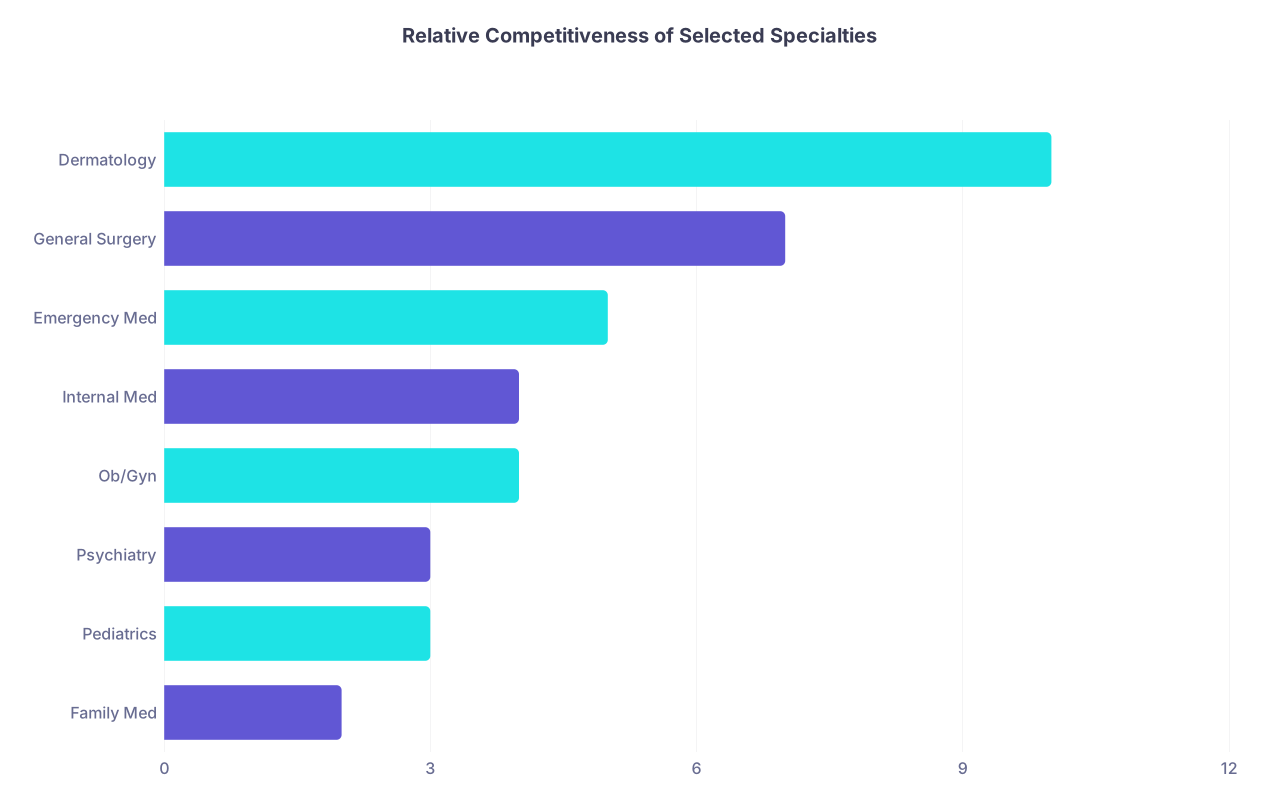
Decide where you fit on the competitiveness spectrum. Realistically.
| Category | Value |
|---|---|
| Family Med | 2 |
| Pediatrics | 3 |
| Psychiatry | 3 |
| Ob/Gyn | 4 |
| Internal Med | 4 |
| Emergency Med | 5 |
| General Surgery | 7 |
| Dermatology | 10 |
(Scale 1–10: 1 = least competitive, 10 = most.)
Hard truth:
If your MS3 transcript is mainly Passes with no standout strengths, the ultra-competitive specialties are not “salvageable with a good story”. They require a near-flawless record or compensating strengths (big-time research, Step 2 monster score, etc.). It is not fair, but it is real.
So:
- If you are aiming for:
- Dermatology, Ortho, Plastics, Neurosurgery, ENT, Rad Onc
- And your transcript is:
- Mostly P with few/no Honors in core rotations
- You have 3 realistic options:
- Pivot to a less competitive specialty that still fits you.
- Build a strong plan for research + potential extra year + Step 2 crush.
- Adjust expectations drastically (community programs, broad geographic net, backup specialty).
If you are targeting:
- IM, Peds, Psych, FM, Neurology, Path, PM&R, Ob/Gyn, EM
then a weak MS3 can be patched with a strong MS4 strategy. You just do not have room for more mistakes.
Make the decision now. Not in September when ERAS opens and your options have already shrunk.
Step 3: Use Fourth Year as a Repair Shop, Not a Vacation
Fourth year is where you prove “I am not my MS3 transcript.” That means deliberate scheduling, not a random pile of interesting electives.
3.1. Front-load your strongest rotations
Your best work needs to appear before programs look at your application.
Rule of thumb:
- Anything done July–October of MS4 is visible and meaningful.
- Anything done November+ is a bonus for rank list updates, but too late to fix a first impression on paper.
You want:
Sub-I / Acting Internship in your chosen specialty
- Aim for Honors or top marks. Non-negotiable.
- This is your “I can function as an intern” proof.
- Ask explicitly:
“Dr. X, I am planning to apply to [specialty]. My MS3 year was not as strong as I wanted, and I am working hard to show improvement. What specific things do you need to see from me on this Sub-I to consider me a top performer?”
At least one strong medicine-style or heavy inpatient rotation
- For any specialty that cares about clinical horsepower (IM, EM, Surg, OB, Neuro):
show you can manage sick patients, call, notes, sign-outs. - If Medicine was weak in MS3, repeat that environment with a vengeance.
- For any specialty that cares about clinical horsepower (IM, EM, Surg, OB, Neuro):
One away rotation (if useful for your specialty)
- Strategic, not random. Go where:
- You have realistic chances of matching, and
- They will actually look at your performance.
- Strategic, not random. Go where:

| Step | Description |
|---|---|
| Step 1 | Start MS4 Planning |
| Step 2 | Front-load Sub-I + Core-heavy AI |
| Step 3 | Sub-I + Strong Medicine AI |
| Step 4 | Plan 1 Away Rotation |
| Step 5 | Add Test-heavy Elective |
| Step 6 | Lock Schedule by April |
| Step 7 | Transcript Weakness? |
3.2. Be strategic, not greedy, about aways
Aways do not automatically fix bad transcripts. They amplify whatever you are.
- If you are inconsistent → they see inconsistency.
- If you are hardworking, improved, coachable → they see that, and some will ignore your MS3 bumps.
Choose away rotations where:
- They historically take students from your school or similar schools.
- You have some connection (geography, prior research, mentor).
- You can actually handle the pace.
Doing a hyper-malignant away as your first Sub-I with a weak transcript is like learning to swim by jumping into a hurricane.
Step 4: Attack Your Weakness Type Directly
You cannot fix “grades” in general. You can fix why the grades were bad.
Most weak MS3 transcripts boil down to one (or two) of these:
- Clinical skills / work habits
- Shelf / exam performance
- Interpersonal / professional reputation
- One-time life event or health issue that tanked a rotation
Each needs its own strategy.
4.1. If the problem was clinical performance
The narrative comments say stuff like:
- “Needed a lot of supervision.”
- “Sometimes disorganized.”
- “Had difficulty prioritizing tasks.”
- “Struggled to present patients concisely.”
This is not fixed with more Anki cards. This is behavior.
You fix it by:
Standardizing your daily workflow
- Pre-round list done the night before.
- Same structure for notes and presentations every time.
- Use checklists. Literally.
I have seen students go from “scattered” to “rock solid” in 4 weeks with a one-page daily template.
Asking for targeted feedback early in a rotation
- Day 3–4:
“Dr. X, I want to make sure I am improving quickly. Can you tell me one thing I should change about how I present or manage patients this week?” - Then document it and show visible change.
- Day 3–4:
Shadowing a strong resident and copying their structure
- How they preround.
- How they write the one-liner.
- How they run their task list.
- It is not cheating. It is apprenticeship.
Your goal for MS4: at least one attending writes, “I would trust this student as an intern on day 1.” That single line in a letter is sometimes more powerful than three Honors on paper.
4.2. If the problem was shelves / exams
Your pattern:
- Comments good.
- Shelf exams dragging the grade down.
- Maybe Step 1 was borderline or took a retake.
Stop pretending “I am just bad at standardized tests”. That phrase reads as “I refuse to change how I study.”
You need a test-taking protocol:
Post-mortem your worst shelves
- Which question blocks crushed you?
Cardiology? OB complications? Psych pharm? - Were you scoring low from:
- Not knowing content?
- Rushing / time?
- Misreading stems?
- Which question blocks crushed you?
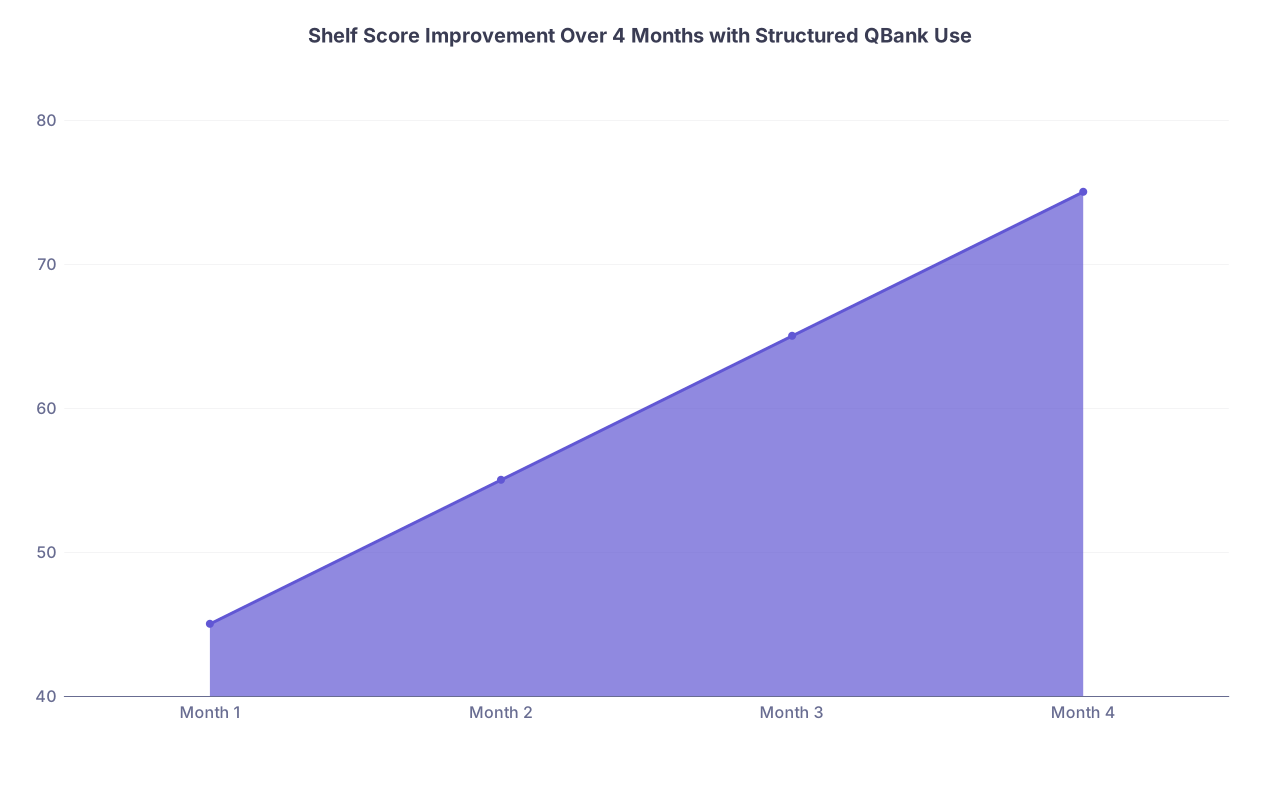
Use UWorld or AMBOSS like a job
- 40–80 questions daily during dedicated weeks.
- Timed, random, full-length blocks.
- Immediate review with notes on patterns of error, not just “I got it wrong.”
Upgrade your resource strategy
- For shelves:
- IM: MKSAP for students + UWorld, maybe OnlineMedEd as backbone.
- Surgery: Pestana + NMS or UWorld surgery questions.
- Peds, Psych, OB: shelf-specific qbanks + short focused texts.
- For Step 2:
- UWorld (non-negotiable).
- NBME practice exams to calibrate.
- For shelves:
| Category | Value |
|---|---|
| Month 1 | 45 |
| Month 2 | 55 |
| Month 3 | 65 |
| Month 4 | 75 |
- Schedule Step 2 CK strategically
- Take it after a strong run of medicine-heavy rotations if IM/surgery-related.
- Not right after a super light elective.
- Give yourself 4–6 weeks of serious prep if your shelves were consistently weak.
If your MS3 transcript is bad but your Step 2 is 250+, many PDs will quietly decide: “OK, this student figured it out.”
4.3. If the problem was interpersonal / professionalism
This one is ugly, but fixable if you are honest.
- “Had difficulty receiving feedback.”
- “Occasionally defensive or argumentative.”
- “Concerns about professionalism / reliability.”
This is the stuff that terrifies PDs more than a low shelf. Nobody wants the resident who blows up the team.
Your job MS4:
Change the pattern, intentionally
- Show up early. Every day. Not on time. Early.
- Say “thank you for the feedback” out loud. Even if you disagree.
- After critique, summarize back:
“So I should focus on X and Y, and avoid Z. I will change that by doing A tomorrow.”
Find one attending who knew you “before” and one who knows you “after”
- Ask both for letters.
The contrast in their letters (if they mention your growth) can be very powerful.
- Ask both for letters.
Address serious professionalism issues transparently in your dean’s letter addendum, if needed
- This is where you briefly acknowledge and show insight:
- What happened.
- What changed.
- How you ensure it will not repeat.
- This is where you briefly acknowledge and show insight:
Not with excuses. With a clean, specific explanation.
Step 5: Engineer Letters of Recommendation That Directly Counter Your Weaknesses
Your letters are your only legal way to shout over a mediocre transcript.
Most students treat letters passively: “Can you write one?” and hope it is good. You cannot afford that.
You need targeted letters that:
- Confirm your clinical competence.
- Highlight growth and improvement.
- Provide context for early weaker performance without sounding like a pity story.
Who should you prioritize?
Sub-I / Acting Internship attending in your chosen specialty
- Must see you at your best.
- Ideally mentions: “Shows clear growth from early to late in the rotation.”
A core clerkship attending where you turned things around
- Ex: You had a rough IM rotation in fall, then crushed a spring IM sub-specialty.
- That attending can say: “I know their early record; what I saw was a much more mature, capable student.”
Research mentor (especially in competitive fields)
- If they can comment on your reliability, work ethic, ability to handle feedback.
How to set your letter writers up without being fake
When you ask:
“Dr. X, I am hoping to apply in [specialty]. My third-year record had some weaker rotations earlier on, but I have been working hard to improve. You have seen me more recently. Would you feel comfortable writing a strong letter that reflects how I am performing now, and my readiness for residency?”
Then:
- Hand them:
- Your CV
- Draft personal statement
- Short bullet list:
- Key projects you did with them
- Situations where you showed improvement or handled difficulty well
You are not telling them what to write. You are handing them reminders so they can build a narrative beyond “hard-working and pleasant.”
Step 6: Decide What to Say About It—and What to Keep Quiet
You do not need to write a novel about every Pass on your transcript. Over-explaining small issues makes them look bigger.
Use a simple rule:
- Is there a clear, discrete, non-recurring event that tanked a rotation or two?
- Serious illness, family crisis, major surgery, etc.
- Documented leave of absence or remediation.
- If yes, you may want a short, factual explanation in:
- Your MSPE / dean’s letter addendum, or
- One sentence in your personal statement, or
- Rarely, in the “additional comments” ERAS section.
If the pattern is just “I was not as prepared for clinical medicine early on,” no dramatic explanation required. That is normal. You just show improvement.
How to phrase it if you must address it
Keep it dry and grown-up. For example:
- “During the fall of my third year, a significant family health issue affected my focus and performance, particularly during my Surgery rotation. I sought support, addressed the situation, and my subsequent rotations reflect my usual level of performance.”
or
- “I initially struggled with the transition to clinical responsibilities, particularly on my early Internal Medicine rotation. With feedback from residents and faculty, I adjusted my workflow and note-writing. The remainder of my clerkships show this improvement.”
Do not:
- Blame a single attending.
- Trash your school’s grading system.
- Write three paragraphs of emotional detail.
PDs are scanning for: “Was this a one-time situation, and did they grow from it?”
Step 7: Widen Your Application Net Intelligently
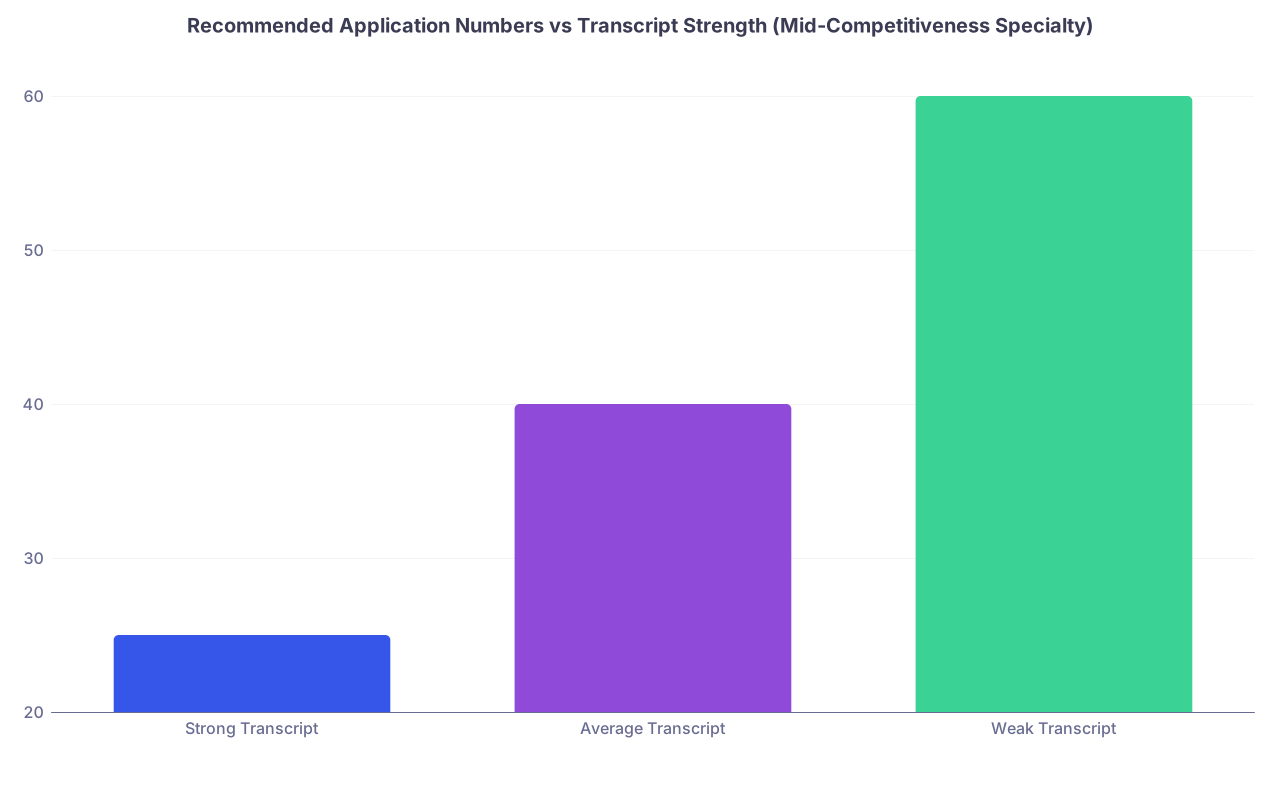
A weak MS3 means you do not get to apply to 10 programs and see what happens.
You need volume and strategy.
| Category | Value |
|---|---|
| Strong Transcript | 25 |
| Average Transcript | 40 |
| Weak Transcript | 60 |
For a mid-competitiveness specialty:
- Strong transcript: 20–30 programs.
- Average: 35–45.
- Weak: 55–70+ (depending on specialty, geography constraints, and Step scores).
Broaden in 3 dimensions:
Geography
- Include:
- Less popular cities.
- Community programs with decent training but less name recognition.
- Do not only apply to the coasts and 5 “brand name” programs you have heard of.
- Include:
Program type
- Mix:
- University programs
- University-affiliated community programs
- Pure community programs
- Mix:
Backup planning
- If your transcript and exam history are shaky and your specialty is moderately competitive (EM, Ob/Gyn, General Surgery):
- Have an honest conversation with an advisor about dual applying or having a clear backup.
- Do it early. Dual applying in October is almost always too late.
- If your transcript and exam history are shaky and your specialty is moderately competitive (EM, Ob/Gyn, General Surgery):
Step 8: Show Up in Interviews as the “Version 2.0” You Built
If your application is put together correctly, here is what a PD sees:
- Mediocre MS3 grades.
- Much stronger MS4 Sub-I, at least one top evaluation.
- Step 2 stronger than shelves suggested.
- Letters that mention growth and reliability.
- Maybe a brief, clean explanation if there was a specific event.
You will be asked something like:
“I notice some Passes early in third year. Can you tell me about that?”
This is where people blow themselves up by either panicking or oversharing.
Your answer should:
- Acknowledge it plainly.
- Name what changed.
- Point to objective proof.
Example:
“You are right, my early third year on Internal Medicine and Surgery was not as strong as I wanted. I underestimated the transition from classroom to clinical work and struggled with time management and prioritizing sick patients. After direct feedback from my residents, I started using a structured prerounding checklist and changed how I prepared my plans overnight.
You can see the result in my later rotations—Pediatrics and my Medicine Sub-I—where my evaluations specifically mention better organization and clinical reasoning. That experience was uncomfortable, but it forced me to build systems I still use every day on the wards.”
Short, specific, and then you pivot back to who you are now.
Step 9: Do a Reality Check with Someone Who Actually Knows
There is one more step that most students skip because it is uncomfortable: you need someone at your school (who has seen many cycles) to sanity-check your plan.
That means:
- A trusted faculty advisor in your specialty.
- Or the dean’s office / career advising.
- Or a clerkship director who likes you and tells the truth.
Send them:
- Your transcript (with honest description of when grades came in).
- Current and projected Step scores.
- Fourth-year schedule draft.
- Target specialty and preliminary program range.
Ask directly:
- “Given this record, do you think my plan is reasonable?”
- “What is the biggest blind spot I am missing?”
- “If you were me, what would you change now, not in September?”
Listen. Especially if they say something you do not want to hear. I have sat in those meetings on the faculty side. The students who adjust early usually match. The ones who insist on magical thinking often do not.
Final Thoughts: What Actually Matters
You cannot retroactively convert a Pass to an Honors. That ship sailed. But residency selection is not a one-variable equation.
The moves that matter most now:
Prove the newer version of you is better than the old one.
Strong MS4 Sub-I, cleaner evaluations, better Step 2. Tangible growth.Design letters and rotations to directly counter your weak spots.
Not general “hard-working” fluff, but specific, recent, credible proof you can function as an intern.Apply broadly and strategically, not emotionally.
The match is partly a numbers game. You stack the odds in your favor with honest specialty choice, careful school list, and serious prep.
Get those three right, and a weak MS3 transcript becomes a footnote. Not your headline.