
The late specialty switch during ERAS season is not brave. It is dangerous. But it is fixable if you treat it like an emergency and follow a tight protocol.
You are not “exploring options.” You are trying to avoid going unmatched while pivoting into a field you decided on three weeks ago during a brutal night shift. If you approach this like a casual preference change, you will get burned. If you treat it like a salvage operation with a 4‑week rescue plan, you still have a shot.
Here is exactly how to do it.
Week 0: Reality Check and Triage (Within 24–48 Hours)
You do not have four weeks yet. You have 48 hours to decide if this switch is even remotely viable.
Step 1: Brutal Assessment of Competitiveness (Same Day)
Pull up your numbers and lay them out like a program director would:
- USMLE/COMLEX scores
- Class rank / AOA / Gold Humanism
- Prior specialty experiences (rotations, sub‑Is, letters)
- Research and publications (especially related to either your old or new specialty)
- Red flags (leaves, failures, professionalism issues)
Now compare that against your target specialty’s usual expectations.
| Specialty Tier | Example Fields | Typical Step 2 (USMLE) | Research Expectation |
|---|---|---|---|
| Ultra High | Derm, Ortho, Plastics | 250+ | Multiple pubs, strong |
| High | ENT, Urology, Rad Onc | 245+ | At least some research |
| Moderate | IM, Gen Surg, EM | 230–240+ | Helpful, not mandatory |
| Lower | FM, Psych, Neuro | 220–230+ | Nice to have, not required |
If you are trying to jump from Family Medicine to Derm with a 225 Step 2 and no research, that is fantasy, not strategy.
You must decide:
- Is this specialty change competitive at any tier (including community and smaller programs)?
- Are you willing to be geographically flexible and prestige‑agnostic?
- Are you willing to apply to a backup specialty in parallel?
If you answer “no” to any of those, the switch is probably reckless.
Step 2: Commit to One of Three Paths
Within 48 hours, pick one:
- Full switch with backup
- Primary push into new specialty
- Parallel, serious application into a safer field (often your original one or FM/IM/Psych depending on your profile)
- Hybrid strategy
- Apply broadly to original specialty
- Apply in a limited, realistic way to new specialty (only where you have some connection or plausible interest)
- Abort the switch
- Stay in the original specialty and stop doom‑scrolling SDN and Reddit
Most people in trouble wait too long to commit. They “see how it goes” with a few late emails and a half‑baked new personal statement. Those applicants are the ones emailing me in March asking about SOAP strategy.
Pick a lane. Then build a plan around it.
Week 1: Build the New Specialty Story and Application Skeleton
Your first week is about two things:
- Making your interest in the new specialty coherent and believable
- Re‑engineering your ERAS materials around that story
Do not start with the personal statement. Start with the narrative.
Step 1: Define a Clear, Non‑Cringe Reason for Switching
Program directors have heard every bad line:
- “I realized I love surgery after scrubbing one case.”
- “I have always been passionate about dermatology” (with zero dermatology on your CV).
- “I want more work–life balance” (in a surgical specialty).
You need a reason that:
- Is grounded in actual experiences
- Shows some reflection
- Does not trash your previous interest
Use this framework:
Trigger – What actually pushed you to reconsider?
Example: A tough MICU rotation where you realized you cared more about longitudinal relationships than acute management.Pattern – What earlier experiences align with this new field?
Example: Longitudinal clinic, continuity clinics, prior volunteering, research themes, mentors.Fit – What specific features of the new specialty match your skills and temperament?
Example: Complexity of chronic disease, procedural content, team structure, patient population.
Write this as a one‑page narrative for yourself first. That becomes the backbone for:
- Personal statement
- Email outreach to programs
- LOR ask script
- Interview answer to “So why the switch?”
Step 2: Rapid CV Reframing
You cannot magically create four away rotations in a new field. You can absolutely reframe prior experiences.
Do this:
- Go through your CV and tag each item as:
- Directly relevant to new specialty
- Indirectly relevant (skills, patient pop, setting)
- Not helpful
Then edit bullet points to highlight what new PDs care about.
Example: Switching from EM to IM
- Old EM‑framed bullet:
- “Managed multiple simultaneous high‑acuity patients in ED, performing rapid assessments and stabilizations.”
- New IM‑framed bullet:
- “Coordinated longitudinal management and disposition planning for complex, multi‑comorbidity patients presenting with acute decompensations.”
Same job. Different framing.
Step 3: Draft Two Personal Statements (Yes, Two)
If you are doing a full switch with backup, you need:
Primary PS for new specialty
- Open with a specific clinical moment tied to that field
- One paragraph on your path and reevaluation
- Two paragraphs on experiences that support fit
- One short paragraph on what you seek in training
Backup PS for safety specialty
- Do not mention the other specialty
- Emphasize genuine reasons you would be content in that field
- Focus on consistency, reliability, and solid training goals
Do not write about your existential crisis. They are not your therapist.
Week 2: Letters, Mentors, and Outreach
Here is where most late switch attempts collapse. They never get the right letters or advocacy.
Your goal in week 2: get at least one credible letter in the new specialty and line up human beings willing to say your name out loud to PDs.
Step 1: Identify Potential Letter Writers (48–72 Hours)
You are looking for:
- Faculty in the new specialty who:
- Have directly supervised you
- Can comment on clinical performance
- Are not complete strangers
Or, if you lack that:
- Core rotation attendings who can:
- Speak to traits that translate (work ethic, clinical reasoning, communication)
- Are senior / well‑known locally
- Are responsive by email
Best case for a late switch:
- 1 letter from new specialty
- 1–2 strong general clinical letters (IM, Surgery, etc.)
- 1 from a research mentor or department leader
When you email:
- Be direct about the specialty switch and timeline
- Attach:
- CV
- Draft personal statement for the new specialty
- Bullet summary of 3–5 things they saw you do well
- Explicitly ask if they feel comfortable writing a strong, supportive letter for [new specialty].
If someone hedges or seems lukewarm, do not use them.
Step 2: Get a Specialty Mentor Fast
You need a guide from that field, even for two or three meetings.
Targets:
- Clerkship director or APD in the new specialty
- Any faculty you vaguely know who seems reasonable
- Recent grads from your school who matched in that field
Your email script, roughly:
- One clear paragraph: your background and current intended specialty
- One paragraph: why you are reconsidering and why [new specialty] fits
- One ask: “Could I schedule a 20‑minute meeting this week to get your honest opinion on whether this is viable and how to approach ERAS this cycle?”
On the call, you want:
- A reality check: are you competitive anywhere?
- Names of programs that may be more open to late applicants or non‑traditional paths
- Names of colleagues they would be willing to email if you apply there
If the mentor says the switch this cycle is unrealistic, listen. You might still apply, but you should double‑down on the backup plan.
Step 3: Direct Outreach Strategy to Programs
For a late specialty switch, cold‑emailing 60 programs is a waste of time. You focus on:
- Programs:
- Where someone knows you or your letter writer
- In regions where you have clear ties (home, family, med school, previous work)
- Community or mid‑tier academic programs more likely to be flexible
Your email content:
- Short subject line: “Applicant – [Name], [Med School], Late Interest in [Specialty]”
- 2–3 short paragraphs:
- Who you are (school, grad year, USMLE)
- Clear explanation that you finalized your decision recently and restructured your application
- Why you are specifically interested in their program (location, patient pop, training model)
- Attach:
- ERAS CV
- New specialty personal statement (optional but helpful)
Do not beg. You are informing, not pleading.
Week 3: ERAS Configuration, Program List, and Backup Plan
Now you are turning this into an executable ERAS strategy.
Step 1: Build a Ruthless Program List
Most late switchers either under‑ or over‑apply. They send 25 applications to ultra‑competitive universities “because that is where the best training is.” Then wonder why no one calls.
You build three buckets:
- High reach (10–20%)
- Slightly above your numbers
- Places where you have strong geography or connections
- Realistic core (60–70%)
- Programs where your scores and CV are right in the middle
- Mix of academic and community
- Safety (15–25%)
- Lower‑tier or less geographically desirable
- Programs with a track record of taking IMGs / DOs / mid‑range scores if that applies
If you are late‑switching into a moderately competitive field (e.g., categorical IM at solid but not elite programs), your realistic total:
- 40–60 programs for the new specialty
- 20–40 for the backup (depending on risk tolerance and finances)
For very competitive fields, you may need >60 applications and a serious backup.
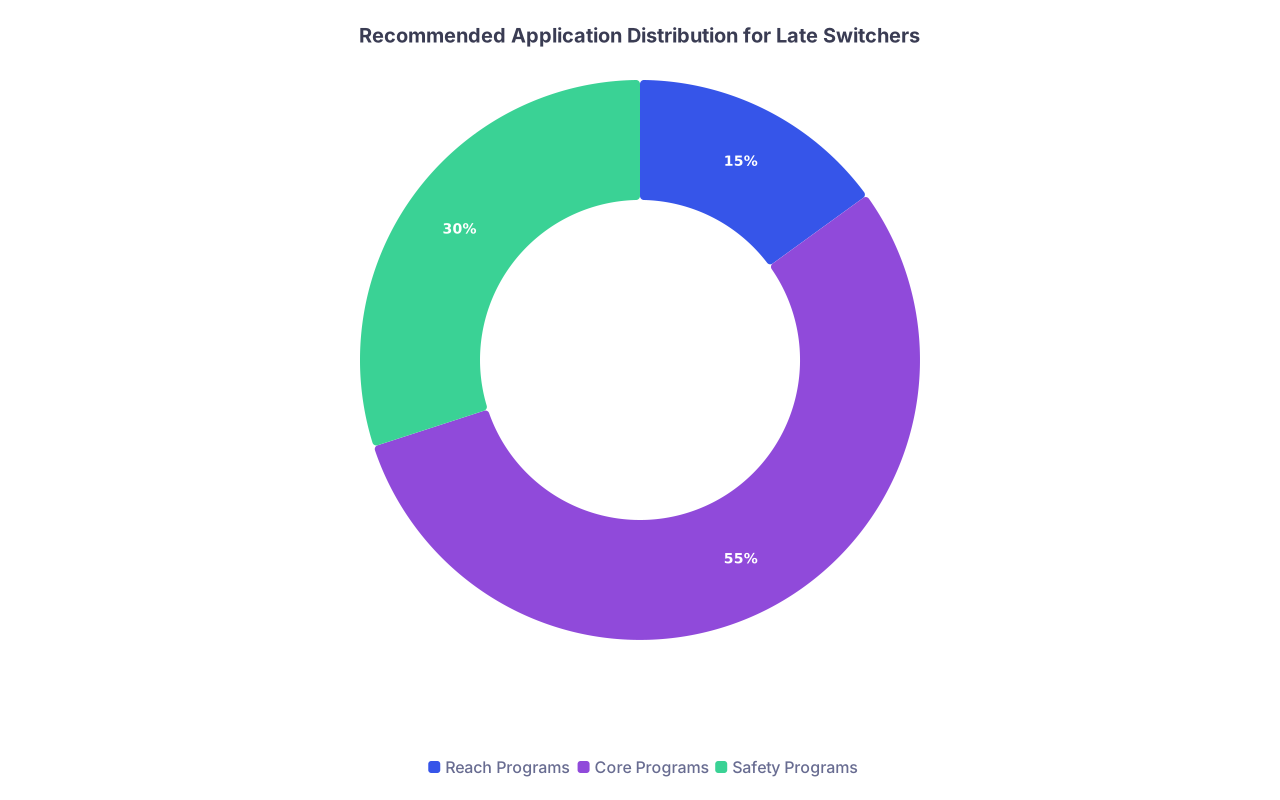
| Category | Value |
|---|---|
| Reach Programs | 15 |
| Core Programs | 55 |
| Safety Programs | 30 |
Step 2: ERAS Document Logistics
You must keep your application internally consistent.
Personal statements
- Upload one per specialty
- Double‑check that each program gets the correct one
- Avoid “switch” language in the backup specialty PS
Letters of recommendation
- Assign:
- New specialty letter(s) to new specialty applications
- General letters to both specialties
- Do not send a letter clearly addressed to “Dear Internal Medicine Program” to EM programs. If your letter writer did that, you may need to drop that letter from other specialties.
- Assign:
Experiences section
- Use neutral language that fits both specialties where possible
- If you mention “planning to pursue [old specialty]” in any description, edit it now
Program signals (if applicable)
- Use them strategically for your new specialty only
- Do not waste signals on pure reaches with no geographic or personal connection
Step 3: Explicit Backup Plan
If you are honest with yourself, there is a real chance the new specialty does not bite this year. You need a pre‑written backup script for March, not a panic plan.
Decide now:
- If you go unmatched, will you:
- Enter SOAP for backup specialty?
- Take a research year or prelim spot?
- Reapply next year with strengthened profile?
And align your application:
- If SOAP into your backup is an option:
- Make sure your backup PS and letters are solid enough to be used there
- If research year is Plan B:
- Start soft networking with potential PIs in the new specialty now, not after you fail to match
Week 4: Polish, Interview Prep, and Damage Control
By week 4, all the structure should be in place. This week is about cleaning up mistakes and getting ready for interviews.
Step 1: Fix Red Flags in Your File
Anything that looks weird will get noticed fast in a late switch:
- Gaps between rotations
- Failed exams or delayed Step 2
- Prior explicit statements about a different specialty (e.g., in your MSPE or dean’s letter)
You cannot rewrite your MSPE. You can prepare concise, non‑defensive explanations:
- One or two sentences per issue
- Focus on:
- What happened
- What you changed or learned
- How performance improved since then
You want to practice these answers out loud. With a friend or mentor. Not alone in your car.
Step 2: Interview Answers for “Why the Switch?”
You will get this question. Every time. If you stammer through it once, you will not rank high.
Use a simple structure:
Acknowledge the original path.
- “I initially planned to pursue Emergency Medicine and completed my core rotations with that in mind.”
Describe the pivot moment + pattern.
- “During my sub‑I on the general medicine service, I realized the longitudinal aspects and complex chronic disease management resonated more with me. When I reflected on earlier experiences—my continuity clinic, my work with patients with multiple comorbidities—I saw a consistent thread pointing toward Internal Medicine.”
Show respectful closure with old specialty.
- “I value what I learned in EM and it strengthened my resuscitation and triage skills, but I recognized that my long‑term professional identity fits better within Internal Medicine.”
Connect clearly to the new specialty.
- “Internal Medicine allows me to combine diagnostic reasoning, relationship‑based care, and systems thinking, all of which match how I work best.”
That is enough. Do not over‑justify. Do not look guilty.
Step 3: Prepare a Consistent Story Across Both Specialties
If you are applying to a backup specialty, assume programs in both fields might eventually see your full file or talk to the same dean’s office.
Your internal rule:
- The reasons for choosing each specialty must stand on their own.
- The reasons for leaving the other specialty should never sound like:
- Burnout
- Laziness
- “I just want better hours/money”
- “I did not match there so now I am here”
Practice:
- 2–3 reasons why [new specialty] fits
- 2–3 reasons why [backup specialty] would also be a genuinely satisfying career
Is that a little emotionally messy? Yes. But it is better than sounding like you do not care where you land.
Tactical Timeline: 4‑Week Rescue Plan at a Glance
Here is the full protocol visually.

| Period | Event |
|---|---|
| Week 0 (Days 1-2) - Assess competitiveness | Decide viability and need for backup |
| Week 0 (Days 1-2) - Choose path | Full switch, hybrid, or abort |
| Week 1 - Define narrative | Clarify reason for switch |
| Week 1 - Reframe CV | Align experiences with new specialty |
| Week 1 - Draft PS | Write new and backup personal statements |
| Week 2 - LOR outreach | Contact faculty for specialty-specific letters |
| Week 2 - Find mentor | Meet with specialty advisor |
| Week 2 - Program contacts | Targeted emails to key programs |
| Week 3 - Build list | Create reach/core/safety program list |
| Week 3 - Configure ERAS | Assign PS and LORs correctly |
| Week 3 - Set backup plan | Decide SOAP/research options |
| Week 4 - Polish file | Fix inconsistencies and red flags |
| Week 4 - Interview prep | Practice switch explanation |
| Week 4 - Monitor responses | Adjust outreach based on interest |
Handling Common Late‑Switch Scenarios
Let me walk through a few real‑world patterns I have seen and how I’d fix them.
Scenario 1: Surgery → Anesthesia in October
- You have:
- Two strong surgery letters
- One medicine letter
- No anesthesia rotation yet
Rescue moves:
- Immediately request an anesthesia elective, even if it starts late. Some programs will like that you have it scheduled.
- Ask surgery letter writers to make letters as general as possible (teamwork, clinical judgment, operative behavior) rather than “future surgeon” language.
- Secure at least one brief anesthesia shadowing or mini‑rotation that can be mentioned in PS and interviews.
- Apply widely in anesthesia and keep a serious backup in prelim surgery or transitional year, depending on your numbers.
Scenario 2: EM → IM Late, After EM Letters Are In
- You have:
- 2 strong EM SLOEs
- 1 IM letter
- Volume of ED experience
Rescue moves:
- Use the IM letter plus 1 EM SLOE for IM applications, especially if the SLOE talks about diagnostic reasoning, patient communication, and reliability.
- Explicitly frame EM experience as a strength for IM (managing acute issues, triage, procedures).
- Ask one EM faculty if they can write a short, IM‑appropriate letter that is not in SLOE format, focusing on general internal medicine skills.
- Apply broadly to IM, including community programs, with a PS clearly oriented to IM.
Scenario 3: Missed the Original Field’s Train (e.g., Late Decider)
Someone realizes in October that their original specialty is nearly closed and hyper‑competitive. They have average scores and no great letters. They want to switch to a more accessible field.
Rescue moves:
- Stop mourning the prestige. Start optimizing chances of matching somewhere you can grow.
- Pick a reasonable specialty where:
- Your numbers align
- You can explain a credible fit story
- Double‑down on getting:
- 1–2 letters in that new field
- Realistic program list (heavy on community / safety)
- Build a hard backup to avoid going unmatched—this might mean FM or a prelim year.
When the Right Move Is Not to Switch This Cycle
Sometimes the honest answer is: you are too late, too under‑prepared, or both.
Typical red‑flag situations:
- You have zero exposure to the new specialty, no rotations scheduled, and no potential letter writers.
- You are aiming at a hyper‑competitive field from a very weak starting point.
- You are not willing to be geographically flexible and refuse to consider a backup.
In those cases, a smarter plan might be:
- Apply normally in your original specialty (or a safe specialty you can live with).
- If you match:
- Explore options for switching internally or after PGY‑1, with a clearer, documented pathway.
- If you do not match:
- Take a focused research year or prelim year in a field related to your true target specialty, then apply with stronger backing.
Match is not the last decision point of your life. But going unmatched when you could have safely matched elsewhere is a brutal, avoidable outcome.
Final Tightening: What Actually Matters
Let me narrow this down to the core moves that change outcomes.
You need a coherent, believable story for the switch.
Not a dramatic one. A consistent one. Trigger → pattern → fit.You must secure at least one credible advocate in the new specialty.
A faculty member or mentor willing to put their name on the line in a letter or an email to a PD. Without this, your application looks impulsive.Your risk is managed by a serious backup plan.
Not a token application to three “safeties.” A real, parallel lane where you could actually match and not hate your life.
If you do those three things systematically over four weeks, a late specialty switch is still dangerous. But no longer reckless. And that is the best outcome you can reasonably engineer this late in the game.