
You are three clicks into ERAS, staring at the “Medical School Experiences” section, and your stomach sinks.
You want a specialty your school barely acknowledges. No home program. No big-name faculty. Maybe one semi-interested clinician who “used to do that in fellowship.”
You know what program directors say: “We like to see strong support from your home department.”
You do not have one.
Let me be direct: this is fixable. Harder, yes. Impossible, no. I have watched students from schools with zero derm, zero ENT, zero neurosurgery match into those exact fields. They were not all 280 scorers. What they did have was a deliberate plan to manufacture what others get handed: credible specialty support.
Here is how you build that from almost nothing.
Step 1: Diagnose Exactly What You Are Missing
“Home program support” is actually four separate things. You are missing some or all of them:
- Letters of recommendation from specialty faculty
- Specialty-specific clinical experiences
- Evidence of sustained interest (research, electives, involvement)
- People who will vouch for you directly to programs
Your job is to replace each of those with credible alternatives.
Start by writing down, on one sheet of paper:
- Target specialty
- Your school’s actual resources:
- Any faculty in that field?
- Any affiliated hospitals with that specialty?
- Career office / dean who cares?
- Your current assets:
- Step scores, grades, class rank
- Any tangentially related experience (ICU for anesthesia, neurology for neuro, etc.)
- Geographic ties to anywhere
Then be brutally honest:
- Do you have zero specialty letters?
- Do you have no rotations in that field?
- Do you have any research even remotely adjacent?
You are about to design around those gaps. The more specific your diagnosis, the tighter your strategy.
Step 2: Build an External “Pseudo-Home Program”
No home program means you must adopt one.
That does not mean a name-drop on your ERAS. It means building real relationships at one or two institutions that can credibly say: “We know this person like a home student.”
You do that through targeted rotations and sustained contact.
2.1. Narrow your “anchor institutions” list
You need 1–3 places where you will concentrate your energy. Not 10.
Use this filter:
- Has your target specialty (obviously).
- Within a geography you can realistically reach.
- Historically takes at least some students from outside affiliated schools.
- Bonus: Has faculty active in national organizations, committees, or with solid publication records (those people carry weight).
Check:
- Program websites: current residents’ med schools.
- FREIDA.
- Your own classmates and recent alumni: where have people rotated / matched?
Make a short list of 3–5, then rank your top 3.
2.2. Lock in away or visiting rotations strategically
You are not doing random aways. Each one must serve a purpose:
- Get a strong letter from a specialty faculty member.
- Be seen functioning like a home student.
- Create at least one advocate who will remember your name in December.
General rule:
- Competitive fields (derm, ortho, ENT, plastics, neurosurg, rad onc, etc.):
- 2–3 aways in that specialty if possible.
- Moderately competitive (EM, anesthesia, gen surg, radiology, etc.):
- 1–2 aways often sufficient.
- Less competitive or with broader home exposure (IM, peds, FM):
- 0–1 away is usually fine, unless you truly have nobody in the field at home.
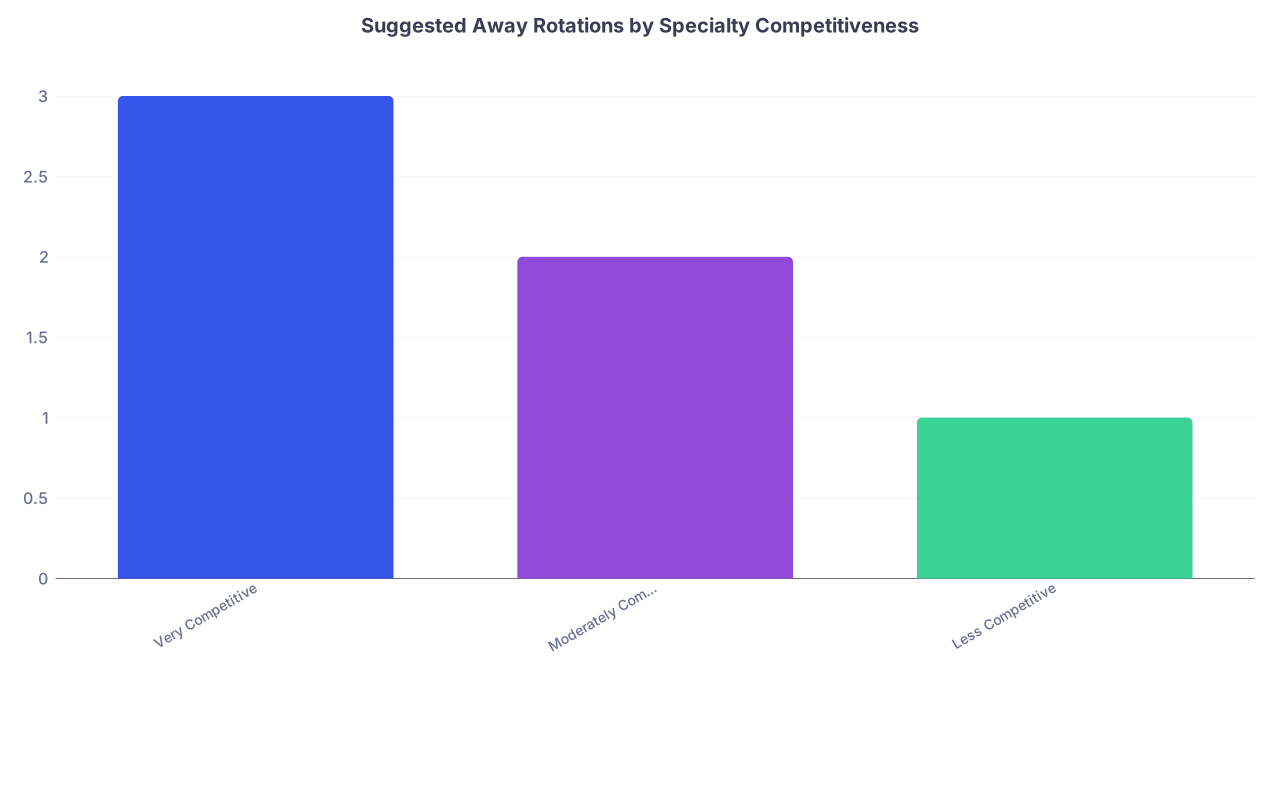
| Category | Value |
|---|---|
| Very Competitive | 3 |
| Moderately Competitive | 2 |
| Less Competitive | 1 |
If your school drags its feet on approving aways:
- Meet with the dean of student affairs with a written plan:
- “Our institution does not have [specialty]. Here are three programs with established rotations. Here is why I need them for credible evaluation and letters.”
- Be blunt but professional. You are asking them to fix a gap in their curriculum.
2.3. Behave like a home student on away rotations
I have seen this mistake countless times: students treat aways like “auditions” but forget to actually integrate.
You need faculty walking away saying: “We should have this student here every year.”
Concrete behaviors:
- Learn names fast. Attendings, residents, nurses, clerks.
- Show up early and stay until your team is done. Not until some arbitrary “student time.”
- Take ownership of a small number of patients and know them cold.
- Volunteer for unglamorous work:
- Pre-rounding vitals.
- Calling consults (with supervision).
- Drafting notes ahead of rounds.
- Ask explicitly for feedback mid-rotation:
- “Dr. Smith, I am very interested in [specialty] and this program. Is there anything you would like me to improve or do differently over the next week?”
End goal: when you later ask for a letter, nobody hesitates.
Step 3: Manufacture Strong Specialty Letters Without a Home Department
You need 3–4 letters that together say:
- This person can do the job clinically.
- This person is serious about this field.
- People in this field already trust them.
Target mix:
- 2 letters from specialty faculty (ideally from away rotations).
- 1 letter from a core faculty in a related field who can speak to your work ethic.
- Optional: 1 letter from research mentor in or adjacent to the specialty.
3.1. Getting letters from away rotations
Timeline: Ask 10–14 days before the end of the rotation, not after you are gone.
Script (direct, in person if possible):
“Dr. Chen, I am applying to [specialty] this cycle, and this rotation has been very important for me. Based on your experience working with me, would you feel comfortable writing a strong letter of recommendation for my residency applications?”
Two key words: “comfortable” and “strong.”
If they hesitate, you move on. A lukewarm letter will hurt you.
Follow-up email same day:
- Subject: “Thank you and LOR request – [Your Name], [Rotation Dates]”
- Include:
- Updated CV
- Draft personal statement
- ERAS AAMC Letter ID
- A paragraph summarizing specific cases / projects you worked on with them (jog their memory).
3.2. Mining your own school for supportive letters
No home program does not mean nobody can advocate for you. You just cannot be lazy about it.
Targets:
- Clerkship directors who saw you at your best.
- Course directors from longitudinal courses.
- Non-specialty faculty where you clearly excelled (ICU attending for anesthesia, neurology attending for neurosurgery, trauma surgeon for EM, etc.)
Your ask is similar, but you position the letter:
“I know our school does not have a [specialty] department, so I am working to make sure programs hear from people who know me well clinically. Would you feel comfortable writing a strong letter that focuses on my work ethic, clinical reasoning, and teamwork?”
That letter will not scream “home [specialty] support,” but it will say you are a safe bet.
Step 4: Create Specialty-Specific Clinical Credibility
You also need to look like you belong in that field on paper. Right now, you probably look like: “Generic MS3 who suddenly decided to do ENT.”
You fix that with targeted rotations and narratives.
4.1. Stack related rotations intelligently
If you cannot get a ton of pure specialty rotations, build a thematically coherent path.
Examples:
- Interested in neurosurgery but no neuro program:
- Required surgery, neurology, ICU.
- Electives: neuroradiology, spine clinic with ortho, pain management.
- Interested in EM with no EM residency:
- ICU, trauma surgery, urgent care, anesthesia.
- Electives in community EDs or private EM groups.
- Interested in derm but zero derm faculty:
- Rheumatology, allergy/immunology, infectious disease, oncology.
- Arrange a community derm clinic elective.
List these clearly in ERAS with cohesive descriptions:
- “Focused on acute neurologic presentations and neurocritical care, including management of [x, y, z].”
- “High-volume ED with emphasis on trauma resuscitation and rapid triage decision-making.”
Programs want to see that you have actually been in the environment, not just liked a YouTube channel.
4.2. Write experiences that scream “target specialty”
Your ERAS experience descriptions need to be precise, not mush.
Bad:
“Assisted in patient care in the ICU, took histories and exams, helped with procedures.”
Better, if you are targeting anesthesia or EM:
- “Performed >40 focused histories and physicals on critically ill patients, presented succinct management plans on rounds.”
- “Observed and assisted with airway management including pre-oxygenation, positioning, and post-intubation sedation in collaboration with anesthesia and EM teams.”
- “Led handoff communication to the ED on transfer patients, standardizing key information to expedite care.”
You are signaling: “I already do the building blocks of your specialty.”
Step 5: Build a Paper Trail of Specialty Interest (Even Late)
Programs distrust “sudden conversions.” They want to see a timeline of interest. You are going to retro-build one.
This does not require a PhD or 10-fancy-pub portfolio. It requires consistent, visible involvement.
5.1. Targeted research: be strategic, not precious
You do not have time for a 3-year basic science saga. You need 1–2 projects that:
- Have a clear tie to the specialty.
- Are likely to produce something presentable within 6–12 months: abstract, poster, or even a case report.
How to find this:
- Search your med school faculty for overlapping interests:
- Cardiology for CT surgery or interventional.
- Rheumatology for derm.
- Radiology for neuro-interventional, etc.
- Email with a focused subject:
- “Med student seeking short-term [specialty-related] project – [Your Name]”
Body (brief, specific):
I am a [MS2/MS3/MS4] at [School] very interested in [specialty]. Our institution does not have a [specialty] department, so I am trying to build strong exposure and scholarship in related areas.
I have [relevant skills or experience: basic stats, prior posters, familiarity with Excel/RedCap]. I am looking specifically for a project where I can contribute meaningfully and ideally work toward an abstract, poster, or brief manuscript over the next [timeline].
Would you have 15 minutes to discuss whether there might be anything in your group that fits this?
Say that to five people. One will bite.

5.2. National and regional specialty organizations
Your lack of home program makes national engagement even more important.
Concrete moves:
- Join the main specialty organization’s student section:
- EMRA for EM, AANS Medical Student Chapter for neurosurg, AAOS for ortho, etc.
- Apply for:
- Student research grants.
- National mentorship programs.
- Student travel awards to annual meetings.
Even one line like “Selected for [Specialty] Student Mentorship Program (nationally competitive)” does a lot of work in your favor. It says: “People in this field already vetted me.”
Step 6: Secure Real Mentors, Not Just Email Ghosts
You need names that program directors might recognize, or at least respect. People with title, reputation, or both.
These mentors do three things:
- Help you target programs intelligently.
- Tell you when your application is unrealistic in certain tiers.
- Quietly email or call colleagues about you.
6.1. Where to find them
- Faculty from your away rotations.
- People you meet at national meetings / regional conferences.
- Alumni from your school now in your target field.
If your school does not maintain an alumni specialty list, ask your dean’s office directly:
“I am applying into [specialty], which we do not have here. I would like to connect with alumni in this field for advice and mentorship. Is there a way to identify alumni in [specialty] that I can reach out to?”
Push on this. Deans often know more people than they initially admit.
6.2. How to turn a conversation into actual mentorship
Your goal is to move from “one-time Zoom advice” to “person who will stake some reputation on me.”
Steps:
First 20–30 minute call:
- You come with very specific questions:
- “With a [Step score, class rank], what tiers should I realistically target?”
- “Given I have no home program, which program characteristics should I prioritize?”
- Ask, near the end:
- “Would it be alright if I sent you my CV and personal statement draft for feedback?”
- You come with very specific questions:
Follow up with clean materials:
- One-page CV.
- One-page personal statement.
- Short bullet list of questions:
- “Are there any obvious red flags?”
- “What types of programs am I under- or over-estimating?”
Second contact (after feedback):
- Thank them.
- Implement at least some of what they suggested.
- Ask: “Would you be comfortable if I sent you my final program list closer to ERAS submission, in case you see any places where you might know someone?”
If they say yes, that is your green light: they are now a real mentor.
Step 7: Fix the “No Home Program” Narrative in Your Application
You cannot pretend this gap does not exist. Program directors are not stupid. They will see “no home [specialty].”
Your job is to control the story:
- You were not “abandoned.”
- You were proactive and built your own track.
7.1. How to handle this in your personal statement
Do not open with “My school does not have a [specialty] program.” That sounds defensive.
Instead:
- Open with a clinical moment or experience that led you toward the specialty.
- Build the case for why the specialty fits you: skills, temperament, values.
- Only then, in 1–2 sentences, address the structural gap:
Example:
Our medical school does not have a [specialty] residency program, so from early in my third year I looked outward to build meaningful exposure. I sought out rotations at [Institution A] and [Institution B], focused my electives in [relevant areas], and pursued related research with [mentor/department]. Those experiences confirmed that [specialty] aligns with how I think and how I want to care for patients.
Short. Factual. Shows initiative instead of victimhood.
7.2. How to frame it in interviews
You will get some version of: “So how did you become interested in [specialty] given your school does not have a home program?”
A good response:
- Acknowledge the reality.
- Emphasize proactive steps.
- Connect back to why you want that specialty.
Sample answer:
That was a real challenge at first. Early in third year I realized there were no structured [specialty] rotations or faculty here, so I pieced things together. I started with [related rotation] and found I really liked [specific aspect]. From there I set up visiting rotations at [Institution] and [Institution], joined the [specialty] student group through [organization], and worked on a project looking at [topic] with [mentor].
It was more legwork than having a home department, but it forced me to be very deliberate. By the time I applied, I was confident this was the right field, not just something I had seen once on a required rotation.
What you absolutely avoid:
- Complaining about your school.
- Sounding resentful or “behind.”
- Over-explaining; keep it crisp.
Step 8: Target Programs Like a Sniper, Not a Shotgun
Without home support, random aspirational applications are a luxury you cannot afford. You must play probabilities, not fantasies.
8.1. Categorize programs ruthlessly
You need a data-driven list.
Variables to track (yes, actually use a spreadsheet):
- Number of residents per year.
- Percent of residents from non-affiliated, non-home institutions.
- Geographic region.
- Historical recruitment of students without home programs (ask seniors, mentors).
- Your competitiveness vs their published or known metrics.
| Program Type | # to Apply | Characteristics |
|---|---|---|
| Reach | 10–15 | Prestige, high scores, few outside students |
| Target | 20–40 | Mid-tier, diverse med schools, moderate scores |
| Safety | 15–30 | Community or newer programs, broad intake |
If your metrics (scores, grades, etc.) are middle-of-the-pack, your application skew should be heavy in target and safety, with just a few “why not” reaches.
8.2. Leverage geographic ties hard
Programs care, often more than they admit, about who is likely to stay in their region.
Your geographic ties include:
- Where you grew up.
- Where family lives now.
- Where you or partner went to undergrad.
- Military or service commitments.
Make this explicit in your personal statement (or a program-specific paragraph if you write one) and in supplementary questions:
I grew up 45 minutes from [City] and my parents and siblings still live here. Being close to home is important to me, and I plan to practice in this region long-term.
This offsets the lack of a home department by saying: “I am not just here for your brand; I am likely to stay.”
Step 9: Use Deans and Offices for What They Are Good At
Your deans cannot conjure a derm program, but they can:
- Write a dean’s letter explaining institutional limitations.
- Advocate for away rotations.
- Connect you to alumni.
- Confirm class rank / performance relative to peers.
You should have a blunt meeting with your student affairs dean and/or career advisor:
Agenda:
- “I am applying into [specialty]. As you know, we do not have this specialty here.”
- “Here is what I have already done:” (aways, research, organizations).
- “Here is where I need your help:”
- “Language in my MSPE that contextualizes the lack of a home department.”
- “School approval for away rotations at [institutions].”
- “Connections with alumni in [specialty] or related fields.”
If they seem clueless about the specialty, bring them a 1-page summary (you make it) of:
- Typical competitiveness (scores, # of programs applied).
- How much home support usually matters.
- Why aways and external letters are crucial.
You are not being needy. You are giving them a chance to do their actual job.
Step 10: Protect Against Common, Avoidable Mistakes
There are some patterns I see over and over with students in your spot. Avoid these and you automatically jump ahead of the pack.
10.1. Going “all in” on a hyper-competitive field with no backup
If you have:
- Below-average board scores for the specialty,
- Mediocre clinical grades,
- And no home program,
You are in a risky group. That does not mean give up. It means plan a real backup early.
Concrete backup strategies:
- Dual-apply to a related specialty (e.g., neurosurg + neuro, ortho + prelim surg, derm + IM, EM + IM, etc.).
- Have a SOAP plan drafted before Match Week.
- Discuss with mentors openly:
- “If I were your student, would you advise dual-applying?”
Being realistic now is better than panicking in February.
10.2. Wasting time on low-yield “interest signals”
Program directors do not care that you:
- Attended a 1-hour Zoom talk.
- Follow 50 attendings on Twitter.
- Watched every episode of a specialty podcast.
They do care that you:
- Showed up in their ED/OR/clinic and worked hard for four weeks.
- Presented a poster at their national meeting.
- Have a letter from someone they trust.
Shift your time investment accordingly.
10.3. Letting imposter syndrome make you sound apologetic
Your lack of home program is a structural issue, not a moral failing. Do not write or talk like you are confessing a crime.
Your tone:
- Calm.
- Matter-of-fact.
- Focused on what you did about it.
Nothing more.
A Quick Reality Check
You are competing with students who have:
- Dedicated home departments.
- Built-in research pipelines.
- PDs who will pick up the phone for them.
You are not going to make that perfectly “even.” But you do not need to. You just need to be:
- Good enough clinically.
- Plausible on paper.
- Memorable to a handful of faculty who will stick their neck out.
Programs ultimately care about:
- Can you do the work?
- Are you serious about this field?
- Are you likely to thrive here?
You can answer “yes” to all three without ever having a home program, if you are deliberate.
Your Next Step Today
Do not sit on this and “think about it.” Open a blank document and do three things right now:
- List your current assets and gaps for your target specialty:
- Scores, grades, any relevant rotations, any potential letter writers.
- Identify 3 potential anchor institutions where you could realistically do aways or get involved.
- Draft one email:
- Either to a potential research mentor,
- Or to a dean/career advisor asking for a meeting about your specialty strategy.
Send that email today.
You do not have a home program. Fine. You are going to build one around yourself. Step by step.