You are sitting in front of your laptop. ERAS is open. Your heart drops.
The status column that used to read “LOR Received” now shows… nothing. Or one of your letter writers emails you: “I’m so sorry, I thought I uploaded this already, but I’m out of town until next week.” Or a program coordinator replies to your panicked message: “We do not have that letter on file.”
Clock is ticking. Interview season or rank-list certification is right around the corner. You are about to lose a strong letter at the worst possible time.
Here is how you fix it.
Step 1: Diagnose the Exact Problem (30–60 minutes, same day)
You cannot solve a vague “something’s wrong with my letter.” You need specifics.
1. Confirm portal status
Log into ERAS (or CaRMS/Via CAS if applicable):
- Check:
- Is the letter listed under “Letters of Recommendation”?
- Status: “Not Uploaded,” “Uploaded,” or “Assigned”?
- Is it attached to each program you care about?
Common scenarios:
- The writer never uploaded it.
- They uploaded it but you never assigned it to programs.
- You assigned it, but the program has a processing lag.
- You changed programs or created new ones and forgot to assign the letter.
If it is a simple assignment error, fix it now and skip half this guide.
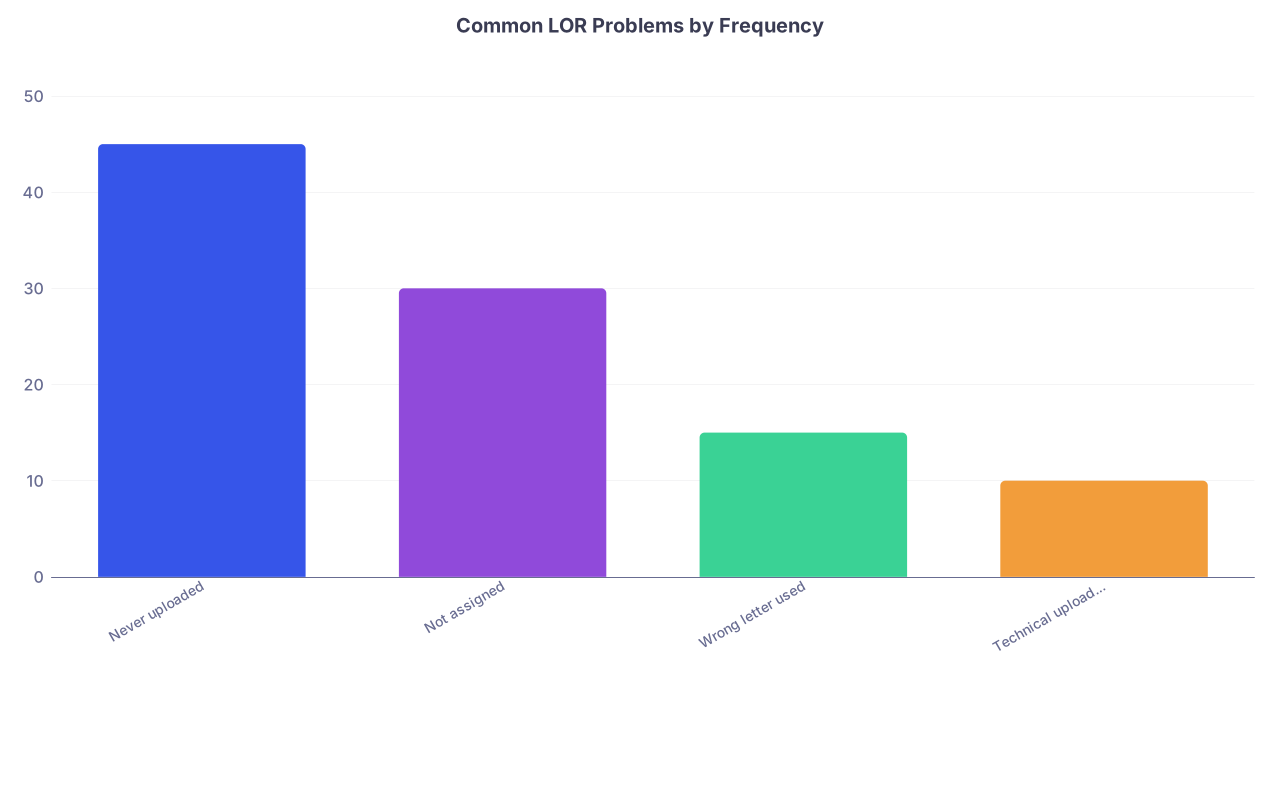
| Category | Value |
|---|---|
| Never uploaded | 45 |
| Not assigned | 30 |
| Wrong letter used | 15 |
| Technical upload issue | 10 |
2. Check email and communication history
Search your email for the letter writer’s name + “letter” or “ERAS”:
- Did they ever confirm upload?
- Did they send you a draft or say they finished it?
- Any sign of illness, travel, or emergency from them?
Also look at:
- Messages from your dean’s office / OSA
- ERAS system notifications
- Program-specific “your application is incomplete” emails
You are trying to answer:
- Is this a new loss (writer bailed, withdrew, or disappeared)?
- Or an administrative loss (technical / assignment / timing)?
3. Prioritize which programs are at risk
Make a quick list:
- Programs that specifically requested that type of letter (e.g., “at least 1 EM SLOE,” “at least 1 IM subspecialty letter”).
- Programs that have already offered you interviews (they may reconsider if the file looks incomplete).
- Programs whose deadlines are within 3–5 days.
This gives you a triage list. Because you cannot fix everything at once.
Step 2: Decide: Replace, Repair, or Work Around This Letter
You have three broad paths:
- Replace the letter with a new writer
- Repair the situation with the original writer
- Work around it with the letters you already have
Here is when to choose each.
| Situation | Best Primary Strategy |
|---|---|
| Writer is responsive but delayed | Repair with same writer |
| Writer vanished / refuses / is incapacitated | Replace with new writer |
| You already have 3–4 solid letters | Work around + maybe replace |
| Deadline within 48 hours | Work around + urgent replace |
A. Repair with same writer (best outcome if possible)
Choose this if:
- Writer is reputable, specialty-aligned, and originally agreed enthusiastically.
- The delay or loss seems accidental.
- You still trust them to come through quickly.
Your move: same-day, very clear email.
Subject line:
“URGENT: Residency LOR for [Your Name] – [Specialty] – Deadline [Date]”
Body (template you can tweak):
Dear Dr. [Last Name],
I hope you are well. I am reaching out because ERAS is not showing your letter of recommendation for my [specialty] residency applications as received. Programs are now reviewing applications, and several have flagged my file as incomplete.
Would you still be able to upload your letter? If so, I can resend the ERAS letter request link immediately. My applications are already submitted, so the sooner the letter is uploaded, the better.
I am very grateful for your support and understand this is a busy time. If it is not possible to complete the letter in the next few days, please let me know so I can arrange an alternate plan.
With appreciation,
[Your Name], MS4
[School] | AAMC ID: [ID]
Key points:
- You give them a graceful exit.
- You make the urgency unmistakable.
- You include the “if not possible, please tell me” line so you are not stuck in limbo.
If they reply “Yes, I will do it this week,” resend the ERAS request link immediately and set a reminder for 48 hours. If there is still no upload after that, move to replacement. No more waiting.
B. Replace with a new writer (when trust is broken or time is up)
Choose this if:
- The original writer is non-responsive for >48–72 hours during crunch time.
- They explicitly say they cannot or will not write.
- You discover they never intended to write a strong letter.
Now your goal: find the fastest viable backup who can say good things about you and is institutionally acceptable.
Step 3: Identify Your Best Emergency Replacement Options
You are not looking for perfection. You are looking for:
- Someone who knows your clinical performance
- Someone who responds to email quickly
- Someone whose name/role will not raise eyebrows in this specialty
1. Tier your options
Highest-yield emergency substitutes:
- Attending from a recent core or sub-I where:
- You were there for ≥2 weeks
- You presented regularly
- They saw you pre-round, write notes, or do procedures
- Clerkship or sub-I director who knows your performance and narrative evals
- Research mentor who has seen you work closely and can speak to your reliability, follow-through, and growth
Mid-tier but acceptable:
- Hospitalist or ward attending you worked with for a shorter block (1–2 weeks) but who liked your work
- Clinic preceptor with multiple encounters, especially in the specialty
- Chief resident or fellow co-writing an attending letter (they draft, attending signs)
Low-yield / last-resort:
- Pre-clinical course directors with minimal recent contact
- Shadowing-only contacts
- “Big name” faculty who barely know you (these letters read generic and sometimes hurt more than help)
2. Check program-specific expectations
For some specialties (EM, ortho, neurosurgery, etc.), specific letter types are not optional. You cannot replace:
- EM SLOEs with random IM letters
- Required home specialty letters with vague medicine letters
If you are in a high-structure specialty, you must prioritize replacement from:
- Another EM site for a SLOE
- Another surgery attending for surgical subspecialties
- Your home specialty department (chair, PD, clerkship director)
You can still use a non-ideal letter as a “fourth letter,” but the core requirement needs to be satisfied by the right type of writer.
Step 4: Make the Ask – Firm, Clear, and Easy to Say Yes To
Time to actually secure the replacement.
1. Who to contact first (Day 0–1)
- First: Attending from your strongest, most recent specialty-relevant rotation.
- Second: Clerkship or sub-I director (they often expect these asks).
- Third: Research mentor or other clinical attending who clearly liked working with you.
2. How to phrase the emergency ask
You need to sound:
- Professional
- Grateful
- Organized
- Urgent but not chaotic
Here is a direct template.
Subject: Request for Emergency Residency LOR – [Your Name], [Specialty]
Dear Dr. [Last Name],
I hope you are doing well. I am writing with a time-sensitive request. I am applying to [specialty] this cycle and recently learned that one of my anticipated letters of recommendation will not be submitted.
I very much valued working with you on [rotation/site/month], and I felt that you saw my clinical work closely. Given the situation, I wanted to ask if you would feel comfortable writing a letter of recommendation on my behalf for [specialty] residency.
I realize this is late in the season and would completely understand if your schedule makes this impossible. If you are able to help, I can send:
– My CV
– Personal statement
– ERAS letter request link
– A brief summary of the patients and cases we worked on togetherMy applications are already submitted and programs are actively reviewing them, so a letter in the next 7–10 days would be extremely helpful.
Thank you for considering this, and for your teaching and feedback during my rotation.
Sincerely,
[Your Name], MS4
[School] | AAMC ID [ID]
If the deadline is much tighter (3–5 days), you can write:
“…a letter in the next 3–5 days would be tremendously helpful. I understand this is a big ask on short notice and completely understand if it is not feasible.”
Be honest. Some people will say no. That is fine. You need one yes.

3. Offer a “letter packet” to make their job easier
Once they say yes, respond quickly with a tight package:
- Updated CV (PDF)
- Personal statement for the specialty
- ERAS letter request link + clear instructions
- 1-page bullet summary:
- Dates of rotation
- Your role and setting
- 3–5 specific patients/cases you were involved with
- Any positive feedback they gave you at the time
This 1–2 hour effort by you can easily shave days off their writing time.
Step 5: Timing Strategy – How Late Is Too Late?
Programs vary. Some will review new uploads right away. Some barely glance once they have screened you.
But generally:
During the pre-interview screening phase:
Late letters can absolutely change whether you get invites, especially if you were borderline but missing a required letter.During the interview season:
New letters can help shore up weaker files. Committees sometimes look again at candidates on the bubble.During the rank-list phase:
Late letters matter less. You are mostly judged on what was available when they met as a committee.
Rule of thumb: If you can get the replacement letter in within 7–14 days of applications opening or before most interview invites have gone out, do it. After that, still upload, but reset your expectations. At that point, it is mostly about strengthening your record for any programs that have not yet deeply reviewed you.
Step 6: Communicating with Programs (When and How)
People overthink this part. Programs do not want a novella describing your drama. They want:
- Clarity
- Brevity
- Reassurance that the gap is being handled
1. When you should contact programs
You should reach out if:
- A program specifically emails you that your application is incomplete due to a missing letter.
- A program clearly requires a particular type of letter (e.g., SLOE) that you know is delayed, and their deadline is soon.
- You are relying on a replacement that will arrive a few days after their stated deadline.
You can skip program contact if:
- You already have the required 3–4 letters and this is just an “extra” one.
- The missing letter is from a research mentor and you still meet requirements with clinical letters.
2. Email template to program coordinators
Subject: Update on LOR – [Your Name], [AAMC ID], [Specialty Application]
Dear [Program Coordinator Name] / [Program Name] Team,
I am writing regarding my residency application to [Program Name]. One of my anticipated letters of recommendation from [Dr. X, Department] will not be submitted due to unforeseen circumstances. I have arranged for an alternative letter from [Dr. Y, Role/Department], who supervised me on [rotation/site].
This replacement letter has been requested through ERAS and should be uploaded within the next [X] days. At present, my application includes letters from [Dr. A, Dr. B, Dr. C].
Thank you for your understanding. Please let me know if there is any additional information you need from me.
Sincerely,
[Your Name], MS4
[Medical School] | AAMC ID [ID]
Short, professional, no theatrics.
Step 7: Tight Internal Workflow – What You Do Over the Next 7 Days
Here is the “do this, then this” version.

| Step | Description |
|---|---|
| Step 1 | Discover missing/bad LOR |
| Step 2 | Check ERAS status & email history |
| Step 3 | Email writer with urgent, clear request |
| Step 4 | Identify backup writers |
| Step 5 | Set reminders & wait 48-72h |
| Step 6 | Email 2-3 backup writers |
| Step 7 | Send letter packet & ERAS link |
| Step 8 | Expand to next-tier writers |
| Step 9 | Track upload status daily |
| Step 10 | Email coordinators with brief explanation |
| Step 11 | Continue monitoring |
| Step 12 | Writer reachable? |
| Step 13 | Promises upload in 48-72h? |
| Step 14 | At least one says yes? |
| Step 15 | Programs flagged incomplete? |
Day 0 (today)
- Verify ERAS status.
- Contact original writer if there is any chance of salvage.
- Identify and email 2–3 backup writers.
- Note which programs are most at risk.
Day 1–2
- Respond immediately to any “yes” from backup writers with your packet.
- If original writer goes dark, stop waiting on them. Move fully to the backup.
- If programs contact you about incomplete files, reply using the template above.
Day 3–7
- Check ERAS portal once per day.
- Confirm that letters show as uploaded and assigned to all programs.
- If upload is delayed beyond what the writer promised, send one polite nudge. If nothing after that, you may need a second backup.

Step 8: Common Mistakes That Make This Worse (Avoid These)
I have watched people turn a solvable problem into a disaster by doing the following. Do not join them.
Clinging to a flaky writer for weeks
If they ignore two clear emails in a 72-hour window during peak season, treat the letter as dead and move on.Over-sharing personal chaos with programs
You are not writing a SOAP note on your emotional state. A concise factual explanation is enough.Panicking and asking completely inappropriate writers
A random PhD who taught you histology in M1 is not better than having one fewer letter. Stick to people who actually saw you in clinical or serious research work.Forgetting to assign the new letter to all programs
This is the quiet killer. Letter is uploaded, but 0 programs see it because you never check the boxes.Sending messy, incomplete information to your backup writer
If they have to dig for your CV, ask which specialty you are targeting, and guess how to access ERAS… your letter gets dropped down their priority list.
Step 9: Long-Term Damage Control and Future-Proofing
Once the fire is out, you still have to live with the application cycle you have.
1. Document what happened for yourself
Write down:
- Which letter was lost
- When you discovered it
- Who replaced it
- When replacement was uploaded
This matters for:
- Future advising meetings
- SOAP / reapplication (if necessary)
- Honest post-mortem on your strategy
2. For next cycles (yours or your classmates’)
If you are early enough in training to learn from this:
- Ask every letter writer:
- “When would be a realistic deadline for you to upload this?”
- “Is there anything you need from me to make this easy?”
- Request letters right after rotations end, while memory is fresh.
- Aim to have all letters uploaded before you submit ERAS. Not “eventually”.
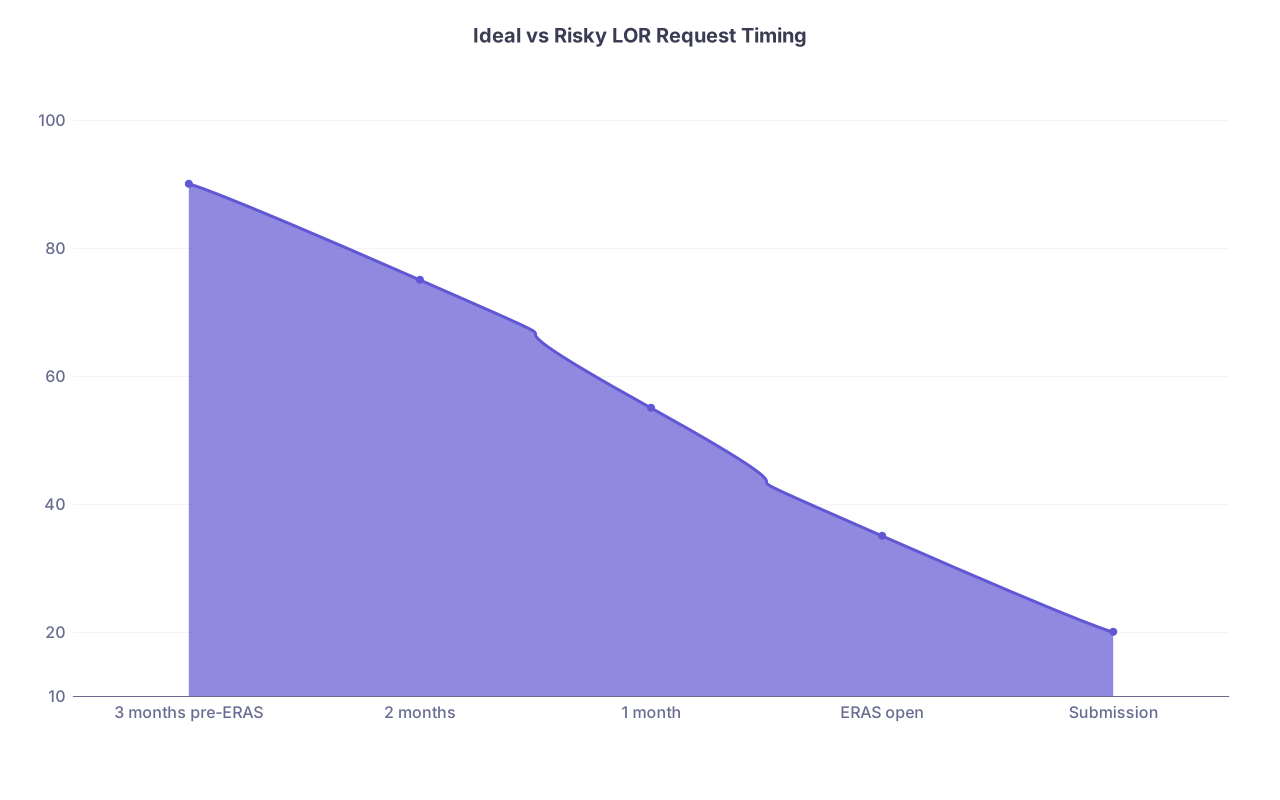
| Category | Value |
|---|---|
| 3 months pre-ERAS | 90 |
| 2 months | 75 |
| 1 month | 55 |
| ERAS open | 35 |
| Submission | 20 |
Think of letter management as part of your professionalism. Programs notice when your file is clean, timely, and complete.
Quick Reference: Tiered Action Plan
If you are reading this in full panic, here is the stripped-down version.
Within the first 2–3 hours:
- Confirm ERAS status and error type
- Email original writer with an urgent-but-polite message
- Identify and email 2–3 backup writers, starting with those who know your clinical work best
Within 48–72 hours:
- Commit: either your original writer is in, or you stop waiting
- Provide full packets to any backup who said yes
- If programs alert you to incomplete files, send brief explanatory emails
Over the next week:
- Monitor ERAS daily
- Make sure letters are assigned properly
- Send one gentle reminder if promised letters are late, then seek a second backup if needed
FAQ (Exactly 3 Questions)
1. Is it worse to have only 3 letters instead of 4, or to add a weaker “emergency” letter?
If your 3 letters are strong, specialty-appropriate, and meet program requirements, I would rather see you submit 3 solid letters than pad with a generic, lukewarm letter from someone who barely knows you. That said, if your emergency letter writer actually supervised you clinically and can comment specifically on your performance, it is usually worth adding as a fourth.
2. Should I tell interviewers about the lost letter during interviews?
Only if they ask directly about letters or there is a clear gap (for example, no letter from your home specialty). Then you give a brief, non-dramatic explanation: the original writer had an unforeseen issue, you arranged a replacement, and you are grateful to those who supported you. No blaming, no long story. Two sentences and move on.
3. Can I reuse this emergency replacement letter if I have to reapply next year?
Yes, in most systems you can. Strong letters are reusable, especially if the writer commented on enduring traits (work ethic, communication, clinical reasoning) rather than a specific date window. If you end up reapplying, you ideally combine that existing strong letter with at least one new letter from a fresh rotation or research experience to show growth.
Key points to walk away with:
- Do not wait on a flaky letter writer. Decide quickly whether to repair or replace, and then commit.
- Your backup letter is only as fast as the packet you give the writer. Make it easy for them to say yes and to write fast.
- Programs care more about having the right kind of letters from people who actually know your work than about you hitting some magic number. Focus on substance and execution, not panic.