Preparing for dermatology board exams is a marathon, not a sprint. With an overwhelming array of books, question banks, flashcards, and courses, the real challenge is not just what to use, but how to structure an efficient, sustainable study plan that works for you.
This guide walks you through the major dermatology board exam study resources, how to choose among them, and practical ways to integrate them into your schedule—whether you’re a PGY-2 just starting dermatology or a senior resident aiming for a top score and a strong derm match profile.
Understanding Your Dermatology Board Exam Landscape
Before building your resource stack, you need a clear map of the exam targets.
1. Types of Exams You’ll Face
Depending on where you are in training, you may be preparing for:
USMLE/COMLEX (Pre-residency)
- Foundation for a competitive dermatology residency application
- Emphasis on core medicine, pathology, basic science
- Dermatology shows up in images, rash differentials, systemic disease associations
In-Training Exams / In-Service Exams (ITE)
- Program-level assessments during residency
- Mirror content and style of the dermatology boards
- Excellent “rehearsal” and gap-assessment tools
Dermatology Board Certification Exam
- Focused on:
- Clinical dermatology (medical, surgical, pediatric, cosmetic)
- Dermatopathology
- Basic science (immunology, genetics, pathophysiology)
- More image-heavy and pattern-recognition focused than general boards
- Focused on:
Understanding the level and goals of each exam helps you pick resources that match the depth you need. For instance, USMLE-style multiple-choice banks with step-style explanations differ in format from image-rich dermatopathology resources used for boards.
2. Core Principles for Choosing Resources
No matter the specific exam, effective dermatology board prep resources should:
- Be high-yield: focus on test-relevant facts, common diagnoses, and key zebras
- Provide clinical images: real-world pattern recognition is crucial in derm
- Include question-based learning: simulate test conditions and reasoning
- Offer integrated explanations: linking clinical, path, and basic science
Core Textbooks and Manuals: Building a Strong Foundation
Textbooks won’t usually be your primary board study tool in the months before the exam, but they create the foundation that makes questions and flashcards meaningful.
1. Essential Clinical Dermatology Texts
These are ideal for early residency and targeted review of weak areas:
Bolognia’s “Dermatology”
- Comprehensive, gold-standard reference
- Strengths: depth, evidence-based coverage, great for complex or rare conditions
- Best use:
- Early residency for foundational reading
- Later: quick reference for topics you keep missing on questions
- Tip: Don’t try to read it cover-to-cover for boards; instead, use it to clarify topics flagged by questions (e.g., porphyrias, autoimmune blistering diseases).
Fitzpatrick’s Dermatology in General Medicine (or Fitzpatrick’s Color Atlas)
- Excellent for:
- Pattern recognition
- Clinical images and classic presentations
- Best use:
- Before blocks or clinics (e.g., review pediatric rashes before peds derm rotation)
- As a visual companion when reviewing question explanations
- Excellent for:
Andrew’s Diseases of the Skin
- Practical orientation with strong clinical correlation
- Good blend of detail and readability
- Best use:
- Section-based review by body system or disease category
- Supplement to question-based gaps
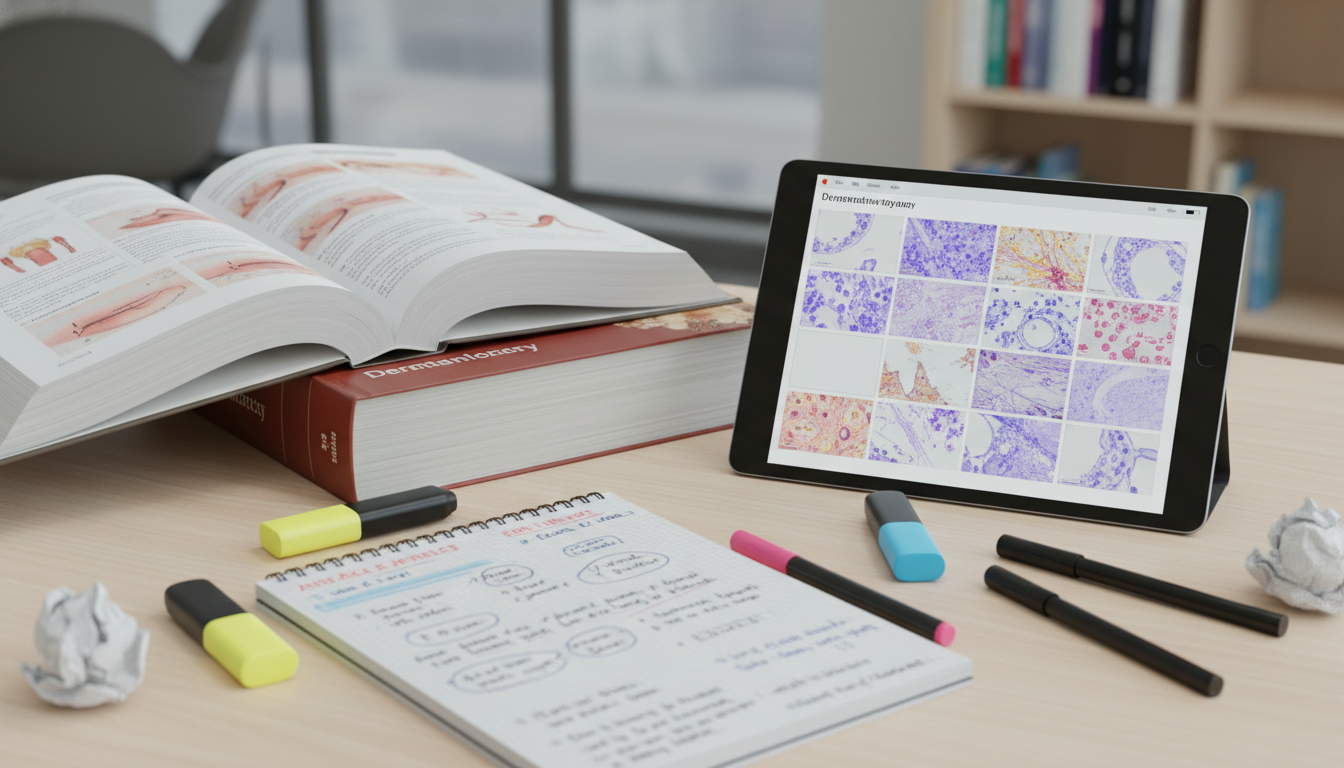
2. Dermatopathology Fundamentals
Given how heavily derm boards test dermpath, you need at least one strong dermpath-focused resource:
Weedon’s Skin Pathology (or concise versions)
- High-yield for pattern-based recognition:
- Interface dermatitis
- Spongiotic processes
- Vesicobullous diseases
- Granulomatous patterns
- Best use:
- Planned weekly dermpath review sessions
- Use with slides/images and compare your impression to key features
- High-yield for pattern-based recognition:
Elston’s Dermatopathology or other board-directed dermpath guides
- More exam-focused, shorter than Weedon
- Often organized by reaction pattern and entity
- Best use:
- 3–6 months before boards as a primary dermpath review text
- Annotate with your own mnemonics and missed-question notes
3. How to Integrate Texts Without Getting Overwhelmed
- Set time-limited reading goals:
- Example: “30 minutes after clinic to skim vesiculobullous disorders”
- Let questions drive reading:
- Miss a question on pityriasis rubra pilaris? Spend 10–15 minutes with Bolognia or Andrew’s on that single topic.
- Use visual anchors:
- When you read about disorders, always look at at least 2–3 images and, if possible, correlate clinical + dermpath.
Question Banks and Practice Exams: The Engine of Your Study Plan
Question-based learning should be the spine of your board exam preparation. It tests knowledge, exposes blind spots, and builds test-taking stamina.
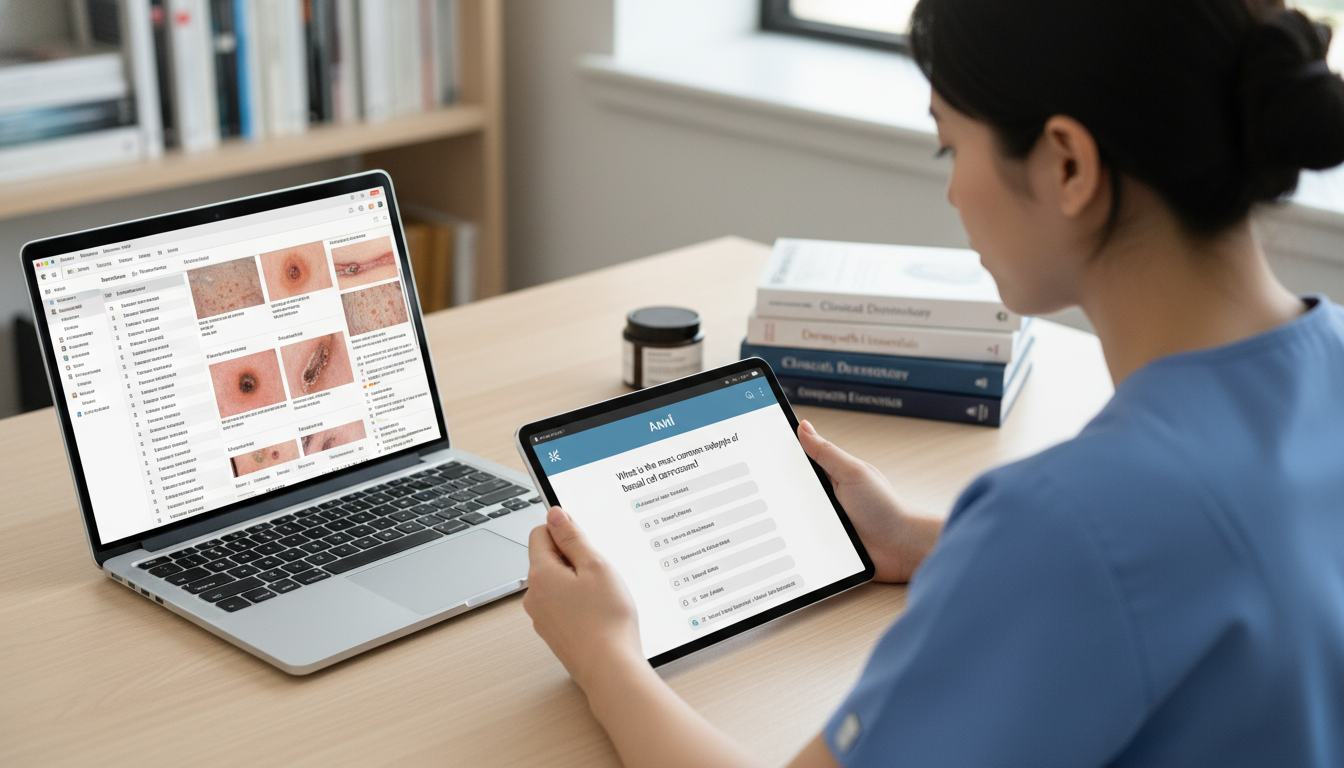
1. UWorld and USMLE-Oriented Question Banks
Even though UWorld is not dermatology-board-specific, its role is critical early in your journey:
For pre-residency and early PGY years
- UWorld is still the premier resource for:
- Building clinical reasoning
- Learning structured approach to multiple-choice questions
- Mastering systemic diseases with dermatologic manifestations
- UWorld tips for derm-bound students:
- Tag skin-related questions for later revisits
- Pay special attention to rash descriptions, mucosal involvement, and systemic associations (SLE, dermatomyositis, vasculitis).
- UWorld is still the premier resource for:
Translating UWorld skills to Derm Boards
- Boards will rely even more on:
- Pattern recognition of images
- Subtypes and variants (e.g., psoriasis variants, lichen planus variants)
- The approach you refine with UWorld—reading stems efficiently, eliminating distractors, reasoning through vignettes—is directly applicable.
- Boards will rely even more on:
2. Dermatology-Specific Question Banks
As you get closer to the actual dermatology board exam, you should transition toward specialty-focused question resources.
Common features to look for:
- Large number of image-based questions
- Separated sections for:
- Medical dermatology
- Surgical dermatology
- Pediatric dermatology
- Dermatopathology
- Detailed explanations that include:
- Why the correct answer is right
- Why each distractor is wrong
Typical resource types (exact titles and vendors may vary by year):
Board-style dermatology Q-banks (online)
- Often used 6–12 months pre-exam
- Best practices:
- Use timed, mixed blocks at least twice per week
- Maintain a log of repeated misses by topic (e.g., “I consistently miss adnexal tumors”)
- Re-do incorrect questions 2–3 months before boards
Dermatopathology-specific question sets
- Slide-based with pattern recognition prompts
- Integrate with your dermpath readouts:
- Try to quiz yourself on pattern (e.g., lichenoid, vesicobullous) before you look at the answer
3. In-Training Exams and Mock Boards
Most residency programs administer:
Annual In-Training Exams
- Use your score to:
- Identify weak domains (e.g., pediatric derm vs dermpath)
- Set targeted goals for the following year
- After results:
- Spend 2–3 weeks focused on your lowest-scoring areas using board review books + topic-specific questions
- Use your score to:
Program-based Mock Exams or Review Sessions
- Treat these like simulations:
- Sit in test conditions
- Practice time-management and endurance
- Ask your program if they can provide a printout of topic-wise performance so you can adjust your study focus.
- Treat these like simulations:
Flashcards, Anki, and Active Recall: Locking in Details
Dermatology is both pattern- and detail-heavy: drug associations, histologic buzzwords, eponyms, and rare syndromes are all fair game. Passive reading isn’t enough—this is where spaced repetition and active recall come in.
1. Using Anki for Dermatology and Board Exams
Anki (or similar spaced-repetition platforms) is especially useful for:
USMLE-level knowledge:
- Many residents already use standard Anki USMLE decks before derm match
- These decks build strong internal medicine, pathology, and pharmacology foundations that will underpin derm boards
Dermatology-specific decks:
- Some residents create (or share) decks focused on:
- Clinical-histologic correlations
- Criteria lists (e.g., diagnostic criteria for atopic dermatitis, systemic sclerosis subsets)
- Treatment ladders (first- vs second-line therapies)
- Practical cards:
- “Question side”: Clinical photo or description + key vignette
- “Answer side”: Diagnosis, hallmark features, dermpath, and first-line treatment
- Some residents create (or share) decks focused on:
Best practices with Anki USMLE and dermatology decks:
- Set a manageable daily review cap (e.g., 80–150 cards/day) to avoid burnout
- Make your own cards for:
- Concepts you keep forgetting on question banks
- Pearls from cases in clinic or dermpath signout
- Avoid copy-pasting entire paragraphs; focus on short, testable nuggets
2. What Content Belongs in Flashcards?
Ideal topics for flashcards:
Lists and criteria
- Diagnostic criteria (e.g., ACR/EULAR for SLE — for systemic derm-neuro conditions)
- Clinical staging systems (e.g., staging of mycosis fungoides)
- Treatment algorithms (e.g., acne, psoriasis, atopic dermatitis)
Rare but testable entities
- Genetic syndromes with skin findings (e.g., Peutz-Jeghers, Cowden syndrome, MEN syndromes with cutaneous clues)
- Classic associations (e.g., dermatomyositis and malignancy)
Dermpath patterns
- “Interface dermatitis: list 5 key differentials”
- “Subepidermal blister with neutrophils: what are the top entities?”
3. Combining Flashcards with Questions
- After a block of board-style questions:
- Flag missed questions that reflect knowledge gaps, not just misreads
- Create 1–3 Anki cards per missed concept
- Before doing new question blocks:
- Briefly review cards from the topic of the day (e.g., bullous disorders, neoplasms) to “prime” your recall.
Courses, Review Books, and Multimodal Resources
Beyond textbooks, questions, and Anki, there are highly targeted resources designed specifically for derm board prep.
1. Board Review Courses (Live and Online)
Many academic centers and national organizations offer:
Live board review courses
- Usually held annually
- Intensive multi-day format covering:
- Medical derm
- Pediatric derm
- Dermpath
- Surgical and procedural topics
- Benefits:
- Structured overview and synthesis
- Opportunity to hear how experienced faculty frame “classic” board questions
- Chance to ask clarifying questions in real time
Online recorded courses
- Flexible viewing on your own schedule
- Can be played at 1.25–1.5x speed for efficiency
- Strategy:
- Use video lectures 6–9 months before exam for broad overview
- Re-watch select difficult topics 1–2 months before exam
When choosing a course:
- Ask senior residents:
- Which course did they use?
- Were the exam questions similar?
- Did the course focus on high-yield content or get lost in minutiae?
- Check if course materials include:
- Handouts, summary tables
- Question sets or mini-exams
2. High-Yield Dermatology Board Review Books
Look for board-focused texts labeled as “review” or “board prep,” often:
- Organized by topic:
- Inflammatory
- Infectious
- Neoplastic
- Genetic
- Pediatric
- Heavily image-based
- Concise bullet-point style
How to use them effectively:
- First pass (6–9 months before exam):
- Read 1–2 chapters per week alongside your clinic cases and question banks
- Second pass (2–3 months before exam):
- Focus only on sections corresponding to your weakest ITE domains
- Annotate margins with:
- Mnemonics
- “Missed on Q-bank” notes
- Final pass (last 2–3 weeks):
- Skim high-yield tables and images daily
- Make quick mental “spot diagnoses” before looking at captions
3. Multimedia and Image-Based Resources
Given the image-intense nature of derm boards, you need frequent exposure to:
Clinical image atlases
- Print or online resources with high-quality photographs
- Practice:
- Look away from captions
- Name the diagnosis, top differentials, and one key histologic feature
Dermpath slide collections
- Whole-slide images (WSI) or static digital slides
- Practice:
- Identify main pattern (e.g., lichenoid, granulomatous)
- List top 3–5 entities that fit the pattern
Podcasts / Audio Summaries
- Useful for:
- Commuting
- Light review when you’re too tired to read
- Focus on:
- Board pearls
- Algorithmic treatment overviews
- Disease overviews (e.g., “approach to blistering diseases”)
- Useful for:
Putting It All Together: Sample Study Strategies and Timelines
Resources are only as effective as the plan behind them. Here are practical examples tailored to different phases.
1. Early Residency (PGY-2 Derm or First Year in Specialty)
Goals:
- Build strong conceptual foundation
- Develop derm-specific pattern recognition
- Transition from USMLE-style studying to dermatology-focused learning
Suggested approach:
- Clinical + text integration
- After clinic: pick 1–2 cases and read 10–20 minutes about them in Bolognia or Andrew’s
- Question exposure
- 10–15 derm questions, 3–4 times per week from a derm question bank
- Dermpath basics
- Weekly dermpath session:
- Review pattern-based chapters in a dermpath text
- Correlate with clinic cases if possible
- Weekly dermpath session:
- Flashcards
- Start a small personalized Anki deck:
- 5–10 new cards per clinic day
- Focus on common diseases and classic board pearls
- Start a small personalized Anki deck:
2. Mid-Residency (PGY-3 Derm)
Goals:
- Improve scores on in-training exam
- Identify and remediate weak areas
Suggested approach:
- Question-heavy focus
- 20–40 questions, 4–5 days per week
- Alternate between:
- Medical derm
- Dermpath
- Peds and surgery/procedural topics
- Post-ITE targeted plan
- After results:
- Identify bottom 2–3 domains
- Spend 4–6 weeks with:
- Topic-specific chapters from board review books
- Focused flashcards
- Extra question sets in those areas
- After results:
- Begin board review course content
- If you have access to recorded lectures:
- Start watching 1–2 hours per week to build a broad framework.
- If you have access to recorded lectures:
3. Board Year (Final Year; 6–12 Months Before Exam)
Goals:
- Consolidate knowledge
- Maximize practice under test-like conditions
- Fine-tune timing and endurance
6–9 Months Out
Full integration
- 30–50 questions/day, 5–6 days/week from dermatology Q-banks
- 1–2 hours/week watching or listening to board review lectures
- 1 dermpath-focused session/week using slides + text
Refine Anki/Spaced Repetition
- Daily review of 80–150 cards (depending on deck size)
- Prioritize:
- High-yield diseases
- Dermpath buzzwords
- Systemic associations
2–3 Months Out
- Simulate exam blocks
- Perform timed, mixed blocks:
- Full-length half-day or full-day practice once every 1–2 weeks
- Review all explanations the next day
- Perform timed, mixed blocks:
- Second pass through review books
- Focus on:
- Inflammatory dermatoses
- Neoplastic lesions
- Pediatric derm
- Dermpath patterns
- Focus on:
- Gap repair
- Keep a “weak topics” list (e.g., cutaneous lymphomas, genodermatoses)
- Schedule focused 1–2 hour sessions just for each topic
Final 2–3 Weeks
- Taper volume, sharpen recall
- Shorter question sets with deeper review
- Fast visual drills:
- Flip through atlases and digital slide collections
- Quickly name diagnoses and patterns aloud
- Light review of summary tables
- Medications, side effects, contraindications
- Genetic conditions, inheritance patterns, and malignancy risks
- Sleep and stamina
- Standardize sleep schedule
- Do at least 2–3 full “test days” to practice mental endurance
FAQs: Board Exam Study Resources in Dermatology
1. How early should I start using dermatology-specific board resources?
You can start light dermatology-focused studying as early as your first dermatology year, but intense board-specific prep typically begins about 6–12 months before the exam. Earlier on, it’s more important to:
- Master clinical fundamentals in clinic
- Build broad medical knowledge via UWorld and other internal medicine/pathology resources
- Gradually introduce derm question banks and dermpath texts
2. Is Anki really necessary for dermatology board prep?
Not mandatory, but highly effective. Anki or similar spaced-repetition tools:
- Help you retain lists, criteria, treatments, and dermpath patterns
- Are particularly powerful if you:
- Make your own cards from questions and cases
- Keep your daily review load manageable Residents who used Anki USMLE effectively often find it natural to extend that habit into dermatology-specific decks.
3. How much should I rely on my residency program’s teaching vs external resources?
Your residency program’s didactics, dermpath signout, and in-clinic teaching are invaluable and should be your primary clinical education. However, for standardized exams:
- You’ll still need external board-directed resources:
- Question banks
- Review books
- Possibly a review course The best results come when you integrate program teaching with structured personal study, using board materials to identify and fill gaps.
4. Is it worth investing in a formal dermatology board review course?
For many residents, yes—especially if:
- You learn well from live or video lectures
- Your program doesn’t have a robust in-house board review
- You prefer a structured, high-yield overview in the 6–9 months before the exam
If budget is a concern, ask:
- Does your program reimburse or subsidize the course?
- Have recent graduates found a specific course noticeably helpful for their board success?
By thoughtfully combining core textbooks, dermatology-specific question banks, dermpath resources, Anki/spaced repetition, and (if helpful) a formal review course, you can build a powerful, efficient dermatology board study plan. Focus on consistent, question-driven learning—anchored in real clinical and dermpath images—and use your in-training exams to steer your efforts.