
What do you actually think when that first interview invite hits your inbox—“Nice, they love me,” or “Okay, logistics”? Because most applicants quietly believe the first one. Early invite = top of the rank list. Late invite = backup. Rejection by delay.
That belief is wrong. And clinging to it makes people make stupid decisions—canceling “late” interviews they think they won’t match at, obsessing over timestamps in SDN threads, spiraling because they got their invite three days after a classmate.
Let’s walk through how this really works, not how applicants tell each other it works.
The Myth: Early Invite = High Rank
The story you hear on Reddit and in group chats goes like this:
Programs send early invites to their favorites.
You got an invite on “wave 1”? You’re high on the list.
You got a “late-season” invite? You’re filler, insurance, a warm body.
There’s a grain of truth here—but it’s tiny compared to the noise.
Here’s the uncomfortable reality: for most programs, the timing of your invite tells you almost nothing precise about where you'll land on their rank list. It usually tells you way more about their admin structure, faculty availability, and IT quirks than about “how much they want you.”
Programs are chaotic behind the curtain. I’ve watched this play out in real time: coordinators wrestling with ERAS filters, faculty demanding specific students be added, last-minute clinic changes blowing up carefully arranged interview grids. Your application is not being read in some clean, perfectly linear order from “best to worst.”
Let’s get specific.
How Programs Actually Send Interview Invites
Forget the fantasy that every program sits down on September 28th, ranks everyone, then invites the top 10% in order. That’s not what’s happening.
Most programs are dealing with:
- Hundreds to thousands of applications
- Limited interview days, half controlled by clinic schedules
- Last-minute faculty switches
- Institutional “rules” that get bent constantly
Here’s a more honest model of what’s going on.

| Step | Description |
|---|---|
| Step 1 | Applications In ERAS |
| Step 2 | Initial Filters (scores, visa, geography) |
| Step 3 | Subset Reviewed By Faculty |
| Step 4 | Batch 1 Invites |
| Step 5 | Hold Applicants |
| Step 6 | Faculty Reviews More Files |
| Step 7 | Batch 2 & 3 Invites |
| Step 8 | Waitlist / Replacement Invites |
| Step 9 | Interview Slots Defined? |
Programs commonly:
Use hard filters first: Step cutoffs, visa status, graduation year, sometimes school lists or geographic ties. This determines who even gets a real look, not who’s “ranked higher.”
Review in chunks: One faculty member reviews 40 apps on a weekend and stars 10. Another reviews a different 60 two weeks later and stars 12. Those two batches might get interviewed on the same day—or not.
Protect certain categories: Home students, couples match pairs, URiM applicants, military deferments. These can be added into the schedule at any time and can trigger reshuffling.
Send invites as logistics dictate: When they’ve locked down sufficient faculty for certain days, they release that day’s slots. If a faculty member cancels a clinic four weeks later? Boom, a “sudden” wave of new invites.
So early invites usually mean: your application lived in the first chunk someone had time to review and there were slots to release that day. That's very different from “we ranked you top 10.”
Where There Is a Signal: Who Gets Invited, Not When
The strongest signal is binary: did you get an interview at all? That means you cleared their filters and someone advocated for you. Not “we will rank you to match.” Just “you are viable and interesting enough to meet.”
The weaker, often over-interpreted signal: how long after apps opened did they get to you?
Sometimes, timing matters a bit. Sometimes, it’s noise. The trick is knowing the difference.
Programs vary a lot in behavior. Here’s a rough comparison:
| Program Type | Typical Invite Pattern | Timing vs. Rank Strength |
|---|---|---|
| Hyper-competitive university | Multiple waves, heavy waitlist | Weak |
| Mid-tier academic | Rolling waves over weeks | Very weak |
| Small community | Single early wave + replacements | Moderate |
| Newer program | Slow, irregular waves | Very weak |
| Home program for many students | Multiple custom adjustments | Chaotic / unpredictable |
At a small community program that interviews 60 to match 8, an early invite might correlate somewhat with being in the “we really want these people” group—because they simply don’t have that many slots to spread across waves. But even there, faculty availability and late-reviewed applicants distort things.
At a big university program interviewing 200+? The difference between being in invite wave 1 vs wave 3 is basically meaningless.
What the Data and Match Outcomes Actually Show
Let’s anchor this in the numbers for a second, not vibes.
NRMP Program Director surveys and Charting Outcomes give you one clear message:
Most programs rank way more people than they actually match, and applicants match at places that interviewed them at all across a wide distribution—not just “early favorites.”
Take internal medicine as an example. Many university IM programs:
- Interview ~300–400 applicants
- Rank ~250–350
- Match ~20–30
Emergency medicine pre-SOAP changes often interviewed ~120–150, ranked nearly all, and matched ~10–15.
So if you have an interview, your competition isn’t “people in wave 1 only.” It’s the entire ranked pool. And programs are terrible at predicting which 10–20 of those 200+ will actually end up there. Couples match, geography, spouse jobs, dual-application to prelim/advanced programs—all of that scrambles the final match list.
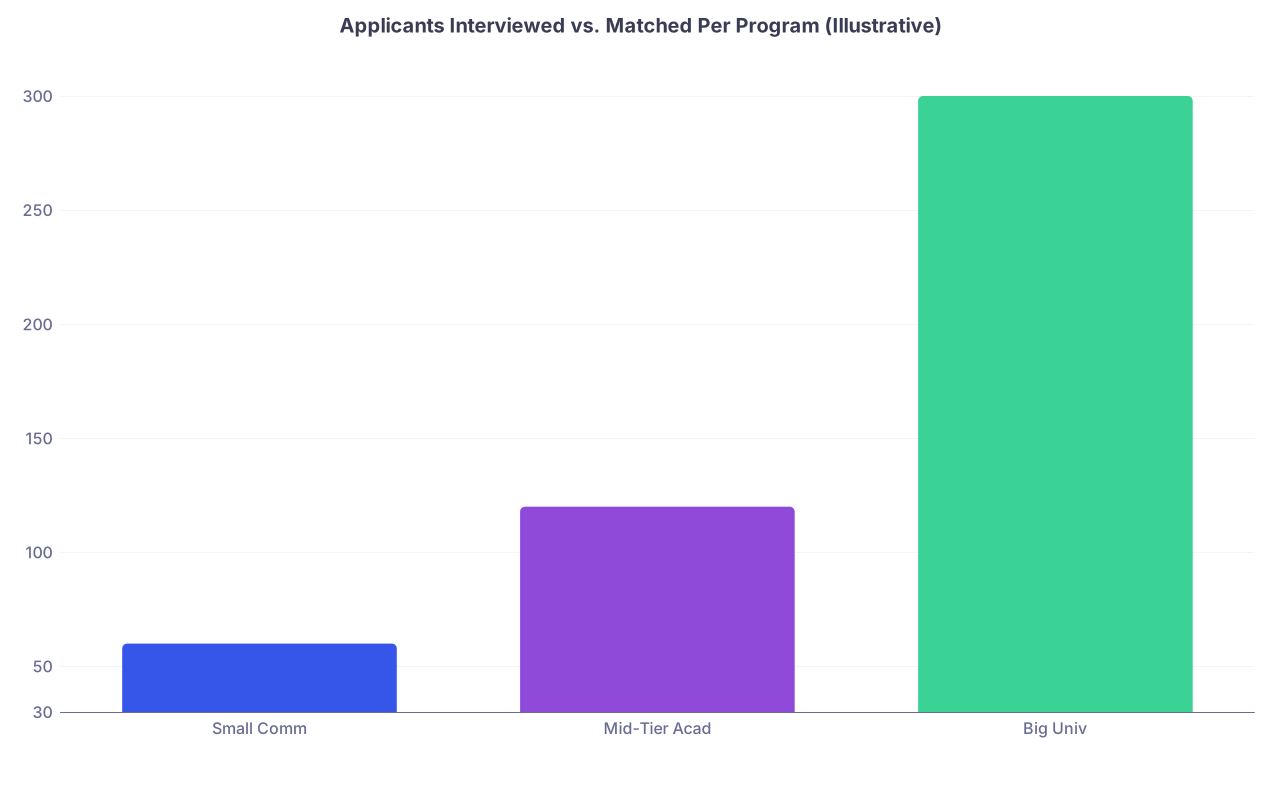
| Category | Value |
|---|---|
| Small Comm | 60 |
| Mid-Tier Acad | 120 |
| Big Univ | 300 |
The graph is just a visual reminder: the majority of people interviewed do not match each program. But they’re all ranked; and the order isn’t set when invites go out.
Also critical: many programs don’t finalize their rank list until very late—sometimes days before the NRMP deadline. That means your interview performance, post-interview communication, and late impressions can absolutely move you up or down, regardless of when the invite came.
I’ve seen applicants who got late-season invites and ended up very high on rank lists because they clicked with faculty, had unique niche interests, or wrote a thoughtful follow-up email that stuck in people’s minds during the ranking meeting.
Why Early Invites Can Still Mislead You
Let’s take the classic scenario:
- You get 5 interviews early at places you like.
- You later get 3 more invites from decent but less “prestigious” places.
- You’re tired, SDN says you’re “probably safe,” and someone on Reddit says, “If they invited you in January, they’re just interviewing backups.”
So you cancel the later ones.
Then March rolls around, and you’re stunned when you match at #4 instead of #1 or #2. Or, in the worst-case scenario, you don’t match, and you’re staring at a SOAP list wondering why you decided you were “safe” with so few programs.
Did the early invites mean those top ones ranked you highest? No. It usually just means they read your application early.
Here’s how this goes wrong on the program side:
- Rank meetings are done in a group. A couple of strongly opinionated faculty can pull you sharply up—or quietly push you down.
- Late-interviewed applicants are fresh in everyone’s memory. Recency bias is real. A mediocre early-interviewed applicant can lose out to a stellar late one.
- There’s horse trading: “If I get to move this applicant up 10 spots, I’m fine with moving that one down.” You are not hearing about those conversations.
So your early interview did not buy you permanent “favorite” status. It bought you a chance. Same as a later one.
The Few Cases Where Timing Might Signal Something
Let me be fair. There are patterns where timing is not completely meaningless.
Here’s where timing can hint at signal:
Extremely small programs with a single invite wave
Think: 3–4 spots, 30–40 interviews, all invitations go out on one single date, and they basically don’t add anyone except replacements. If you were in that first and only blast, it probably means you were in their core batch. But even then, how you actually perform on interview day can change your rank significantly.“Courtesy” invites very late to clearly unmatched applicants
Some programs do toss out late invites in January to applicants with no interviews or clear red flags if they have leftover slots. These can be lower-yield in terms of match odds. But they still sometimes match people from this group too, especially in less competitive specialties or regions.Incomplete applicants who cleared once scores/letters arrived
If you were screened out early because you had missing Step 2 or a weak letter that got replaced, a later invite might mean: “We weren’t sure at first; now we are interested.” That’s less about rank, more about “you cleared our bar later.”
Even in these cases, the ceiling remains: once you’re in the interview pool, performance and fit can matter more than the timestamp on the invite.
The Real Signals You Should Pay Attention To
Instead of sweating “wave 1 vs wave 3,” you should be paying attention to things that actually track with match outcomes:
Total number of interviews
NRMP gives very clear guidance in Charting Outcomes. There’s a rough plateau where additional interviews add diminishing returns. For most core specialties, going from 3 to 8–10 interviews massively improves your chances. Going from 16 to 22? Not so much. Timing doesn’t meaningfully change that curve.Program fit and geography
Programs are biased toward people who genuinely want to be in their city and in their type of practice. If you’re from the region, have real ties, or made a compelling case for wanting that environment, that can bump you more than being an “early invite.”How the actual interview goes
I’ve seen PDs tank an applicant for arrogance, vague answers, or weird behavior despite early invites and strong scores. I’ve also seen them aggressively push a late-invited “sleeper” candidate way up because the person was grounded, thoughtful, and clearly a fit.Faculty advocates
If a specific faculty member really wants you—because of your research interest, shared background, or clinical performance—that will usually matter more at the rank meeting than the date on your invite email.
What You Should Do With Early vs Late Invites
So how do you actually behave strategically, knowing all this?
First: stop reading invite timing as a scoreboard. It is not a rank list preview. Getting your invite three days earlier than your classmate doesn’t mean you’re “higher” at that program.
Second: do not cancel “late” interviews just because you assume you’re low priority. Cancel only if:
- You’re over the interview number where data says your match odds plateau and
- You genuinely would not be willing to train there under almost any scenario
Third: treat every interview like the one that might save your match. Because sometimes it is. I’ve watched people match at a program they almost didn’t rank highly, from an invite that came late, in a city they were lukewarm about—because the “dream” places overestimated their reach and under-ranked them.
And programs? They’re terrible forecasters too. They often think, “This superstar won’t actually come here,” and then undershoot on ranking… and then act surprised on Match Day.
One More Ugly Truth: Programs Don’t All Have Their Act Together
Some programs are well-oiled machines with structured scoring systems. Others are held together by one overworked coordinator and a PD who does rank lists on a Sunday night after a long week on service.
So you’re trying to read deep meaning into systems that are frequently:
- Disorganized
- Inconsistent across years
- Subject to last-minute GME or institutional pressure (“We need more local grads,” “We need more IMGs,” “We need to show we interview more URiM applicants,” etc.)
Thinking you can decode all that from being invited on October 10th vs October 25th is wishful thinking.
The Bottom Line
Let’s strip it all the way down.
Getting an interview is the real threshold; timing is a weak signal at best. Early invite does not equal “top of their rank list,” and late invite does not equal “backup only.”
Your match chances are driven by number of interviews, fit, and performance—not the invite timestamp. Obsessing over waves distracts you from the part you can actually control: how you show up on interview day and how smart your rank list is.
If you have an interview, you’re in the game. Stop trying to reverse-engineer the draft order from when your email landed and focus on playing it well.