
Matching is not “all about Step 2 CK.” But if you pretend scores don’t matter, you’re lying to yourself.
Both extremes are wrong:
– “It’s 100% Step 2 CK.” False.
– “Scores don’t matter, it’s holistic now.” Also false.
The truth is uglier and more nuanced: scores are the gatekeeper, holistic review is the tiebreaker. And depending on your specialty and where you’re applying, the gatekeeper can be a flimsy rope or a concrete wall.
Let’s walk through what the data actually show, not what comforting advisors tell you in group sessions.
What Programs Actually Use Scores For
Residency programs are drowning in applications. The NRMP Program Director Survey and independent studies are blunt about this: scores exist because programs need a fast way to say “no” to most people.
Here’s what scores usually do in the process:
- Initial screen: Decide whose application gets opened and whose goes straight to the reject bin.
- Risk filter: Identify applicants likely to pass boards on the first try (ACGME and hospitals watch these numbers).
- Comparator: When PDs have 40 applicants from similar schools, research, and class rank, scores become the numeric tiebreaker.
After Step 1 went pass/fail, Step 2 CK inherited most of the old Step 1 role. Not all of it—but most.
, Letters of Recommendation, Personal Statement, Research Experience](https://cdn.residencyadvisor.com/images/articles_svg/chart-relative-importance-of-application-factors-program-9276.svg "Relative Importance of Application Factors (Program Director Self-Report)")
| Category | Value |
|---|---|
| Step 2 CK Score | 80 |
| [Clerkship Grades](https://residencyadvisor.com/resources/residency-application-guide/what-pds-actually-weigh-more-ms3-clerkship-grades-vs-step-2-ck) | 70 |
| Letters of Recommendation | 75 |
| Personal Statement | 40 |
| Research Experience | 45 |
Do I trust PD self-report as perfect truth? No. But when ~80% of them list Step 2 CK as “important” or “very important” for interview decisions, you’d be delusional to act like it’s a side detail.
The actual pattern I’ve seen across programs is roughly this:
- Step 2 CK = interview access
- Clinical performance + letters = rank list order
- “Holistic” factors (life story, red flags, fit) = outliers upward or downward
If your Step 2 is strong, holistic review can help you shine. If your Step 2 is weak, “holistic” may just mean someone politely reads your file before rejecting you.
The Myth of Pure Holistic Review
Let me be very clear: “holistic review” does not mean “scores don’t matter.”
Originally, holistic review in GME was supposed to mean:
- Considering experiences (research, leadership, work, volunteering)
- Considering attributes (advocacy, resilience, background, diversity)
- Considering metrics (grades, scores)
…in a balanced framework, not just sorting by a single number.
The AAMC and ACGME have both pushed this language hard, especially after Step 1 went pass/fail and as diversity became a more explicit institutional priority.
Here’s what actually happens in most programs:
- They still use a screen, often with an informal or soft Step 2 CK cutoff.
- Among those who pass the screen, they shift to something closer to holistic review.
- Only a minority of programs truly read every application without an initial numerical filter. (Usually very small programs or very mission-driven ones.)
Think of it like airport security. TSA doesn’t profile only on your “whole person.” They scan your bag, your ID, your body. A red flag on one thing can send you to secondary, no matter how lovely your personality is. Holistic? Sort of. But heavily frontloaded with screening.
So yes, holistic review is real—but usually inside a Step 2 CK–filtered pool.
How Different Specialties Weigh Step 2 CK vs Holistic Factors
Specialties are not created equal. The idea that “the Match is holistic now” is too broad to be useful. You need to know your lane.
| Specialty | Step 2 Emphasis | Holistic / Mission Fit Emphasis | Notes |
|---|---|---|---|
| Dermatology | Very High | Medium | Scores + research dominate |
| Orthopedics | Very High | Medium | Athletics / personality also matter |
| Plastic Surgery | Very High | Medium | Research pedigree huge |
| Radiology | High | Medium | Strong preference for high metrics |
| Anesthesiology | High | Medium-High | Slightly more flexible |
| Internal Med (university) | High | Medium-High | Research + letters key |
| Internal Med (community) | Medium | High | More score flexibility |
| Family Medicine | Low-Medium | Very High | Mission fit genuinely big |
Competitive, “numbers-driven” specialties
Derm, ortho, plastics, neurosurgery, radiology, ENT. These are brutally score-sensitive.
Here’s the general reality:
- If you’re below the national mean for Step 2 CK and not from a powerhouse school with strong connections, your odds drop hard.
- Even with good research and strong letters, you’re often playing catch-up.
- Holistic review might get you looked at, but you’re starting from behind.
Can exceptions happen? Yes. I’ve seen them. Non-traditional background, insane research portfolio, glowing letters from ultra-big names. But they are exceptions, not a strategy.
Moderately competitive, mixed approach
Internal medicine, pediatrics, EM, OB/GYN, general surgery.
Here the conversation gets more honest:
- University programs: still care a lot about Step 2 CK. They’re not thrilled about borderline scores.
- Community programs or regionally focused ones: more willing to take someone with average scores if clinical feedback and letters are excellent.
- Holistic factors—language skills, service background, alignment with population needs—can legitimately move the needle.
Primary care and mission-heavy programs
Family medicine, psych (varies), some IM/Med-Peds, rural and underserved tracks.
This is where “holistic” is closest to truth—after minimum competency is established.
I’ve seen programs where:
- They explicitly say: “We don’t have a Step 2 cutoff, but we worry under 220.”
- Once you clear that bar, they obsess more about: Will you stay in our region? Do you care about underserved care? Do you speak the local languages? Are you going to bolt for fellowship?
This doesn’t mean they ignore scores. It means once you hit “safe enough,” they’re genuinely open to weighing other strengths more heavily.
What the Data Actually Show About Cutoffs and Filters
Programs rarely post their exact filters publicly, but multiple studies and PD surveys paint the same picture: Step scores are used heavily for interview selection, less rigidly for ranking.
A few consistent findings:
- Many programs—especially in competitive specialties—use numeric screens on Step 2 CK (or Step 1 when it was numeric).
- A significant number of programs admit to “sometimes rejecting” an applicant solely based on a low Step score, regardless of other strengths.
- Once interviews are offered, factors like interview performance, letters, perceived fit, and professionalism often outweigh small differences in scores when ranking.
Here’s how that tends to look in practice:

| Step | Description |
|---|---|
| Step 1 | All Applications |
| Step 2 | Auto or near-auto screen out |
| Step 3 | Deeper file review |
| Step 4 | Low priority for interview |
| Step 5 | Interview invite pool |
| Step 6 | Interview performance & fit |
| Step 7 | Rank list decisions |
| Step 8 | Step 2 CK above internal threshold? |
| Step 9 | Strong letters & clerkship grades? |
Notice where holistic review actually kicks in: after the Step 2 threshold.
Anyone telling you “we’re holistic, we don’t care about scores” is either:
- At a niche program that truly reviews every file (rare), or
- Being aspirational for PR reasons.
Where Holistic Review Really Does Save People
Now, to be fair: I’ve seen applicants with mediocre Step 2 CK do quite well. Holistic review is not fake. It’s just misrepresented.
There are four main situations where holistic factors can legitimately override a non-ideal score:
1. Strong institutional or personal connection
- Home program advantage is real. PDs know your attendings, your reputation, your work ethic.
- Rotating away at a place and absolutely crushing it—clinically and interpersonally—can make them overlook a borderline score.
- If faculty they trust go to bat for you (“I’ll stake my name on this person”), Step 2 can become less decisive.
2. Clear, consistent excellence elsewhere
If your Step 2 is 225 but:
- You have honors in core clerkships,
- You have stellar, specific letters (not “pleasant to work with,” but “top 5% I’ve worked with in 10 years”),
- You’ve shown sustained commitment to that field (research, QI, leadership, advocacy),
then many programs will say: “The test doesn’t fully capture this person.”
Is that enough for neurosurgery at a top-10 academic center? Probably not. Is it enough for solid mid-tier IM, peds, EM? Often, yes.
3. Compelling non-traditional story
This is where the buzzword “holistic” isn’t just marketing.
Examples I’ve seen work:
- Someone who worked full-time for years before med school, supporting family, then did well clinically even if the Step isn’t perfect.
- Refugee or first-gen immigrant background with deep community ties and language skills the program desperately needs.
- Prior nursing, PA, or paramedic background with a clear trajectory and strong bedside performance.
Programs under pressure to serve diverse populations or build a resident class that matches their patients will absolutely factor this in. But again, usually after you’ve proven basic test competence.
4. Red flag explained, not excused
Say you have one poor exam (e.g., low Step 1, stronger Step 2), or a leave of absence, or some personal crisis in your record.
If your Step 2 shows solid recovery, and your personal statement plus MSPE clearly and honestly contextualize what happened, holistic review can keep you from being thrown away wholesale.
But you still want Step 2 to be on the “safe side” for your specialty. Holistic review forgives a stumble; it doesn’t magically erase an ongoing pattern of underperformance.
What To Do If Your Step 2 CK Is Weak
You cannot change your score, but you can change how you’re perceived.
The fantasy fix is “I’ll just lean on holistic review.” The practical fix is: “I need to offset this number so PDs feel safe ranking me.”
That means:
- Apply to more programs than the average applicant in your specialty. Not 5–10% more. Think 30–50% more, depending on how far below the target you are.
- Target programs that historically take more IMGs, DOs, or have a track record of interviewing applicants with your stats range.
- Max out your strengths: rock-solid letters, clear alignment with program mission, clean application with no new red flags.
- Use your personal statement and any secondary questions to frame your trajectory (growth, resilience, upward trend), not to grovel or over-explain.
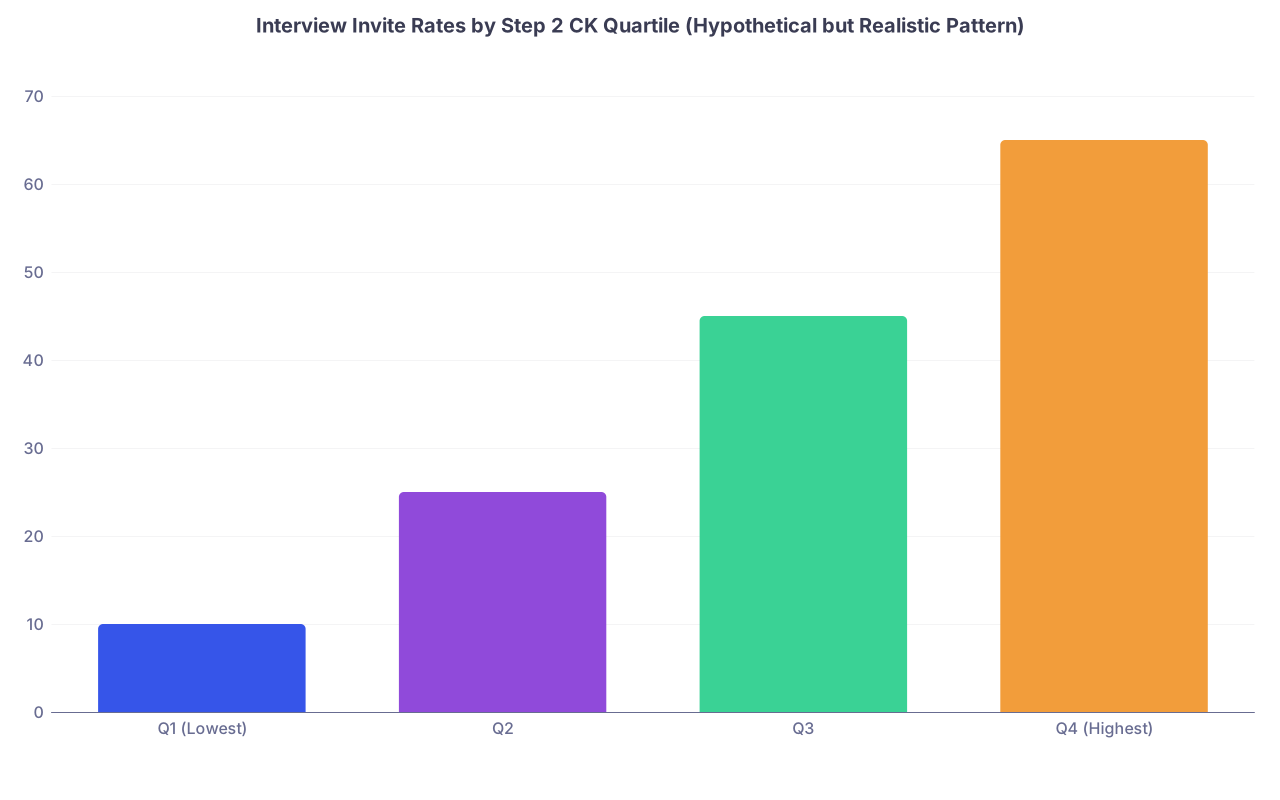
| Category | Value |
|---|---|
| Q1 (Lowest) | 10 |
| Q2 | 25 |
| Q3 | 45 |
| Q4 (Highest) | 65 |
No, it’s not “fair” if your life circumstances made studying harder. The system cares a lot more about: “Will this resident pass boards and not get us in trouble?” than about a philosophically perfect meritocracy.
You play the game that exists, not the one that should.
If Your Step 2 CK Is Strong — Don’t Get Lazy
The flip-side myth is: “I have a 260; I’m set.”
High scores buy you more looks and more interviews. They absolutely don’t guarantee:
- That your letters will be enthusiastic,
- That your interpersonal skills will be tolerable,
- That you won’t come off as arrogant, disinterested, or awkward on interview day.
I’ve watched high-scorers get mysteriously few interviews and quietly slide down rank lists because:
- Their letters were lukewarm or generic,
- Their rotations in that specialty were limited or half-hearted,
- Their interview presence was flat, arrogant, or manic.
Once you’re in the interview chair, your score becomes background noise. Programs are thinking: “Can I put this person on nights with my sickest patients and not regret it?”
Holistic review dominates there. And it can tank you even with a sparkling score.
The Bottom Line: What the Data and Reality Agree On
Strip away the wishful thinking and PR language, you’re left with three blunt truths:
Step 2 CK is the main quantitative filter for interviews, especially post–Step 1 P/F.
Not the only filter, but the first and often the harshest. Saying “the Match isn’t about scores anymore” is fantasy.Holistic review is real—but mostly within the pool that passes numerical screening.
Scores open the door; letters, clinical performance, mission fit, and your story decide who actually gets invited in and ranked.Both sides of the myth are dangerous.
Pretending it’s “only Step 2” leads you to neglect relationships, letters, and fit—things that determine rank lists. Pretending “scores don’t matter” makes you underestimate how brutal the initial screen is.
Understand the game. Use scores to get seen. Use everything else to get chosen.