
The Truth About ‘Reaching’ Programs: How Often Long-Shots Match
How many of the people you know who matched at a “reach” program were actually long-shots… and how many just thought they were?
Let’s cut through the folklore.
Every residency season, I hear the same nonsense in student group chats and hallway whispers:
- “Do not waste ranks on places you can’t possibly match.”
- “You need mostly safeties; reaches are lottery tickets.”
- “Top-tier programs only take 260+ Step scorers with PhDs.”
Most of that is flat-out wrong or wildly exaggerated.
You should be asking a sharper question:
What does the data say about matching at programs where you’re below average on paper—but not completely off the map?
Because “reach” is not a feeling. It’s a probability question.
What A “Reach” Program Actually Is (And Is Not)
Let’s define terms before people start waving around anecdotes.
A true reach program is one where you are clearly below that program’s usual profile on one or more major axes:
- Step 2 CK below their typical range
- Class rank or MSPE language weaker than their standard intake
- Little or no home advantage or institutional tie-in
- Limited or no research for research-heavy places
- DO applying to programs that rarely take DOs, or IMG without strong US ties
That’s reach.
What isn’t a reach?
- You’re “only” at the 50th percentile Step for that specialty
- You don’t go to a top-20 med school
- You have 1–2 minor red flags but strong letters and solid clinical remarks
- You feel like an impostor so everything feels out of reach
In other words, a lot of what you’re calling “reach” is just “competitive but realistic.”
The NRMP Charting Outcomes data makes this painfully clear: most matched applicants don’t have perfect profiles. They’re not all AOA, 270, 30 pubs. They’re a mix of strong and average components, with some weaknesses.
What The Numbers Actually Say About Long-Shot Matching
Let’s talk probabilities, not vibes.
First: specialty matters.
| Specialty Type | Example Fields | Approx. US MD Match Rate* |
|---|---|---|
| Less Competitive | FM, Psych, Peds | 85–95% |
| Moderately Competitive | IM, EM, Anesth | 75–90% |
| Competitive | Radiology, Derm-path | 60–75% |
| Very Competitive | Ortho, Derm, PRS | 50–65% |
*Rough ranges from recent NRMP cycles; exact numbers vary by year.
Now, inside any given specialty, applicants distribute themselves across “tiers” of programs. Here’s the part students get wrong:
You don’t need to be a “top-tier” applicant to match at a “top-tier” program.
You need to be acceptable to some fraction of those programs, then give the algorithm enough shots.
How often do “below-average” profiles still match at strong programs?
From Charting Outcomes patterns and talking to PDs over multiple cycles, you see a consistent theme:
- Applicants 5–10 points below the median Step for a given program tier still match into that tier regularly—if their other components are strong and if they apply/rank broadly within that tier.
- Near the extreme (20+ points below typical, multiple red flags), match probability at those programs drops hard. But it doesn’t go to zero. I’ve watched 220s match mid-tier rads and solid anesthesia programs when everything else was excellent.
What kills “reach” chances more often than stats?
Application behavior.
People add 15 “reach” programs, get 0–2 interviews among them, then rank those 0–2 programs and 2–3 realistic ones and act shocked they didn’t “hit a reach.”
That’s not evidence that reaches don’t work. That’s evidence of bad risk management.
How Many “Reach” Programs Usually Hit? The Quiet, Boring Reality
Let me answer the question everyone dances around:
If you rank a lot of reach programs, how often will one of them be your match?
Not “can it happen?”
How often does it?
Here’s what I consistently see in real rank lists and outcomes, in moderately to highly competitive specialties (anesthesia, EM, rads, some surgical subs):
- Applicants who rank 5–10 true “reach” programs and also 10–20 realistic programs:
- Roughly 20–40% end up matching at what they personally considered a “reach.”
- Applicants who rank 1–3 reach programs with mostly safeties:
- Maybe 10–15% end up at the reach, often because they badly underestimated themselves and those programs weren’t true reaches to begin with.
- Applicants who rank mostly reaches (10–15) and only a few realistic programs:
- When they match, it’s at a realistic program more often than not. When they don’t match, this behavior is a major factor.
That 20–40% zone is the real story: reaches hit often enough that it’s irrational to ignore them, but not so often that you can treat them like a primary strategy.
To make that concrete, think about your whole list, not one program:
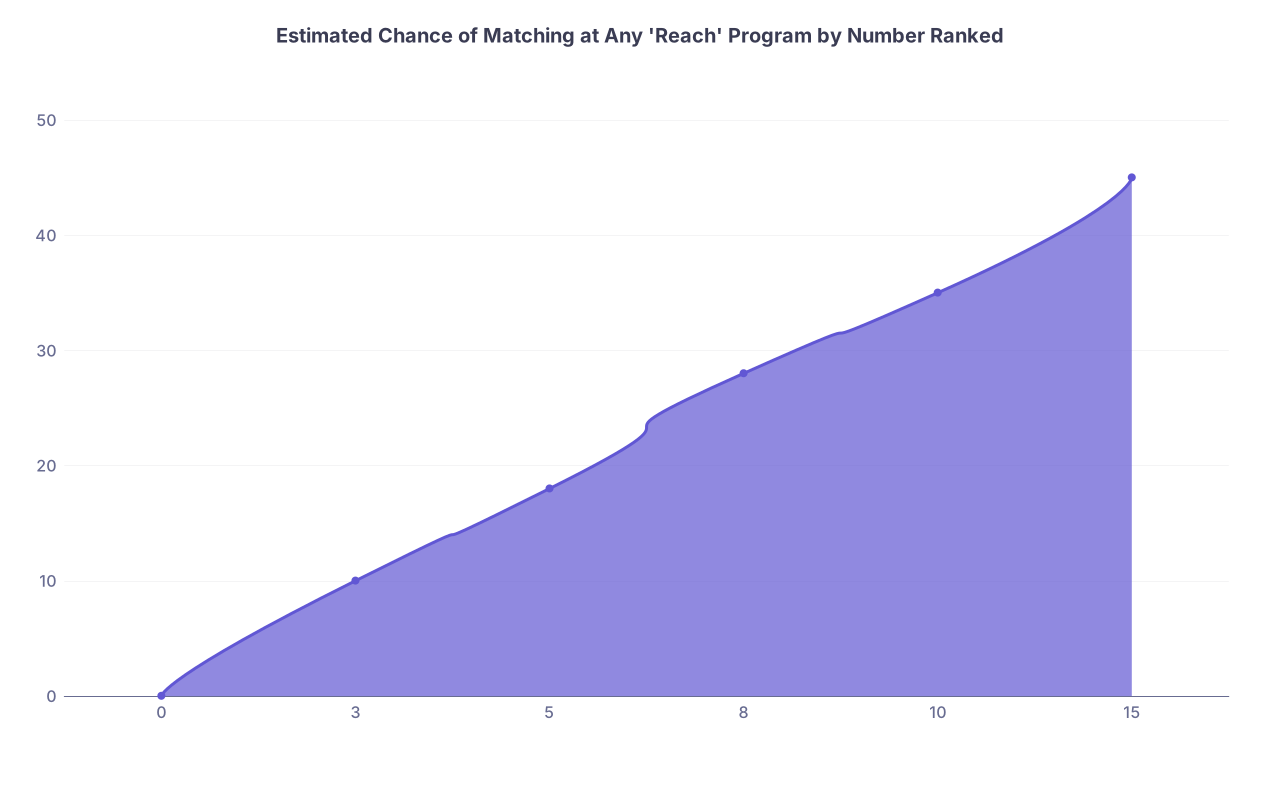
| Category | Value |
|---|---|
| 0 | 0 |
| 3 | 10 |
| 5 | 18 |
| 8 | 28 |
| 10 | 35 |
| 15 | 45 |
Those are illustrative, not exact, but they track what I’ve seen over multiple cycles: your odds of any reach hitting climb as you rank more of them, but they’re never 80–90%.
This is where people fool themselves. They think:
- “I have 10 reaches on my list, so I have a great chance at matching at a top place.”
No. You have a reasonable chance—if you also give the algorithm plenty of non-reach options so you don’t fall through.
The Match Algorithm Doesn’t Care About Your Ego (Or Your Dream Program)
The NRMP algorithm is applicant-favoring—but only if you use it correctly.
Its priority is:
- Give you the highest-ranked program that also wants you.
- If no programs on your list want you, you go unmatched. Even if you were 100% competitive for 20 programs you never ranked.
Where do people screw this up with reaches?
- They assume “reach” = “low probability no matter what,” so they under-rank them.
- Or the opposite: they put 10 reaches at the top, then 3 realistic options, then stop. So if the reaches all say no and the realistic ones already filled with higher-ranked applicants, they’re out.
The algorithm’s not biased toward realism or dreams. It just needs data: enough ranked programs where your actual probability isn’t microscopic.
Which means this:
- Ranking reaches above realistic programs never hurts your chance of matching at those realistic ones.
- What hurts you is not ranking enough realistic programs.
So the advice “don’t waste ranks on reaches” is mathematically wrong. A rank is free. An unranked program is where you forfeit any chance, realistic or not.
The Three Myths That Keep You From Smart “Reaching”
Myth 1: “Reaches are a waste unless I’m already top tier.”
Reality: for most mid-to-strong applicants, 1–3 “reach” matches happen every year in their specialty from their med school. You hear about them on Match Day: the “how did she pull off MGH?” or “wait, he matched at Duke Radiology with a 240?”
How? Because the rest of their file offset the reach criteria: killer letters, strong clerkship narratives, aligned research, being exactly the type of human that program needed in that specific year.
You don’t have to be a unicorn. You have to be viable.
Myth 2: “Programs only care about Step cutoffs; I’m below, so it’s over.”
Wrong in two ways:
- Step cutoffs are mostly for interview offers, not final rank. Once you’re on the interview list, the spread of scores at a given program gets wider.
- Programs absolutely move people with lower metrics up the rank list if they love them on interview/have strong fit, especially for diversity of background, skills, or life experience.
I’ve seen PDs argue to rank a 230 applicant above a 250 applicant because the 230 turned out to be an unusually strong communicator and teacher. Their phrase: “I want someone my patients will not hate.”
Is that common? No. But it doesn’t have to be common. It just has to be possible—and you need enough programs where that possibility exists.
Myth 3: “I know which programs are reaches based on Doximity / vibes.”
Doximity is trash as a serious decision tool. It’s popularity mixed with reputation mixed with historical bias. Program competitiveness is:
- Applicant pool strength that year
- Regional desirability
- Hidden constraints (visa, DO/IMG quotas, internal candidates)
- Niche departmental politics (new chair, losing faculty, expansion)
The number of times I’ve seen students label a program “mid-tier, safe” and then get zero interview from it—while getting interviews from what they thought were “top 5” programs—is not small.
You’re bad at predicting who will like you. Everyone is. That’s why you spread your bets.
How To Use “Reach” Programs Without Getting Burned
Let me be blunt: the danger isn’t adding reaches. The danger is using them as emotional anchors instead of probabilistic plays.
Here’s the sane way to think about it.
Step 1: Define your true reach bands
Rule of thumb:
- Step 2 CK more than ~10 points below a program’s typical intake range
- Zero institutional or regional connection to a place that strongly favors home/regional students
- For DO/IMG: programs that take your background only rarely and also are top-tier prestige
Those are true reaches. Some will still interview you; most won’t. But that’s the nature of the category.
Step 2: Decide on a reach ratio, not a fantasy list
For most applicants in moderately competitive specialties, something like:
- 25–40% of your applications to “reach” programs
- 40–60% to realistic/target programs
- 10–25% to safer programs
More competitive specialties? Shift a bit more into realistic and safe—but still keep a real fraction of reaches. That might look like 20–30% reaches instead.
The key is: you don’t do 80% reaches and then act surprised when there’s no cushion.
Step 3: Rank like a rational person, not a romantic
Once you have interviews:
- Rank every program where you’d actually go. Period.
- Put reaches at the top in the exact order you’d like them. There’s no penalty for this.
- Then fill in with your realistic and safer options. A lot of them.
The mistake is not ranking a program because you feel “I have no chance anyway.” If they interviewed you, you had a non-zero chance. They already spent a slot on you. Let the algorithm work.
Who Actually Matches At Reaches? (And Who Doesn’t)
Pattern you see if you pay attention for more than one cycle:
People who disproportionately match at “reach” programs usually have one or more of:
- Region or personal connection (spouse’s job, grew up there, former research there)
- Extremely tailored interest to that department’s niche (e.g., quality improvement, global health, med-ed track)
- Very strong, credible letters from well-known faculty—especially with direct program connections
- Stellar interview performance that clearly separated them from the pack
And just as crucial: they applied broadly and didn’t treat any one program as destiny.
The ones who crash?
- They mistake prestige for fit, aim 80–90% of their list at aspirational places their file doesn’t support, and don’t pad enough realistic programs.
- Or they underestimate decent mid-tier programs, assume they are “safeties,” apply to only a handful, and get burned when those programs fill with people who actually treated them seriously.
I’ve seen too many great applicants fail to match because they loved their reach list more than they respected the math.
So… How Often Do Long-Shots Match?
Summing it up without the fluff:
- Long-shots match regularly, but not frequently. Think: meaningful minority, not rounding error.
- If you rank 5–10 genuine reach programs and 10–20 realistic ones, your odds of ending up at a reach are often in the 20–40% range, depending on your specialty and how “reachy” they really are.
- The Match algorithm doesn’t punish you for ranking aspirational programs; it punishes you for failing to rank enough non-aspirational ones.
Reaches are not fairy dust. They’re leverage.
Used correctly, they move your distribution upward. Used foolishly, they give you a great unmatched story about how you “shot your shot.”
Years from now, you won’t be bragging about how “rational” your rank list was. You’ll just be living the consequences of the risks you took—or refused to take—when you still had the chance.