Most of what you’ve heard about “red flags” in ERAS is exaggerated, outdated, or just flat‑out wrong.
People throw that phrase around like confetti: “Oh, that’s a red flag.” One leave of absence? Red flag. One failed quiz in M1? Red flag. Didn’t do an away in that specialty? Red flag. It becomes meaningless fear‑mongering.
Let’s cut through the mythology. Programs do care about red flags, but not the way Reddit thinks they do. The real pattern isn’t “any imperfection = doomed.” It’s “unexplained, repeated, or current problems that suggest you’ll struggle with patient care or professionalism.”
What Program Directors Actually Mean by “Red Flag”
Program directors are not hunting for perfection. They’re trying to avoid three categories of headache:
- People who cannot reliably pass licensing exams.
- People who create professionalism, behavioral, or integrity problems.
- People who are actively unsafe or unreliable in a clinical environment.
Most so‑called “red flags” boil down to those buckets. If it doesn’t touch one of those, it’s usually just a yellow flag at worst.
Here’s the part nobody likes to hear: the same issue can be a non‑event for one applicant and a genuine dealbreaker for another. It depends on:
- How severe it is
- Whether it’s repeated vs. one‑off
- How recent it is
- How well it’s explained and contextualized
- Whether there’s evidence you’ve rebounded
Programs don’t reject because “you have a blemish.” They reject because your story suggests a pattern they don’t want to inherit.
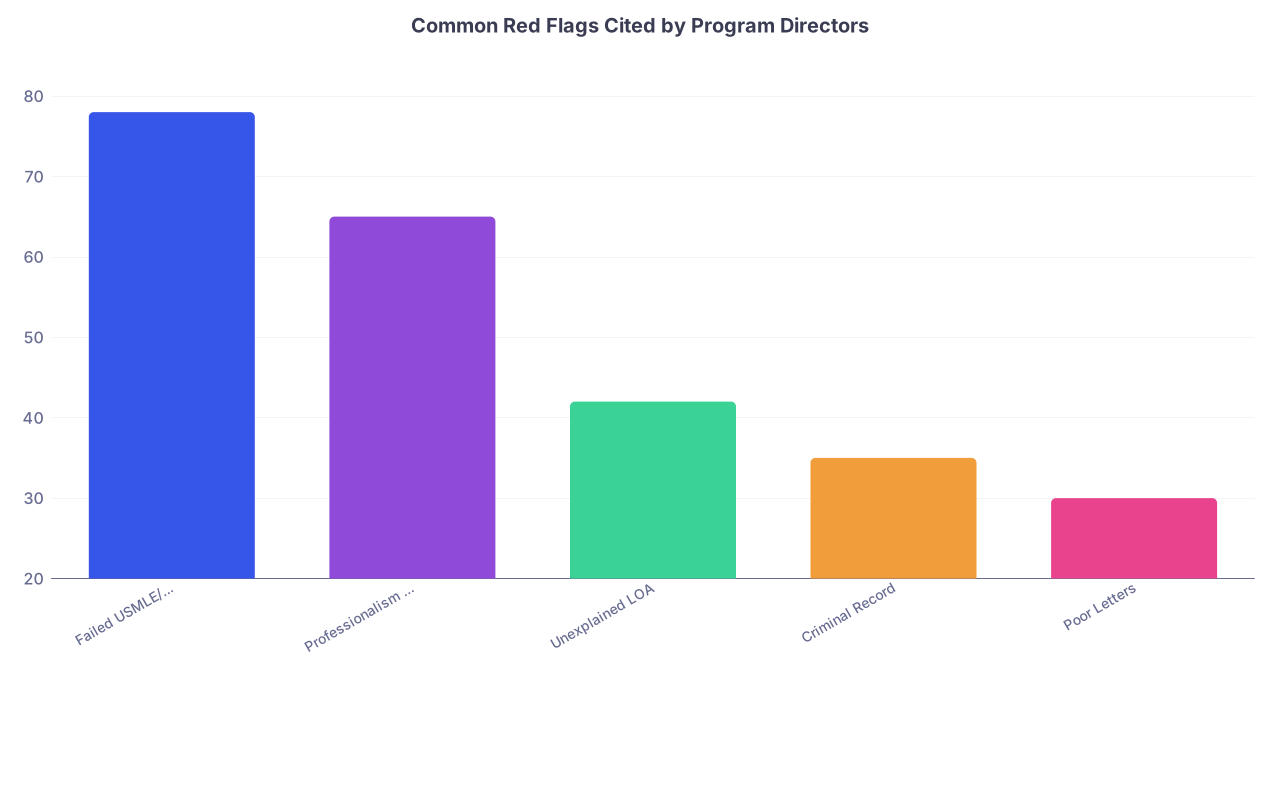
| Category | Value |
|---|---|
| Failed USMLE/COMLEX | 78 |
| Professionalism Issues | 65 |
| Unexplained LOA | 42 |
| Criminal Record | 35 |
| Poor Letters | 30 |
(Percentages approximate, drawn from multiple NRMP PD surveys over the last decade: the themes have been remarkably stable.)
Myth #1: “Any board failure is an automatic death sentence”
Bluntly: a USMLE or COMLEX failure hurts. A lot. But “automatic death sentence” is lazy thinking.
Programs look at two questions:
- Can this person pass on the next try and be board‑eligible on time?
- Does this look like a pattern of academic struggle or a single crash‑and‑burn?
Huge difference between:
- The student who failed Step 1, then scores above average on Step 2, has strong clinical evals, and has explicit support in letters: “They struggled early, then crushed it.”
vs. - The student who fails Step 1, scrapes by on retake, fails Step 2 once, needs remediation on multiple clerkships, and has vague letters: “Ongoing performance concern.”
For most core specialties (IM, FM, peds, psych, neurology, pathology, prelim medicine), a single Step/COMLEX failure with a clear upward trajectory is a hurdle, not a hard stop.
Where things shift toward “dealbreaker”:
- Multiple exam failures (e.g., Step 1 failed twice, Step 2 failed once)
- Failure of a clinical CS‑type exam (for those who still had CS) with weak clinical comments
- Very low passing scores that show no trend of improvement
- Failure with no explanation and no evidence of changed study habits or support
You know what programs like to see in your application if you’ve failed?
- Step 2 significantly higher than passing threshold
- Concrete narrative: what went wrong and what changed (not “I had anxiety,” but “I used only question banks, didn’t review explanations, changed to X, Y, Z approach”)
- An attending explicitly saying in a letter that they trust you to pass future exams
Dealbreaker? No, not automatically. But if you have a failure and then treat it like a dirty secret you hope no one notices? That’s where programs start to worry.
Myth #2: “Any leave of absence is fatal”
Another overblown myth. Leaves of absence (LOAs) are common enough now that most PDs have seen dozens. The problem isn’t the existence of an LOA. It’s the black box.
Programs ask:
- Was this voluntary or forced?
- Was it academic, health, family, or professionalism?
- What’s different now? Are they stable and ready?
Let me be very clear: medical, mental health, or family‑driven LOAs are rarely dealbreakers when:
- They’re time‑limited
- They’re clearly explained
- There’s a clean performance record after return
- Your dean’s letter/MSPE doesn’t hint at unresolved issues
Where LOAs drift toward red flag territory:
- Unexplained or vaguely described: “personal reasons” with no context
- Multiple fragmented LOAs across several years
- Coupled with failed courses, repeated remediation, or professionalism write‑ups
- The MSPE uses coded language like “concerns about reliability” or “difficulty meeting professional expectations”
You don’t need to write a trauma memoir in your personal statement. But you do need a coherent, adult explanation in your application or an addendum section:
Something like:
“I took a leave of absence from January–June 2023 due to a significant family health crisis that required my support. Once the situation stabilized, I returned to clerkships and have since completed all requirements on time with strong evaluations.”
That’s not a dealbreaker. That’s life.
Myth #3: “One failed clerkship = you’re done”
Reality: a failed core clerkship (IM, surgery, OB/GYN, peds, psych, FM) matters. But context dominates.
Programs scrutinize:
- Which clerkship?
- What year? How early?
- Was it knowledge, clinical performance, professionalism, or attendance?
- Did you repeat it, and how did you do?
- Are there other borderline passes in the same domain?
Here’s how this tends to break down:
- Failed preclinical course → usually survivable if rest of record is solid.
- Failed shelf exam, but passed rotation after remediation → yellow flag.
- Failed core rotation, repeated and got Honors, with a strong letter from that department → many programs will accept that as “resolved.”
Dealbreaker patterns:
- Repeated failures in the same type of rotation (e.g., multiple struggles with surgery‑like environments)
- Fails tied to professionalism (“didn’t show up,” “refused feedback,” “dishonest documentation”)
- Weak or missing letter from the specialty you’re applying into, plus a failed rotation in that field
If you failed medicine and want internal medicine, you have to hit this directly. A strong IM letter that says “They failed early, did X to improve, and I’d take them in my program” carries enormous weight.
If you failed a non‑target specialty (e.g., surgery fail but applying psych), and everything else is solid? Usually survivable with a clear explanation and a narrative that fits: “my skills and temperament align with psychiatry, where I’ve had excellent evaluations.”
Myth #4: “Non‑AΩA / mid‑class rank = red flag”
This one’s almost funny.
Not being top 10% of your class is not a red flag. It’s called… being normal.
Most residents in most programs are not AΩA, Gold Humanism, or top‑quintile. Program directors know the distribution. They care far more about:
- Shelf/clerkship performance pattern
- Step 2 / Level 2 performance
- How your school writes the MSPE comparative language
- What your letters actually say
For many students at less grade‑inflated schools, a bunch of “High Pass” grades plus solid Step 2 is more reassuring than straight Honors plus barely‑passing boards.
Where academic standing becomes a genuine yellow/orange flag:
- Consistently bottom quartile plus low boards
- A pattern of “barely passing everything” with no upward slope
- Negative or lukewarm MSPE comments like “improvement needed in reliability, initiative, and communication”
That’s not a single red flag; that’s a pattern issue. But simply “not stellar”? Programs see that all day.
Myth #5: “Programs freak out about any gap or non‑linear path”
Again, nuance.
Taking a research year, an MPH, a year in industry, or even time away for personal reasons is not automatically suspicious. Some specialties (derm, plastics, oncology‑aimed IM) practically expect a research gap.
What programs do worry about:
- Long, unexplained time away from clinical medicine
- Graduated long ago with no clear continued clinical engagement, especially for IMGs
- Gaps coinciding with exam failures, dismissals, or disciplinary actions
A 6‑ to 12‑month gap with a coherent story and clear re‑entry into clinical work? Typically fine.
A 3‑year stretch between graduation and application, with minimal US clinical experience, vague descriptions, and repeated exam failures? That’s where “dealbreaker” becomes very real, especially in competitive specialties.
| Situation | Typical Interpretation |
|---|---|
| 1 exam fail, strong retake, good evals | Hurdle, not automatic rejection |
| Explained medical LOA, strong return | Acceptable with context |
| Failed core clerkship, repeated with Honors | Serious, but can be rehabilitated |
| Unexplained professionalism LOA | Major red flag |
| Multiple exam failures + old graduation | Often a dealbreaker |
The Red Flags That Actually Are Dealbreakers
Let’s talk about the ones that really do kill applications at many programs, often instantly.
1. Unresolved or repeated professionalism issues
Program directors can forgive a lot academically. They have almost no appetite for:
- Dishonesty (charting things you did not do, lying to staff, cheating on exams)
- Harassment, discrimination, or boundary violations
- Repeated “no shows,” chronic lateness, disappearing on call
- Pattern of poor communication with staff and patients
If your MSPE hints at or explicitly describes these—and they’re recent, repeated, or only weakly addressed—many programs will quietly move you to the “do not rank” bucket. They won’t debate it.
If you have a professionalism hit in your past, you need three things:
- Time since the incident
- Documented clean record afterward
- At least one strong letter that implicitly or explicitly counters that concern (“professional,” “reliable,” “excellent team member”)
A single, isolated issue years ago with clear remediated behavior? Hard, but not impossible. A pattern? That’s where the door actually closes.
2. Legal or criminal issues related to safety or trust
Minor college nonsense (old underage drinking ticket, for example) rarely sinks you, especially if disclosed early and honestly.
What scares programs:
- DUIs, especially multiple or recent ones
- Assault, harassment, or violent offenses
- Fraud, prescription drug issues, or anything that touches controlled substances
- Active legal proceedings with uncertain outcomes
They see this as risk to:
- Patients
- Hospital reputation
- Licensing and credentialing processes
If you’re in this territory, you need competent legal guidance and usually proactive explanation. Some programs will never touch it. Others will consider it only with overwhelming evidence of rehabilitation—and even then, in less competitive fields.
3. Chronic exam failure without clear turnaround
I’ll be blunt here. Multiple failures across the USMLE/COMLEX ladder, without a clear, sustained upward trend, are one of the hardest things to overcome.
Not because programs are heartless. Because they’re graded on their board pass rates, and they cannot afford residents who struggle repeatedly with standardized tests. Their accreditation literally depends on it.
If your record looks like:
- Step 1: fail → low pass
- Step 2: fail → barely pass
- Several remediation exams in medical school
- COMLEX series with multiple retakes
Programs immediately worry that you’ll fail in‑training exams and board certification. Some community programs may take a chance if you’re otherwise outstanding and applying in a less competitive specialty. Many will not.
Myth #6: “One bad letter of recommendation will destroy everything”
One truly bad letter—explicitly negative—can absolutely hurt you. But most “bad” letters are just… lukewarm.
I’ve seen letters that said, “X performed adequately and met expectations.” That’s not a death blow. It’s just not helpful. Programs will weigh it against the rest of the file.
Real red‑flag letters say things like:
- “Struggled with reliability and required frequent reminders”
- “Had difficulty accepting feedback and became defensive”
- “Would likely benefit from further development before assuming resident responsibilities”
You almost never see these if you chose your letter writers wisely. Where people get burned is:
- Letting a clerkship director they barely worked with choose to write “on their behalf”
- Asking someone who gave them negative feedback clinically to write a letter anyway
- Not reading the tea leaves when an attending is clearly lukewarm
If you suspect one letter is weak, the solution is not to panic. It’s to drown it out with:
- Multiple strong letters that highlight reliability, growth, and clinical ability
- A personal statement and MSPE that match that narrative
The Stuff People Panic About That Usually Isn’t a Red Flag
Let’s be clear about a few more non‑issues that get over‑dramatized:
- Not doing an away rotation in the specialty (outside of a few fields like ortho, derm, ENT, where aways matter more)
- Being at a non‑top‑tier medical school
- Not having a PhD or 15 PubMed publications
- Having a pass/fail preclinical curriculum
- Not being AΩA or Gold Humanism
- One or two minor comments about needing to improve efficiency in early clerkships
Programs know real life when they see it.
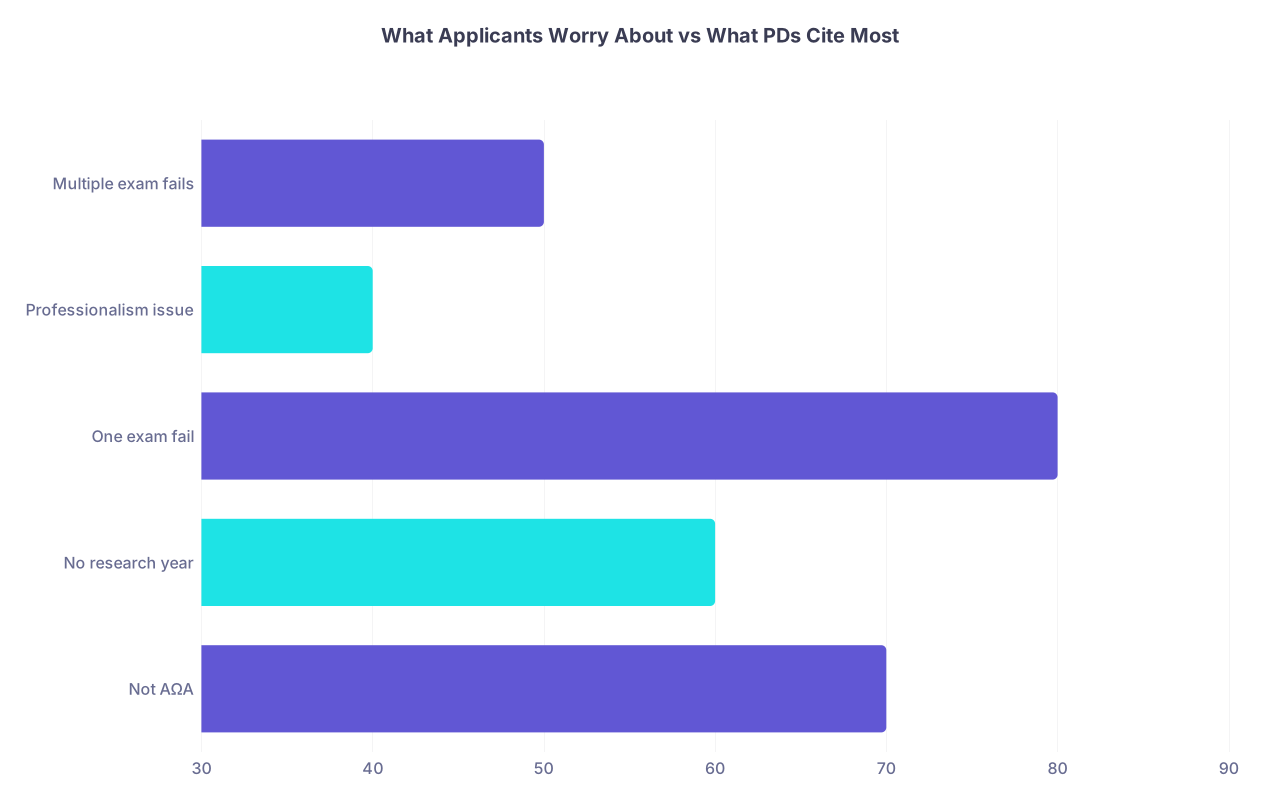
| Category | Value |
|---|---|
| Not AΩA | 70 |
| No research year | 60 |
| One exam fail | 80 |
| Professionalism issue | 40 |
| Multiple exam fails | 50 |
(Applicant worry is high across the board. PDs, per surveys and actual behavior, care most about the last two. The disconnect is the problem.)
How to Handle True or Potential Red Flags Strategically
If you do have something that could be perceived as a red flag, you’re not powerless. But you cannot pretend it isn’t there.
A few hard‑won rules:
- Name it, don’t hide it. Silence suggests denial. A brief, factual explanation suggests maturity.
- Show the fix, not just the problem. What changed in your behavior, habits, supports, or environment?
- Align your letters. Ask letter writers who have seen the post‑red‑flag version of you and can vouch for it.
- Target your applications. Highly competitive specialties and elite programs can be unforgiving. Many solid programs are more pragmatic if they see growth and reliability.
- Beware inconsistent stories. Your personal statement, MSPE, and interview answers must tell the same story.
You can’t erase the past. You can outgrow it—and show that clearly on paper and in person.
The Bottom Line: What Actually Counts as a Dealbreaker
Strip away the noise and you’re left with this:
- Is there a sustained pattern of poor performance or inability to pass exams?
- Is there credible evidence of professionalism, honesty, or safety problems?
- Is the issue unresolved, recent, or poorly explained?
If the answer to those is “yes,” then yes, you’re in real red‑flag territory.
If the answer is “no,” you probably have a story to manage, not a dealbreaker.
Remember:
- Imperfections are not red flags. Patterns are.
- Silence and vagueness are far more toxic than a clean, direct explanation.
- Program directors are not searching for flawless robots. They’re looking for people who can take care of patients, pass their boards, and not blow up the team.
Everything else is just internet noise.