
Being in the couples match does not automatically hurt your chances. In some scenarios it helps you. The problem is not the NRMP algorithm. The problem is how most couples use it.
Let me be blunt: the “couples match hurts your odds” line you hear from upperclassmen and anxious attendings is oversimplified, half-remembered folklore. The data tell a more nuanced story, and it is very different from the horror stories you hear in the call room at 2 a.m.
Let’s walk through what actually happens, what the numbers show, and when couples matching is a liability versus a strategic advantage.
What the Data Actually Show About Couples Match
First, some hard numbers from recent NRMP data (they’ve been tracking couples for years):
- Roughly 1 in 15–20 applicants participates in the couples match.
- A large majority of couples match both partners into residency.
- Unmatched rates are higher than for non-couples, but not in the apocalyptic way people talk about.
Here’s a simplified comparison using typical patterns from recent NRMP Results and Data reports (exact numbers vary year to year, but the relationships are stable):
| Group | Match Rate (at least one partner) | Both Partners Matched | Both Partners Unmatched |
|---|---|---|---|
| All Singles (US MD) | ~92–94% | N/A | ~6–8% |
| Couples (US MD pairs) | ~95–97% (at least one) | ~80–90% | ~5–10% |
Now read that carefully:
- Odds that at least one partner in a couple matches somewhere are actually higher than odds a single applicant matches.
- The tougher part is both partners matching into acceptable programs in the same geographic area.
So no, couples matching is not some death sentence. It shifts your risk profile. You’ve turned “my individual outcome” into “our joint outcome.” That’s different. Not automatically worse.
To visualize this tradeoff:
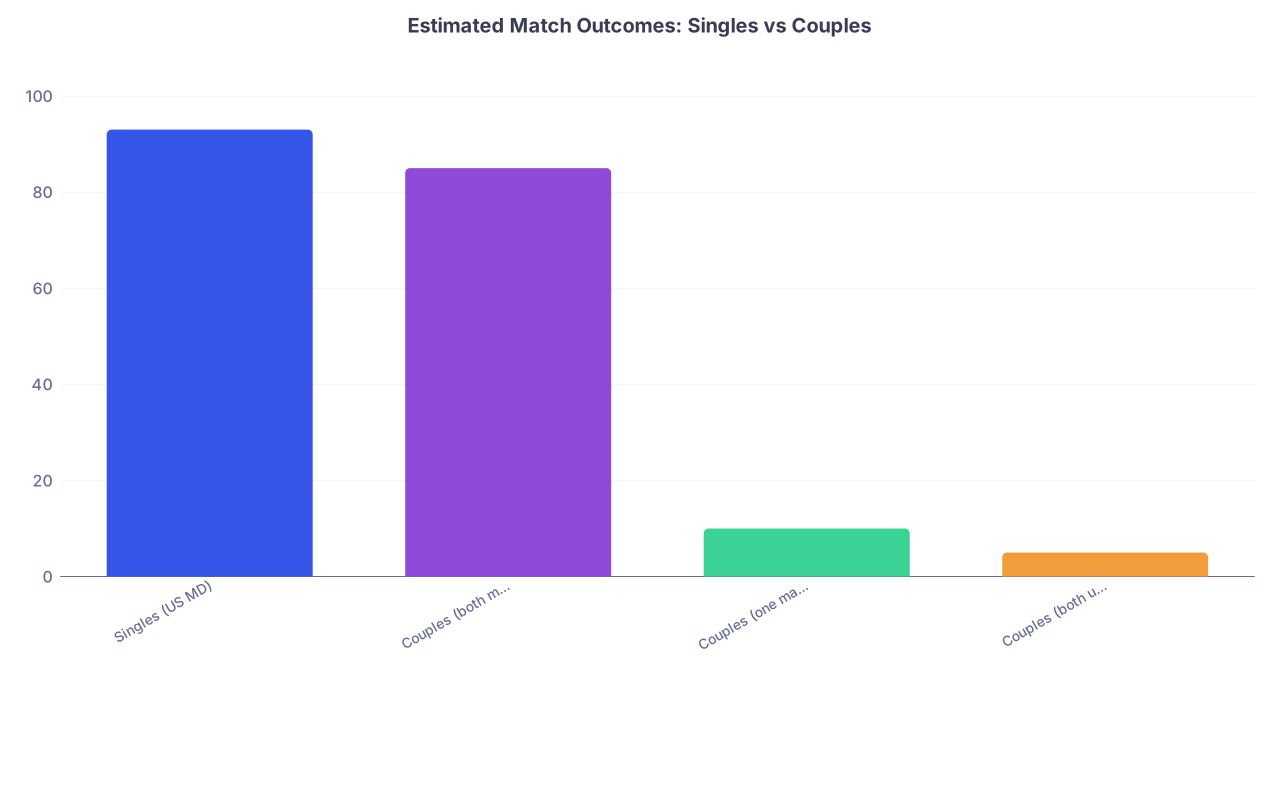
| Category | Value |
|---|---|
| Singles (US MD) | 93 |
| Couples (both matched) | 85 |
| Couples (one matched) | 10 |
| Couples (both unmatched) | 5 |
The myth comes from people focusing only on that “both matched, same place” bar and ignoring everything else.
How the Algorithm Actually Treats Couples (Not the Urban Legend Version)
A big source of confusion is the algorithm. People imagine some weird side-channel where couples are “penalized” because they’re more complex.
That’s wrong.
The couples match uses the same core stable matching logic as the individual match. The only difference: your rank list consists of pairs of programs, and the algorithm treats those pairs as a single preference line.
If you rank:
- (Partner A: Hopkins IM, Partner B: Hopkins Peds)
- (A: Hopkins IM, B: Maryland Peds)
- (A: Maryland IM, B: Hopkins Peds)
- (A: Maryland IM, B: Maryland Peds)
- (A: Hopkins IM, B: “No match”)
- (A: “No match”, B: Hopkins Peds)
…the algorithm goes down that list, trying to place both of you in the best possible combination consistent with both your pair ranking and programs’ preferences. It does not say, “oh, a couple, let’s lower their priority.”
What hurts couples is almost never the algorithm. It’s bad list construction. Unrealistic pairings. Tiny lists. Or one partner thinking “I’ll only go to a big-name program,” while the other is weaker on paper.
Think of it this way:
As a single, you rank one dimension: program prestige/fit vs location.
As a couple, you rank three: your program, their program, and geography.
More dimensions means more chances to over-constrain the system.
To see how this realistically plays out across common couple types:
| Couple Type | Geographic Flexibility | Specialty Competitiveness | Risk Level if Couples Match |
|---|---|---|---|
| FM + Peds / IM + Peds | High | Low–Moderate | Low |
| IM + General Surgery | Moderate | Moderate–High | Moderate |
| Derm + Anything / Ortho + Ortho | Low | Very High | High |
| Both FM / Both Psych, flexible | High | Low | Low |
It’s not “couples match is bad.” It’s “highly competitive specialties + low geographic flexibility + couples match is risky.” That’s a different statement.
When Couples Matching Helps You (Yes, Really)
Here’s the part almost nobody talks about: being a couple can be strategically useful.
Programs are run by humans. Humans at academic centers are constantly fighting recruitment battles with other programs and other cities. A couple presents an opportunity:
- Two residents filled with one emotionally “sticky” unit.
- Higher odds you stay for fellowship or as faculty.
- Less chance of mid-residency transfer driven by relationship stress and long distance.
I’ve heard PDs say this explicitly on interview days: “We love couples; you’re more likely to put down roots.” That’s not fluff. Programs in less glamorous cities use this as a recruiting edge.
Where couples status can actually help:
Middle-tier or location-challenged programs
Think Rust Belt IM, Midwest psych, Southern university hospitals. They like stable pairs who clearly want to be there.One partner clearly stronger on paper
If the stronger partner loves a program, that program may be a bit more generous on the other partner if they’re reasonable on paper. No, they won’t drag someone unqualified through. But borderline vs solid? That can shift.Primary-care-oriented couples
FM + Peds, IM + FM, Psych + IM. There are a lot of slots to work with. A couple who’s open to multiple regions can do very well.Markets with multiple academic centers in one metro
Philly (Penn, Jefferson, Temple), Boston (MGH, BWH, BID, BU, Tufts), Chicago (UChicago, Northwestern, Rush, UIC). If you’re okay matching to different institutions in the same city, couples matching can expand—not limit—your options.
No, this is not formal policy. You won’t find it in an NRMP document. But I’ve seen it in admissions committee rooms: “He really wants to come here and his partner is a great fit for our peds program; let’s bump her up a bit if the rest is fine.”
Is this guaranteed? Of course not. But it directly contradicts the “couples status only hurts you” myth.
When Couples Matching Really Does Hurt You
Now, the ugly side. There are specific patterns where couples matching absolutely raises your risk. These are the parts the horror stories grow out of.
1. Two hyper-competitive specialties, zero flexibility
Classic example: Ortho + Derm. Or Plastics + ENT. Both insisting on:
- “Top 25 academic institutions only”
- “We will not live outside these 2 metro areas”
- Short rank lists because “we don’t want to end up somewhere random”
This is how you end up unmatched, scrambling, or SOAPing into a backup you never seriously researched.
2. One partner overestimates their competitiveness
You know this couple. One has a 260+ Step 2, AOA, multiple first-author pubs. The other is 220, no AOA, marginal letters, maybe a red flag. But they both talk like they’re equals: “We’re gunning for all the big-name programs.”
You can couples match safely with uneven applications. But only if:
- You’re brutally honest about the gap.
- The stronger partner is genuinely willing to apply “down” or broader geographically.
- The weaker partner has realistic solo options that can be paired in multiple cities.
If the weaker applicant is unwilling to consider “less shiny” but solid programs and the stronger one refuses to compromise, the couples match exposes you. Very fast.
3. Tiny rank lists “to avoid a bad outcome”
This one is a chronic mistake. Couples think: “We’ll just rank 10–15 pairs we’d be happy with; worse case, we go unmatched and try again.”
Not smart. Every NRMP chart shows the same relationship: longer rank lists, lower unmatched rates. This is even more critical for couples.
On average, couples who build 25–30+ realistic pairs do dramatically better than those with 10–12 “perfect world” combinations. You are not gaming the system by being picky. You’re just shrinking the algorithm’s ability to place you.
4. Underselling “fallback” cities or combos
Some couples quietly do have acceptable backup plans but refuse to actually rank them because “we don’t want to live in Cleveland” or “I don’t want to do community IM.”
Then March hits, they both go unmatched, and suddenly those options look very different. The couples match did not do that to you. Your unwillingness to put realistic backups on the list did.
How To Use the Couples Match Without Getting Burned
Here’s the evidence-aligned way to approach this as a couple.
Step 1: Get brutally honest about each of your individual profiles
Before you even say the word “couple” to a program, you each need to know where you stand as if you were applying alone.
That means:
- Step 2 score band (not just the number—how it compares in your specialty)
- Class rank / AOA / Gold Humanism (if relevant)
- Research productivity relative to your field
- Strength of letters compared to your own classmates
Talk to advisors who will tell you the truth, not what you want to hear.
Step 2: Decide your true geographic and prestige flexibility
Not the Instagram version. The real one.
- Are you genuinely okay with midwestern cities?
- Would you actually go to a solid community program if it meant being together?
- Are you truly willing to be at different institutions in the same city?
Write this down. Because when you build your rank pairs, your future selves will pretend you never said half of it.
Step 3: Build rank lists that the algorithm can actually work with
Couples who do well generally:
- Apply broadly enough (numbers vary, but 30–40+ programs per person for competitive fields is common).
- Generate many realistic rank pairs—often 25–40+.
- Include:
- Top-choice pairs,
- Cross-institution same-city pairs,
- “One academic, one community” pairs,
- And yes, a few “this is not our dream but we’d live with it” backups.
Visually, it looks like this dynamic, not a tiny list of fantasy scenarios:

| Step | Description |
|---|---|
| Step 1 | Top Choice Pairs |
| Step 2 | Same City Different Institutions |
| Step 3 | Academic + Community Pairings |
| Step 4 | Broader Geographic Backups |
| Step 5 | Acceptable Safety Options |
The couples who implode are the ones who stop the flow at “Top Choice Pairs.”
Step 4: Communicate smartly with programs
You do not need to write a dramatic “we’re a couple” novel in every email. But you should:
- Clearly indicate you’re participating in the couples match on ERAS.
- Where appropriate, mention your partner and their specialty in your communication with programs—especially in cities with multiple institutions.
- Be consistent: don’t tell two different places “You’re our top choice AND we’re absolutely committed to this city” when those cities are 1,000 miles apart.
Programs are not stupid. If they like you and they also have a reasonable spot for your partner nearby, they will sometimes informally coordinate. They also gossip. Use that to your advantage by being clear, not manipulative.
Reality Check: Long-Distance vs Couples Match
One more myth that needs killing: “We’ll just apply separately; if we end up long-distance for a few years, we’ll manage.”
Some couples do manage. Many do not.
What you trade:
- Couples match risk: Harder to optimize two careers simultaneously. Slightly higher chance of one or both landing at a less-preferred program. More work building rank pairs.
- Long-distance risk: Constant travel cost, emotional strain during the most demanding years of your training, complicated vacation scheduling, vastly increased chance of mid-residency transfer attempts (which programs hate).
You’re not choosing between “safe” and “risky.” You’re choosing which risks you prefer: professional optimization risk vs relationship and mental health risk.
I’ve seen more relationships die from three-year long-distance training than from “we’re both in solid but not prestigious programs in the same city.”
You have to decide what matters more. But pretending that skipping the couples match is automatically safer is delusional.
To see why program directors actually take couples seriously:
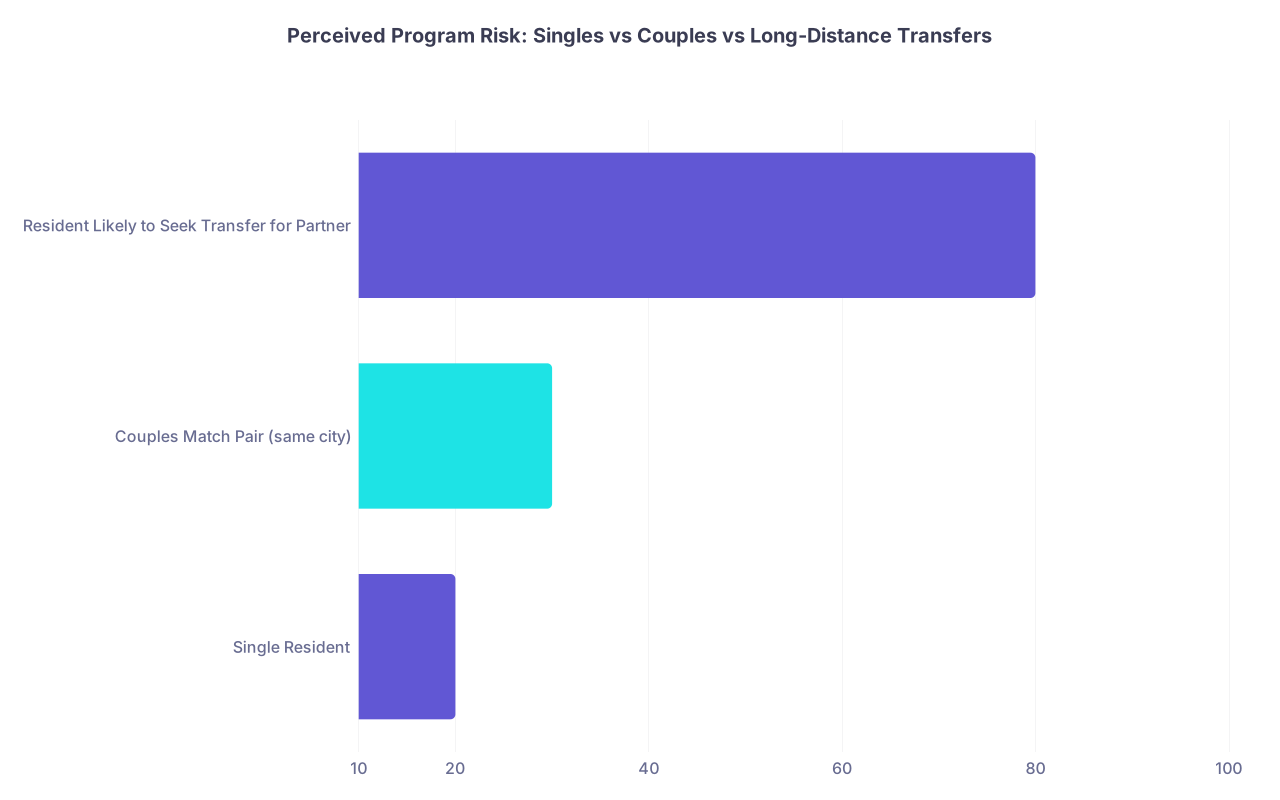
| Category | Value |
|---|---|
| Single Resident | 20 |
| Couples Match Pair (same city) | 30 |
| Resident Likely to Seek Transfer for Partner | 80 |
Programs hate unplanned attrition. A stable couple is often a better long-term bet than a star single who is quietly planning to leave.
Quick Comparison: When Couples Match Helps vs Hurts
| Situation | Effect of Couples Match |
|---|---|
| Both in moderate-demand fields, flexible city | Often helpful / neutral |
| One strong, one average, flexible programs | Can be helpful with good strategy |
| Both in ultra-competitive fields, inflexible | Often harmful / high risk |
| Tiny rank list, prestige-obsessed | Harmful |
| Long, honest, broad rank list | Generally safe / reasonable |
FAQs
1. Should every couple automatically use the couples match?
No. If your relationship is new, unstable, or one of you is half-committed to medicine or the specialty you chose, tying your outcomes together may be unwise. The couples match makes sense when you’re serious about staying together and both reasonably committed to your career paths.
2. Does couples matching hurt your chances at top programs?
It can, but mostly indirectly. Top programs are already selective. If forcing both partners into the same city or institution drastically limits your rank options, then yes, your odds at the single “dream” place might drop. But strong couples with realistic geography and willingness to consider nearby alternatives still match at elite institutions every year.
3. Can one partner match to an advanced position (like anesthesia) and the other to a categorical program through couples match?
Yes. You can pair transitional or prelim years with categoricals or advanced positions in the rank pairs. It’s more complex list-building, but the algorithm supports it. The hard part is not the math; it’s ensuring you both have reasonable options in both the PGY-1 and advanced years and that you do not under-rank backup transitional/prelim options.
4. Is it ever smarter to apply as a couple but not officially “couples match”?
Sometimes. If one partner is applying in a tiny specialty (like neurosurgery) with limited spots and the other is in a big field (IM, FM, psych), you might decide that the small-field partner will aim broadly and the big-field partner will adapt after the fact, outside the algorithm. You lose the formal coordination but avoid over-constraining the neurosurgery applicant. This is a tactical choice, not a moral one.
Key points:
- Couples matching does not inherently “tank your chances”; it changes the problem from one outcome to two linked outcomes.
- Most of the risk comes from unrealistic expectations, tiny rank lists, and over-constraining geography or prestige—not from the algorithm.
- Done strategically and honestly, couples match can be neutral or even slightly advantageous in the eyes of many programs, especially outside the ultra-competitive niches.