
Residency thank-you emails are wildly overrated.
Not completely useless. But nowhere near the “this will make or break your rank” folklore you hear in group chats, from anxious classmates, and sometimes from advisors who haven’t looked at actual data since ERAS went electronic.
Let me be blunt: if you’re spending more than a sliver of cognitive energy stressing over thank-you emails, you’re misallocating your limited bandwidth in the most competitive year of your life.
Here’s what the data – and what real PDs actually say behind closed doors – shows.
The Myth: “If I Don’t Send Thank-You Emails, I’ll Drop on the Rank List”
You’ve probably heard versions of this:
- “Program X literally said they notice who doesn’t send thank-yous.”
- “My advisor told me at least a short note to every interviewer is mandatory.”
- “My friend didn’t match and she never sent thank-yous. Just saying.”
This is classic post‑hoc superstition. Something bad (or good) happens, and people rush to attach meaning to whatever variable they can see. Thank‑you emails are a visible, easy scapegoat.
What do we actually know?
What surveys and PD comments show
Multiple NRMP and specialty‑specific surveys over the last decade converge on the same theme:
- Program directors overwhelmingly rate interview performance, letters, MSPE, Step scores, and clinical performance as high‑importance factors.
- “Post-interview communication” (which includes thank-you notes) consistently falls into low-importance territory.
In one published survey of program directors (EM, IM, and surgery all represented), most PDs either:
- Do not track thank-you notes at all, or
- Track them informally, and admit they rarely (if ever) move someone meaningfully on the list.
And when PDs are being honest at faculty meetings or in interview‑day debriefs, what they say sounds like this:
- “I didn’t get a thank-you from him, but he was outstanding. He’s staying in our top 5.”
- “She sent a nice note, but the interview still felt flat. I wouldn’t bump her up based on that.”
- “I receive 100+ nearly identical thank-you emails every year. It’s noise.”
Translation: your presence (or absence) of a thank-you note almost never overrides the big stuff.
Where Thank-You Emails Actually Sit in the Real Hierarchy
Let’s put this in plain hierarchy form. Here’s the rough internal ranking that plays out in real rank meetings.
| Factor | Typical Impact on Rank |
|---|---|
| Interview performance | Very high |
| Letters of recommendation | High |
| MSPE / clinical performance | High |
| Board scores (specialty-dependent) | Moderate–High |
| Fit with program culture | High |
| Research (specialty-dependent) | Low–Moderate |
| Personal statement | Low–Moderate |
| Thank-you emails | Very low |
Could a thank-you email ever matter? Yes, but the bar is ridiculous:
- You’re sitting right at a cluster boundary (e.g., they’re debating who should be #9 vs #10).
- Other variables are nearly identical.
- A faculty member pipes up: “They wrote a really thoughtful follow-up; seemed genuinely enthusiastic about our program.”
That might nudge you a spot or two.
But note the unstated truth: if you were underwhelming in the interview, there is no paragraph of gratitude that fixes that. Conversely, if you crushed the interview, forgetting a thank-you email doesn’t suddenly make you invisible.
The Data vs. The Anxiety: Why This Myth Survives
If thank-you emails are weak signals, why does every applicant obsess over them?
Three reasons.
1. Applicants cling to controllable rituals
You cannot change your Step score. You cannot rewrite your MS3 evals. But you can send 12 thank-you emails by midnight.
So you do. You build a spreadsheet. You draft templates. You fuss over synonyms for “honored” and “grateful”. It feels like work. It feels like control. But it’s mostly emotional self-soothing.
2. Programs are inconsistent and vague
Some programs:
- Explicitly say, “Thank-you notes are not necessary,” in pre-interview emails.
- Others say nothing.
- A few old-school places hint that they “appreciate” follow-up.
So the rumor mill fills in the gap with, “Better safe than sorry.” After all, there’s no experiment where you apply to the same program in parallel universes with and without thank-you emails and compare outcomes.
3. Survivorship bias and storytelling
The unmatched student who says, “I never sent thank-yous,” becomes cautionary folklore. The student who matched at their #1 after sending meticulously customized emails says, “I think they helped a lot.”
Neither has any idea. Correlation feels like causation when you’re desperate for a narrative.
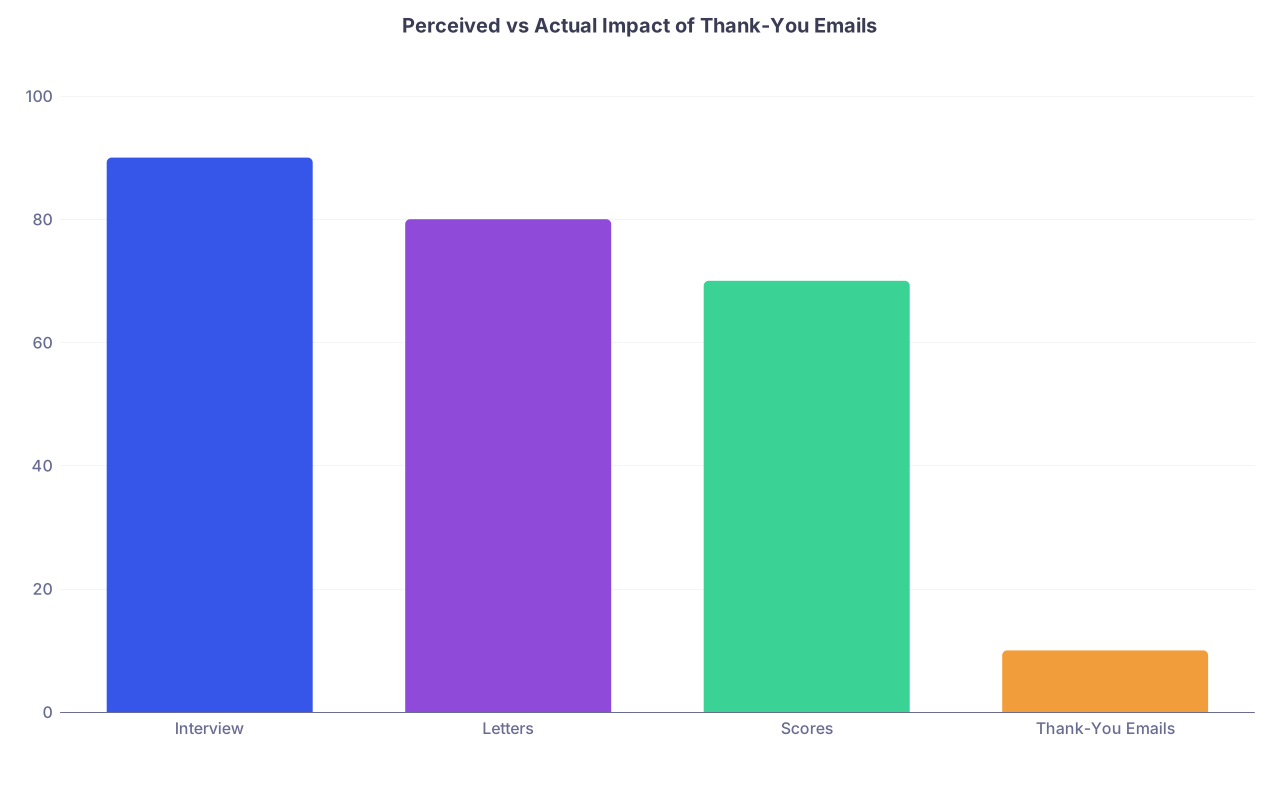
| Category | Value |
|---|---|
| Interview | 90 |
| Letters | 80 |
| Scores | 70 |
| Thank-You Emails | 10 |
Applicants perceive thank-yous as medium-impact; PDs treat them as rounding error.
When Thank-You Emails Can Help (A Little) — And When They Hurt
Here’s the contrarian part: “They never matter at all” is just as wrong as “they’re critical.” The truth is narrower.
Situations where they can help:
- Clarifying legitimate interest
If you had a strong interview and you genuinely connected with a faculty member, a brief, specific email can:
- Reinforce that you paid attention.
- Highlight one or two concrete ways you’d fit (especially if you didn’t articulate them well in real time).
- Signal that you’re not just mass-applying; you actually noticed their curriculum, patient population, or niche.
This effect is subtle. Think “micro-boost,” not “rank list catapult.”
- Correcting or adding a key piece of information
Did you forget to mention that a paper just got accepted? Or that a visa/relocation concern you nervously brought up is actually resolved?
A short, factual, non-groveling note can repair a small hole:
- “Since our conversation, our manuscript on X was accepted to Y journal. I enjoyed discussing Z with you and thought you might like the update.”
- Ethical signaling in gray zones
Some programs still try to play the “we can’t tell you your rank, but we really liked you” wink-wink game. You don’t need to dance with them, but if you are genuinely ranking them highly, a clear, honest line like:
- “Your program will be ranked very highly on my list due to A, B, C”
can, occasionally, reassure a borderline nervous PD that you’re not ghosting them for a bigger name.
Notice: none of this is “I will rank you #1” unless you mean it. Lying here is a character test, not a strategy.
When thank-you emails actively backfire
Yes, you can hurt yourself. I’ve seen all of these:
Obvious copy-paste mistakes
“I really enjoyed learning about your program’s strong emphasis on cardiology” … sent to a psychiatry program. That does get remembered. Just not the way you want.Overly long, needy messages
Multi-paragraph, emotional outpourings about how this program is your “dream since childhood” read unsteady and anxious, not dedicated.Fishing for feedback or reassurance
“Do you think I’d be a good fit?” or “I hope I didn’t come across as nervous.” That’s not endearing; it’s awkward, and it puts faculty in a position they can’t respond to honestly.Boundary-crossing or personal oversharing
Turning a professional email into a life story or trauma narrative is not scored as “vulnerability.” It’s scored as poor judgment.
In other words: a neutral, professional email ranges from “slightly positive” to “irrelevant.” A bad email can actually become memorable in the wrong way.
What Programs Actually Do With Your Thank-You Emails
Let’s walk through what happens in most programs, because applicants wildly overestimate the backend process.
The standard reality in many departments
Faculty interviews you.
Later that day or week, they put a score or comments into some system:
“Strong candidate, good fit, interested in X, would rank in top third.”Rank meeting happens much later. Everyone looks at:
- Composite interview scores
- File summary
- Any extreme comments (red flags or raves)
Thank-you emails? Usually:
- Sitting in someone’s inbox.
- Maybe skimmed, maybe not.
- Almost never brought into the formal scoring conversation.
At a minority of programs, a coordinator or chief resident keeps a light spreadsheet:
- Y/N for “sent thank-you”
- Maybe a note if something was unusually positive or concerning.
Even then, it’s usually used as a tiebreaker only when everything else is equal and they are obsessing about a decision that probably doesn’t change their actual resident pool that much.

| Step | Description |
|---|---|
| Step 1 | Interview Day |
| Step 2 | Interviewer Scores Applicant |
| Step 3 | Scores & Notes Logged |
| Step 4 | Rank Meeting |
| Step 5 | Rank Based on Scores & Fit |
| Step 6 | Consider Minor Signals (Interest, Thank-You) |
| Step 7 | Borderline Tie Between Applicants? |
You’ll notice: there is no dedicated “thank-you email review” stage. Because that would be a terrible use of time.
Strategic Advice: What To Actually Do (And Stop Doing)
Let me make this extremely practical.
1. Stop worshiping the ritual
You do not need:
- Color-coded spreadsheets tracking every sent email.
- Unique, flowery, essay-length notes per interviewer.
- To stay up until 2 a.m. after every interview night trying to hit same-day thank-yous.
Residency applications are a stamina game. Protect your brain.
2. Use a simple, efficient system
If you’re going to send them (and yes, sending a few sane ones is fine), do it like an adult with limited time:
- One clean template per program type (e.g., categorical IM, prelim, EM).
- Swap in 1–2 specific details max: a conversation point, a curriculum element, a patient population feature.
- Send within 24–72 hours. Not minutes. This is not DoorDash.
Something like:
Dr. Smith,
Thank you for taking the time to speak with me during my interview at [Program]. I appreciated our discussion about [specific topic], especially your perspective on [short phrase].
Our conversation reinforced my interest in [Program], particularly because of [1 concrete program feature].
Best regards,
[Name], [School]
That’s it. No dramatic story arc. No emotional monologue.
3. Decide where your scarce energy goes
Here’s a blunt allocation recommendation for post-interview season:
- 90–95% of your energy:
Finalizing your rank list thoughtfully. Sleeping. Finishing rotations without burning bridges. Taking care of your health. - 5–10%:
Efficient, low-effort thank-you notes if you choose. Plus any real “letter of intent” if there’s a true #1.
If you are sacrificing sleep, studying, or clinical performance to perfect thank-you emails, you’re doing it backwards.
What the Evidence Shows vs What You Should Believe
The data and lived experience line up:
- PD surveys: thank-you notes are low-importance signals.
- Behavior in conferences and rank meetings: people mention them only occasionally, and rarely to justify major moves.
- Applicant outcomes: you can easily find people who matched brilliantly without sending a single one, and people who blanked after obsessively crafting them.
This is exactly what you’d expect from a weak, noisy variable in a competitive but structured system.
Think of it like this:
Thank-you emails are to residency matching what extra credit quizzes are to your grade. Nice. Occasionally nudges a borderline. But if you bombed all the midterms, the extra credit is not rescuing you.
The Bottom Line
Three points, and then you can close that Gmail tab.
Thank-you emails are low-yield. They rarely move your position on a rank list in any meaningful way. They’re a marginal, sometimes-positive, sometimes-neutral signal at best.
Use them sparingly and professionally. Short, specific, non-cringey notes to a few key interviewers or to a program you genuinely loved are fine. They should never consume serious time or emotional bandwidth.
Focus on the levers that matter. Your interview day performance, your track record, and your honest, well-thought-out rank order list will decide your match—not whether you found a fresh synonym for “grateful” in Outlook.