37% of graduating U.S. MD seniors end up matching at a program that was not in their original “top happiness tier” when they built their early lists—yet the vast majority still report being satisfied with their training by PGY-3.
That statistic alone should make you suspicious of the very common advice: “Only rank places where you’d be happy to match.”
It sounds wise. It’s repeated by advisors, upperclassmen, and random Reddit threads like it’s NRMP gospel. But it is strategically sloppy, psychologically misleading, and mathematically wrong.
Let’s take this apart.
What the Match Algorithm Actually Optimizes (Hint: Not Your Vibes)
The NRMP algorithm is applicant-proposing. Translation: the system is designed to favor you, the applicant, as long as you give it something to work with.
Here’s the part most people never internalize: ranking a program cannot hurt you. You can only hurt yourself by not ranking a place that’s even slightly better than going unmatched.
Not “better than your top choice.”
Not “better than your Instagram aesthetic.”
Better than going unmatched. That’s the bar.
The algorithm tries to place you in your highest-ranked program that also wants you. If you don’t match there, it checks the next one. And the next. If you leave programs off your list because you “wouldn’t be happy there,” the algorithm does not reward you with a magically better spot. It just runs out of options faster and dumps you into:
- The Supplemental Offer and Acceptance Program (SOAP), or
- A gap year
- A scrambled, panic decision you have essentially no control over
I’ve watched people delete mid-tier but solid programs from their lists because “I didn’t vibe with the residents” or “the city isn’t me,” then end up SOAPing into places objectively worse than the ones they refused to rank. And no, they were not happier.
If you remember nothing else: the algorithm can only use the preferences you actually list. Anything you don’t rank is treated the same as it being forbidden territory.
The Data: Satisfaction Is Not as Predictable as You Think
Happiness in residency is a messy outcome. It’s not tightly coupled to “Was this your dream program on interview day?”
NRMP and AAMC surveys, plus follow-up satisfaction studies, show a few consistent patterns:
- Residents report similar overall satisfaction levels even when they matched at their 3rd–5th choice rather than 1st–2nd.
- Burnout is driven more by specialty, workload, culture, leadership, and support than by “rank list position.”
- Many people who matched at “safety” or “backup” programs ended up content, especially by PGY-2 or PGY-3, once they formed relationships and gained competence.
On the ground, I’ve seen this play out constantly. The ecstatic MS4 who matched their #1 in a “sexy” city but ends up miserable under malignant leadership. The quiet applicant who matched at #7 in a mid-size city and later says, “Honestly, this was the right fit for me. I just didn’t realize it on interview day.”
Here’s what the “only rank where you’d be happy” crowd never admits:
Your ability to predict future happiness at a program based on 6–8 hours of staged exposure is poor. Extremely poor.
You see:
- Hand-picked residents
- A curated tour
- A program director’s sales pitch
- Residents on their best behavior in front of applicants
You don’t see:
- The overnight call culture at 3 a.m. on a Tuesday
- How the PD handles a resident in crisis
- Whether the scheduler actually cares if you get a day off for your sister’s wedding
- How your own life circumstances change over the next 3–7 years
So pinning your entire match strategy on “only where I’d be happy” is building a financial plan around scratch-off tickets. It feels like “listening to your gut.” It’s actually just overconfidence.
“Happy” vs “Tolerable”: You’re Using the Wrong Cutoff
Let’s sharpen the language, because this is where people get screwed.
The usual advice:
“Only rank programs where you’d be happy to match.”
What the algorithm actually demands, if you want to avoid disaster:
“Rank every program you would rather attend than go unmatched.”
Those are absolutely not the same thing.
You should have a hard floor: places you genuinely believe would be toxic, unsafe, or so misaligned with your values that you’d accept SOAP or a gap year instead. Those you leave off.
But that floor is a lot lower than “I didn’t love the city” or “the residents seemed tired” or “their ultrasound machine was old.” You are signing up for postgraduate training, not a curated lifestyle brand.
This is where people confuse ideal with acceptable. They treat “not thrilled” as equivalent to “unacceptable.” That’s how people end up with brutally short rank lists in competitive specialties and then “mysteriously” go unmatched.
Let me be blunt: if there are programs on your list where, faced with a choice between that program and SOAP, you would pound the SOAP button, fine—do not rank those.
But if you know that in March, when the email hits your inbox, you’d much rather see “You matched” at that merely-okay place than “You did not match,” then you are playing games with yourself by omitting it.
What Actually Matters More Than Your Initial “Happiness” Impression
The people who survive residency and don’t hate their lives did not magically find their 100% perfect happy place. They landed somewhere good enough on factors that actually predict a tolerable training environment.
You want to be rational? Stop asking, “Did this place make me feel happy on interview day?” Start asking questions like:
- Is this program accredited, stable, and not on probation?
- Do graduates pass boards and get decent jobs/fellowships?
- Is there clear evidence of resident abuse, chronic under-staffing, or unfixable toxicity?
- How are duty hours actually handled? Not the slide deck. The whisper from the PGY-2 in the corner.
- Do I have any support in this city (friends, partner, family) or at least can I reasonably live here without being miserable?
You do not need fireworks. You need a floor of safety, education, and livability.
Let’s put it side by side.
| Factor Type | High-Impact (Real) | Overrated (Fantasy) |
|---|---|---|
| Training | Case volume, supervision | Shiny facilities |
| Culture | PD responsiveness | Interview day “vibe” |
| Outcomes | Board pass rates | Instagram presence |
| Life logistics | Cost of living, support | Trendy city reputation |
| Safety | Duty hours, backup | Hotel quality on interview |
The myth that you should only rank “happy” places pushes you to overweight the fantasy column and underweight the reality column.
The Risk Math: Why Short Rank Lists Are Playing with Fire
Here’s where the contrarian part stops being cute and starts being blunt: if you’re in a competitive specialty and you keep your rank list artificially short because of the “happy only” nonsense, you are gambling with terrible odds.
Look at NRMP data:
- Unmatched rates are substantially higher for applicants with shorter rank lists, controlling for competitiveness.
- U.S. MD seniors who ranked ≥10 programs in moderately competitive fields had dramatically lower unmatched rates than those who ranked 4–5.
- Even strong applicants get burned when they underestimate competition at “mid-tier” programs and fail to rank enough of them.
Let’s visualize something simple: hypothetical match rates vs how many programs you rank in a moderately competitive specialty.
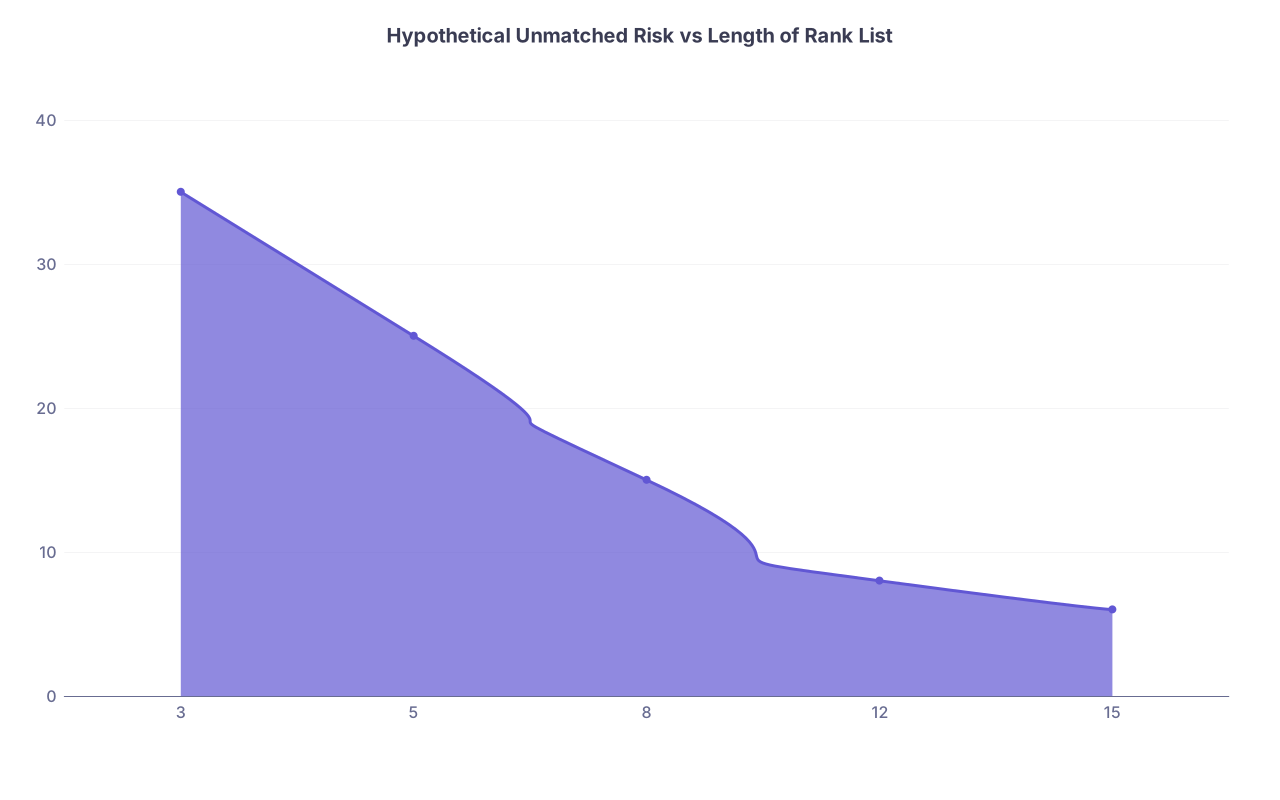
| Category | Value |
|---|---|
| 3 | 35 |
| 5 | 25 |
| 8 | 15 |
| 12 | 8 |
| 15 | 6 |
No, those are not exact NRMP numbers. But they mirror the pattern in their data: more programs ranked → lower unmatched risk. The function isn’t linear, but the direction is loud and clear.
Yet every year, I see rank lists like:
“I interviewed at 14 places but I’m only ranking 5 where I’d be happy.”
Then Match Week:
“I cannot believe I went unmatched. I had strong scores. How did this happen?”
It happened because you voluntarily narrowed your safety net in a system that punishes that kind of purity test.
“But Won’t Ranking a Program I Don’t Love Hurt My Chances at Better Ones?”
No. That’s not how the algorithm works.
This misconception never dies, so let me be very explicit.
- Ranking a program lower does not signal disinterest to that program. They do not see your rank order.
- Ranking a “backup” program does not pull you away from a higher-ranked program that also wants you. You’ll still land in the highest program on your list that ranks you high enough.
The only effect of adding a program lower on your list: if you do not match at any program above it, you have an extra chance to match instead of going unmatched.
That’s it.
The idea that ranking more places somehow “waters down” your application or harms your chance at top choices is superstition. Mathematically wrong. Repeated anyway.

| Step | Description |
|---|---|
| Step 1 | Start with Applicants #1 |
| Step 2 | Temporarily Match Here |
| Step 3 | Try Next Choice |
| Step 4 | Unmatched |
| Step 5 | Program ranks you high enough? |
| Step 6 | Any choices left? |
See the missing step “Punish applicant for having backups”? Exactly. It does not exist.
When You Actually Should Leave a Program Off Your List
Let me balance this, because “rank every place” is just as stupid as “only rank happy places.”
There are legitimate reasons to exclude a program:
- You have credible reports of malignant culture, harassment being ignored, or systemic bullying.
- You’d be unsafe there as a person (identity-related concerns, dangerous environment, zero support).
- The training is so weak (no cases, no supervision) that it may legitimately damage your career prospects.
- You have life constraints where matching there would create unmanageable hardship (serious family illness needing you local, for example).
In those cases, yes—you might rationally decide you’d rather risk SOAP or unmatched than bind yourself to 3–7 years there. That’s not about “happy.” That’s about basic safety and viability.
But that’s a far cry from “The resident dinner felt awkward” or “I wanted to be coastal” or “The call rooms were ugly.”
The Emotional Trap: You’re Over-Optimizing for a Single Day
Here’s the psychological piece people underestimate: by March, your reference point will change.
Right now, as an MS4 or applicant, your world is filled with fantasy versions of your top programs. Gleaming names on a spreadsheet. Imaginary happy future selves.
But on Match Day, your reference point collapses into a binary question:
- Did I match?
- If yes, am I in a program that’s at least decent enough that I can make this work?
The brain adapts. People grow into their programs. Residents build friendships, carve out niches, and discover that being respected, trained, and not destroyed is far more “happiness-inducing” than the coastal skyline they thought was non-negotiable.
Ironically, the people who cling hardest to “only where I’d be happy” often end up the least happy—because they end up unmatched and thrown into last-minute SOAP chaos with far less control than they would’ve had by just ranking decent-but-imperfect programs.
A Saner Framework for Your Rank List
Here’s the approach that actually aligns with how the Match works and how human satisfaction works:
- First, identify and blacklist the truly unacceptable programs: unsafe, malignant, or life-sabotaging for you.
- Among the remaining programs, rank in true order of preference, from “I’d be thrilled” down through “I can live with this; it beats going unmatched.”
- Do not cut off the bottom just because the name or city makes you feel lukewarm.
If that means 15 programs on your list, so be it. If that means 7 because you genuinely only interviewed at 7 places you’d accept over SOAP, fine. But let that decision be about real thresholds, not perfectionism dressed up as “protecting your happiness.”
And be honest with yourself: if, on Match Day morning, staring at the NRMP portal, you know that an okay-but-not-exciting program would still feel infinitely better than “You did not match,” then it belongs on your list. Period.
The Bottom Line
Three key points and we’re done:
- The Match algorithm can’t hurt you for ranking “backup” programs—it only punishes you for not ranking programs you’d actually accept over going unmatched.
- Your ability to predict where you’ll be “happy” based on a single interview day is weak; focus on safety, training quality, and basic livability instead of chasing a perfect vibe.
- You shouldn’t “only rank places where you’d be happy.” You should rank every place you’d rather attend than SOAP or go unmatched—and let the algorithm do its job.