A doctor I’ve seen before in one form or another: one to three years out from regular clinical work, worried the gap is poisoning the application, convinced that one fresh U.S. re-entry rotation will fix the story.
Educational disclaimer: This article is for educational purposes only and does not constitute legal, financial, tax, or professional career advice. Residency selection practices vary by program and specialty, and applicants should seek guidance from qualified advisors, mentors, attorneys, or other professionals as appropriate for their situation.
On paper, the logic sounds clean. “I’ll show them I’m back. I’ll get a current letter. I’ll prove I can still function.”
Then the rotation happens.
No disaster. No screaming attending. No formal professionalism report. Just something worse in residency selection: faint praise. “Pleasant.” “Worked hard.” “Improving.” “Would benefit from additional supervised experience.” The kind of language that sounds polite to the applicant and lethal to the committee.
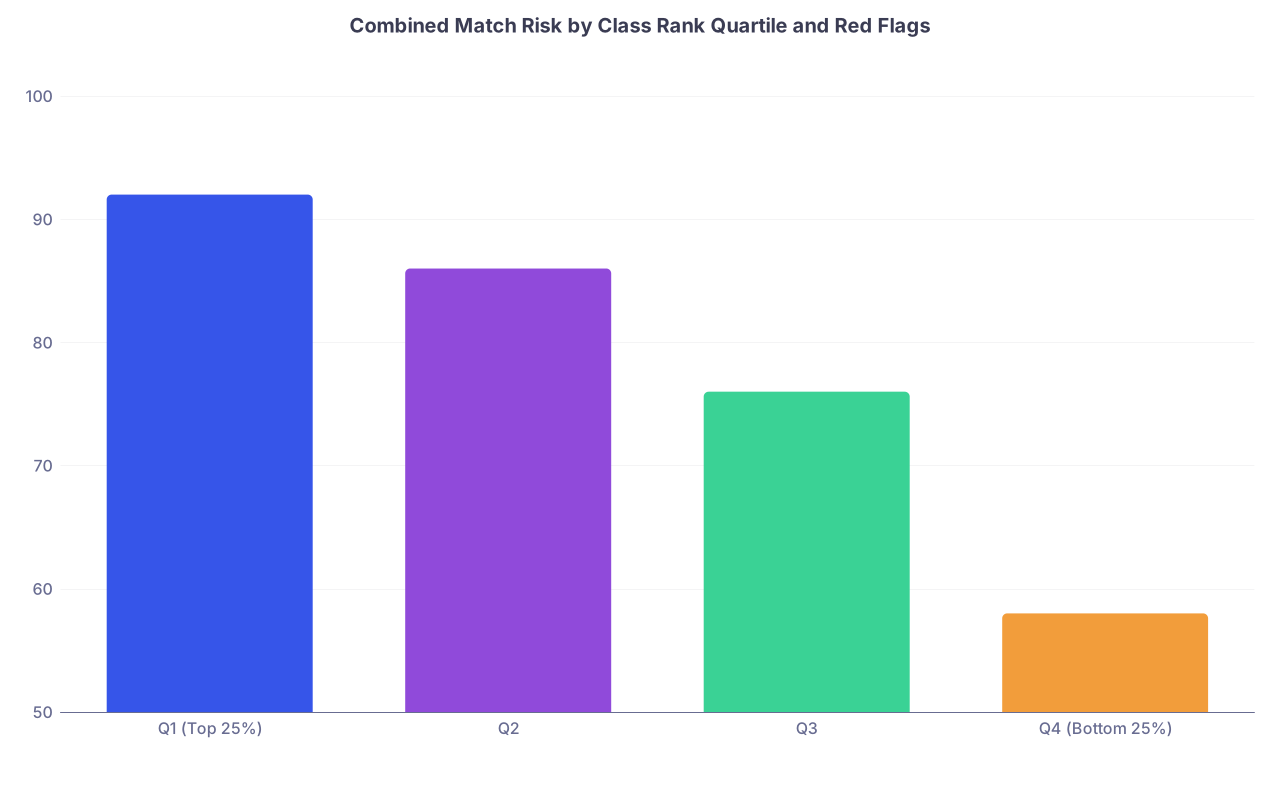
Let me tell you what really happens behind closed doors. In many selection meetings, an old gap gets discussed for two minutes. A weak recent clinical performance gets discussed for fifteen. Why? Because the gap is history. The weak rotation feels like current evidence. Committees can tolerate historical uncertainty if you give them a coherent reason for the time away and then hand them strong, believable proof that you’re ready now. What they struggle to forgive is recent proof that raises doubt.
That’s the whole game.
Yes, a weak re-entry rotation can hurt you more than the gap itself. In fact, it often does when it confirms exactly what faculty were hoping not to find: rust, slow thinking, poor communication, shaky professionalism, weak team integration, or inability to function in the current U.S. clinical environment.
This matters because applicants routinely make a bad strategic move here. They rush into the first available rotation out of fear. Fear of looking inactive. Fear of the blank space on the CV. Fear of the inevitable question: “What have you done recently?” And that fear pushes them into high-risk settings with unclear supervision, vague expectations, and evaluators who compare them to polished current fourth-years instead of to someone rebuilding after time away.
That is how a fix becomes a fresh red flag.
What follows is the part nobody explains well. I’m going to walk you through how program directors actually think about gaps, why re-entry rotations so often go wrong, when they are still absolutely worth doing, and how to avoid creating preventable damage.
A Familiar Disaster Scenario: The Comeback Rotation That Backfires
Here’s the version I hear all the time. An applicant has a two-year gap. Maybe it was visa delay. Maybe family illness. Maybe research. Maybe health recovery. Maybe a messy combination of life and bureaucracy. They know the gap needs explaining, but they also know explanation alone won’t carry them. So they line up a U.S. clinical re-entry experience at a busy hospital and tell themselves this is the comeback.
For the first few days, they feel behind. Presentations are too long. The EMR feels slower than they remembered. Notes take forever. Team rounds move at a speed that punishes hesitation. They compensate by staying late, smiling more, volunteering constantly. Very common. Also very dangerous if the underlying performance doesn’t catch up.
By the end of the month, nobody says they failed. But nobody plants a flag for them either. The attending writes a letter that sounds supportive on the surface and noncommittal underneath. The final evaluation mentions dedication, improvement, and the need for continued clinical exposure. That applicant thinks, “At least I have something recent.”
The committee may hear something very different: “We gave this person a current chance to show readiness, and the result did not reassure.”
That’s the tension applicants miss. A gap creates uncertainty, yes. But uncertainty is survivable. Weak current evidence is harder to survive because it looks predictive. Faculty can forgive distance from clinical work if you explain it well and show strong recent readiness. They cannot easily ignore recent data suggesting you may still be rusty, hard to teach, awkward with teams, or not ready for service.
That is the thesis of this whole article. A weak re-entry rotation can absolutely hurt more than the gap itself when it confirms feared weaknesses rather than resolving them.
And the cruel part? Most of this is preventable. Not by pretending the gap doesn’t matter. By understanding exactly how programs read it, and by refusing to walk blindly into a rotation that was structurally likely to expose you rather than support you.
What Program Directors Really Think About Gaps Versus Recent Weakness
A gap is a question mark. A weak re-entry rotation can become an answer they don’t like.
That’s the cleanest way to understand committee psychology.
When faculty review an application with time away, the first private question is obvious: “Why were they out?” But the second question is the one that actually drives interview decisions: “What have they done recently that reassures us?” If the answer is good, the gap often shrinks. If the answer is bad, the gap expands and hardens into a narrative of decline.
Here’s the hierarchy of concern I’ve seen in real conversations. First, unexplained gaps. Programs hate stories they cannot make coherent. Next, skills decay. Then professionalism concerns, communication problems, poor teachability, inability to fit team workflow, and unreliable self-awareness. That last one is underrated. A lot of faculty can work with a struggling trainee. They do not want a struggling trainee who doesn’t realize they’re struggling.
Not all gaps are judged the same. Caregiving is not repeated exam failure. Visa delay is not disciplinary trouble. Health recovery is not disappearing without explanation. Research years, system barriers, family obligations, and immigration logistics are often understandable if presented clearly and calmly. Repeated performance problems without evidence of repair are a very different animal. Program directors may still review them, but the threshold for reassurance becomes much higher.
Recent performance carries disproportionate weight for three reasons.
First, it’s close in time. Faculty assume fresh data reflects current ability better than older accomplishments.
Second, they can imagine it in their own program. A weak inpatient rotation at a recognized U.S. site doesn’t feel abstract. It feels like a preview of July.
Third, the evidence often comes from people or systems they trust. If the evaluator is known, or the institution has a credible reputation, the comments hit harder. A bland or hesitant letter from a respected attending is often more damaging than applicants realize.
And here’s the risk logic nobody says out loud enough: programs are not simply selecting the worthiest person. They are trying to avoid the person who may struggle on service, slow down the team, create patient safety concerns, or require disproportionate remediation early in training. Merit matters. Potential matters. But risk management is baked into every rank list.
I’ve heard faculty mentally frame it like this, even when they don’t say the exact words: “I can explain a gap to the committee; I cannot defend fresh weak clinical feedback.”
That sentence should change how you plan your comeback.
Why Re-Entry Rotations Go Wrong: The Hidden Ways Applicants Hurt Themselves
Most applicants choose re-entry rotations for the wrong reason. They want something recent. That is not enough. Recent is not the goal. Favorable current evidence is the goal. Big difference.
The bad setup usually starts with desperation. An applicant sees a month available at a U.S. hospital and grabs it without asking the questions that matter. Who directly observes me? What level am I expected to perform at by week one? Is there midpoint feedback? Is this mentorship, or is this an audition wearing a mentorship costume? Who writes the final evaluation? Has this site worked well for returning graduates before?
They don’t ask. They show up. And then the problems appear fast.
Slow presentations are the classic one. Not because you don’t know medicine at all, but because retrieval speed has changed. You know the disease. You can’t organize it quickly enough under pressure. Attendings notice that immediately.
Then EMR fluency. If you haven’t worked in a modern U.S. clinical system recently, your note structure, chart navigation, order familiarity, and inbox rhythm may look clumsy. Again, not fatal by itself. But in a high-pressure service, slowness gets interpreted as inability.
Outdated medical decision-making is another trap. Applicants often prepare by reviewing broad content, but the team is listening for current guideline language, current workflow assumptions, and current thresholds for escalation. If your plan sounds a few years old, people may not say that directly. They’ll simply stop trusting your readiness.
Team communication matters even more than applicants think. Awkward sign-outs. Trouble reading when to speak. Too much explanation. Too little ownership. Over-formality. Rambling answers. Visible anxiety that gets misread as confusion. I’ve seen good people look weak because they were operating three seconds behind the rhythm of the team.
And then there’s overcompensation. Very common. The applicant senses they’re rusty, so they become hyper-eager. They volunteer for everything, talk too much on rounds, send too many follow-up messages, apologize constantly, stay conspicuously late, and create the impression of strain rather than competence. Effort is respected. Strain is remembered.
(See also: using away rotations to overcome red flags for more.)
The mismatch problem is where many of these stories become predictable. A highly acute inpatient service is often the worst place to re-enter if you are still rebuilding speed. It exposes rust instantly. A lower-acuity environment, a transitional supervised role, or an observership-to-hands-on progression may be far smarter. But applicants chase prestige. Or urgency. Or the belief that “real” medicine has to mean maximal pressure. Wrong.
Another hidden problem: unclear expectations. Plenty of sites advertise support and mentorship, then function like audition rotations with no meaningful feedback until the end. By then it’s too late. The applicant thinks they’re doing adequately because nobody has criticized them directly. Faculty think they were being gently obvious. Welcome to medicine.
And let me tell you a brutal truth. Attendings often compare a re-entry applicant not to the applicant’s difficult life story, but to the last polished fourth-year or intern they supervised. That’s the comparison set living in their head. Not fair. Still true.
This is why lukewarm language is dangerous. “Pleasant.” “Eager.” “Improving.” “Performed at expected level for time away.” Applicants hear kindness. Committees hear lack of endorsement. A strong letter says more than that. It gives specifics. It makes claims. It signals confidence. Anything less, after a gap, risks validating every suspicion the committee was trying not to hold.
The biggest red flag here isn’t rust itself. Rust can be repaired. The bigger red flag is poor judgment: choosing a setting where weak performance was foreseeable and then presenting the outcome as evidence of readiness.
That mistake reads badly because residency is full of choosing the right next step under pressure. If you mismanaged your own re-entry, some faculty will wonder how you’ll manage patients.
When a Re-Entry Rotation Is Still Worth It — and How to Make It Safer
Now the other side, because I’m not telling you to avoid re-entry rotations categorically. That would be lazy advice. Sometimes they are exactly the right move.
A re-entry rotation is strategically valuable when a program or specialty truly expects recent hands-on evidence, when your prior letters are stale, when your U.S. system familiarity is thin, or when you have a realistic path to a strong current letter writer who will directly observe you. In those situations, not having recent clinical evidence can leave too much doubt on the table.
But the setup has to be right.
A safer re-entry environment has structure. Orientation. Defined tasks. Direct observation. An attending who is actually available. Midpoint feedback. A service where visible growth over a few weeks is possible. You want a place where you can start a little slower and become stronger, not a place that punishes you irreversibly for not being sharp on day one.
Ambulatory continuity settings can work well. Lower-acuity inpatient teams can work well. Transitional sub-internship style experiences can work well. Supervised externships can work well when rules and expectations are clear. The exact format depends on specialty and what is legally permitted, but the principle stays the same: choose settings that reward preparation and growth, not instant speed alone.
You need to vet the site like an adult, not like a grateful supplicant. Ask bluntly:
Who will observe me directly? What role will I actually have? Who writes the evaluation? Is midpoint feedback routine? Have returning graduates done well here? If I’m underperforming early, will someone tell me in time to correct it?
If they are vague, smiley, and full of phrases like “we’ll see how you do,” be careful. That often means hidden audition environment.
Preparation before day one is where smart applicants separate themselves. Review current guidelines in the bread-and-butter problems of the specialty. Practice oral presentations out loud, timed. Rebuild note structure. Learn common handoff language. Review order set logic if you can access examples. Rehearse how to present an assessment and plan crisply. If your last real clinical rhythm was years ago, don’t assume your brain will just snap back because you’re motivated. Motivation helps. Repetition matters more.

Do a self-audit before you commit. Can you give a concise oral presentation without drifting? Can you speak at a clinically normal tempo? Are your knowledge base and confidence close to evaluable level, not perfect but functional? If the answer is no, you may need a bridge step first. Simulation. Observership. Case-based mentorship. Chart review with feedback. CME paired with structured discussion. Shadowing that lets you relearn the workflow without being judged as fully performance-ready. There is no shame in a ramp-up phase. There is shame in forcing yourself into a formal evaluation you weren’t ready to survive.
(See also: which gap-year activities move the needle for more.)
Here’s the insider rule. Do not do a re-entry rotation because you are scared of the gap. Do it only if you have a credible reason to believe it will produce favorable current evidence.
That means you’ve picked the environment carefully, prepared seriously, and confirmed that supervision and feedback are real. If you cannot line up those conditions, alternatives may be smarter. A strong narrative letter from a supervised observership can help. Research with clinically connected mentors can help if they can speak credibly about your engagement and judgment. Longitudinal patient-facing volunteer work, where allowed, can help. Delaying the application to build stronger current evidence can absolutely help.
Applicants hate hearing that because delay feels expensive. Maybe it is. But a rushed weak rotation can be more expensive. It doesn’t just fail to solve the gap. It may create a newer, stronger reason to doubt you.
How to Talk About a Weak Re-Entry Rotation If It Already Happened
First rule: don’t panic. Second rule: don’t spin.
Programs can smell defensive framing from across the room. If you start explaining away every concern, blaming the site, or inflating a clearly average experience into a triumph, you’ll make it worse. What helps is accurate self-assessment.
Start by separating anxiety from evidence. Lots of applicants feel they did terribly when they were merely rusty at first. Look at the actual data. What does the formal evaluation say? Will the writer support you enthusiastically, weakly, or not at all? Were there explicit concerns about professionalism, teamwork, reliability, judgment, or safety? Those are the real dividing lines.
A slow start with later improvement is often recoverable. So is a rotation where you were a bit hesitant early but ended up solid and coachable. Committees can understand that. What alarms them are concerns about boundaries, ownership, communication under stress, reliability, inability to accept feedback, or unsafe clinical behavior. Those issues don’t read as transitional. They read as intrinsic risk.
Your response framework should be simple. Brief explanation of the original gap. Brief acknowledgment that re-entry was challenging. Then the crucial part: specific remediation and newer evidence. Not vague growth language. Evidence.
Maybe you did a second, better-vetted rotation and earned a stronger letter. Maybe a supervisor can document visible improvement in presentations, workflow, and clinical reasoning. Maybe you completed simulation-based assessment and can speak concretely about what changed. Maybe you now have current patient-facing or clinically adjacent work that demonstrates consistency, communication, and readiness.
That newer evidence matters because committees need a reason to believe the weak rotation was transitional, not definitive.
Letter strategy is where applicants sabotage themselves constantly. If a prestigious evaluator is likely to write a lukewarm letter, prestige will not save you. I’ve seen applicants insist on using letters from famous names who barely knew them, while bypassing less famous supervisors who would have written specific, forceful endorsements. That is vanity disguised as strategy.
Ask directly: “Can you write me a strong letter for residency?” Not “a letter.” Strong letter. If the answer is hesitant, diplomatic, or soft, move on if you can.
What impresses committees after a stumble is not perfection. It’s insight. Accountability. Corrective action. A believable pattern that shows the problem was part of re-entry, not your ceiling. If you can say, plainly, “I underestimated how much speed and workflow I had lost, I sought structured feedback, I changed how I prepared, and my later supervisors can speak to the difference,” that lands far better than polished denial.

Here’s the reminder I want you to keep. The lesson is not “avoid all re-entry rotations.” The lesson is much sharper than that: never let desperation create fresh proof against you.
A gap is survivable. I’ve seen that again and again. Applicants recover from time away when they tell the story cleanly and then provide strong current evidence. What is much harder to outrun is self-inflicted current doubt. Especially when you created it trying to look proactive.
Choose evidence, not activity. Choose structure, not wishful thinking. Choose settings that let you rebuild rather than expose you for sport.
That’s what really moves committees.