
Most applicants with a long training gap do not need years of fresh experience — they need 3–6 genuinely strong, recent clinical months.
Let me be blunt: programs are not counting your entire life story. They’re asking two simple questions:
- Are you clinically current and safe to put in front of patients on July 1?
- Do we trust your recent performance enough to risk interviewing and ranking you?
“Recent clinical months” is how they answer both.
This is where most applicants with gaps get it wrong. They either do way too little (one observership and call it a day) or they panic and try to piece together random, low-impact experiences that don’t actually help.
Here’s the answer you’re looking for — with numbers, not vague vibes.
What Programs Really Mean by “Recent Clinical Experience”
When programs talk about “recent clinical experience,” they generally mean:
- Real, hands-on or at least closely involved clinical work
- In the same or similar healthcare system you’re applying into (for US residency: U.S. clinical experience, USCE)
- Supervised by physicians who can write credible, detailed letters
- Done within the last 6–24 months (the closer to application, the better)
Translation: a shadowing month from 5 years ago doesn’t count. Neither does only research, or a random non-clinical job. They want to see what you’re like in patient care right now.
For applicants with a long gap (2+ years away from full-time clinical work), the “recency” requirement matters even more, because your old training no longer reassures them.
How Many Recent Clinical Months Do You Actually Need?
Here’s the short, honest breakdown by scenario.
1. Mild gap: 1–2 years away from clinical work
Think: you graduated recently but took time for research, family, visa delays, or another degree.
Typical safe target: 2–3 months of recent, solid clinical experience in the last 12 months.
- Ideal: 3 months of USCE (for US programs), mix of inpatient + outpatient
- At least 2 strong letters from those rotations
If you’re only 1 year out and your med school performance was strong, some programs will tolerate less. But you’re not here to aim for “bare minimum.” You’re trying to remove a red flag.
2. Moderate gap: 3–5 years out of clinical training
This is where most programs start to get nervous.
Typical safe target: 3–6 months of recent clinical work, as close to application season as possible.
- 3 months is the minimum that looks serious
- 4–6 months starts to convince people you’re back in “clinical mode”
- You want at least 3 letters, ideally all from recent supervisors
(See also: Should I Write a Separate Red Flag Statement in ERAS or Just Use PS? for more.)
If you’re older (say, graduated 7–8 years ago) but with good older residency experience abroad, you still need these recent months to show you haven’t gone rusty.
3. Major gap: 6–10+ years since serious clinical work
This is the “big red flag” category. It’s not automatically a death sentence, but programs will require more proof.
Realistic target: 6–12 months of recent clinical work, with clear continuity and progression.
- Closer to 6 months if your older background is strong and relevant
- Closer to 9–12 months if you have weak prior training or no residency abroad
If you can’t show at least half a year of current, supervised clinical work, many PDs will simply move on. They don’t have time to convince their committee to take a chance on someone clinically “cold.”
| Training Gap Length | Typical Target for Recent Clinical Months |
|---|---|
| 1–2 years | 2–3 months |
| 3–5 years | 3–6 months |
| 6–8 years | 6–9 months |
| 9–12+ years | 9–12 months |
| Ongoing practice | May need only 1–2 USCE months |
Not every program has hard rules, but that table matches what I’ve seen across internal medicine, FM, peds, and even some lower- to mid-tier competitive programs.
What “Counts” as a Clinical Month — And What Barely Helps
Not all months are created equal. This is where people waste time.
Highest value (green light)
These months actually move the needle:
- Hands-on externships or pre-residency fellowships in the U.S.
You’re seeing patients, writing notes, presenting, maybe even entering orders (under supervision). - U.S. sub-internships / acting internships (for recent grads)
- Ongoing licensed clinical practice abroad, if you’re still truly full-time and can document it
- Hospital-based observerships with deep involvement: daily rounds, presentations, direct interactions with residents/attendings, continuity over at least 4 weeks
These give programs what they need: evidence of current clinical reasoning, reliability, and day-to-day performance.
Moderate value (yellow light)
These help but don’t fully substitute for strong clinical months:
- Short observerships (2 weeks per site) with no clear responsibilities
- Outpatient-only clinics with minimal complexity
- Telemedicine-only shadowing without charting or presentations
- Pure research roles with only occasional clinic exposure
They’re better than nothing. But if your gap is >3 years, these alone won’t fix your red flag.
Low value (red light for expectations)
These usually do not “count” as recent clinical experience:
- Volunteering in non-clinical roles (front desk, scribes who never speak in clinical language, transport, etc.)
- Online “virtual observerships” with no real patient involvement
- Single-day “shadowing” experiences
- Working in non-physician healthcare roles (phlebotomist, tech) — good for story, not enough to prove physician-level readiness
You can still mention them in your application for context, but don’t rely on them to solve the “recent clinical months” problem.
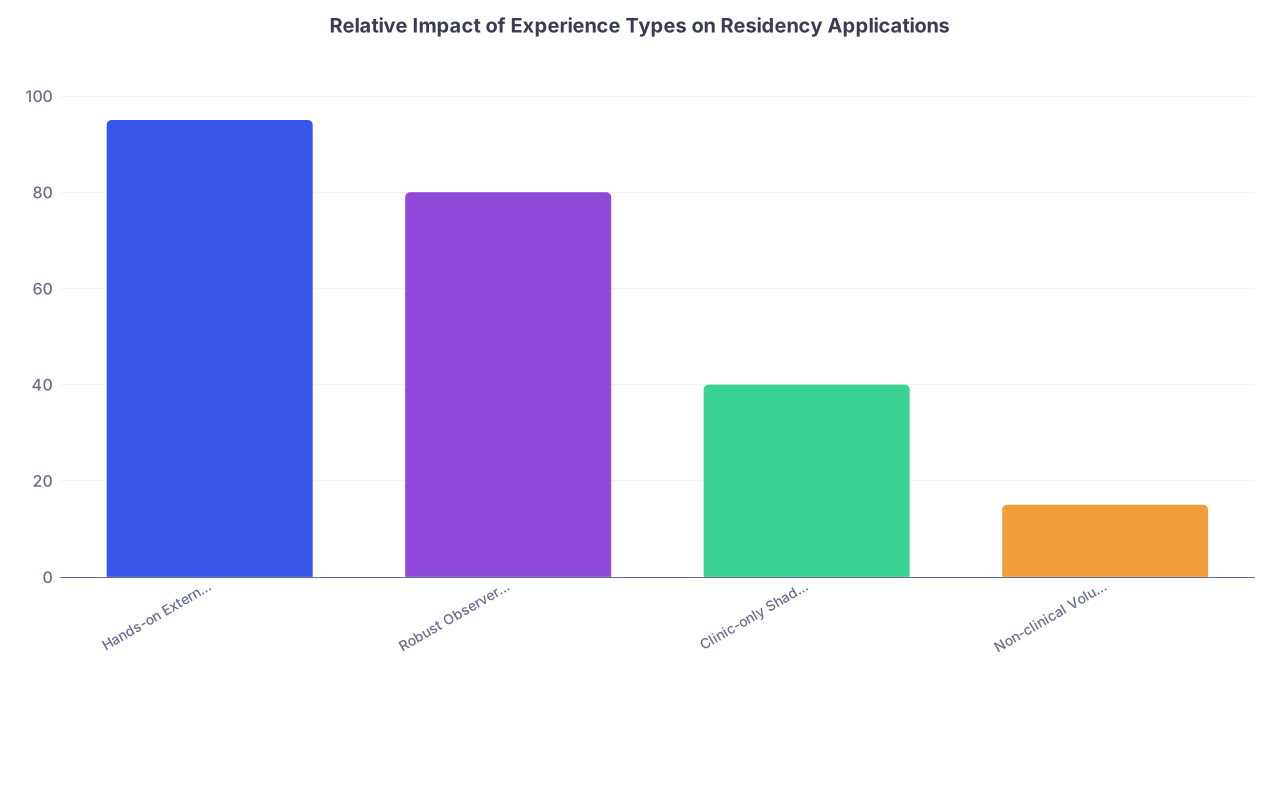
| Category | Value |
|---|---|
| Hands-on Externship | 95 |
| Robust Observership | 80 |
| Clinic-only Shadowing | 40 |
| Non-clinical Volunteering | 15 |
How Fresh Do These Months Need To Be?
This is where timing crushes people.
Most programs will quietly ignore experience older than 24 months when they’re screening for “recent clinical experience.” They may still like the story, but it won’t erase a current gap.
For most applicants with a gap, aim for:
- At least 2–3 months of clinical work in the 12 months before you submit ERAS
- Even better: something ongoing that extends into the application cycle
If your last clinical month ended 3 years ago, you still have a long training gap. It does not matter that you once did 12 months of observerships unless some of it is truly recent.
How To Prioritize If You Can’t Get Many Months
Not everyone can pull off 6–12 months of fresh clinical work. Visa issues, finances, family, geography — all real.
If you’re limited, here’s how I’d prioritize:
Step 1: Get at least 2–3 continuous, high-quality months
Continuous matters. Three one-week experiences scattered across different hospitals look like tourism, not training.
If you can do:
- 3 months of strong inpatient + outpatient in the U.S.
vs. - 6 months of weak, superficial shadowing
Pick the 3 strong months every time.
Step 2: Maximize letters, not just hours
One month that yields a genuinely strong, detailed letter is more valuable than two months where nobody really got to know you.
Make sure your rotations allow:
- Regular case presentations
- Feedback conversations
- Direct observation of your work
- A clear supervising attending who knows they’ll be writing a letter
Step 3: Combine clinical with something else that shows momentum
Programs like to see you moving forward, not just waiting.
If you only have 3–4 clinical months, you can stack that with:
- Ongoing research in the same specialty
- Quality improvement or patient safety projects
- Teaching roles (if you were faculty or senior resident abroad)
- Passing/strong scores on current exams (Step 3, language exams, etc.)
The story you want: “I came back into clinical work and you can see it in my rotations, my letters, and my ongoing commitments.”
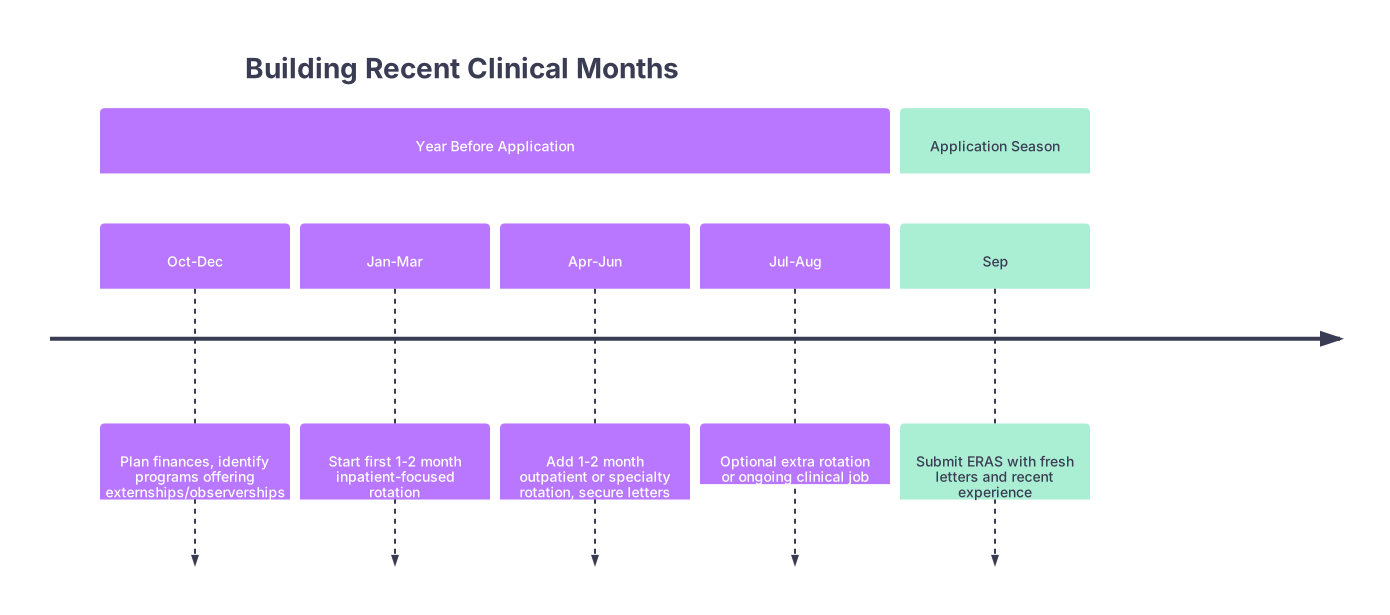
| Period | Event |
|---|---|
| Year Before Application - Oct-Dec | Plan finances, identify programs offering externships/observerships |
| Year Before Application - Jan-Mar | Start first 1-2 month inpatient-focused rotation |
| Year Before Application - Apr-Jun | Add 1-2 month outpatient or specialty rotation, secure letters |
| Year Before Application - Jul-Aug | Optional extra rotation or ongoing clinical job |
| Application Season - Sep | Submit ERAS with fresh letters and recent experience |
Special Situations: How Many Months Do You Need If…?
Let’s hit a few common edge cases.
You’ve been practicing abroad continuously
If you’re still a full-time physician abroad, your “gap” is mainly from the U.S. perspective, not clinically.
- You still want at least 1–3 months of USCE, ideally inpatient, in your specialty of interest
- Programs will consider your continuous foreign practice as proof you’re clinically active
- Focus on bridging: “I know the system abroad, here’s proof I can also work in the U.S. system”
These applicants are often better off than someone who has done nothing clinical for 6 years, even if both are “old grads.”
You paused for a non-clinical degree (MPH, MBA, PhD)
Programs don’t hate this, but they do not assume you’re clinically current.
- Target: 2–4 recent clinical months in the 12 months before applying
- Use your personal statement to clearly explain why the degree makes you better clinically, not further away from patients
You had a gap for health, family, or personal reasons
You do not have to give your entire medical record. But programs will want to see:
- Clear return to function: recent, sustained clinical work (3–6 months minimum)
- A straightforward, confident explanation — no rambling, no defensiveness
Here, the actual number of months matters less than the continuity and the absence of recent interruptions.
How Programs Screen You in 10 Seconds
Here’s what a PD or coordinator implicitly does when they scan your ERAS:
- Grad year: “2014. That’s 11 years ago.”
- Recent work: “Last clinical entry… 2020. Then nothing until one month observership in 2025.”
- Verdict: “Too much unexplained downtime. No evidence of sustained, current practice. Pass.”
Compare that to:
- Grad year: “2014.”
- Recent work: “2023–2024: 8 months IM externship + ongoing hospitalist role abroad.”
- Letters: “Three recent letters all commenting on clinical reasoning and reliability.”
- Verdict: “Old grad, but clinically current. Worth a closer look.”
The difference is not magic. It’s documented, recent clinical time.
Quick Reality Check: What If You Can Only Get 1 Month?
Then you do 1 month. But you don’t pretend that’s enough to fully erase a long gap.
In that situation, your job is:
- Make that 1 month extremely strong: punctual, reliable, eager, teachable
- Secure the best possible letter
- Add other “proof of currency”: Step 3, recent CME, research, teaching, tele-clinics abroad
- Apply smart: community programs, prelim spots, less competitive specialties, places that say they’re flexible with older grads
But if you want a clean, non-arguable file at most programs with a long training gap? You’re aiming for 3–6+ strong, recent clinical months, not just one.
FAQs
1. Is 1–2 months of U.S. observership enough after a 5+ year gap?
Usually no. One or two short observerships after a long gap look like a brief visit, not proof you’re clinically ready. With a 5+ year gap, you should be thinking in the 3–6 month range at minimum, ideally with continuity and strong letters.
2. Do research months count as recent clinical experience?
Not by themselves. Research is great for your CV and narrative, but unless it includes substantial, regular clinical duties (clinic, rounds, patient interactions), programs will not count it as clinical months. You still need separate, clearly clinical rotations or jobs.
3. How far back can my “recent” clinical experience be?
Most programs quietly use about a 2-year window. Anything older than 24 months starts to lose power. For someone with a training gap, you want at least a chunk of your experience — 2–3 months minimum — in the year before you apply.
4. Are unpaid externships or observerships viewed differently than paid clinical jobs?
Programs care more about what you did than whether you were paid. A well-structured unpaid externship with hands-on work and strong supervision is better than a weak, hands-off paid role. That said, a real, ongoing paid clinical job (abroad or in some U.S. settings) can be very persuasive that you’re truly active.
5. If I’m still practicing abroad, do I really need 3–6 months of USCE?
You might not need that much. Continuous, full-time practice abroad already proves you’re clinically active. In that case, 1–3 months of solid U.S. clinical experience can be enough to show you understand the U.S. system. The longer your gap from any clinical work at all, the closer you should aim to that 6–12 month range.
Key takeaways:
- With a long training gap, most applicants should aim for 3–6+ months of genuinely recent, strong clinical experience; 6–12 months if the gap is extreme.
- Recency and quality beat sheer number: continuous, supervised, and letter-generating rotations matter more than scattered, superficial observerships.
- Your goal is simple: when a PD scans your application, your recent clinical months should make the “training gap” feel like old history, not a current risk.
(Related: The Quiet Backchannel Ways PDs Verify Your Application Red Flags)