
The biggest mistake applicants make with red flags is either explaining too much or not explaining at all.
You want the middle path: explain clearly when you must, stay quiet when you should, and never accidentally highlight something programs would’ve ignored.
Here’s how to know if your red flag actually requires a formal explanation addendum.
The Core Rule: When You MUST Write an Addendum
Let me be blunt. If a program director will look at your application and say, “What happened here?” you probably need a formal explanation.
You almost always need an addendum if you have any of these:
USMLE/COMLEX issues
- Step 1, Step 2 CK, or COMLEX failures
- Large score drop between attempts
- Major delay between exams that isn’t obvious (e.g., didn’t test for 2+ years without a clear reason in the timeline)
Academic problems
- Course failures in med school (especially core clerkships)
- Remediation of a clinical rotation
- Academic probation
- Required leave of absence connected to academic performance
Professionalism / conduct issues
- Professionalism probation or formal sanctions
- Disciplinary action documented in your MSPE
- Dismissal from a program (med school, prior residency, grad program) even if later reinstated
Unusual training interruptions
- Long leave of absence (usually >3–6 months) not clearly explained elsewhere
- Withdrawal and re-entry into med school
- Switching schools or programs under circumstances that raise questions
The pattern is simple: if it’s formally on record and negative—especially in your MSPE, transcript, or exam history—it usually deserves a clear, targeted explanation.
When You Should Not Write an Addendum
A lot of you are about to overshare. Do not.
These usually do not need a formal explanation addendum:
“Low but passing” board scores
- 210 on Step 2? Not an addendum issue.
- 490 on COMLEX? Same.
- You can address strategy and fit in your personal statement if you want, but an addendum will just shine a spotlight on something many PDs would’ve skimmed past.
Being below-average in your class
- No honors, mostly passes. That’s common, not an explanation problem.
- Only consider addressing this if there’s a clear story tied to a true event (major illness, caregiver burden) and even then, personal statement is usually better than a formal addendum.
No research, no leadership, no fancy extras
- That’s not a “red flag.” It’s just a profile. Programs might care, but it doesn’t need a formal “Explanation of Deficiency” document.
Not matching previously but nothing else negative
- Past SOAP / reapplicant status does not automatically require a red-flag style addendum. Programs see your timeline.
- You can tackle this in your personal statement: “I applied last cycle, learned XYZ, and have done ABC since.”
Older age / non-traditional background
- Not a red flag. Don’t turn it into one by over-explaining.
If explaining something will create more concern than it answers, step back. Many borderline issues are better left to interview conversations or lightly framed in your personal statement.
Quick Triage: Does This Need an Addendum?
Here’s a simple way to decide.
Ask yourself these questions:
Is there a formal entry in:
- MSPE
- Transcript
- Exam reports
- Dean’s letter / professionalism notes
If no, probably no addendum.
If a PD sees this, is the cause obvious?
- Example: Maternity leave with clear timing and clean return? Often no addendum needed.
- Example: Academic probation for “unprofessional behavior”? You absolutely explain.
Could they reasonably assume a worse story than what actually happened if you stay silent?
If yes, you explain. Your job is to prevent their imagination from making it uglier.
What Belongs in a Formal Explanation Addendum (And What Doesn’t)
Once you’ve decided you truly need one, do it properly.
The structure that works
Keep it short and surgical. This is not your memoir.
Target length: 1–3 short paragraphs, 150–300 words.
Hit these points:
Name the issue clearly “During my second year of medical school, I failed the Internal Medicine clerkship.”
State the cause without drama
- Take ownership where appropriate.
- If there were circumstances (illness, family crisis), mention them succinctly.
- Do not turn this into a justification rant.
Show what changed
- Actions: tutoring, counseling, schedule changes, time management, therapy, learning accommodations.
- Outcomes: improved grades, consistent passes/honors afterwards, stronger evals.
End with forward focus
- “Since that time, I have performed consistently at or above expectations in all subsequent clinical rotations.”
That’s it. No apology tour. No emotional overshare.
Example: USMLE Step 1 failure
Bad version (what I actually see in drafts all the time):
I have always struggled with standardized exams and was overwhelmed during the COVID pandemic. In addition, I was dealing with family stressors, anxiety, and a new living situation. My school also changed the exam schedule on short notice, which made everything harder. I want programs to know that this one exam does not reflect my true abilities…
You’ve said a lot. And explained nothing.
Better version:
I failed USMLE Step 1 on my first attempt in June 2022. I underestimated the volume of material and did not structure my study schedule effectively. After this, I met with my advisor, created a detailed study plan, and completed a structured question-bank-based curriculum. I also worked with our learning specialist on test strategy and time management. I passed Step 1 on my second attempt and went on to pass Step 2 CK on the first attempt with a [XXX] score. These experiences have led to more disciplined preparation habits that I now use consistently in my clinical work.
Short, factual, accountable, and it points to durable change.
Example: professionalism probation
During my third year, I was placed on professionalism probation after arriving late to multiple clinic sessions and failing to complete notes on time. I took responsibility for this, met with my clerkship director, and worked with our academic support office to develop a system for task tracking and schedule management. Since then, I have had no further professionalism concerns. My subsequent clerkship evaluations consistently comment on reliability, punctuality, and follow-through.
That’s what PDs want: “Here’s what happened. Here’s what I did. Here’s how you can trust me now.”
Where Do You Put an Explanation Addendum?
You have three main vehicles. Do not confuse them.
| Location | Best For |
|---|---|
| Formal Addendum/Note | Clear, factual explanation of events |
| Personal Statement | Context, growth, reflection |
| Interview Conversation | Nuance, attitude, answering follow-ups |
Some systems (like ERAS) don’t have a neat “Addendum” box, but you still have options:
ERAS: “Additional Information” / “Explain Gaps” sections
Use any official text field that explicitly invites explanation. That’s where your addendum-style blurb belongs.Dean’s letter / MSPE
Sometimes your school already writes the explanation. If their version is clear and fair, you may not need your own. If it’s vague or harsh, a short, consistent explanation from you can help.Personal statement
Use this for personal meaning and growth, not for the raw facts of a sanction. If the event is central to your story (illness, family crisis, burnout), mention it there, but keep the “what exactly happened” piece concise and separate.Supplemental application questions
Some specialties or programs ask directly about leaves, failures, or professionalism issues. Answer there. That answer can double as your formal explanation.
Edge Cases: Situations People Always Ask About
These come up over and over, so let’s just answer them.
1. I took a leave of absence for mental health. Do I explain?
If it’s recorded and visible as a leave or gap, yes, but keep it high-level. You do not owe anyone your diagnosis.
Example:
I took a personal leave of absence from January to June 2023 to address health concerns. During this time, I worked closely with my physician and support systems, and I returned to full-time training with clearance from my care team. Since returning, I have completed my remaining clinical rotations without interruption and with strong evaluations. This period helped me develop sustainable coping strategies that I use in my daily life and clinical work.
That’s more than enough.
2. I failed one preclinical course but all my clinical work is fine. Do I explain?
If it’s clearly visible on your transcript as a failure + remediation, I’d lean toward a brief explanation. Especially if it was an outlier.
Something like:
During my first year, I failed the Neuroscience course. I struggled with the pace of content and did not seek help early enough. After meeting with faculty, I remediated the course successfully and changed my study approach, including regular practice questions and scheduled review. I have not failed any subsequent courses and have passed all clinical rotations on the first attempt.
Short, contained, and shows a pivot.
3. I repeated a year with no clear public explanation. Do I explain?
Yes. Program directors notice a 5-year MD.
Do not leave them guessing whether this was Step failures, fitness-for-duty, or academic dismissal. A precise, contained explanation helps.
4. I switched specialties during a prior residency. Do I explain?
If you actually started another residency and left, you absolutely explain, even if it’s “amicable.”
PDs worry about people leaving their program too. They want to see:
- That you left professionally.
- That you understand why that specialty wasn’t the right fit.
- That you have a clear, grounded reason for the new one.
5. I have minor professionalism comments but no formal probation. Do I explain?
If it’s just a line in one eval—no probation, not highlighted in the MSPE—usually do not do a formal addendum. You can discuss at interviews if asked.
If the MSPE explicitly flags “patterns of unprofessional behavior,” you explain.
How Program Directors Actually Read These
Here’s the part applicants underestimate: PDs are skimming.
Your goals with any formal explanation:
- Clarity: They can quickly understand what happened.
- Containment: This was a bounded problem, not your whole personality.
- Trajectory: There’s clear improvement and no repetition.
- Maturity: You take responsibility without self-flagellation or blaming everyone else.
What they absolutely do not want:
- Excuses with no ownership.
- Overly emotional, rambling narratives.
- Vague language that sounds like you’re hiding something.
- No explanation at all when the record clearly screams for one.
If you’re debating one sentence vs three paragraphs, choose one sentence. Brevity signals confidence that the issue is closed.
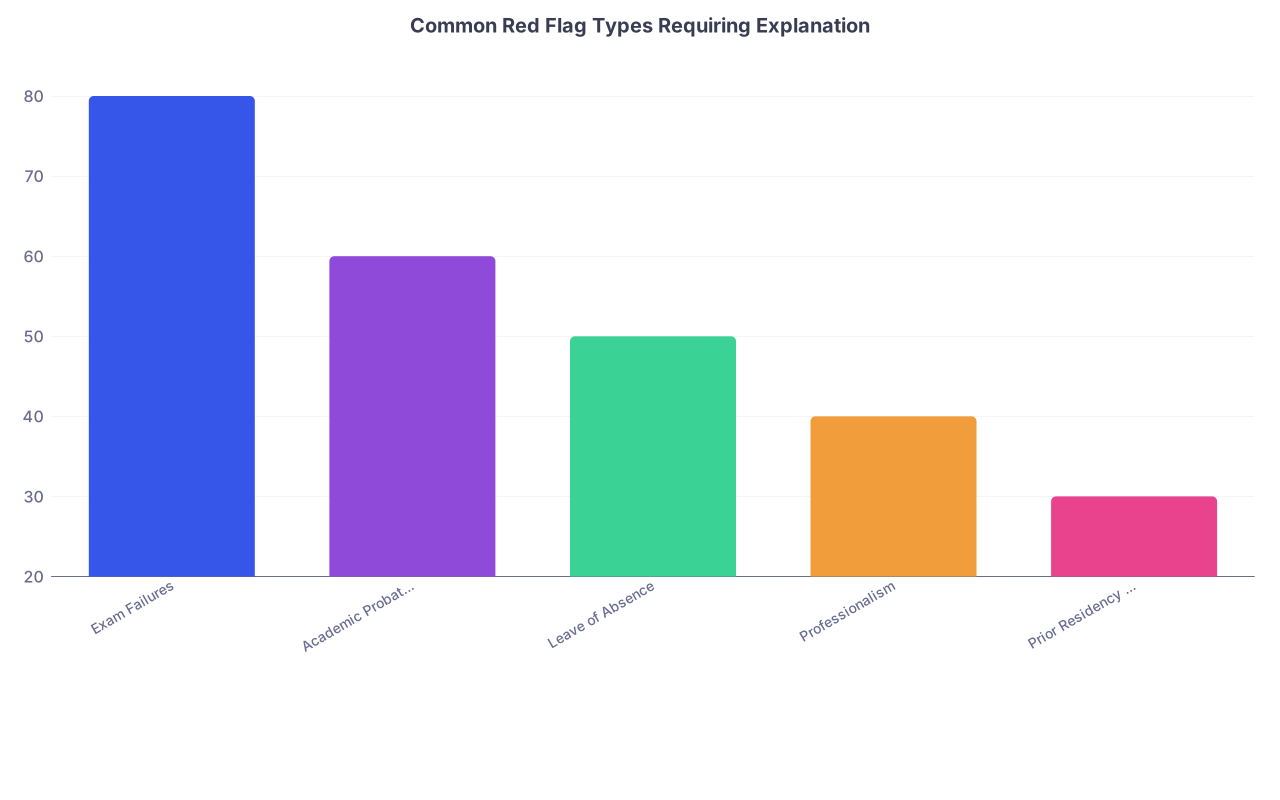
| Category | Value |
|---|---|
| Exam Failures | 80 |
| Academic Probation | 60 |
| Leave of Absence | 50 |
| Professionalism | 40 |
| Prior Residency Exit | 30 |
FAQs
1. Should I mention my red flag in every personal statement for every specialty/program?
No. If it truly requires explanation, have one clear, factual explanation somewhere (addendum/ERAS field/supplemental). In your personal statement, only include it if it meaningfully connects to your story or growth. You do not need to center your entire narrative around your red flag.
2. What if my school’s MSPE already explains the issue—do I still need my own addendum?
If the MSPE explanation is accurate, specific, and reasonably balanced, you can often let that stand alone. If it’s vague (“faced personal challenges”), confusing, or harsher than reality, a short, aligned explanation from you can help PDs understand your perspective without contradicting the official record.
3. How many red flags can I address in one addendum?
Group related issues (e.g., Step 1 fail + repeated year linked to the same period) into one concise explanation. If you have completely unrelated issues (e.g., Step failure and a separate professionalism probation years apart), use distinct short paragraphs. Don’t write a single mega-paragraph that blends them together.
4. Can an explanation addendum hurt me more than help me?
Yes—if you use it to spotlight something programs might have ignored, or if you come across as defensive, vague, or blame-shifting. That’s why the first step is deciding if the issue is formally documented and obviously visible. If it is, silence hurts you more. If it’s subtle or borderline, an addendum may do more harm than good.
5. Who should review my explanation before I submit it?
At minimum, have one person who understands residency applications read it: a dean, advisor, trusted attending, or a resident who’s been involved in selection. Ask them specifically: “Does this sound factual, accountable, and done?” If they say, “You’re oversharing” or “This sounds defensive,” revise until it’s clean and boring—in the best way.
Key points to keep:
- Explain only what’s formally visible and would reasonably prompt “What happened?” from a PD.
- When you do explain, be brief, factual, accountable, and focused on what changed.
- Do not turn minor weaknesses into formal “red flags” by over-explaining them—save the addendum for the things programs absolutely will notice.