
Most applicants are handling red flags in ERAS the wrong way.
If you have a red flag—failed Step, leave of absence, professionalism concern, big gap, failed class—you’re not asking the right question. The real question is not “Should I write about it?” but “Where, how much, and how obvious?”
Here’s the direct answer you’re looking for:
If ERAS gives you a dedicated space to explain a red flag, use that space.
Do not bury it in your personal statement as your main strategy.
In many cases, you should do both—but for different reasons and in different depths.
Let me break it down cleanly so you’re not guessing.
1. The Short Answer: Separate Red Flag Statement vs Personal Statement
Here’s the hierarchy:
- If ERAS (or a program) has a specific question/box for “explain academic/USMLE irregularities, LOA, etc.” → Use that dedicated space as your primary explanation.
- Use your personal statement to briefly reinforce growth and insight, not to become “the red flag essay.”
- Only use the personal statement as the main/only place to explain a red flag if:
- There is truly no other field to address it, and
- The red flag would confuse reviewers if ignored.
Red flags should be acknowledged, explained, and contained. Not allowed to swallow the whole application.
So:
If you’re asking, “Should I write a separate red flag statement in ERAS or just use PS?”
My default rule:
Yes, write a separate explanation where ERAS allows it, and keep your personal statement primarily about who you are, not what went wrong.
2. What Counts as a “Red Flag” Worth a Separate Statement?
Not every blemish deserves its own essay. Some things are just… life.
Real red flags that usually deserve explicit explanation:
- USMLE/COMLEX issues:
- Failed Step 1, Step 2, or COMLEX
- Multiple exam attempts
- Large score drop between attempts
- Academic problems:
- Course failures or repeating a year
- Deceleration, remediation
- Leaves and gaps:
- Formal leave of absence (for any reason)
- Prolonged unexplained gaps (≥ 6 months) in training or work
- Conduct and professionalism:
- Institutional action or professionalism citation
- Probation, suspension, or dismissal (even if reversed or resolved)
- Legal or licensing problems:
- DUI / arrests that appear on background checks
- Licensing exam irregularities/investigations
Minor stuff you often do NOT need a separate statement for:
- One borderline rotation evaluation if the narrative overall is strong
- A slightly lower Step 1 but passing on first attempt
- A small 2–3 month gap that’s clearly explained by graduation timing, moving, family reasons, or job changes in the CV
If you’re not sure whether something is a “real” red flag: if your dean’s office went “we need to talk about this” when it happened, assume programs will too.
3. Where to Put the Explanation in ERAS
ERAS and program supplements give you multiple potential locations. You have to choose smartly.
Here’s the structure I recommend:
| Red Flag Type | Primary Location | Secondary (Optional) |
|---|---|---|
| Failed Step/COMLEX | Exam/Additional Info box | 1–2 lines in PS |
| LOA / Extra Year | Education / Add’l Info | Brief mention in PS |
| Course or Clerkship Failure | Education / Add’l Info | Only if needed in PS |
| Professionalism / Action | Institutional Action box | Very carefully in PS |
| Long Gap (≥ 6 months) | Experiences / Add’l Info | Short context in PS |
Dedicated ERAS sections
Depending on your year, you may see:
- “Explain any interruptions in education/training”
- “Explain any failures, decelerations, or repeated coursework”
- “Institutional action” narrative box
- Program-specific supplemental questions
Use those first. That’s where program directors expect to find the messy stuff. I’ve heard PDs say exactly this: “If it’s in the right box and appropriately handled, I don’t need a sob story in the personal statement.”
When to keep it out of the PS entirely
You can usually keep it entirely out of the personal statement if:
- The red flag is clearly, fully explained in a dedicated ERAS section, and
- It does NOT define your overall narrative, and
- It isn’t central to why you took a detour into another path or specialty.
Example: Failed Step 1, passed on second attempt, now have a solid Step 2. You used the ERAS exam irregularities section and explained it concisely. You don’t need to burn a paragraph in the PS rehashing it. Maybe one half-sentence nod at resilience or growth, max.
4. How to Write a Strong Separate Red Flag Statement
You’re not writing a confessional. You’re writing a professional risk assessment and mitigation note.
Use this 4-part framework:
- Briefly state what happened
- Provide focused context (not excuses)
- Show what you did to fix it/change
- Show evidence that it worked and why it is unlikely to recur
You can almost template it:
- “During [time], I [failed Step 1 / took a leave of absence / repeated my M2 year] due to [short, factual reason].”
- “At that time, I was dealing with [specific issue: health, family, adjustment, overcommitting, etc.] which impacted my performance.”
- “Since then, I have [sought support / changed study strategies / adjusted responsibilities / received treatment / implemented specific system].”
- “These changes allowed me to [pass on first attempt subsequently, honor rotations, complete year without issues]. I am confident this pattern will continue into residency.”
What weak statements sound like:
- Endless justification about how unfair everything was
- Overexplaining personal drama
- No clear ownership, everything passive: “things happened,” “circumstances arose”
- No concrete behavioral change
What strong statements sound like:
- “I underestimated…”
- “I made the mistake of…”
- “I changed my approach by doing X, Y, Z…”
- “After implementing these changes, I [data/evidence].”
5. How Much (If Any) to Put in the Personal Statement
Here’s the rule: your personal statement is your sales pitch, not your defense brief.
Use the PS for red flags only when:
- The red flag is inseparable from your path (e.g., a mental health crisis that led to a leave and shaped your desire to go into psychiatry).
- Ignoring it in the PS would make your story confusing or incomplete (“Why did you graduate two years late?”).
- There is no dedicated ERAS place where it fits.
When you do include it, follow these guidelines:
- Do not start with the red flag. Start with who you are and why this specialty.
- Keep the red flag explanation to a single short paragraph, not the backbone of the essay.
- Focus on growth, insight, and current readiness, not pain or drama.
Good PS red flag paragraph example:
In my second year of medical school, I failed Step 1 on my first attempt. I had underestimated the exam and relied too heavily on passive review. The experience forced me to completely rebuild my study approach: I shifted to active recall, scheduled spaced repetition, sought faculty guidance, and joined a structured study group. These changes not only allowed me to pass Step 1 on my next attempt and score significantly higher on Step 2 CK, but they also reshaped how I approach clinical learning. I now treat feedback and preparation as continuous processes rather than last-minute events.
Notice the ratio: one problem, multiple concrete changes, then results.
6. Common Scenarios: What You Should Actually Do
Let’s run through specific situations.
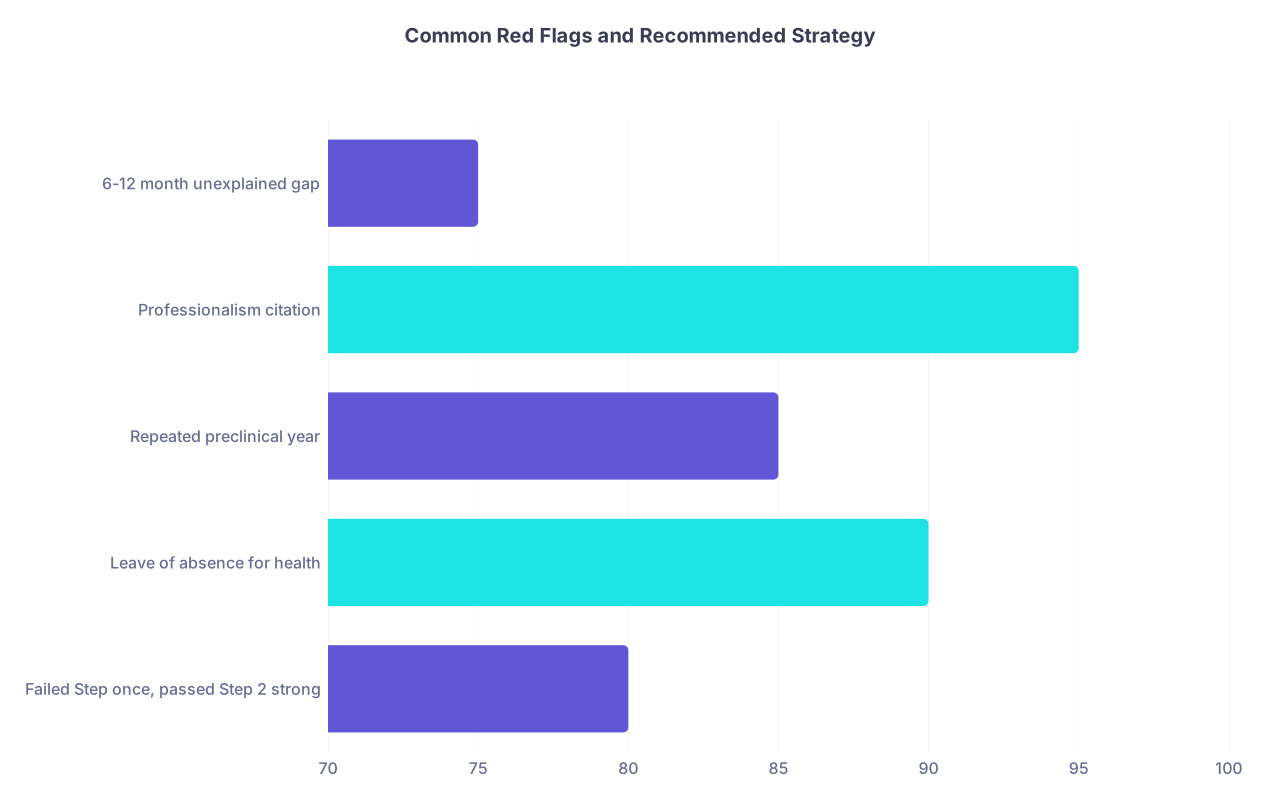
| Category | Value |
|---|---|
| Failed Step once, passed Step 2 strong | 80 |
| Leave of absence for health | 90 |
| Repeated preclinical year | 85 |
| Professionalism citation | 95 |
| 6-12 month unexplained gap | 75 |
(Values here = % of cases where a separate ERAS explanation is recommended vs PS-only.)
Scenario 1: Failed Step 1, Passed Step 2 with solid score
- Use ERAS exam/irregularities section as the main explanation.
- In PS: optional, 1–2 sentences anchored in growth, if at all.
- Make sure your LORs and MSPE emphasize current reliability and clinical performance.
Scenario 2: Leave of absence for medical/mental health reason
- Use the “education interruption / LOA” explanation box in ERAS.
- Be honest but not graphically detailed. “Health reasons,” “family illness,” “personal health challenges” is usually sufficient.
- In PS: brief mention only if it ties tightly to your story or specialty choice. Avoid turning your PS into a therapy note.
Scenario 3: Course or rotation failure; repeated year
- Use the academic issues/education section.
- Focus on what changed academically (study structures, time management, support systems).
- In PS: usually skip, unless it’s central to your growth narrative.
Scenario 4: Professionalism or institutional action
This one is high stakes. Programs care a lot.
- Use the institutional action section fully and carefully.
- Take responsibility without self-destruction. If there was context (miscommunication, remediated successfully), state it factually.
- Emphasize what you learned about team communication, boundaries, documentation—whatever applies.
- PS: only touch this if (a) you can do it extremely professionally, and (b) mentors reviewing your draft agree it helps, not hurts.
Scenario 5: Gap year or multiple-month gap
- If the gap is structured (research year, degree, family caregiving, visa delay), just reflect it clearly in ERAS experiences and education.
- Separate red flag statement only if it looks like a black hole with no activity and would raise eyebrows.
- PS: you can frame it positively if that gap shaped you—e.g., full-time caregiver, health recovery, research focus.
7. Mistakes That Make Red Flags Worse
I’ve watched decent candidates destroy their own chances by mishandling explanations.
Avoid:
- Pretending it didn’t happen when it’s already visible in your file
- Over-explaining personal trauma in graphic detail—PDs are not your therapist
- Attacking your school, faculty, or the system (“I was targeted,” “the grading was unfair”)
- Dramatic language: “devastated,” “crushed,” “unfairly ruined”
- Making your entire personal statement about your red flag
You want programs thinking: “Okay, there was an issue, it’s resolved, they’re stable now, I can trust them with my patients at 3 a.m.”
Not: “This person might bring drama into our residency.”
8. Quick Decision Framework
Use this simple decision flow.

| Step | Description |
|---|---|
| Step 1 | Identify Red Flag |
| Step 2 | No formal statement needed |
| Step 3 | Explain fully in ERAS field |
| Step 4 | Use Addl Info / Experience section |
| Step 5 | Brief, growth-focused note in PS |
| Step 6 | Keep PS focused on strengths |
| Step 7 | Visible in ERAS? |
| Step 8 | Dedicated ERAS field? |
| Step 9 | Central to your story? |
If you follow that, you’ll avoid the two worst errors: hiding what’s already obvious, and over-identifying yourself with your worst moment.
FAQ (Exactly 7 Questions)
1. If I explain my red flag in ERAS, will it automatically screen me out?
No. The red flag itself is not always the dealbreaker. The pattern matters more: repeated failures, no evidence of change, or unprofessional tone when explaining. A single failed Step with a clear, mature explanation and strong subsequent performance is often survivable, especially in less competitive specialties.
2. Should I apologize directly in my red flag statement?
A brief acknowledgment of responsibility is enough. You do not need a dramatic apology paragraph. Something like “I take full responsibility for underestimating the exam and not structuring my preparation adequately” is fine. Then spend more words on what you changed and how you’ve proven reliability since.
3. How specific do I need to be about mental health or personal issues?
You do not have to disclose specific diagnoses or deeply personal details. “I experienced health challenges that required treatment and a temporary leave; I am now stable under ongoing care and have completed my training without further interruption” is usually adequate. The key is: concise, honest, and reassuring about current stability.
4. What if my school already explains the issue in the MSPE? Do I still need to?
Yes, usually. Programs expect to see you address it in your own voice. The MSPE is the school’s perspective; your ERAS explanation is your perspective and your chance to show maturity, insight, and accountability. Keep it consistent with the MSPE facts, but you can add your own reflection and changes.
5. Can I use one generic red flag statement for every program?
Yes. ERAS central text fields are universal, and that’s fine. You don’t need different red flag stories per specialty. Do, however, make sure nothing in your explanation contradicts your specialty choice (e.g., don’t say you can’t tolerate stress if you’re applying to surgery).
6. What if I have multiple red flags—should I explain each one separately?
If ERAS has distinct fields (e.g., exam failures vs institutional action), address each in its correct section. If you’re using a general additional information box, group related issues and show a single clear narrative of what happened and how you changed. Do not write three separate emotional essays. One coherent, structured explanation is better.
7. Bottom line: separate red flag statement, personal statement, or both?
If there is a dedicated ERAS or program field, use that as your primary explanation. Keep your personal statement focused on your strengths, motivation, and fit, with only a brief, growth-oriented mention of the red flag if it’s central to your story. Both can be used—but the heavy lifting belongs in the ERAS red flag section, not in your PS.
Key points:
Use the ERAS red flag / additional info sections as your main explanation, and keep them factual, concise, and growth-focused.
Do not let your personal statement become “the red flag essay”—you’re more than your worst exam or hardest year; let the PS prove that.