
It’s late. You’ve got ERAS open, your personal statement half-written, and you’ve just hit the part where you’re wondering: “Do I mention my depression? My burnout? That leave of absence?” You know hiding things can backfire, but you’ve also heard horror stories about programs quietly binning apps over “mental health issues.”
Here’s the blunt answer: you should be extremely selective about how much mental health detail you share—and why you’re sharing it. You’re not writing a therapy note. You’re building a professional narrative.
Let’s break this down so you can decide what to disclose, how much, and where.
The Core Rule: Purpose, Not Confession
Start with this filter:
If mentioning your mental health doesn’t clearly help your application, don’t include it.
You are not obligated to share diagnoses, meds, therapy history, or trauma. This is not “full medical history or you fail.” It’s a professional application. Programs are thinking:
- Can this person handle residency stress?
- Will they show up reliably?
- Are they safe for patients and the team?
Anything you say about mental health gets subconsciously filtered through those questions.
So ask yourself before writing a single word:
- What is my goal in sharing this?
- Does it explain an anomaly (LOA, failed step, repeated year, bad semester)?
- Does it demonstrate growth, resilience, and stability now?
- Would my application be equally strong—or stronger—if I left it out?
If your only reason is “I want to be totally honest” or “maybe someone will appreciate my vulnerability,” that’s usually not enough. This isn’t a wellness essay contest.
When You Should Talk About Mental Health
There are a few situations where addressing it briefly and strategically makes sense.
1. You have an obvious red flag that needs context
Examples:
- A leave of absence in MS2
- Failed Step 1/Step 2 or a shelf exam
- A big drop in clinical performance for one block
- A professionalism incident tied to your mental state (this one is delicate)
If you say nothing, programs will make up their own story. And the story they invent is rarely flattering.
In these cases, a carefully framed, high-level explanation can help:
- No diagnostic labels needed
- No symptom lists
- No drama
Just enough to answer:
- What happened?
- What did you do about it?
- Why is it not an ongoing problem?
Example language:
“During my second year, I experienced a significant period of personal health challenges that affected my academic performance. I sought professional help, took a brief leave, and returned with a structured plan that’s allowed me to remain stable and successful since then. My subsequent clinical evaluations and exam scores reflect the progress I’ve made.”
Notice what’s missing:
- No “major depressive disorder, recurrent, severe”
- No list of meds
- No crisis play-by-play
You give them what they actually need: a plausible explanation, evidence of insight, and proof of current stability.
2. The experience clearly led to meaningful, relevant growth
If your mental health journey:
- Directly shaped your interest in a specialty (psych, FM, peds, etc.)
- Led to concrete work (peer support programs, QI projects, advocacy, curriculum work)
- Produced clear professional skills (empathy, communication, working with vulnerable patients)
…then you can use it, but still with restraint.
This is not “my suffering makes me a better doctor” in vague terms. That’s been overused and often reads as emotionally manipulative if not done carefully.
Better approach:
- Briefly mention the experience
- Focus 80–90% of the space on what you did with it and how it shows in your work now
Example:
“In my first year of medical school, I struggled with anxiety and burnout, which pushed me to engage deeply with mental health resources and peer support. That experience made me more attentive to subtle distress in patients and colleagues. It also led me to co-lead a wellness initiative that increased utilization of confidential support services among students.”
You’re not centering your illness. You’re centering what you built from it.
When You Should Not Talk About It
Let me be direct: there are situations where mentioning mental health is more likely to hurt you than help.
1. There is no red flag to explain
If your record is solid—good scores, no LOA, decent evals—there’s usually no benefit in announcing:
- “I have bipolar disorder”
- “I’ve had multiple suicide attempts”
- “I was hospitalized for severe depression”
- “I’ve been struggling with severe anxiety this entire time”
Programs are human. They carry biases. They also have legitimate concerns:
- Will you be able to work nights, 80-hour weeks?
- What happens during a flare or crisis?
- Will they have to scramble to cover you?
Unless you’re explaining an actual anomaly or tying it to substantial, relevant growth, this often reads as a risk with no clear upside.
2. You’re still unstable or in the middle of active crisis
If what you’re describing is ongoing chaos—frequent hospitalizations, repeated leaves, uncontrolled symptoms—broadcasting that won’t help your chances. Programs are not set up to be intensive treatment centers. They want to see functioning and stability, not just “I’m trying.”
You should absolutely take care of yourself, delay applying if needed, and prioritize your health. But using the application to process an active crisis is a bad play.
3. The tone is confessional, raw, or trauma-dump-y
If the draft reads like:
- A journal entry
- A therapy session
- A long story of suffering with very little about your current function
…programs will worry. Rightfully. They’re trying to select colleagues, not memoirists.
Your application voice should be reflective, coherent, and controlled. If writing about it still makes you feel emotionally flooded, it likely doesn’t belong in this cycle’s materials.
How Much Detail Is the Right Amount?
Think 30,000-foot view, not ground-level.
Here’s the range:
Too much detail (don’t do this):
- Naming specific diagnoses when not required
- Detailing suicide attempts, self-harm, psych hospitalization
- Describing panic attacks, flashbacks, severe symptoms in graphic detail
- Sharing childhood trauma in depth
Reasonable level of detail:
- “Personal health challenges”
- “A period of significant anxiety and burnout”
- “A medical leave to address mental health and well-being”
- “I worked closely with mental health professionals and support systems”
You’re allowed to be vague. In fact, vague but honest is usually the smartest play.
Where To Put Mental Health Content (If You Use It)
Let’s talk locations: personal statement, experiences section, supplemental essays, interviews, and advisor communications.

1. Personal Statement
Use only if:
- You’re explaining a major disruption in your training, and
- You can pivot quickly to how you’ve grown and why you’re ready now
Keep it to 2–4 sentences. Max.
Do not build your entire personal statement around your mental illness. Programs want to know why you chose this specialty and how you function as a clinician, not just why life has been hard.
2. ERAS “Education” / Leaves / Comments sections
If there’s an official LOA or unusual timeline, you may need a brief explanation here.
Example:
“Leave of absence (4 months) during MS2 for personal health reasons. Completed treatment, returned with full clearance, and have performed consistently since, as reflected in subsequent grades and evaluations.”
Clean. Direct. No over-sharing.
3. Experiences Section
If your mental health experience led you to do something concrete—peer support leader, wellness committee, advocacy group—you can mention the work there. The mental health origin story can be one short line, if at all.
Focus on:
- Role
- Actions
- Outcomes
4. Interviews
If they ask directly about:
- LOA
- Transcript irregularities
- Failures
You should have a concise, practiced answer that hits:
- Brief context
- What you did (treatment, support, change in habits)
- What’s different now
- Evidence of stability
Example:
“During my second year I struggled with significant burnout and anxiety, which affected my performance. I took a short leave to address it with professional support. Since returning I’ve maintained strong performance across my clinical rotations and Step 2, and I’ve built systems—regular therapy, structured schedule, boundaries—that have kept me functioning well.”
And then stop talking. Don’t nervously add details.
5. Talking With Advisors and Deans
This is where you can be more open. Your advisor doesn’t rank you; they can help you figure out what goes where, and how much to share.
If you’ve had:
- LOA
- Fitness for duty eval
- Dean’s letter mention
You should have an explicit strategy conversation with someone who knows your school’s politics and typical program expectations.
How Programs Actually Think About This
Let’s be a bit cynical but honest.
Programs live in two realities:
- Official line: “We value wellness, support residents, and care about mental health.”
- Backroom reality: “We’re terrified of call-outs, no-shows, and catastrophic events on our watch.”
Both are true.
They’re not screening for “perfect people without issues.” They’re screening for:
- Reliability
- Self-awareness
- Ability to function under stress
- Willingness to use help early, not after disaster
So if mental health comes up, shape it around those themes.
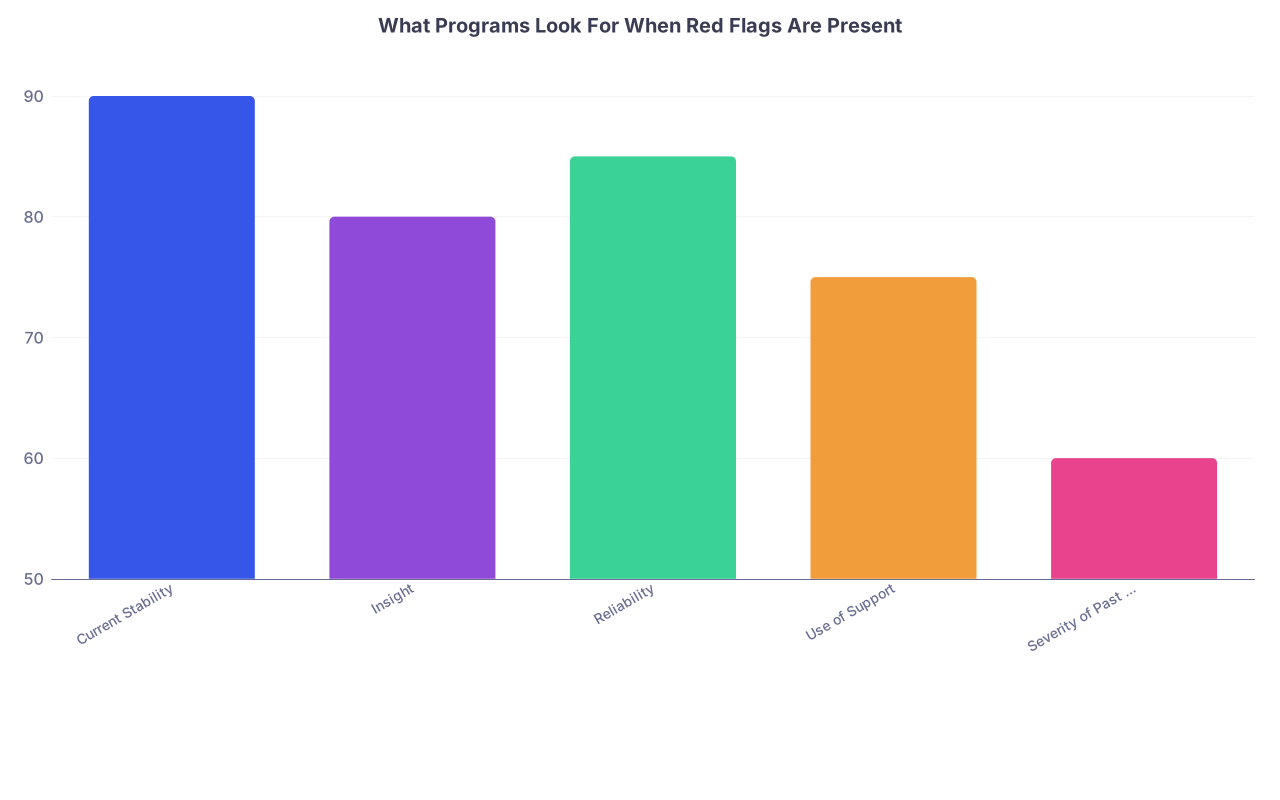
| Category | Value |
|---|---|
| Current Stability | 90 |
| Insight | 80 |
| Reliability | 85 |
| Use of Support | 75 |
| Severity of Past Issue | 60 |
Interpretation:
- They care most about how you’re doing now and whether you understand your patterns.
- “Severity” of past issue matters less than what you did with it and how long you’ve been stable.
Practical Decision Guide: Should I Mention It?
Use this quick framework. If you answer “yes” to all three, disclosure (in limited form) may be useful.
Is there something in my record that looks bad or confusing without context?
If no → probably skip it.Has this been stable for a meaningful period?
(Think: at least 6–12 months of good functioning with evidence—grades, evaluations, Step scores.)
If no → don’t center this in your application.Can I describe this briefly, with focus on actions and current function, without spiraling into details?
If no → probably not ready to include it.
If you’re stuck, draft both versions:
- One application narrative with mental health mentioned
- One without
Have a trusted advisor read both and tell you which one makes you look like someone they’d want as a colleague at 3 a.m. That’s the bar.

| Step | Description |
|---|---|
| Step 1 | Mental health question |
| Step 2 | Probably do not include |
| Step 3 | Minimize details, focus on actions; consider delaying application |
| Step 4 | Get advisor help; consider not including |
| Step 5 | Include concise, growth-focused explanation |
| Step 6 | Red flag to explain? |
| Step 7 | Stable now? |
| Step 8 | Can you be brief and professional? |
One Thing You Can Do Today
Pull up your personal statement or your “difficult circumstances” section. Highlight any part where you mention mental health, burnout, depression, anxiety, etc.
Ask yourself for each highlighted sentence:
Does this help a PD trust me more as a resident?
If the answer is anything short of a clear “yes,” rewrite or cut it.
FAQ (Exactly 7 Questions)
1. Should I name my specific diagnosis (depression, bipolar, PTSD) in my application?
Usually no. You almost never need to name the diagnosis. Programs care about function, stability, and what you did to address the problem—not the DSM label. Use general language like “personal health challenges” or “mental health concerns” unless a specific label is genuinely required for clarity (rare).
2. Can programs ask me directly about mental health or psychiatric treatment?
They can’t legally ask about specific diagnoses or treatment details in most contexts, but they can and do ask about your ability to meet job requirements, past leaves, or fitness for duty. If they ask about a LOA, you can stay high-level: brief context, what you did, how you’re functioning now.
3. I took a leave of absence for mental health. Do I have to say it was mental health–related?
No, you don’t have to disclose the exact reason. You can say “personal health reasons” or “personal reasons” and focus on: you addressed it, you’re stable, and your performance since returning supports that. If you’re comfortable adding “mental health” and your advisor agrees it’s safe, that’s optional, not mandatory.
4. What if my school mentioned my leave or mental health in the MSPE (Dean’s Letter)?
If the MSPE explicitly references it, you usually want a brief, aligned explanation somewhere (application comments or, rarely, personal statement). Don’t contradict the MSPE; instead, provide a concise, mature framing that emphasizes treatment, growth, and current stability. Have your advisor review both documents together.
5. Is it ever a good idea to build my whole personal statement around my mental illness story?
Almost never. It can come across as over-identified with illness, emotionally raw, or light on actual clinical content. If you include it, keep it to a short segment and pivot to why you love the specialty, what you’ve done clinically, and how you function on a team. Programs want to see you as a physician, not only as a patient.
6. What if my mental health struggles are the main reason my application is weak (low scores, failed exams)?
You can acknowledge that personal or health challenges affected your performance, but don’t rely on it as a blanket excuse. Programs want to see concrete evidence you’ve turned things around: improved scores, consistent clinical performance, strong letters. Mental health may explain the past, but it doesn’t automatically reassure them about the future. Your current track record does.
7. I feel strongly about destigmatizing mental health. Should I be fully open on principle?
Your values matter, but so does strategy. Residency applications are not the best arena for personal activism if it meaningfully harms your chances. You can still be an advocate—through research, QI, peer support, policy work—without disclosing every detail about yourself. Protecting your own career while fighting stigma is not hypocrisy. It’s survival in a flawed system.
Open your most recent draft right now and delete any sentence that’s there just to “tell your story” but doesn’t clearly make you look more capable, stable, and prepared to be someone’s resident at 2 a.m. That’s your real audience.