You should almost never lead with your failed clerkship in the personal statement. But ignoring it completely can be just as bad.
Let me be blunt: a failed clerkship is a red flag. Program directors notice it. They talk about it in ranking meetings. You don’t get to pretend it didn’t happen. But you do get to decide where and how to explain it so it does the least damage — and occasionally, even helps you.
This is a strategy question, not a morality question. You’re not confessing your sins; you’re managing risk in a high-stakes application.
Here’s how to think about it — and exactly where to address the failed clerkship, when to skip it, and how to phrase it so you look like a grown-up, not a victim.
The Core Answer: Personal Statement vs. Other Places
Here’s the short version most people don’t tell you:
- The personal statement is for your story, motivation, and fit for the specialty.
- The failed clerkship is a problem to be explained once, cleanly, and then moved on from.
So:
- Don’t center your personal statement around your failed clerkship.
- Don’t put it in the opening paragraph.
- Don’t make it the emotional climax of your “overcoming adversity” narrative.
Instead, in most cases:
- Use the ERAS “Additional Information”/“Education/Training interruptions”/misc text box or
- A separate short “red flag” paragraph at the end of your personal statement (if there’s no other logical place),
- And be prepared to address it succinctly in interviews if asked.
Your personal statement should still make a program think: “I want this person on my team.”
The failed clerkship explanation is about: “Is this risk acceptable?”
Two different jobs. Don’t confuse them.
First: How Bad Is The Failed Clerkship, Really?
You can’t decide whether to address it in the personal statement until you know how it looks from a PD’s chair.
Ask yourself these questions:
How many failures?
- One isolated failed clerkship that you remediated and then passed? Manageable.
- Multiple clerkship failures or repeated attempts? Bigger problem that probably does need explicit addressing.
What specialty did you fail, and what are you applying into?
- You failed Surgery and are applying FM? Less directly relevant, but still a professionalism/clinical performance signal.
- You failed Internal Medicine and you’re applying Internal Medicine? That will get attention in every review meeting.
What happened afterward?
- Did your later rotations show clear improvement and strong comments?
- Or is there a pattern of marginal performance, low passes, and vague evaluations?
What was the cause?
- Health issue? Personal crisis? Terrible professionalism? Lack of knowledge/skills?
- Be honest with yourself here. How you frame it depends heavily on the true cause.
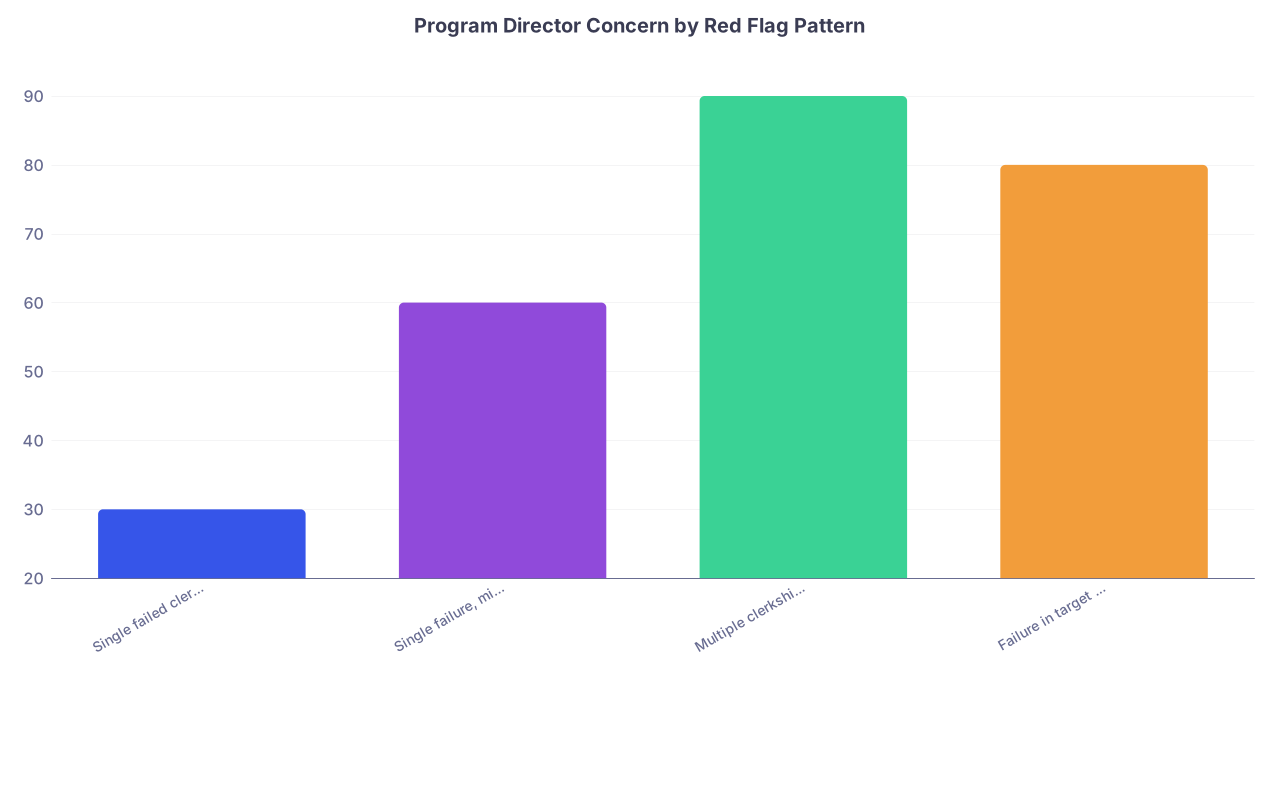
Here’s how those scenarios often play out in PD brains:
| Category | Value |
|---|---|
| Single failed clerkship, strong afterward | 30 |
| Single failure, mixed later evals | 60 |
| Multiple clerkship failures | 90 |
| Failure in target specialty clerkship | 80 |
The higher the implied “concern,” the more likely you need some explanation, somewhere in your application.
When You Should Not Put It In the Main Body of the Personal Statement
There are several situations where bringing your failed clerkship into the core of your personal statement does more harm than good.
You probably should not include it in the main narrative if:
It’s a single, remediated failure with clear improvement afterward
Example:- MS3: Fail OB
- Remediate, then Pass OB
- Rest of clerkships: mostly High Pass/Honors, solid comments
In this case, you still need to be ready to explain it if asked, but it doesn’t need to hijack your main essay.
You already have a better place to explain it
Some schools or ERAS cycles have:- An “Additional Comments” or “Education interruptions” section
- A Dean’s Letter/MSPE explanation that already clearly addresses it
If it’s already explained factually and responsibly there, don’t repeat it in depth in your PS.
You’d be using it as forced “drama”
If your only reason for including the failure is to create some emotional arc — “I failed, I cried in the call room, I grew” — skip it. Program directors are not looking for Netflix scripts. They’re looking for evidence you’re safe, reliable, and teachable.You can’t discuss it without sounding defensive or blaming
If you’re still angry at the clerkship director, the resident, or “the system,” that will leak into your tone. Until you can say it neutrally and with ownership, don’t frontload it in your PS.
In all of these cases, the safer move is:
- Primary personal statement: focus on why this specialty, who you are, what you bring.
- Short, separate explanation elsewhere (ERAS box, brief addendum paragraph).
When You Should Address The Failed Clerkship Somewhere (and Possibly In the PS)
There are scenarios where pretending it didn’t happen makes you look worse.
You probably need to address it explicitly somewhere if:
You failed the core clerkship of the specialty you’re applying into
Example: Failed IM, now applying IM.
They will absolutely talk about it. At that point, a brief, mature explanation in the latter part of your personal statement can be reasonable.You have multiple major red flags
Let’s say:- A failed clerkship
- A probation or professionalism note
- A leave of absence
Now your application has a pattern question: “Is this person going to be okay in residency?”
Here, a cohesive narrative that shows understanding, remediation, and stability does help. That might live partly in your PS, partly in ERAS comments.Your MSPE is vague or misleading
Sometimes the Dean’s Letter mentions “academic difficulty” or “needed extended time” without clear context. If you know PDs will be confused, it may be better to give a clean, direct 3–4 sentence clarification in your PS near the end.Your school offers no structured place to explain
If ERAS and your school don’t give you a logical box for this, then a short paragraph at the end of the PS is acceptable:- Not the hook
- Not half the essay
- Just: “Here’s what happened, what I did about it, and why it’s no longer an issue.”
How To Decide: A Simple Framework
Here’s a workable decision process.

| Step | Description |
|---|---|
| Step 1 | Failed clerkship |
| Step 2 | Multiple failures or patterns |
| Step 3 | Brief note in PS + ERAS comments |
| Step 4 | ERAS comments only, PS optional |
| Step 5 | Address clearly in PS + ERAS comments |
| Step 6 | Single isolated failure? |
| Step 7 | Strong later performance? |
| Step 8 | Failure in chosen specialty? |
If you land in:
- G: Your personal statement can remain almost completely focused on motivation and strengths.
- F or H: You probably need a short, controlled explanation towards the end of your PS.
How To Phrase It If You Do Mention It in the Personal Statement
Here’s the structure that works. Treat it like a problem you’ve already solved, not a wound you’re still bleeding from.
Four steps:
- State the fact briefly.
- Give concise context (not a dramatized story).
- Own your part without groveling.
- Show concrete evidence of improvement.
Example of a solid paragraph you might put near the end:
During my third year, I failed my initial Internal Medicine clerkship. I struggled to balance the steep learning curve of inpatient medicine with personal stress I didn’t manage well, and my performance suffered. After meeting with my clerkship director and advisor, I remediated the rotation, focused on organizing my clinical reasoning, and sought more feedback on my presentations. Since then, I’ve passed all subsequent rotations, earned Honors in my sub-internship, and received consistent comments on my reliability and growth. That experience has made me more proactive about seeking help early and more attuned to how stress affects my performance.
Notice what this does:
- No drama. No victimhood.
- Clear ownership: “my performance suffered,” “I didn’t manage well.”
- Specific corrections: organizing reasoning, seeking feedback.
- Concrete outcomes: “Honors in sub-I,” “consistent comments.”
What you don’t want to do:
- Attack the rotation: “The expectations were unrealistic.”
- Sound vague: “I learned from this and grew as a person.”
- Spend 70% of the PS on this. One solid paragraph is enough.
If You Keep It Out of the Personal Statement Entirely
Say you decide: “I’m not putting this in my PS.” Fine. Then you need three things:
A clear, factual explanation somewhere else
Use:- ERAS “additional information” text box, or
- A school-specific “academic irregularities” question.
Same 4-step structure: fact → context → ownership → evidence of improvement.
Alignment with your MSPE
The story in your MSPE, your ERAS comments, and what you say in interviews must match. If your Dean’s Letter hints at something more serious than you’re describing, PDs will assume you’re minimizing or hiding.An interview script
You will almost certainly be asked about it on at least some interviews. You need a 30–60 second answer that:- Doesn’t ramble
- Doesn’t blame
- Ends on what’s different now
Example:
I failed my OB/GYN clerkship during third year. I underestimated how different the workflow would be, and I didn’t ask for enough feedback early on. When my mid-rotation evaluation showed concerns, it was already too late to correct course. I remediated the clerkship, worked closely with my attending on improving my efficiency and communication, and then went on to pass all remaining rotations, with strong comments on being prepared and reliable. The big change for me has been seeking feedback in the first week and adjusting quickly, which I’ve continued in my sub-Is.
That’s it. No monologue, no emotional spiral.
Don’t Let the Failure Hijack Your Whole Application
The worst thing applicants do with a failed clerkship is let it define everything:
- Personal statement: 70% about the failure.
- Interviews: constantly circling back to it.
- Letters: all asking recommenders to “explain what happened.”
You’re not “the student who failed a clerkship.” You’re an applicant who:
- Had a documented problem
- Understood it
- Fixed it
- Has evidence it’s unlikely to recur
Make sure the bulk of your application still shows:
- Consistent work ethic
- A track record of being teachable
- Clinical growth and stability
- Genuine interest in and understanding of the specialty
That’s what saves people with red flags. Not a perfectly-written apology paragraph.

Quick Examples: Where To Put It Based On Scenario
Here’s how I’d handle it in a few common situations.
| Scenario | Where to Address It |
|---|---|
| Single failed clerkship, strong later performance, not in target specialty | ERAS comments only; PS usually no |
| Single failed clerkship in target specialty, strong turnaround | Brief paragraph at end of PS + ERAS comments |
| Multiple failed clerkships or remediation year | Clear explanation in PS + ERAS comments |
| Failure plus professionalism note/probation | Integrated narrative in PS + formal explanation elsewhere |
| Vague MSPE hinting at “academic issues” | Short clarification in PS or ERAS to avoid speculation |
| Category | Value |
|---|---|
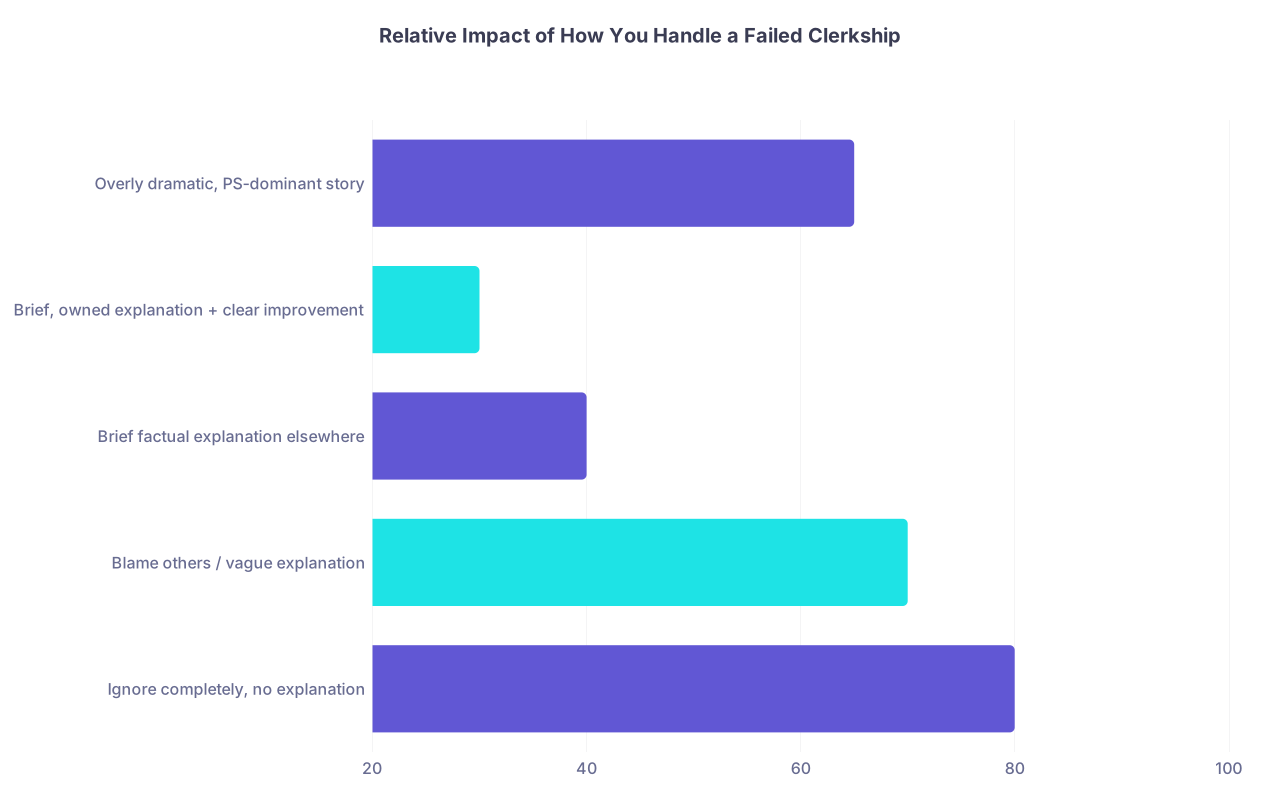
| Ignore completely, no explanation | 80 |
| Blame others / vague explanation | 70 |
| Brief factual explanation elsewhere | 40 |
| Brief, owned explanation + clear improvement | 30 |
| Overly dramatic, PS-dominant story | 65 |
Lower “impact” here is better — less concern, more reassurance. Notice that:
- Total silence looks bad.
- Blame and drama look bad.
- Brief, owned, improvement-focused explanation is what calms people down.

FAQs About Failed Clerkships and Personal Statements
1. Do I have to mention my failed clerkship in the personal statement?
No, you don’t have to. You do need to make sure it’s explained somewhere in your application if it’s likely to raise concern (especially if it’s in your chosen specialty or part of a pattern). For a single, remediated failure with strong later performance, an ERAS comment box or MSPE explanation is often enough, and you can keep your PS focused on your strengths and interest in the specialty.
2. Will mentioning it in my personal statement hurt my chances?
It can hurt your chances if you let it dominate the essay, sound defensive, or don’t show clear improvement. A single, well-written paragraph near the end that owns the issue and shows concrete growth usually doesn’t tank you — and can actually reassure PDs. The key is proportion: one tight paragraph, not the main storyline.
3. How specific should I be about the reasons I failed?
Specific enough to sound real, not so detailed that you sound like you’re making excuses. “I had unmanaged anxiety and was missing key teaching due to appointments” is better than “personal issues.” “I didn’t ask for feedback and was disorganized on the wards” is better than “things happened.” Avoid oversharing sensitive personal trauma unless it directly explains the issue and you’re comfortable with PDs knowing it.
4. What if the failure was mostly the attending’s fault?
Then you’re in the same situation as many students who had bad luck. But blaming an attending or clerkship in writing is a bad idea. PDs don’t know your side is 100% accurate, and even if it is, they’ll question your professionalism. You can say, “Expectations weren’t aligned and I didn’t clarify them early enough,” which puts the focus on what you controlled. Save the full story for friends, not ERAS.
5. Should I ask my letter writers to talk about the failed clerkship?
Only if they can directly speak to your improvement afterward. For example, an attending on your sub-I who knows about the failure and can truthfully write, “I was aware of a prior difficulty on this student’s IM clerkship; in my experience they performed at or above the level of their peers.” Don’t have letters re-litigate the failure itself. That just keeps the spotlight on it.
6. Can a failed clerkship keep me from matching at all?
Yes, in combination with other issues it can. But I’ve seen applicants with a failed clerkship match solidly — even into competitive-ish fields — when they 1) clearly explained what happened, 2) showed a real pattern of improvement, and 3) built a strong, coherent application otherwise (good Step scores, strong letters, solid interview performance). Your goal isn’t to erase the red flag; it’s to show it’s an isolated, understood event, not a preview of your residency performance.
Key takeaways:
- Don’t let the failed clerkship hijack your personal statement — explain it briefly, elsewhere or in a short end-paragraph, and move on.
- Own what happened, show specifically how you improved, and back it up with later performance.
- Consistency across MSPE, ERAS comments, personal statement, and interviews matters more than one “perfect” paragraph.