
You do not need to randomly volunteer your leave of absence to every interviewer. But if they ask about it—even indirectly—you answer clearly, briefly, and consistently. That’s the rule.
Let me walk you through how smart applicants handle this, because I’ve seen it done well and I’ve seen it absolutely tank interviews.
1. The Core Answer: Who Needs to Know, When, and How Much?
Here’s the clean breakdown.
Do you have to tell every interviewer about your leave of absence (LOA)?
- No, you don’t have to bring it up in every conversation.
- But: if it’s on your transcript, MSPE, or ERAS, you must be ready to talk about it with anyone who asks.
- If they see it and ask, and you dodge or minimize it, that’s worse than the LOA itself.
Who definitely knows about your LOA:
- Program Director and/or selection committee (they read your file)
- Anyone on the interview day who has your full application packet (often faculty interviewers, sometimes residents)
- Occasionally, they’ll ask a generic “Tell me about any challenges in medical school” that’s clearly fishing for this
So your stance should be:
- Don’t hide it.
- Don’t overexpose it.
- Answer directly when it’s relevant or asked.
If an interviewer never brings it up, are you obligated to say, “By the way, I had an LOA”?
No. That’s not honest disclosure; that’s oversharing. The information is already in your file.
2. When You Should Bring It Up vs When You Can Let It Go
The trick is knowing when you should proactively address it and when you can leave it alone.
Times you should address your LOA
They explicitly ask about it.
Example questions:- “I see you took a leave of absence—can you tell me about that?”
- “Walk me through your timeline in medical school.”
- “I noticed a gap year; what happened there?”
Here you answer directly. No dancing around it.
They ask about academic struggles or challenges.
A lot of programs use vague questions to see whether you’ll bring it up:- “What’s been your biggest challenge in medical school?”
- “Tell me about a time you faced adversity.”
- “Is there anything in your application you’d like to explain?”
If your LOA is your biggest obvious “red flag,” it’s usually best to address it here yourself. If you ignore it and talk about something minor, it can look evasive.
You took the LOA for a reason that’s now a strength.
For example:- You took time off for a structured research year and produced strong work.
- You took leave for a serious health issue that’s now well-controlled, and the experience clearly shaped your maturity and perspective. In those cases, it can actually help to briefly bring it up when they ask:
- “Tell me about something that changed the way you see medicine.”
- “What experience most prepared you for residency?”
Times you don’t need to bring it up
They don’t have your full file or they never reference it.
Some resident interviews are more “vibe checks” than file reviews. If they’re just asking:- “Why this specialty?”
- “What do you like to do outside medicine?” There’s no need to insert the LOA.
It’s already explained clearly in your MSPE and your PD letter.
If your school and your advisor have already contextualized it, you don’t need to re-litigate it unless asked.It was administrative and trivial (and documented that way).
Examples:- Structured research year built into a dual degree.
- Pre-planned LOA for a formal program (e.g., MPH, MBA, research fellowship) with no academic concern.
3. How Programs Actually View Leaves of Absence
Here’s the part applicants underestimate: context matters more than the LOA itself.
| LOA Type | Typical Program Reaction |
|---|---|
| Structured research/degree year | Generally neutral to positive |
| Family emergency / caregiving | Neutral if resolved, honest |
| Medical/mental health, treated | Mixed but often understanding |
| Academic remediation | Cautious, wants clear recovery |
| Unexplained / evasive answers | Very negative |
Programs are asking themselves three things:
- Are you reliable?
- Are you stable enough to get through residency?
- Did you learn something and improve since the LOA?
I’ve seen candidates with an LOA match into strong programs because they addressed it like an adult: clear, concise, accountable, and focused on growth.
I’ve also seen people sink themselves by giving long, messy, emotionally raw monologues that left the room thinking, “Is this going to happen again as an intern?”
4. How to Answer LOA Questions Without Digging a Deeper Hole
You need a script. Not something robotic, but a tight story that hits three points:
- Why it happened (brief, factual)
- What you did (took responsibility, got help, or completed a plan)
- How you’re different now (specific changes that reduce the chance of recurrence)
Here’s a simple framework:
“During [year/phase] of medical school, I took a leave of absence due to [category-level reason, not a full life story]. During that time, I [what you did to address it—treatment, family support, academic remediation, etc.]. Since returning, I’ve [what’s changed: performance, habits, supports]. My subsequent [clinical evaluations/Step scores/research/productivity] reflect that I’m stable, focused, and ready for residency.”
Concrete examples:
Example – Mental health LOA
“In my second year, I took a leave of absence due to depression and anxiety that developed under a combination of academic and personal stress. I used that time to start therapy, optimize medication with my physician, and put real structure into my daily routine. Since returning, I’ve completed all rotations on time with strong clinical evaluations, and I continue regular follow-up. It was a difficult period, but it pushed me to build habits and supports that I plan to carry into residency.”
Example – Family emergency LOA
“During third year, my father had a sudden, life-threatening illness. I took a leave of absence to be a primary caregiver and to help my family navigate his treatment. Once he stabilized and we had other support in place, I returned and completed the year without further interruptions. It was a hard decision, but it taught me a lot about caregiving from the other side of the bed and reinforced my commitment to medicine.”
Example – Academic remediation LOA
“Early in second year, I failed two systems exams and, after discussion with the promotions committee, took a leave to remediate coursework and reassess my study approach. I worked closely with the learning center, built a structured schedule, and changed how I use practice questions. Since then, I’ve passed all subsequent courses, scored [XX] on Step 2, and earned strong clinical evaluations. It was humbling, but it forced me to fix habits that wouldn’t have survived residency.”
Key rules:
- 30–60 seconds, max.
- No rambling.
- No blaming the school, faculty, or “the system.”
- No graphic medical or psychiatric detail.
5. Privacy vs Dishonesty: How Much Detail Do You Owe Them?
You’re allowed boundaries. Programs aren’t entitled to your full medical chart or family history.
You do owe:
- A clear, honest category:
- Health issue (physical or mental)
- Family emergency/caregiving
- Academic difficulty/remediation
- Personal/financial hardship
- Structured research or degree
You don’t owe:
- Detailed diagnostic labels
- Names of family members and their conditions
- Exact medications
- Graphic trauma narratives
If they push for detail inappropriately, you can say something like:
“I’d prefer not to go into medical specifics, but broadly, it was a health issue that’s now well-managed with ongoing care and follow-up. I’ve had no further interruptions and my performance since then reflects that.”
If an interviewer reacts badly to that kind of answer, that’s usually a program you don’t want anyway.
6. Making Sure Your Story Is Consistent Across Interviews
Programs hate one thing more than red flags: inconsistent explanations.
You want:
- The same basic story in:
- MSPE / Dean’s letter
- Advisor/PD letter (if it mentions the LOA)
- Your own interview answers
- Same timeline, same reason category, same message about how you’ve stabilized.
Quick way to test yourself:
If I read your MSPE, then heard your answer in the interview, would it sound like the same story told from two angles? That’s the goal.
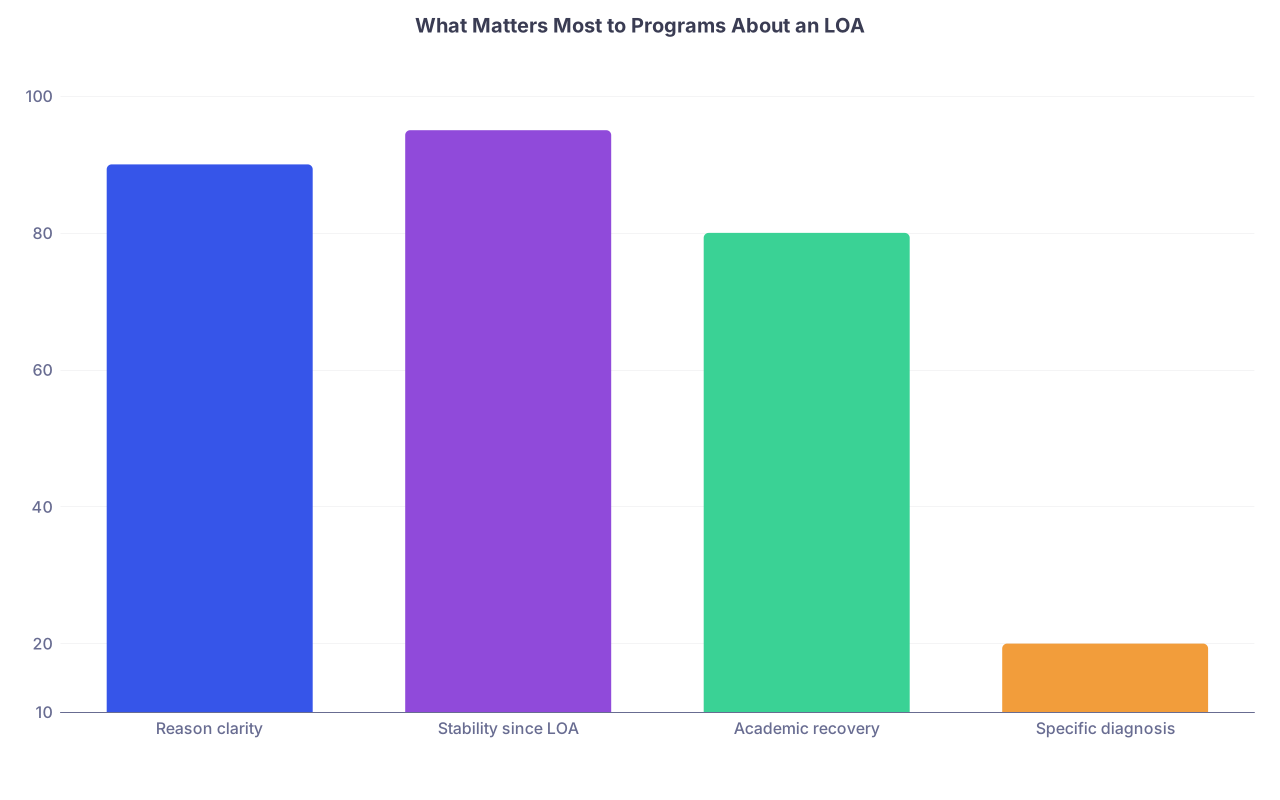
| Category | Value |
|---|---|
| Reason clarity | 90 |
| Stability since LOA | 95 |
| Academic recovery | 80 |
| Specific diagnosis | 20 |
Programs care far more about clarity and stability than they do about the exact diagnosis label.
7. Special Situations: Short LOAs, Multiple LOAs, and Hidden Gaps
Not all LOAs are created equal.
Short or administrative LOAs
- One month for logistics, minor surgery, or an approved short break?
Usually a non-issue if:- It didn’t delay graduation significantly, and
- It’s clearly documented and explained briefly in your MSPE.
You can usually answer in one sentence if asked:
“I had a brief approved leave to address a minor health issue; it was uncomplicated and I’ve had no ongoing problems.”
Multiple LOAs
Now we’re in “higher concern” territory, and you need to be even cleaner with your explanation.
- Be explicit about:
- What changed between the first and second LOA.
- What’s different now that makes recurrence unlikely.
If you’ve had more than one LOA, I’d absolutely rehearse this explanation with a trusted advisor or PD before interviews. You don’t freelance this.
Gaps that aren’t formally labeled LOAs
Sometimes schedules shift, electives move, or preclinical → clinical transitions create weird calendar gaps.
If a program asks about a “gap” that wasn’t officially an LOA:
Clarify the structure:
“That wasn’t actually a leave; that’s how my school sequences clerkships. During that period I was doing [X: research, Step prep, electives].”
Have concrete activities you can name.
8. How to Prepare Practically Before Interview Day
Don’t just think about this in the shower and hope it comes out right later. Write it down. Say it out loud.
Here’s a simple prep plan:
- Write a 3–4 sentence explanation using the framework:
- Why → What you did → How you’re doing now.
- Practice saying it out loud until:
- You don’t sound defensive.
- You don’t overshare.
- You can stop talking after 30–60 seconds.
- Add one short “growth” reflection:
“That experience made me more intentional about [self-care / communication / asking for help / time management], which I think will help me as a resident.”
- Ask a mentor or advisor:
- “If you were a PD, how would this land? What would you be worried about? What would you want me to emphasize?”
You want this answer to feel boring to you by interview day. Rehearsed but natural.

| Step | Description |
|---|---|
| Step 1 | Interview Day |
| Step 2 | Give clear 30-60 sec explanation |
| Step 3 | Address briefly as main challenge |
| Step 4 | Do not bring it up |
| Step 5 | Interviewer asks about LOA or challenges? |
| Step 6 | Is LOA your obvious main red flag? |
FAQ: Leaves of Absence and Residency Interviews
1. Do I need to mention my leave of absence in every interview, even if they don’t ask?
No. If it’s in your file, they can see it. You don’t have to volunteer it spontaneously. You only need to discuss it when asked directly or when a “challenge” question clearly calls for addressing your biggest red flag.
2. Will a medical or mental health LOA automatically prevent me from matching?
No. I’ve seen plenty of people with mental health–related LOAs match well. Programs care about clarity, treatment, stability, and your track record since returning. Evasive answers and ongoing instability are what hurt you, not the label itself.
3. How detailed do I need to be about the reason for my LOA?
You should provide a clear category-level reason (health, family, academic, structured research, etc.), but you don’t have to share intimate medical or personal details. A concise, honest explanation plus evidence of recovery and strong performance is enough.
4. What if my LOA was for academic reasons—does that doom me?
It’s a concern, but not an automatic no. You need to show clear improvement: better course performance, strong clinical evals, solid Step 2 score, and a mature explanation of what you changed. If you present it as a turning point with proof, many programs will still seriously consider you.
5. My school already explained my LOA in the MSPE. Should I repeat that explanation?
You don’t need to recite it, but your story should line up with it. Use similar structure and emphasis, in your own words. If they ask, you give a brief, consistent explanation and then pivot to how you’ve done since coming back.
Key takeaways:
You don’t have to tell every interviewer about your leave of absence—but you do need a clean, consistent, 30–60 second explanation ready for anyone who asks. Focus less on defending the past and more on proving stability, maturity, and strong performance since the LOA.