
It’s December. You’re staring at your ERAS portal, obsessively reading your LORs again because you know what’s coming next: rank lists.
In the back of your mind there’s this constant drumbeat: “Will these amazing letters be enough to make them forget about my failed course, my low Step 1 performance, or that leave of absence?”
Here’s the blunt truth: letters of recommendation can absolutely soften academic red flags and sometimes fully rehabilitate you. But only in specific ways, and only if they’re the right kind of strong.
Let’s walk through what they can and can’t do—and how to maximize their impact.
1. What Program Directors Actually Use LORs For
Forget the fantasy that a glowing letter makes your transcript disappear. That’s not how PDs read applications.
Program directors use letters to answer a handful of very specific questions:
- Can I trust this person with my patients at 2 a.m.?
- Do they play well with others, or are they work for me?
- Are they lazy, average, or a workhorse?
- If there’s a red flag, is it a pattern—or a one‑off that’s already been fixed?
Letters are less about “are they smart?” and more about “are they safe, reliable, and coachable?”
So when you’re asking “Can strong letters offset my red flags?” what you’re really asking is:
“Can trusted faculty convince a PD that my red flags don’t predict future disaster?”
Sometimes yes. Sometimes no. The details matter.
2. Which Red Flags Letters Can Help With (And Which They Can’t)
Not all red flags are created equal. Some are fixable with strong narrative support. Some are mostly stone.
Here’s the breakdown.
| Red Flag Type | Can Strong LORs Help? | Typical Impact Level |
|---|---|---|
| Single failed class/rotation | Yes | Often substantial |
| Low Step 1 (pass) / Step 2 (low) | Partially | Moderate |
| Step 1/2 failure (later passed) | Sometimes | Moderate if well-framed |
| Leave of absence (non-misconduct) | Yes | Often substantial |
| Mild professionalism concern | Sometimes | Variable |
| Severe professionalism / misconduct | Rarely | Minimal |
Where letters can really move the needle
- Single failed course or rotation, now performing well
If you bombed a clerkship early (say, Medicine) but then got Honors in later rotations, strong letters from those later attendings can absolutely reframe the story:
- “Early in third year, they struggled with time management but I’ve seen marked improvement and now they function at the level of a new intern.”
- “Whatever happened in that early rotation does not reflect the person I worked with—this student was in the top 5% of all learners I’ve supervised in the past 5 years.”
That kind of language doesn’t erase the F, but it downgrades it from “danger sign” to “growing pains.”
- Leave of absence for health, family, or personal reasons
Program directors are wary of unexplained gaps. But a letter from someone who knew you before and after can stabilize the picture:
- “After a brief leave for personal reasons, they returned with renewed focus and have consistently performed at or above the level of their peers.”
- “They handled a difficult period in their life with maturity and transparency, and I have full confidence in their resilience moving forward.”
Here, letters help PDs think: “This isn’t ongoing chaos. This is dealt with.”
- Step failure followed by strong clinical performance
A failed Step 1 or Step 2 is still a big deal. But if you later:
- Passed on the second attempt
- Performed strongly on wards
- Have multiple attendings vouching for your clinical reasoning
…then strong letters can shift the narrative from “can’t hack it” to “late bloomer who figured it out.”
Where letters help some but don’t fix everything
- Low Step 2 score, especially in competitive fields
If you’re applying to derm with a 220 Step 2 and the program usually interviews 250+…no letter is magic enough to change their score filter. The letter only matters once you’re past the screening stage.
Same story for EM with SLOEs, surgery with strong hands-on letters, etc. Once the door is cracked open, letters can pull you up. But they often can’t open the door by themselves if hard filters are used.
- Pattern of marginal performance
If your whole transcript is sprinkled with Cs, borderline passes, and “meets expectations” comments, three glowing letters don’t suddenly make you a star. PDs will assume:
- you picked your biggest fans
- your performance elsewhere might have been very average or worse
Letters can help them think “they’ll be fine,” but not “they’re a rockstar” if your record doesn’t back it up.
Where letters almost never fix the problem
- Repeated or severe professionalism concerns
- Dishonesty, plagiarism, cheating
- Ongoing reliability issues (no-shows, chronic lateness documented in MSPE)
- Behavior that made your school write a big “concerned” paragraph in your dean’s letter
You can get the most glowing letter from a research mentor saying you’re brilliant, and a PD will still think: “That doesn’t change the fact they lied on a chart.”
3. What a “Strong” Letter Actually Looks Like
Everyone calls their letter “strong.” Most aren’t.
Program directors skim hundreds of LORs. They can tell in about eight seconds which ones matter.
Here’s what actually qualifies as strong in this context:
- Specific comparison language
“I would rank them in the top 5% of all students I’ve worked with in 10 years.”
“Easily in the top quartile of students at their level.”
“This student meets or exceeds the level of our current interns.”
Vague praise like “a pleasure to work with” or “I recommend without hesitation” is white noise.
- Concrete behavioral examples
Instead of: “They’re hardworking and compassionate.”
You want things like:
“On my busy inpatient service, they routinely stayed late to ensure every patient’s questions were answered, without being asked, and never complained despite 12+ hour days.”
Or:
“They independently followed up on a diagnostic uncertainty over the weekend, read primary literature, and presented a nuanced plan Monday morning that our team adopted.”
Details = credibility.
- Direct address of the red flag (when appropriate)
Gold standard is a letter that doesn’t tiptoe around your issue but reframes it:
- “They had academic struggles early in medical school. Since then, I’ve seen consistent improvement and no evidence of ongoing weaknesses.”
- “I’m aware of their leave of absence, and based on my work with them since returning, I have no concerns about reliability, professionalism, or stamina.”
This tells a PD: “Yes, we saw the red flag. No, we’re not worried anymore.”
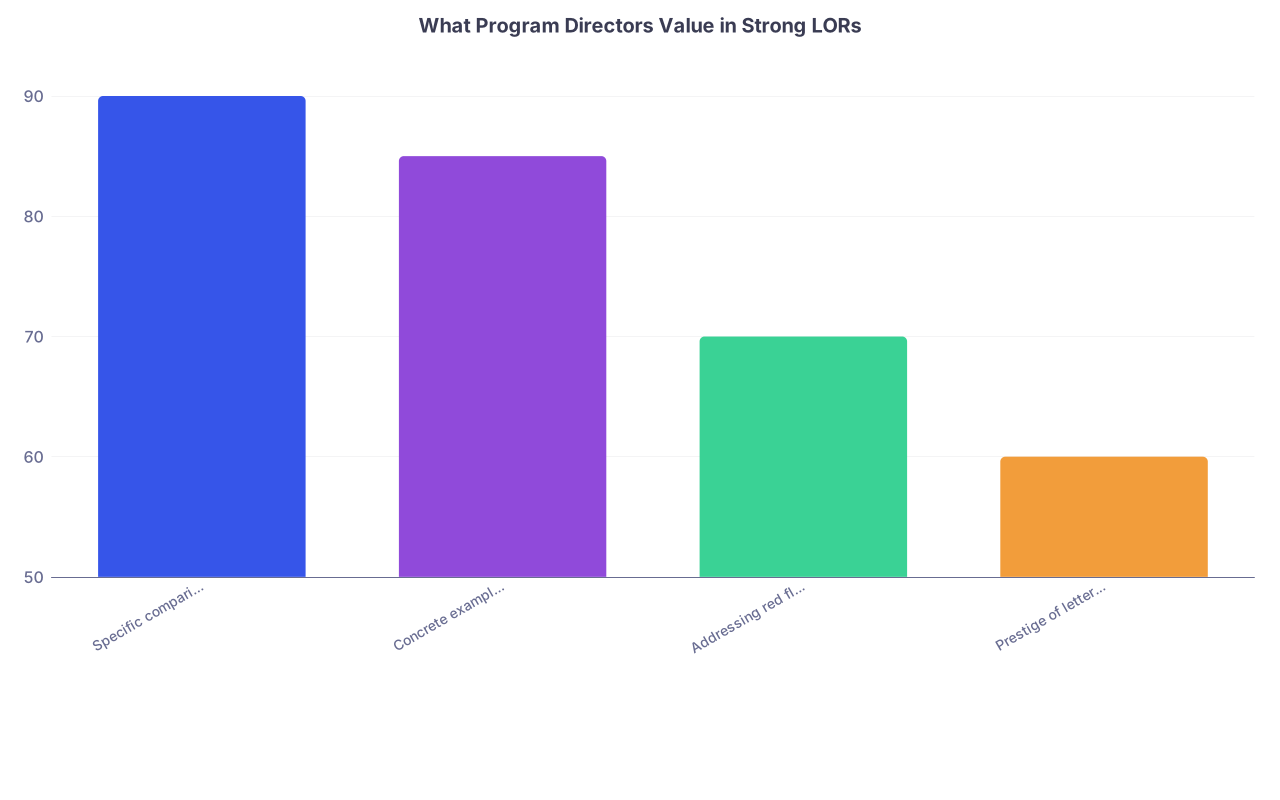
| Category | Value |
|---|---|
| Specific comparisons | 90 |
| Concrete examples | 85 |
| Addressing red flags | 70 |
| Prestige of letter writer | 60 |
- Writer credibility
Who the letter is from matters, but not how students think it does.
Best combo for red-flag repair:
- Someone who directly supervised you clinically
- In the specialty you’re applying to (or closely related)
- Known as a straight shooter, not a “everyone’s amazing” person
A generic “big name” who barely knew you is less useful than a local workhorse attending who clearly watched you grind on the wards.
4. How to Get Letters That Actually Help Offset Red Flags
This is the part most students screw up. They just “ask for a strong letter” and hope for the best.
Don’t do that.
Here’s the actual playbook.
Step 1: Choose writers strategically
Prioritize:
- Attendings who saw you at your best, especially after the red flag event
- Supervisors who saw you in stressful, high-volume environments
- People who’ve written letters before and know what programs want
For example, if you failed IM early but crushed a sub-I later, your sub-I attending is gold.
Step 2: Be transparent about your situation
You don’t need to dump your whole life story, but say something like:
“I had an academic stumble earlier in medical school (failed X / LOA in Y year), and I’ve worked hard to address it. Because you saw me later in my training, I’m hoping you’d be comfortable commenting on my current level and reliability. Do you feel you can write a strong, supportive letter for residency that reflects that?”
That last line—“strong, supportive”—is important. It gives them a graceful out if they’re not going to go to bat for you.
Step 3: Provide targeted context
Give them:
- Your CV
- Personal statement
- Brief 1-page summary of:
- What the red flag was
- What you’ve done since
- What you hope their letter can emphasize
Example bullets you might include:
- “Early in MS2 I failed X due to poor time management and difficulty adjusting to volume. Since then:
- Passed all subsequent courses and clerkships
- Step 2: 235
- Sub-I in Medicine: High honors, strong feedback on reliability and independence”
You’re handing them the story you want told, not begging for rescue.
5. How Programs Actually Weigh Letters vs Red Flags
Here’s what tends to happen in real selection meetings.
They’re looking at your file. Someone says:
“Step 1 failure, now passed. Step 2 is 228. What do the letters say?”
If your letters read like:
- “Top 10% of all students I’ve worked with. Functions at intern level.”
- “I would have no hesitation having them care for my own family.”
- “Any concerns from earlier in training have been resolved—I saw a reliable, conscientious, and clinically sharp student.”
Then the room shifts from “probably no” to “okay, let’s interview them.”
Letters rarely make you jump from bottom of the list to “must rank #1.” But they absolutely can:
- Get you an interview you might not have gotten
- Move you from “we’re nervous about them” to “they’ll be solid”
Where they’re less powerful:
- Overcoming hard score filters in very competitive specialties
- Fixing ongoing or recent professionalism problems
- Overriding a weak MSPE that subtly (or not so subtly) trashes you
If your medical school’s MSPE basically says “this person caused us trouble,” three glowing letters will look suspicious, not reassuring.
6. Practical Strategy If You Know You Have Red Flags
Here’s the simple framework I’d use:
Clarify your main red flag(s)
Is it one failed course? A Step 1 fail? LOA? Multiple issues?Decide on your story
One-sentence version, like:
“I struggled early with time management but have shown steady, objective improvement and now perform at or above level.”Align all pieces
- Personal statement: brief, mature mention (no excuses, clear growth)
- MSPE: request your dean to frame it as “resolved and improved” if possible
- LORs: from people who can confirm the “now at level / improved” storyline
Overweight clinical performance
Crush your sub-Is. Ask for letters from those rotations. Residency is a clinical job; PDs love to see: “They already look like an intern.”Be realistic about specialty competitiveness
Sometimes the honest move is:- Choose a less competitive specialty
- Or apply very broadly
- Or be ready for SOAP
Letters help. But they don’t rewrite the competitiveness math for derm, ortho, plastics, etc.

| Step | Description |
|---|---|
| Step 1 | Identify Red Flag |
| Step 2 | Focus on later strong rotations |
| Step 3 | Consider less competitive specialties |
| Step 4 | Pick attendings who saw improvement |
| Step 5 | Brief faculty on red flag + growth |
| Step 6 | Request explicit, strong letter |
| Step 7 | Align story in PS + MSPE |
| Step 8 | Stronger chance at interview |
| Step 9 | Single or Repeated? |
FAQs
1. I failed Step 1 but passed on the second try. Can strong letters really make programs overlook this?
They won’t make programs forget the fail, but they can absolutely downgrade the concern. Programs will ask: “Is this person going to struggle with board-style thinking and in-training exams forever, or was this one bad chapter?” If your letters consistently describe strong clinical reasoning, reliability, and improvement, some PDs will say, “We can live with the Step issue.” Especially in less hyper-competitive fields or community programs with more holistic review.
2. Should I ask letter writers to directly mention my red flag?
If the red flag is academic (failed class, Step fail, LOA for non-misconduct), yes—ideally one of your strongest letter writers should touch it briefly and then pivot to your growth and current performance. Something like: “Although they had academic difficulties early in medical school, by the time I worked with them I saw a highly reliable, prepared, and clinically sharp student.” It signals awareness and resolution. Don’t force every writer to mention it—that looks weird and overcompensatory.
3. Does a big-name letter (famous chair, national PI) help more with red flags?
Only if they actually know you and describe your clinical performance in detail. A generic two-paragraph letter from a famous name who barely supervised you is mostly useless for red-flag repair. Program directors care far more about: “I worked with them daily on a busy service and they function at intern level” than “I’m the Chair of X and I think they’re great” with no specifics. If that big name really did see you working hard clinically, then yes, that combo can be powerful.
4. What if my best letter writer isn’t in the specialty I’m applying to?
Still use them. For red-flag applicants, your strongest, most concrete letter about your work ethic, reliability, and clinical ability is more important than matching specialty every time. Ideal setup: at least one letter from your target specialty, and one or two from other rotations where you absolutely crushed it—especially later in training. PDs can extrapolate: if IM thought you looked like an intern, that matters even if you’re applying to anesthesia.
5. My school’s MSPE hints at “professionalism concerns” but doesn’t spell them out. Can strong letters counter that?
They can soften the blow but usually can’t completely override it. PDs trust MSPE writers more than individual letter writers when it comes to professionalism. The best you can do is stack letters that emphasize your reliability, communication, and maturity without sounding defensive. If an attending can honestly say, “I had no concerns about professionalism; they were a model team member,” that helps. But if the MSPE strongly implies real issues, some programs will simply move on. That’s reality.
6. How many strong letters do I need to meaningfully offset a red flag?
For most specialties, 3–4 total letters, of which at least 2 are truly excellent and detailed, is a good target. One great letter surrounded by two bland, generic ones isn’t nearly as convincing as a consistent pattern of strong support. You’re trying to create a chorus, not a solo act. If three separate attendings, on different rotations, all say “intern-level, reliable, improved over time,” PDs start to believe the pattern—not the single red mark on your record.
Key points:
- Strong letters can’t erase red flags, but they can reframe them as one-time problems in an otherwise solid, trustworthy trainee.
- The only letters that really help are specific, comparative, and ideally written by faculty who saw you excel after the red flag.
- Align your story—personal statement, MSPE, and LORs should all quietly say the same thing: “Yes, there was a problem. No, it’s not who I am anymore.”