The uncomfortable truth: most “gap-year” activities that reapplicants choose do almost nothing for their chances.
If you’re reapplying after not matching, the bar is higher. You are no longer being judged on potential. You’re being judged on evidence that something has changed. Programs are asking one blunt question:
“Why will this applicant succeed this time when they did not last time?”
If your gap year doesn’t answer that clearly, it’s a wasted year.
Let me walk you through what actually moves the needle—and what is mostly cosmetic.
The Core Reality: Programs Want Risk Reduction, Not “Well-Rounded”
PDs are not looking for a cute story about “growth.” They’re doing risk management.
Here’s what they care about in a reapplicant gap year:
- Have you fixed or mitigated the specific weaknesses that hurt you last time?
- Have you proven you can function safely and reliably in a clinical environment?
- Did someone they trust (US faculty, especially in the specialty) put their name behind you with a strong, recent letter?
- Do your new activities clearly align with the specialty you’re applying to?
That’s it.
Everything you do should be aimed directly at one or more of those.
To make this concrete, here’s how common gap-year paths compare.
| Activity Type | Impact on Reapplication |
|---|---|
| Formal Transitional/Prelim Year | Very High |
| Dedicated Research in Target Specialty | High |
| US Clinical Experience (hands-on) | High |
| Chief Year / Extended Training Role | High |
| Non-specialty Clinical Job (scribe, MA) | Moderate (contextual) |
| Generic Volunteer/Shadowing | Low |
| Random Nonclinical Master’s | Very Low (usually) |
If your plan doesn’t fall into the “high impact” buckets—or isn’t tightly justified—you’re probably in the “nice, but not decisive” category.
High-Impact Gap-Year Activities That Truly Move the Needle
These are the things that can actually change how PDs perceive you as a candidate.
1. Transitional Year, Preliminary Year, or Other Accredited Training
This is the gold standard for many unmatched US grads and strong IMGs.
Why it matters so much:
- You prove you can function as a physician within the system: call, notes, orders, night float, handoffs.
- You generate fresh, powerful letters from faculty who see you as a doctor, not a student.
- You show that another program was willing to invest actual funding into you.
- You may be able to transfer PGY-1 credit into another residency (depending on specialty and board rules).
For reapplicants to internal medicine, family med, peds, psych, neurology, etc., a solid PGY-1 year with strong evaluations can absolutely flip your narrative from “risk” to “safe hire.”
When it works best:
- You had marginal scores or weaker clerkship narrative, but good clinical potential.
- You struggled to get interviews the first time, but your application was not catastrophic.
- You apply again early with updated letters from your current program director and attendings.
When it doesn’t help much:
- You do the year but:
- your evaluations are mediocre;
- you have professionalism issues; or
- you don’t obtain strong, specific letters (“Among the top residents I worked with…”).
If you’re in or starting a prelim/transitional year now, your main job is simple: be a top 10–20% resident on your team. Show up early, know your patients, take ownership, and ask for letters before the ERAS season.
2. Specialty-Focused Research with Real Output
Research only moves the needle when it is:
- In your target specialty
- Under mentors who are known or credible to PDs
- Leading to something tangible: abstracts, posters, publications, or at least clear in-progress manuscripts
Just “did a research year” is worthless if there’s no evidence of work beyond your CV bullet.
Research helps in three key ways:
- Fixes a lack of scholarly activity, especially for competitive or academic-leaning specialties.
- Gives you new, strong letters from research mentors who can say you showed up, took initiative, and delivered.
- Gives you specific talking points and a coherent narrative for “Why this specialty?”
Signs that a research year will actually help:
- You’re at a recognizable institution in that specialty.
- Your mentor writes letters for residents/fellows regularly.
- You have a pipeline: one abstract submitted, one paper under review, one in progress.
- You can talk about your project intelligently at a conference-style level.
Warning signs it’s a waste:
- You’re months in and mostly doing data entry or “I’ll loop you in later” busywork.
- You have no plan to submit anything before ERAS opens.
- Your PI is absent, uninterested, or doesn’t know your name well enough to write a strong letter.
If you’re already in a research year, set aggressive milestones: one abstract submitted within 4–6 months, one manuscript draft by 8–10 months. And explicitly ask your PI what would make a “strong letter” possible.
3. Structured, Hands-On US Clinical Experience
This matters a lot for IMGs/FMGS, and can still help US grads who had very weak clinical evaluations or limited exposure to their target specialty.
What helps most:
Observerships and externships that are:
- in your target specialty,
- at US teaching hospitals, and
- with clear evaluation and letter-writing built into the structure.
Postgraduate clinical fellowships (e.g., non-ACGME fellowships) where you:
- run clinics or assist directly,
- join inpatient teams,
- and obtain letters from supervising physicians.
What doesn’t move the needle:
- Shadowing another year without letters.
- Informal “I hung out in the clinic periodically” experiences.
- Short 1–2 week experiences that cannot possibly support a meaningful letter.
The point is not to accumulate hours. Programs want evidence from US-based clinicians that you can handle their system and their patients.
4. Chief Year or Extended Training in Current Program
This applies if you matched into something but are pivoting (e.g., internal medicine resident trying to switch to dermatology, prelim surgery trying for radiology, etc.)
A chief year or additional year in your current program helps if:
- Your PD is strongly supportive and will call on your behalf.
- Your evaluations are consistently strong (no professionalism, punctuality, or teamwork concerns).
- You can demonstrate leadership, teaching, and reliability.
This is less about “padding your CV” and more about screaming: “This person already works well in a residency environment. They’re safe to hire.”
Moderate-Impact Activities: Helpful, But Not Magic
These can help—but only if they clearly connect to your specific weaknesses.
1. Clinical Jobs (Scribe, MA, RN, Hospitalist Extender, etc.)
For US grads, these rarely transform an application. But they can help:
- If your previous concern was lack of clinical exposure or slow clinical reasoning.
- If your letters hammered you on organization or communication and you’ve improved.
- If you’re an older grad and need to show you’ve stayed clinically engaged.
For IMGs, scribe or MA roles can be more valuable because they show familiarity with US systems, EMRs, and team structure.
Just don’t kid yourself: a scribe job doesn’t erase a low Step score for a competitive specialty. It’s a supporting piece, not the centerpiece.
2. Teaching Roles (Adjunct, Tutor, Anatomy Lab, etc.)
Teaching can help shape a good narrative—especially for primary care, peds, psych, and academic programs.
It suggests:
- Communication skills.
- Patience and professionalism.
- Comfort explaining complex ideas clearly.
But again, it only moves the needle when it’s part of an overall improvement arc, not a stand-alone “look how busy I was” line on your CV.
Low-Yield or Misused Gap-Year Choices
Now the part some people will not like.
These activities are common, but often do little for reapplicants unless extremely well-justified.
1. Generic Master’s Programs (MPH, MBA, MS, etc.)
I’ve seen many unmatched applicants flee into an MPH because it feels productive. For most, it does not move the needle.
It helps only when:
- You’re genuinely pivoting toward academic/public health–oriented programs that care deeply about it.
- You’re producing actual output: quality improvement projects, health systems work, policy briefs, etc.
- You simultaneously fix other issues (Step 2 CK, more clinical exposure, stronger letters).
It does not help simply because it exists on your CV. Some PDs actually see the “degree chase” as a red flag: more time away from real clinical work.
2. Random Extra Volunteering
Working in a free clinic. Doing health fairs. Community service.
These are good as a human being. But as a reapplicant, they’re seldom decisive.
They support:
- A narrative of service.
- Some “fit” for primary care–oriented programs.
They do not fix:
- Bad exam performance.
- Weak letters.
- Poor clinical evaluations.
- No specialty fit.
If you’re going to volunteer, tie it tightly to your specialty and make it meaningful: longitudinal, clear responsibility, ideally supervised by someone who can write a letter.
The Part Everyone Skips: Fixing Your Real Weaknesses
Before you choose anything, you need a brutal audit of why you didn’t match.
That means:
- Reading your prior MSPE and clerkship comments honestly.
- Looking at your Step/COMLEX scores relative to matched cohorts in your specialty.
- Counting how many interviews you got last time and where.
- Admitting any professionalism issues, red flags, or SOAP disasters.
Then choosing gap-year actions that directly target those things.
Here’s how that mapping actually looks.
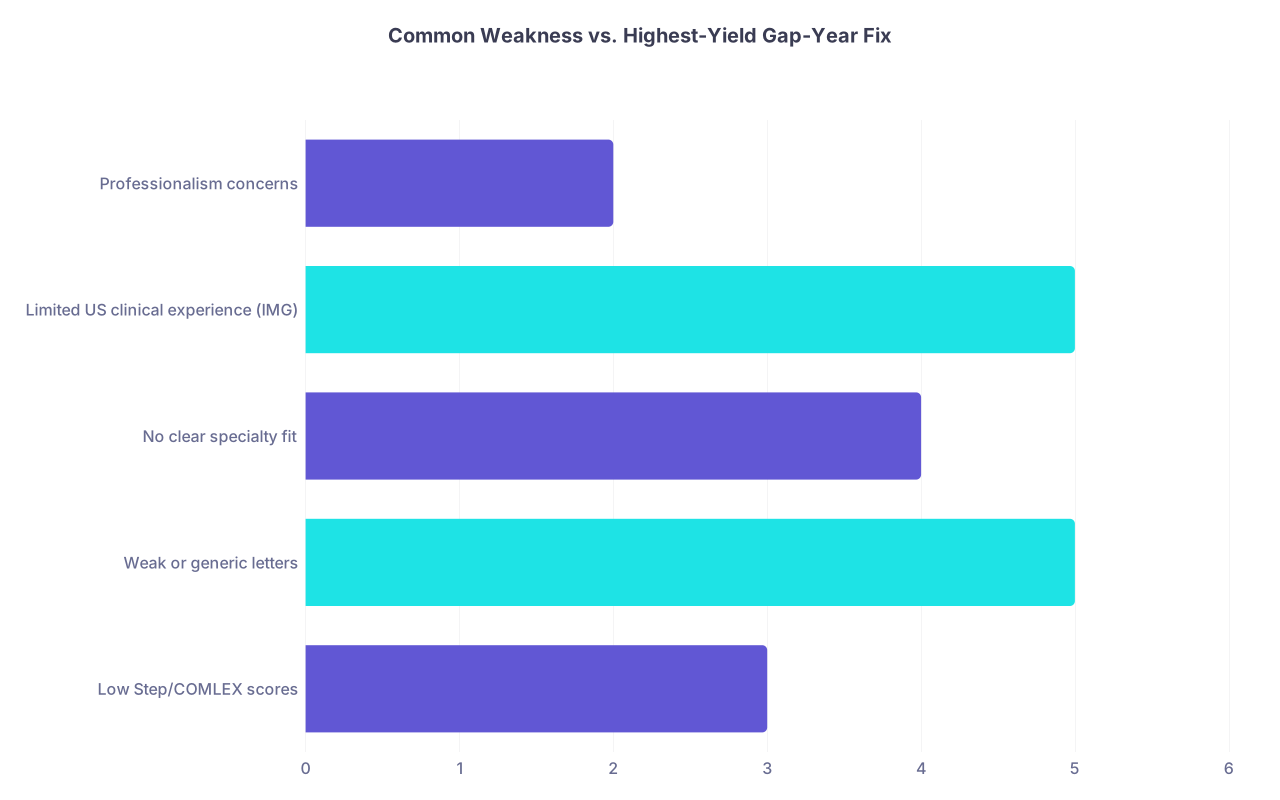
| Category | Value |
|---|---|
| Low Step/COMLEX scores | 3 |
| Weak or generic letters | 5 |
| No clear specialty fit | 4 |
| Limited US clinical experience (IMG) | 5 |
| Professionalism concerns | 2 |
(Scale: 1 = least responsive to gap-year fixes, 5 = most)
Interpretation, not just numbers:
- Low Steps: hard to fix after the fact. You may need to lower specialty competitiveness or strengthen every other dimension.
- Weak letters / unclear specialty fit / limited USCE: highly fixable by the right research/clinical year.
- Professionalism: partially fixable with flawless performance under supervision and a PD willing to vouch for you—but this is slow work.
If you do not align your gap year to your main deficits, you’re just burning time.
How to Decide: A Simple Flow
Here’s the logic I use when advising reapplicants.

| Step | Description |
|---|---|
| Step 1 | Unmatched or Unhappy with Match |
| Step 2 | Very Low Scores / Multiple Fails |
| Step 3 | Few Interviews / Weak Letters |
| Step 4 | IMG with Limited USCE |
| Step 5 | Poor Clinical Eval / Professionalism |
| Step 6 | Reassess Specialty & Program Tier |
| Step 7 | Consider Less Competitive Fields |
| Step 8 | Targeted Research or Prelim Year |
| Step 9 | Get New Strong Letters |
| Step 10 | Hands-on USCE & US Letters |
| Step 11 | PGY-1 or Job with Direct Supervision |
| Step 12 | Documented Excellent Performance |
| Step 13 | Main Issue? |
If your plan doesn’t fall on one of these branches, think hard.
What About Explaining the Gap Year in Your Application?
The activity itself isn’t enough. You have to frame it correctly.
Your personal statement and interviews should answer:
- What went wrong previously?
- What did you do, specifically, to address it during the gap year?
- What concrete evidence can you show that things are now different?
Bad version: “I took this year to grow personally, explore my interests, and reflect on my passion for medicine.”
Good version: “After receiving few interviews last cycle, my mentors and I recognized that my application lacked recent, specialty-specific clinical evaluations and strong letters. I spent this year working as a research fellow in the cardiology department at X, where I rounded with the inpatient team, co-authored two abstracts presented at Y, and received direct feedback on my clinical reasoning and patient communication. My attending, Dr. Z, has written a letter reflecting my growth in these areas.”
Programs want the second version. Clear problem. Clear response. Clear proof.
Quick Comparison: If You’re Deciding Between Two Options
| Situation | Better Choice (Usually) |
|---|---|
| Unmatched IM applicant: TY vs. MPH | Transitional/Prelim Year |
| IMG with no USCE: Research vs. Observerships | Hands-on, structured USCE with letters |
| Weak specialty identity: Generic job vs. Spec Research | Specialty-Focused Research |
| Low Step but decent clinicals: Research vs. Scribe | Specialty Research with strong mentorship |
When in doubt, ask one question:
“Will this give me strong, recent, specialty-relevant letters?”
If the answer is no, it’s probably not your main gap-year move.
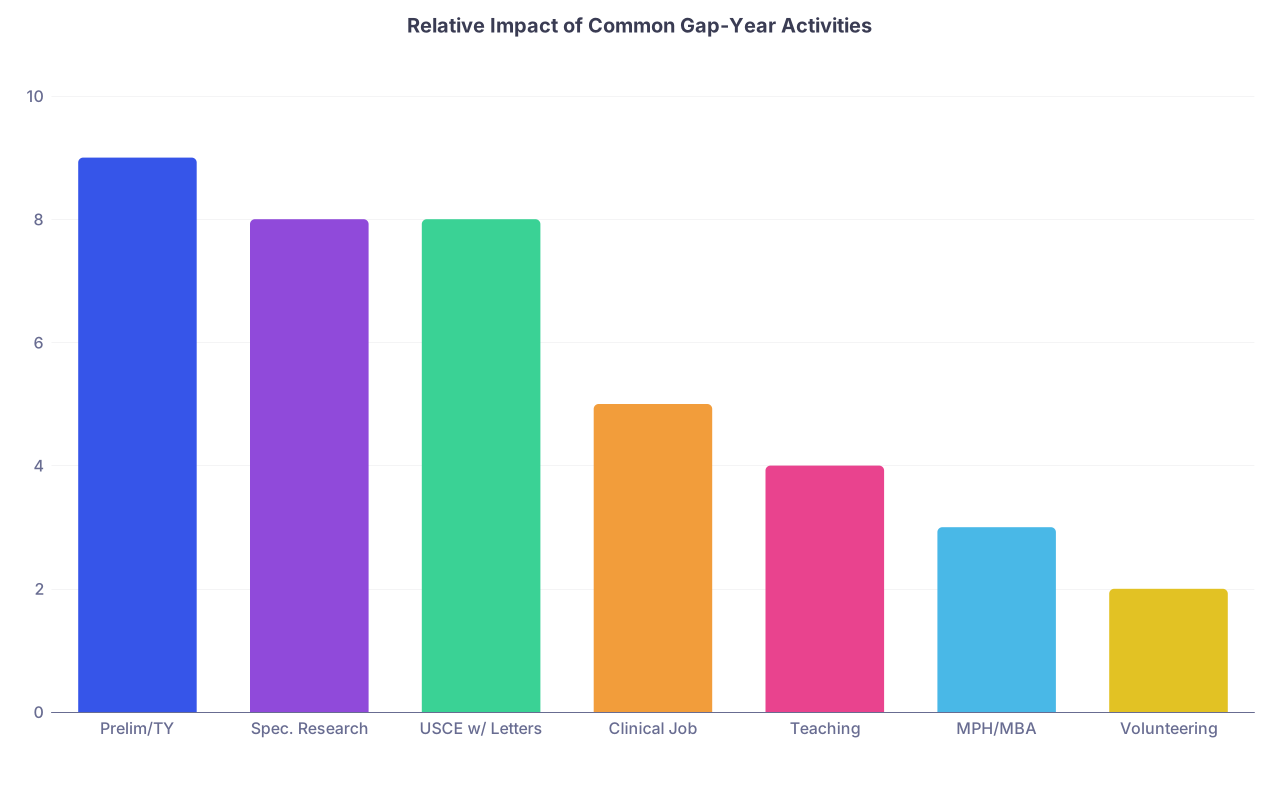
| Category | Value |
|---|---|
| Prelim/TY | 9 |
| Spec. Research | 8 |
| USCE w/ Letters | 8 |
| Clinical Job | 5 |
| Teaching | 4 |
| MPH/MBA | 3 |
| Volunteering | 2 |
(Scale 1–10: my realistic take on how often each truly changes outcomes for reapplicants.)
FAQ: Reapplicant Gap-Years, Answered
1. Do I have to do a gap year if I didn’t match?
Not always. If you got a decent number of interviews but didn’t match due to rank list issues, geographic constraints, or bad interview skills, you might reapply the next cycle with more applications and better strategy, without a full “gap year pivot.” But if you had very few or no interviews, or your application had clear weaknesses, a well-planned gap year is often the only way to materially alter your chances.
2. Is it better to do any prelim/TY spot or wait for my dream specialty?
If your dream specialty is extremely competitive (derm, ortho, plastics, ENT, etc.) and your metrics are far below matched averages, a random prelim year will not magically fix that. In that scenario, primarily unmatched US grads often do better either: a) recalibrating to a more realistic specialty and using a TY/prelim strategically, or b) doing highly targeted research with strong mentors in their dream field. For core specialties (IM, FM, peds, psych), a well-done PGY-1 year is usually a substantial plus.
3. I’m an IMG. Should I focus on research or US clinical experience?
If you have zero or minimal US clinical experience, prioritize structured, hands-on USCE that produces US letters. Programs care deeply about whether someone familiar with US training can vouch for you. Research is valuable if it’s in your target specialty and at a US institution, but it should be an add-on, not a substitute for USCE, unless you already have strong US letters.
4. Will an MPH or MBA help me match if I already applied once and failed?
By itself, rarely. An MPH or MBA can enhance your profile if you are aiming at academic, leadership, or public health–focused programs. But if the reasons you failed to match were low scores, poor letters, or minimal clinical experience, a degree does not address those. If you pursue a degree, pair it with real clinical exposure and clear output (projects, QI, publications), and make sure it fits a coherent narrative.
5. How much does it matter that my gap-year activity is in the same specialty?
A lot. A research year in cardiology is much more persuasive for an IM applicant than generic bench research in basic science. USCE in psychiatry is much more meaningful for a psych applicant than shadowing in dermatology. Specialty alignment tells programs you are serious about their field, you understand it, and people in that field are willing to trust you with their patients.
6. If I’m working a nonclinical job to pay bills, am I doomed?
No. But you need to be strategic. Keep at least one foot in medicine: part-time clinic work, ongoing USCE, volunteer roles in a specialty clinic with meaningful responsibility, or research with evening/weekend flexibility. Programs understand financial reality. What they do not like is a complete, unexplained disconnect from clinical work for a year or two with no effort to maintain skills or demonstrate commitment.
7. What’s the single biggest mistake reapplicants make with gap years?
They “stay busy” instead of being surgical. They load their CV with random jobs, courses, degrees, and volunteer hours that don’t directly address why they didn’t match. You’re not trying to impress programs with how much you did; you’re trying to reassure them about very specific concerns. Before you sign any contract or enroll in anything, ask: “Can I clearly explain how this reduces the risk of hiring me?” If you cannot, rethink it.
Open your previous ERAS application or Match dossier right now.
Circle the three biggest weaknesses that likely kept you from matching. Then, write one concrete gap-year action next to each weakness that directly attacks it. If your current plan doesn’t match that list, change the plan—today.