

You are not ruined because you didn’t match. But your brain is absolutely convinced you are.
Let’s just say the quiet part out loud: the idea of having to explain “I went unmatched” over and over again to strangers in suits, who hold your future in their hands, feels humiliating. Like you’re going to walk into every room with “DIDN’T MATCH” stamped across your forehead in red.
You’re probably thinking through every awful scenario:
They’ll assume I’m incompetent.
They’ll assume I’m unprofessional.
They’ll assume everyone else already rejected me, so why should they take me?
And the worst one:
They’ll never see anything except “unmatched.”
I’ve watched this play out more times than I can count. People who didn’t match and then spend the next year terrified of interviews that haven’t even been scheduled yet.
Let’s actually unpack this. Because your fear is loud, but it’s not accurate.
First: You’re Not the Only “Unmatched” They’ve Ever Seen
Residency program directors are not shocked that someone went unmatched. They’re not clutching their pearls going, “My God, this has NEVER happened before.”
They see this every. single. year.
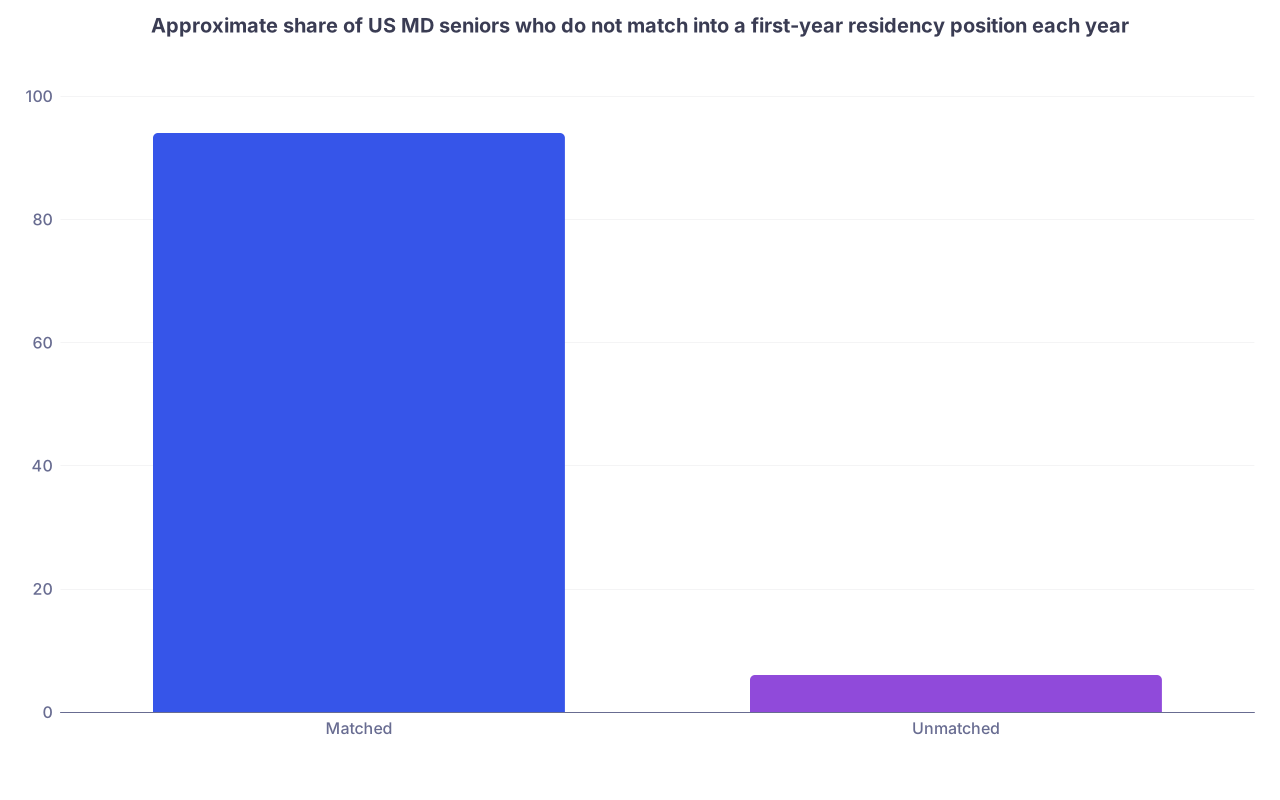
| Category | Value |
|---|---|
| Matched | 94 |
| Unmatched | 6 |
Is 6% small? Yes. But in absolute numbers, that’s still thousands of applicants across MD, DO, and IMGs when you add everyone together. Programs know this.
I’ve heard PDs say things like:
- “We always get a few applicants who are reapplying.”
- “I actually like seeing people who didn’t match but used the year well.”
- “Sometimes the unmatched ones have a better story and more maturity.”
Is every program kind and understanding? No. Some are jerks. But most are not shocked by the word “unmatched.” They’re more curious about what you did after.
The story isn’t “I didn’t match.”
The story is “Here’s what I did next.”
The Ugly Fear: “They’ll Think I’m Defective”
Here’s the core fear, right? That being unmatched is some sort of permanent label. That PDs will pull up your file, see that gap, and mentally put you into the “reject” bucket before you even speak.
Let me be honest: some will. A few programs, especially ultra-competitive ones, use harsh filters. Some will think: if others passed, I will too.
You don’t need all of them.
I’ve seen:
- A US MD who didn’t match into general surgery, did a year of research, then matched categorical at a strong mid-tier program the next cycle.
- A DO who went unmatched in IM, worked as a hospital scribe + part-time research, then matched into community IM and is now a chief resident.
- An IMG who went unmatched twice, picked up US clinical experience, Step improvements, and eventually matched FM.
Were their interviews full of probing questions about being unmatched? Yes.
Did it matter in the end? Also yes—but in a different way than you think.
Programs weren’t thinking: “You’re defective.”
They were thinking: “Does your explanation make sense, and does your trajectory since then show growth?”
There’s a huge difference.
The Question You’re Dreading: “So… Why Didn’t You Match?”
Let’s talk about the actual interview room.
Because your mind probably imagines some interrogation:
“Why did no one pick you?”
“What’s wrong with your application?”
“Explain this giant red flag.”
Reality is more like: calm, direct, professional.
Most versions sound like:
- “Can you walk me through what happened in your previous application cycle?”
- “I see you re-applied—what did you change between cycles?”
- “Tell me about your path since graduation.”
It feels personal and painful to you. To them, it’s just another data point.
The danger isn’t the question.
The danger is you answering from a place of shame or panic.
The goal: calm, factual, brief, and forward-looking. Not defensive. Not oversharing.
Something like:
“I applied broadly to [specialty] last cycle, but I think there were a few issues: my application was a bit late, I didn’t have strong specialty-specific letters, and my Step 2 was pending. After I went unmatched, I took a structured approach: I completed [research/job], strengthened my clinical experience in [field], obtained stronger letters, and improved [X—could be Step score, communication, or specific skills]. I’m glad I had this year, actually—it made me more certain about [specialty] and pushed me to grow in ways I might not have otherwise.”
Notice what that does:
- It acknowledges the mismatch without groveling.
- It takes responsibility without self-destruction.
- It shifts quickly to what you did to correct course.
If the real reason was painful? Like rank list miscalculation, not applying broadly enough, family emergency, visa issues? You still keep it short and structured:
“I only applied to a very narrow set of programs for personal reasons and my rank list ended up being too small. That was a mistake. Since then, I’ve broadened my approach, improved [X], and I’m applying more strategically this cycle.”
Or:
“I had a family situation that impacted my ability to complete all parts of my application on an optimal timeline. That’s now fully resolved, and this past year I’ve been focused on [job/research/clinical work], which has kept me both clinically engaged and more prepared.”
You don’t owe them your entire trauma diary. You owe them clarity, stability, and a story that makes sense.
Don’t Turn “Unmatched” Into Your Entire Personality
Here’s another trap I see unmatched applicants fall into: over-explaining.
They walk into the room already apologizing. Body language, tone, everything screams, “I’m sorry I exist.”
They joke about it. Or bring it up unprompted. Or circle back to it constantly like they need to keep proving they’re not a failure.
That energy? Programs can feel it.
Remember this: you’re not just “the unmatched reapplicant.” You’re still a med school graduate. You still passed exams, took care of patients, survived rotations, worked nights, wrote notes at 3 a.m. All of that is still true.
You don’t open with it. You don’t bring it up when they didn’t ask.
You answer cleanly when they do ask, and then you move on.
They want to talk about:
- How you work in a team
- How you handle difficult patients
- How you respond to feedback
- What you’re like at 2 a.m. on call
If you mentally reduce yourself to “I’m the one who didn’t match,” you’ll show up that way. And that hurts you way more than the fact of being unmatched.
The Part You’re Really Scared Of: Judgment and Pity
There’s another fear buried under the logistics: you don’t want their pity.
You’re picturing that look. The “oh… you’re one of those.”
Or the tone: “I’m sorry to hear that,” dripping with condescension.
Sometimes you will get that. I won’t lie. Some interviewers don’t mask their reactions well. Some have never been on the wrong side of any process and have no idea what that feels like.
You can’t control their face.
But you can control how you carry the story.
Programs are often impressed—genuinely—by people who get knocked down and come back with receipts. With a year of solid work. With evidence of resilience rather than collapse.
Think about how you view someone who:
- Failed an exam, then crushed it on the retake.
- Didn’t make a team, then trained harder and made it the next season.
- Lost something important, then rebuilt without becoming bitter.
The “unmatched” label feels like a scarlet letter to you. To them, it can look like a test of character.
If you treat it like your ultimate shame, they’ll feel that.
If you treat it like a hard chapter that you learned from and moved forward, they’ll feel that too.
What You Should Actually Be Doing This Year (Besides Panicking)
If you’re unmatched now and already mentally stuck in “I’ll have to defend myself at interviews,” pause.
The best defense is not some perfect speech.
It’s what you do between now and those interviews.
Your explanation lands completely differently if it’s backed by:
- A solid, structured role: research fellow, prelim year, teaching position, clinical job, or something with real responsibility.
- Strong letters from this year: “X has been reliable, clinically engaged, good with patients, and a pleasure to work with.”
- Clear growth: maybe you improved a Step 2 CK score, or took on more responsibility, or got a poster accepted, or led a project.
- Evidence that you didn’t emotionally implode and vanish.
Here’s the brutal truth: saying “I learned a lot” means nothing if you can’t point to what you did differently.
You want to be able to say something like:
“Last cycle I didn’t have specialty-specific letters. This year I worked with Dr. ___ in ___, and they’ve seen me closely over months, in clinic and on call.”
Or:
“I realized I wasn’t as strong in [skill], so I spent this year doing ___, where I had to use that daily. My supervisor has given me really good feedback about how much I’ve grown.”
That’s the stuff that flips the interview script from “Why didn’t you match?” to “Wow, you actually turned this into something.”
How to Keep Your Brain From Imploding Before Interviews
Your anxiety is going to try to rehearse this conversation in your head a thousand times. In the shower. In bed at 2 a.m. During lunch. Any time your brain isn’t fully occupied.
You’ll run through every version:
- “If I say X, they’ll think Y.”
- “If I admit Z, they’ll reject me.”
- “If I don’t mention Q, they’ll think I’m hiding something.”
Here’s what I’d do instead:
Write out one clean paragraph that explains your unmatched year. Just one.
Not three pages. Not seven different emotional versions. One.
Then refine it until it has:
- A clear reason or set of factors (without 30 caveats).
- Specific actions you took afterward.
- A calm, forward-looking tone.
Memorize the outline, not the exact script. Practice it a few times out loud until it stops making your throat close up.
Then stop rerunning it every day. You’re not going to make it “perfect.” You’re just going to make it sound robotic and overthought.
Use the rest of your mental energy to actually become the person that paragraph describes.
What Programs Actually Care About When You’re a Reapplicant
To simplify the chaos in your head, programs are basically asking themselves three questions about you as a reapplicant:
| Question | What They’re Really Looking For |
|---|---|
| Why didn’t you match? | A logical, non-chaotic explanation |
| What did you do afterward? | Productivity, maturity, engagement |
| Who are you *now*? | Growth, stability, team fit |
They’re not digging for a confession.
They’re trying to predict how you’ll function as a resident.
Are you going to crumble when things are hard?
Blame everyone else?
Disappear when stressed?
Or are you going to show up, ask for feedback, and improve?
They look at this unmatched year like a stress test. It’s not the one you wanted. But now you’re in it, and how you handle it matters more than the fact that it exists.
You’re Allowed to Be Embarrassed — Just Don’t Let It Drive the Car
I’m not going to pretend you can just “positive mindset” your way out of the sting. It hurts. It’s embarrassing. It messes with how you see yourself.
But here’s the thing: the interview room is not your therapy session.
You’re allowed to feel everything.
You’re not required to bring all of it into that room.
You can feel:
- “This feels unfair.”
- “I’m scared they’ll judge me.”
- “I hate that I have to talk about this.”
And still say, calmly:
“I went unmatched last cycle. These are the main reasons. Here’s how I responded. Here’s who I’ve become since then. I’m ready now.”
Both things can be true at the same time.
If You Take Nothing Else From This
Keep these three points:
- “Unmatched” is not a permanent label unless you make it one. Programs see it every year. What they care about is the story after.
- Your explanation doesn’t need to be epic. It needs to be clear, honest, and focused on growth. One clean paragraph beats ten minutes of apologizing.
- The real work isn’t crafting the perfect answer—it’s living a year that makes your answer easy to believe. Grow in public. Get receipts. Then walk into those interviews as the person you’ve actually become, not the failure your anxiety insists you are.
You’re not done. You’re in the hard middle. And you’re allowed to come back from this.


