
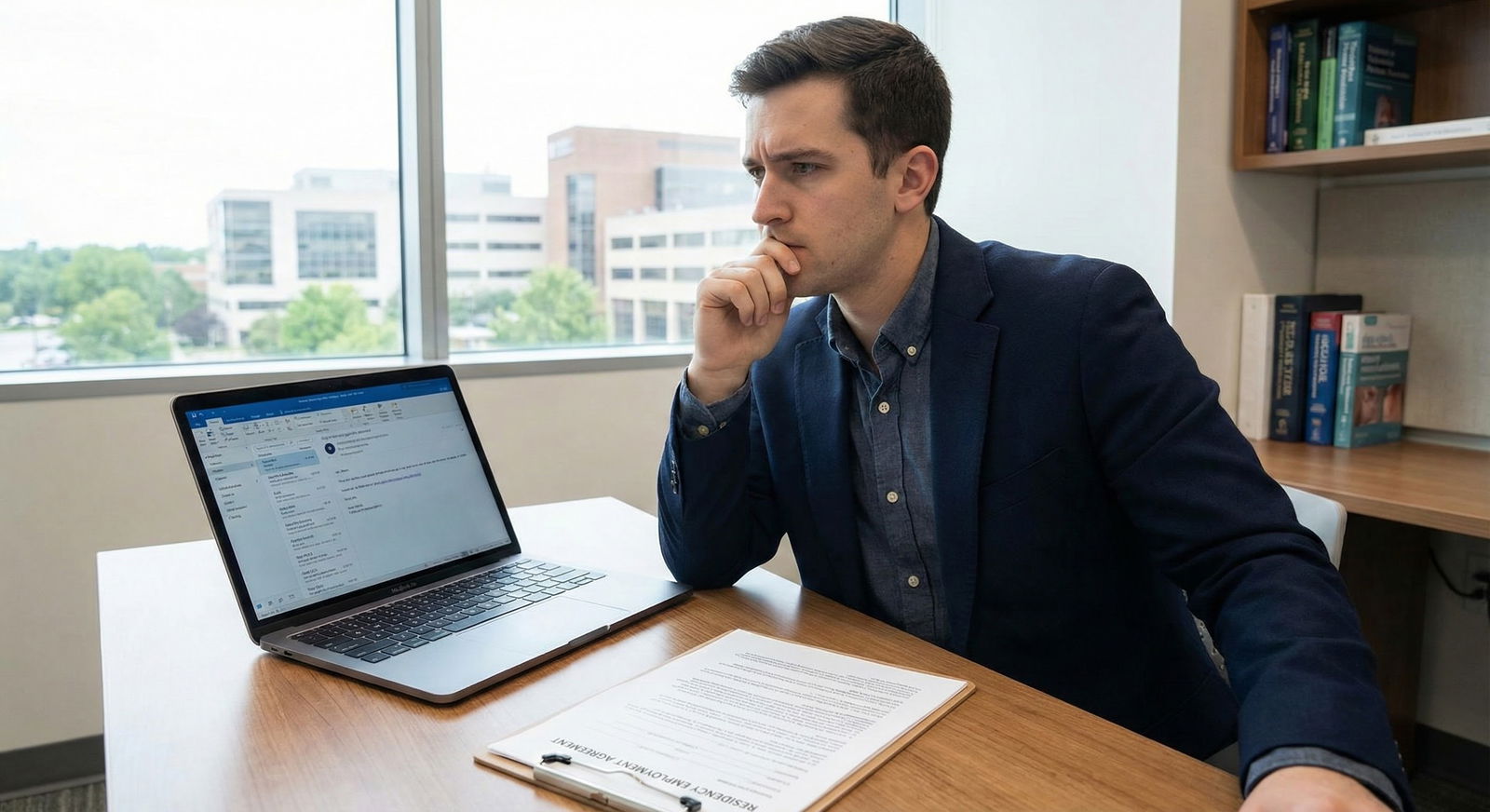
You’re sitting in a small apartment, laptop still open to the NRMP “Sorry, you did not match” screen. Your I-20 or DS-2019 end date is circled in red on a paper calendar. Friends are talking about intern orientation; you’re googling “unmatched IMG on visa options” at 1:30 a.m., stomach in a knot.
If that’s where you are, let’s be blunt: you don’t have time for theory. You need to know what you can actually do in the next 2–12 weeks so you don’t lose status, don’t get banned from coming back, and don’t accidentally blow your best shot at matching next cycle.
This is the playbook.
Step 1: Get brutally clear on your current visa and deadlines
Before you do anything else, you need to know exactly what you’re on and when it ends. Not approximations. Not “I think it’s next summer.” Open the documents.
Look at:
- Your passport visa stamp (just tells you entry permission, not how long you can stay).
- Your I-94 record (controls your authorized stay).
- Your SEVIS document (I-20 for F-1, DS-2019 for J-1).
- Any USCIS Approval Notice (I-797) if you’ve changed status inside the US (e.g., to H-1B).
Most unmatched applicants I see fall into one of these buckets:
| Situation | Typical Status |
|---|---|
| US med school graduate | F-1 (student) |
| US clinical/research fellow | J-1 research scholar |
| Pending residency that fell through | H-1B cap-exempt offer that won’t start |
| Home-country grad visiting US | B-1/B-2 or no current US status |
Now, the hard part: timeline.
- F-1: usually 60-day grace period after your program end date or after authorized OPT ends.
- J-1: usually 30-day grace period after your DS-2019 end date.
- H-1B: often up to 60 days if employment ends early (but if the job never starts, that “grace” is messier and very fact-specific).
- B-1/B-2: you stay only until I-94 “admit until” date. No built-in “grace” after that.
If you don’t know how your exact I-94 date and program dates interact, you talk to an immigration attorney now. Not next month. Not after you “see what happens with SOAP.” Now.
And yes, you should expect to pay for at least one actual attorney consult. Not Reddit. Not Telegram. An immigration lawyer who handles FMG/physician visas regularly.
Step 2: Decide your primary goal—for THIS year, not your whole life
Most people in your shoes have three competing goals swirling around:
- Do not fall out of status or trigger a re-entry problem.
- Stay in the US if at all realistically possible.
- Get back into the Match next cycle with a stronger application, not a weaker one.
You can’t maximize all three equally. So you pick your priority hierarchy, fast.
Typical patterns I see:
- If you’re single, flexible, and early in your career: you prioritize not violating status, even if it means going home for a year.
- If you have a family in the US (kids in school, spouse working): you prioritize staying in the US legally, even if you have to do a less-than-ideal research job.
- If your CV is already borderline for your specialty (low scores, attempts, big gaps): you prioritize improving your application even if that means leaving the US temporarily.
Write this down on a piece of paper. Rank them. It’ll keep you from making panic moves that just “delay” a problem instead of solving it.
Step 3: If you’re on F-1 (US med school or grad program) and unmatched
You’re in better shape than you feel. F-1 has more viable paths than almost anything else.
You’ve got three main levers: program end date, OPT, and possibly another degree.
Path A: Adjust your current program end date strategically
Some US med schools and grad programs can adjust your I-20 end date a bit by:
- Extending for a research elective
- Adding a formal “scholarly project” term
- Allowing you to delay graduation slightly if you still meet academic rules
The trick: it has to be academically real and school-approved. You can’t just “extend to extend.”
Why this matters:
- It can buy you time to apply for OPT at a better moment.
- It can give you more coherent dates for next year’s Match (less unexplained gap).
If your school is immigration-clueless, push (politely) to speak with the Designated School Official (DSO) directly.
Path B: Use (or salvage) OPT in a way that doesn’t wreck your Match chances
Most F-1 med students get 12 months of post-completion OPT. Some blow it accidentally on non-medical jobs or poor-titled positions that residency programs side-eye.
If you’re just now graduating and unmatched, you might:
- Apply for post-completion OPT, and
- Use that OPT for a job that’s “directly related to your major” and also strengthens your application.
What works well:
- Clinical research associate or post-doc in your intended specialty at a teaching hospital.
- Formal gap-year research positions at big places (MGH, Mayo, Cleveland Clinic, etc.).
- Rare but gold: hospital roles that involve supervised clinical exposure under a research or observer status umbrella.
What gets sketchy:
- Calling a random clinic scribe job “directly related” to your MD degree without a good paper trail.
- Working non-medical jobs “under the table” while authorized for OPT somewhere else.
- Doing nothing and using up days of unemployment (you’re limited in how many unemployed days you can have on OPT).
If your OPT is already running from something else, you need to know:
- How many unemployment days are left.
- When it expires.
- Whether you can switch employers cleanly without creating an unlawful gap.
You can absolutely match while on OPT. But you want a clean story:
- “I did a 1-year research fellowship with Cardiology at X, produced Y poster, Z paper, strong letters”
will always beat - “I floated between random part-time work because of visa issues.”
Path C: Second degree or certificate purely for status? Careful.
Med schools sometimes push “just do a Master’s” as a visa solution. Sometimes that’s rational. Often it’s lazy and expensive.
Good reasons to do it:
- The program is cheap or funded.
- It’s in something that actually helps your long-term goals (public health, clinical research).
- You’ve confirmed the school will support your next cycle of Match applications and LORs.
Bad reasons:
- “I just need to stay in the US.”
- It’s an online-only program with no real mentorship or hospital affiliation.
- It leaves you with debt and no better letters or publications.
If you do choose this route, make sure:
- The program start date doesn’t leave you with a gap in status.
- You still have the time and mental space to build your residency application (Step 3, research, observerships, etc.).
Step 4: If you’re on J-1 research/short-term scholar and unmatched
J-1 is trickier. You have fewer ways to extend just for the sake of extending.
Your key questions:
- When does your DS-2019 end?
- Is there a 2-year home residency requirement attached (212(e))?
- Can your current institution legally extend your J-1 category?
Scenario 1: Your J-1 research appointment can be extended
Then your best move is often:
- Negotiate a 6–12 month extension tied to clear research deliverables.
- Get your PI fully on board with next year’s Match.
- Make sure the title does not look like a random lab tech job. “Research Fellow,” “Postdoctoral Research Fellow,” “Clinical Research Scholar” look better.
Your year’s goal: two things only.
- A materially stronger ERAS (more US letters, more output, better narrative).
- Clean, uninterrupted lawful presence so you can re-enter training on J-1 clinical or H-1B if you match.
Scenario 2: No extension possible, DS-2019 ending soon
Then you plan for exit, not denial. You:
- Use your 30-day grace period to pack up and wind down.
- Start building your next-year strategy from outside the US (research collaborations, remote data projects, home-country clinical work).
- Make sure you depart before the last lawful day. Don’t “just stay and see.”
If you do have the 2-year home rule (212(e)), do not assume you can just “switch to H-1B and it’s fine.” For most J-1 physicians, that’s simply wrong until you get a waiver.
Step 5: If you were counting on H-1B for a residency that you did not get
If you already had an H-1B cap-exempt offer lined up from a residency and then you went unmatched or the program changed its mind, you’re in a gray zone.
Key distinction:
- Were you inside the US changing status to H-1B?
- Or were you outside the US planning to get an H-1B stamp to enter?
If you’re outside:
You’re actually safer. If you never entered on H-1B, you haven’t started any unlawful presence. You simply regroup, apply again next year, and look for J-1/H-1B offers.
If you’re inside the US and the H-1B petition was approved but the job disappeared:
- Talk to an immigration lawyer immediately about whether the 60-day grace period applies in your specific facts.
- Do not assume you can just “hang out” until next July.
- Your realistic options often involve: finding another cap-exempt H-1B employer (usually another hospital or academic role), switching to F-1 by starting a degree, or departing and reapplying from abroad later.
I’ve seen people try to “fix” this by doing B-2 change-of-status to sit in the US doing nothing. It almost always backfires when they later apply for a J-1 or H-1B at a consulate. Consulates absolutely look at past “tourist” changes that were obviously just to bridge gaps.
Step 6: If you’re on no long-term visa (B-1/B-2, ESTA, or similar)
If you were just visiting for observerships or interviews, unmatched, and your I-94 is expiring in 2–3 weeks, you’re not going to solve this with a magic visa inside the US.
Your best play is usually:
- Leave before your I-94 expires.
- Do not play games with B-2 extensions “to prepare next year’s application” unless an attorney with skin in the game tells you it’s worth the risk.
- Start planning from home country: get clinical work, build research ties with US mentors remotely, and prep for a stronger application.
Overstaying even 1 day can haunt your future visa interviews. Overstaying 180+ days is catastrophic (3-year ban). Trying to fix a bad B-2 situation later is painful.
Step 7: Parallel track—how to use the “lost year” without killing your CV
Visa is the skeleton. Your application is the muscle. You can’t just keep your body here and let your career wither.
For most unmatched international grads, the bare minimum for a strong reattempt:
- Some form of structured activity in the US or in your home country that fits your specialty story.
- New, recent US letters or strong letters from recognized faculty.
- Evidence of productivity: publications, QI projects, teaching, leadership.
If you’re staying in the US (F-1 OPT, J-1 research, H-1B research):
- Aggressively ask for meaningful responsibilities: database management, patient recruitment, manuscript writing, guideline work.
- Target at least 1–2 abstracts/posters and 1 decent manuscript in a year. It’s doable if you push.
- Keep detailed documentation for visa compliance (job duties, hours, connection to your degree) so you’re not scrambling when asked.
If you’re leaving the US:
- Get a real clinical job in your home country, not just “preparing for exams.”
- Ask about taking on QI, teaching medical students, or joining research work with US-based collaborators via Zoom and email.
- Don’t disappear from your US mentors. Regular updates keep you on their radar for letters and advocacy.
Step 8: Timing your next Match cycle around your visa reality
Residency applications run on a very specific calendar. Your visa decisions need to line up with that.
Here’s the basic rhythm:
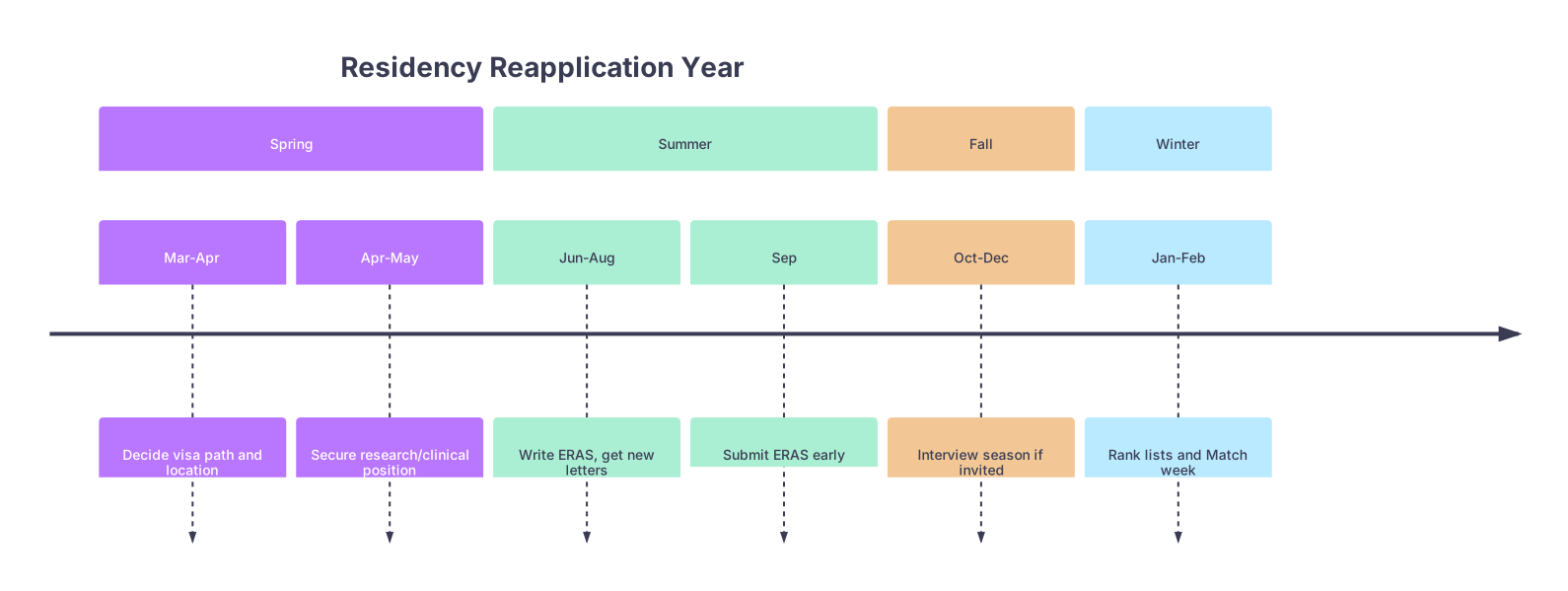
| Period | Event |
|---|---|
| Spring - Mar-Apr | Decide visa path and location |
| Spring - Apr-May | Secure research/clinical position |
| Summer - Jun-Aug | Write ERAS, get new letters |
| Summer - Sep | Submit ERAS early |
| Fall - Oct-Dec | Interview season if invited |
| Winter - Jan-Feb | Rank lists and Match week |
You want your legal status story to sound like:
- “I finished med school in May, started a 1-year research fellowship in July, applied in September, matched in March, changed to J-1/H-1B in June.”
Not:
- “I was on questionable status extensions through three different schools while also applying, then briefly overstayed while waiting for something, then left, then came back.”
Programs care about stability and reliability. They also talk to their GME offices, who care a lot about how hard it’ll be to get you a visa.
A clean, coherent timeline helps both.
Step 9: What to say (and not say) to programs about your visa and being unmatched
You’ll have to explain this year. You’ll be asked:
- “What did you do after not matching?”
- “Tell me about your visa situation.”
- “Are you able to work on J-1? H-1B?”
You want an honest but controlled narrative:
- “I didn’t match last year. I realized my application was weak in X and Y, so I took a research fellowship at Z, focused on ABC, and now have 2 papers under review. I’m currently on F-1 OPT valid until [date], and I’m fully eligible for J-1 or H-1B sponsorship.”
Avoid:
- A rant about immigration unfairness.
- Blaming prior programs or accusing the system.
- Revealing that you’ve been living on a sketchy B-2 extension with no real activity.
You don’t have to overshare. But you cannot lie. If they ask directly “Did you overstay your visa?” and the honest answer is yes, you own it and show how you resolved it (and expect it to hurt, frankly).
Step 10: When you absolutely need a lawyer—and when you don’t
There are two groups that consistently screw international doctors:
- People who think lawyers are optional and try to DIY clearly complex cases.
- People who blindly follow the first “visa consultant” from WhatsApp groups.
You do not need a lawyer for:
- Basic understanding of grace periods if your situation is straightforward.
- Standard OPT applications with a simple job offer that clearly fits your degree.
- Asking your school’s DSO whether a program extension is possible.
You absolutely need a real immigration lawyer (ideally one who works with physicians) for:
- Any possible overstay, unlawful presence, or border denial in your history.
- J-1 waiver questions (212(e) home requirement).
- H-1B change-of-status issues after an unmatched or withdrawn residency contract.
- Complex plans that involve switching between F-1 → J-1 → H-1B in non-standard ways.
If money is tight, do a one-hour paid consult and get very specific:
“Here is my I-94, visa sticker, I-20/DS-2019, and last EAD. Here’s what happened. Here’s what I want next year. What are my legal options and risks?”
Take notes. Ask follow-ups. Then act.
A quick reality check on “just staying at all costs”
I’ve seen this play out badly more times than I’d like:
- Grad stays on a shaky B-2 extension.
- Does informal observerships or “volunteers” in clinics in ways that technically violate status.
- Later applies for J-1 or H-1B, gets grilled at consulate: “Why did you stay so long? What were you really doing?”
- Denial. Or 221(g) administrative processing hell.
Sometimes the most strategic move is to leave early, fix your profile, and come back through a front door—clean, documented, straightforward.
Staying in the US illegally or on thin ice does not make you more likely to match. It just makes everything harder.
Final, practical moves for the next 7–14 days
If you’re unmatched and on a visa right now, your immediate homework:
Pull all your documents and confirm:
- Visa class
- I-94 “admit until” date
- I-20/DS-2019 end date
- Any EAD card validity dates
Email or meet:
- Your school’s DSO (for F-1) or your J-1 program officer.
- Your PI or department chair if you’re in a research position.
- One immigration attorney for a targeted consult if things look even slightly messy.
Decide:
- Am I staying in the US this year, or leaving and regrouping from home?
- What concrete role will I hold for the next 12 months that makes me a better applicant?
Start:
- Drafting a one-paragraph explanation of your unmatched year and your visa plan in plain English.
- Lining up a research/clinical/job offer that matches that explanation.
Key takeaways
First: Do not let panic push you into violating status. A clean exit and planned return is almost always better than a messy overstay and desperate extensions.
Second: Your visa plan and your reapplication strategy have to be designed together. A year of “just existing on some visa” without meaningful activity will not magically fix your Match chances.
Third: Talk early to the right people—DSO, PI, and a real immigration lawyer if your case is even slightly complicated. You have more options in the first 30–60 days after not matching than you do once deadlines and grace periods quietly expire.


