

Most of what you’ve heard about explaining an unmatched year is wrong – and some of it will actively hurt you if you follow it.
I’ve watched applicants sabotage otherwise solid re-application cycles because they clung to bad folklore: “never admit weakness,” “blame the system,” “tell a dramatic sob story,” or the classic, “if they ask about it, you’re already rejected.” Nonsense.
Let’s dismantle the biggest myths one by one – and replace them with what actually works in front of real PDs and selection committees.
Myth #1: “If you didn’t match once, programs assume you’re damaged goods.”
This is the fear that sits in your stomach at 3 a.m.: “They’ll see ‘previously unmatched’ and automatically trash my application.”
No. It makes your file higher risk, not radioactive.
Look at what programs actually do. When PDs talk candidly (hint: at specialty conferences or small-group zoom info sessions, not on glossy websites), here’s the rough hierarchy they describe when they see an unmatched prior applicant:
- Why did they miss the first time?
- What have they done since?
- Is the risk now acceptable for our program?
That’s it. They’re not mourning your moral character. They’re mostly running a probability calculation: “If we rank this person, how likely are they to fail exams, struggle clinically, or leave?”
You’re not automatically out. But you are under a harsher microscope.
Here’s where people get it twisted: they assume being unmatched is the main problem. Often it’s a symptom.
Common underlying issues I’ve seen in unmatched candidates:
- They applied to 35 EM programs with a 220/Pass Step 1 and weak SLOEs.
- They applied to 20 derm programs with no derm research and no backup.
- They had obvious professionalism red flags in MSPE or LORs.
- They had low Step 2 or multiple fails and applied late.
- They had strong scores but rank-listed only 4 programs. Yes, really.
Programs know all these patterns. Being unmatched tells them there was at least one of these problems. Your interview answer has to show three things:
- You understand what actually went wrong.
- You’ve done something concrete to fix or compensate for it.
- The “new you” is lower risk than the “old you.”
If your explanation does that, the prior non-match becomes a challenge, not a death sentence.
Myth #2: “Just be totally honest and vulnerable. Radical transparency will win them over.”
The pendulum swing from “never show weakness” to “trauma dump everything” has gone way too far.
You’ve probably been told: “Just be honest; tell them everything; vulnerability is strength.” Not in an interview. Not like that.
You’re not on a podcast. You’re in a job interview with people who are legally and professionally responsible for the residents they choose. They’re not your therapist and they don’t want to be.
Unfiltered “honesty” I’ve actually heard:
- “I was really burned out and I just kind of shut down during interview season.”
- “My mental health was really bad and I couldn’t get out of bed most days.”
- “I didn’t get a lot of guidance from my school and kind of drifted.”
- “I had a lot of family drama and just couldn’t focus on applications.”
Do these things happen? Absolutely. Are they understandable? Of course. Will they calm a PD worried about whether you’ll show up to work, take call, pass boards, and not collapse under stress? No.
Radical transparency about every raw detail is a luxury you don’t have.
The right standard isn’t “tell them everything,” it’s “tell them enough to be credible and accountable, but filtered through the lens of: can I trust this person to function as a resident?”
So no, you don’t lie. But you also don’t perform your lowest moments in high definition.
Better structure:
- Name the core issue in professional terms (without dramatics).
- Take ownership for your part.
- Give only as much personal detail as needed to make the story coherent.
- Pivot quickly to evidence of growth and current stability.
For example:
“Looking back, I underestimated how competitive my specialty was given my Step scores and late application, and I didn’t apply broadly or early enough. I also wasn’t proactive in seeking feedback after my first few rejections. Since then, I’ve worked closely with my advisors, completed a dedicated sub-I where I earned strong evaluations, and improved my Step 2 score. I’m much more deliberate now about planning and asking for feedback early.”
That’s honest. It doesn’t overshare. And it stays focused on the professional arc, not the emotional spectacle.
Myth #3: “Blame the system. There are too few spots; it’s just bad luck.”
I hear this one constantly, usually in some version of:
“The Match is broken. There just aren’t enough positions. Lots of great people don’t match. It’s all random.”
Yes, the system is flawed. No, that is not a good interview answer.
Let’s separate macro truth from micro usefulness.
Macro truth:
There are specialties (EM, ortho, derm, plastics, some IM subs) where supply–demand imbalance and geographic clustering absolutely hurt borderline applicants. There are DO bias pockets. There’s IMG bias. There are programs that pre-screen by Step score alone. The game is not fair.
Micro reality:
In front of a PD, “the system is unfair” sounds like “I externalize blame and I’m not that interested in figuring out what I could have done differently.” That is instant risk in their eyes.
The most effective unmatched-year explanations I’ve seen acknowledge reality without hiding behind it. Something like:
“The field is competitive and I knew I was in a borderline range with my Step 2 and lack of home program. That said, looking back, I under-applied to community programs and overestimated my chances at a lot of academic places. That mismatch between my application and my list contributed to the outcome. This cycle, I’ve targeted a better mix and strengthened my clinical letters in community settings where I think I’d be a great fit.”
Notice the nuance: yes, competitiveness matters. But you still claim agency. It tells them: “When something goes wrong, I analyze and adjust.” That’s what they care about.
The “pure bad luck” narrative is almost never convincing unless:
- You had very strong board scores and clinicals
- You applied broadly and appropriately
- You had solid letters
- You ranked a healthy number of programs
- And you’re in an extremely bottlenecked specialty
Even in that small group, most PDs will still wonder what they’re not seeing. Your job is to show them – through letters, improved metrics, and your explanation – that there isn’t a hidden red flag.
Myth #4: “You should build a dramatic comeback story. Program directors love redemption arcs.”
No, they love predictability and low drama.
The “redemption arc” narrative people try to craft is usually overcooked. I’ve seen applicants spin their unmatched year as if it was an epic hero’s journey:
“I was devastated… but then I realized this was an opportunity to reinvent myself. I learned resilience, empathy, and leadership. I started three research projects, led a QI committee, and now I’m stronger than anyone who matched on their first try.”
It sounds like a LinkedIn post written on too much caffeine.
You’re not trying to win an inspirational speaking contest. You’re trying to convince them that if they give you a resident badge, you’ll quietly handle your business for 3–7 years.
What actually lands well is boringly concrete:
- You did a structured research year and produced X poster, Y manuscript.
- You completed an observership or prelim year with objective strong evaluations.
- You passed Step 3 if relevant.
- You demonstrated reliability, punctuality, and teamwork in a clinical setting that writes detailed letters.
- You fixed specific gaps (e.g., more ward-based IM letters, an EM rotation with SLOEs, etc.).
| Evidence Type | Weak Version | Strong Version |
|---|---|---|
| Research | “Helped on some projects” | 1 poster, 1 submitted manuscript |
| Clinical work | “Shadowed a lot” | Formal sub-I with detailed evals |
| Exams | “Studied harder” | Step 2 from 225 → 243, Step 3 passed |
| Professionalism | “I grew a lot as a person” | LOR explicitly praises reliability |
Programs trust evidence, not adjectives.
If your “comeback” story can’t be backed by something they can read in your ERAS or letters, it’s fluff.
Myth #5: “You must have a perfect, polished script. Any stumble means you’re done.”
This is how people sound when they over-rehearse:
Interviewer: “Can you walk me through what happened last cycle and what you’ve done since?”
Applicant (robotic): “Thank you so much for that question. I have reflected extensively on that experience. The main contributors were a misalignment between my competitiveness and my program list as well as limited early mentorship. Since then, I have taken concrete steps to address these gaps including research, clinical experience, and personal growth.”
It’s not bad content. It just sounds fake. Interviewers smell that a mile away.
On the flip side, raw and unstructured is also a problem:
“I mean, I was really shocked that I didn’t match. My school told me I was a strong candidate. I guess something went wrong with interviews? I’m still not totally sure. The SOAP was brutal. But I’m hoping this year things go better.”
That answer tells them: I don’t really understand what happened, and I don’t have a clear plan.
You want the middle path: clearly thought-out, but conversational. A 60–90 second answer you can say in different words every time and still hit the same backbone:
- Briefly: what happened.
- What you learned / what you identified as the root causes.
- Specifically what you did in the interim.
- Why you’re stronger now / how that benefits the program.
Think of it as a story outline, not a monologue.
If you find yourself reciting, you’ve overdone it. If you’re rambling and surprising yourself with what you’re saying, you’ve underdone it.
Myth #6: “If they ask a lot about your unmatched year, they’re just being nosy or judgmental.”
No. They’re doing risk management. And protecting their current residents.
Pressure on programs has increased. Duty hour violations, ACGME citations, resident wellness, board pass rates – everything is tracked, reported, and sometimes publicly visible.
So when they dig into your unmatched year, their mental questions are:
- Is there a hidden professionalism problem?
- Is this someone who cracks under pressure?
- Is this going to be a remediation project?
- Will they fail in-training exams and drag down our averages?
- Are they going to leave the program or switch specialties?
That’s what’s in play. Not moral judgment about your worth as a human.
Your answers need to be designed for that audience. Not for your classmates, not for your parents, not for premed Reddit.
Example bad frame:
“I was really depressed and overwhelmed. I just wasn’t myself for months.”
Example better frame (assuming you’re currently stable and cleared, and you truly are ready):
“During that period I went through a difficult time personally and my performance suffered. I got appropriate help, put structure around my days, and since then I’ve consistently shown I can manage stress while performing well. My recent clinical rotations and Step 3 score reflect that. I’ve also been proactive about maintaining the support systems that keep me functioning at a high level.”
You’re not denying reality, but you’re speaking to the question they actually care about: “What’s the risk now?”
Myth #7: “There’s one perfect explanation. Say the right magic words and you’re safe.”
This is the MCAT mindset bleeding into residency: there must be a “right answer” somewhere online.
There isn’t. There are only better and worse patterns for how you explain it.
The pattern that usually works:
Specific, non-dramatic root cause
- “Applied too narrowly and too competitively for my Step profile.”
- “Lack of strong home specialty letters and only one away rotation.”
- “Step 2 taken late with a marginal score.”
Ownership without self-destruction
- “I misjudged how competitive the field was and I didn’t seek feedback early enough.”
- Not: “I completely failed and I’m terrible at planning.”
Concrete corrective actions
- New rotations with strong evals
- Additional exam success
- Research or clinical productivity tied to specialty
- Mentorship and better application strategy
Forward-facing conclusion
- “Because of that, I now do X differently…”
- “That experience taught me to Y, which I’ve applied by…”

| Step | Description |
|---|---|
| Step 1 | Unmatched Outcome |
| Step 2 | Identify Root Causes |
| Step 3 | Take Concrete Actions |
| Step 4 | Gather Objective Evidence |
| Step 5 | Craft Concise Explanation |
| Step 6 | Deliver Calmly in Interview |
Notice what’s missing: magic phrases. You don’t need them.
You need clarity, accountability, and evidence.
Myth #8: “Programs are doing you a favor by interviewing you, so stay apologetic and grateful.”
This is the quiet, destructive myth. The one that makes you shrink in your chair and over-explain.
Being unmatched can warp your posture. You start every interaction like you need to justify your existence. That anxiety leaks out as:
- Over-apologizing
- Over-explaining every minor weakness
- Talking too long about the unmatched year and too little about who you are as a clinician
- Sounding chronically defensive or fragile
Remember: if you’re in the interview room, they saw enough on paper to consider you. They’re not benevolently giving you closure. They’re scouting.
Your job is not to grovel your way back into medicine. Your job is to make a rational case:
“I had a setback. I analyzed it. I improved. Here’s how I can contribute to your program now.”
If you believe you’re a high-risk, borderline case who might collapse at any time, you’ll communicate that subconsciously. If, instead, you’ve truly done the work and know you’re stronger and more prepared now, you’ll come across as a candidate who had a bump but now is steady.
That shift in mindset – from apologizing for your existence to owning your growth – is subtle but huge.
Two things most people ignore: timing and receipts
One last reality check. Good explanations can’t completely override bad data.
If your unmatched year explanation is beautiful but:
- You still haven’t fixed the original problem (e.g., no Step 2, no recent clinicals, still no relevant letters), or
- Your application this cycle is basically copy–paste from last cycle,
then the answer doesn’t matter. They see the lack of receipts.
On the flip side, if your file this year is obviously stronger – more clinical, better letters, improved scores – your explanation only needs to not screw things up. You don’t have to be some master storyteller.
Programs are heavily influenced by the trajectory they see on paper:
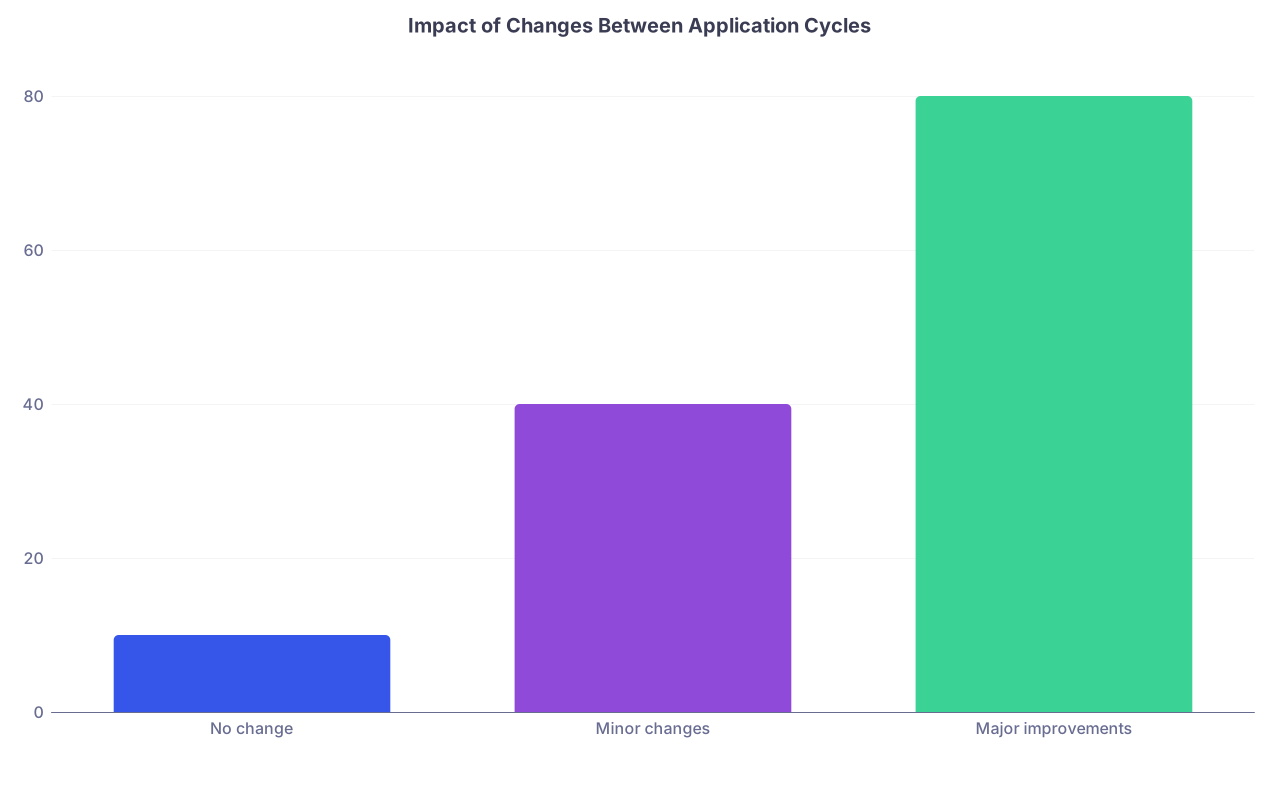
| Category | Value |
|---|---|
| No change | 10 |
| Minor changes | 40 |
| Major improvements | 80 |
Roughly speaking: the more objectively you’ve strengthened your file, the more forgiving they are of the narrative.
The bottom line
Three key truths to walk away with:
- Being unmatched is a risk factor, not a life sentence. Programs care less about the label and more about whether you’ve identified and fixed the root causes.
- Over-sharing, blaming the system, or performing a dramatic redemption arc all backfire. Calm accountability plus concrete evidence of growth is what actually reassures PDs.
- Your explanation doesn’t need to be perfect; it needs to be clear, concise, and aligned with a file that is objectively stronger than last time. The story alone can’t save you – but a good one can let your improvements actually count.


