

Doing a “research year” after not matching is massively oversold.
In a lot of hallways and Reddit threads, it’s treated like a magic reset button. You don’t match → do a research year → problem solved. Back in the real world? The data is messier, the benefits are specialty‑dependent, and for some applicants it’s an expensive, demoralizing detour that doesn’t fix the root problem.
Let’s strip the hype and walk through what actually changes your odds—and when a research year is smart, useless, or a straight-up bad move.
The Myth: “Everyone Who Doesn’t Match Should Do a Research Year”
I’ve heard this line from attendings who haven’t opened an NRMP Charting Outcomes PDF in a decade:
“You didn’t match? Just grab a research year. Programs love that.”
No. Programs love results. They don’t hand out interview invites because you sat in a lab for 12 months. They care if what you did addresses their concerns about you as an applicant.
For an unmatched applicant, those concerns typically fall into a few buckets:
- Board scores / exam performance
- Specialty switch or unclear narrative
- Weak or generic letters
- Limited clinical performance or red flags
- Late or disorganized application
- Applying too top-heavy / too few programs
- Poor interview skills or professionalism issues
Now ask yourself this: which of those does “did a research year” fix by itself? Essentially none.
A research year only helps if:
- Your target specialty actually values research heavily, and
- You turn that year into concrete, visible productivity with strong mentorship, and
- You simultaneously fix the non-research problems that tanked your first attempt.
Miss any of those three and you’re basically buying an expensive gap year with a white coat costume.
What the Data Actually Shows (Not the Stories You Hear)
You’ll hear emotional stories (“My friend did research at Big Name University and matched derm!”) but anecdotes are cherry-picked. Let’s anchor in what we do know from NRMP and specialty data.
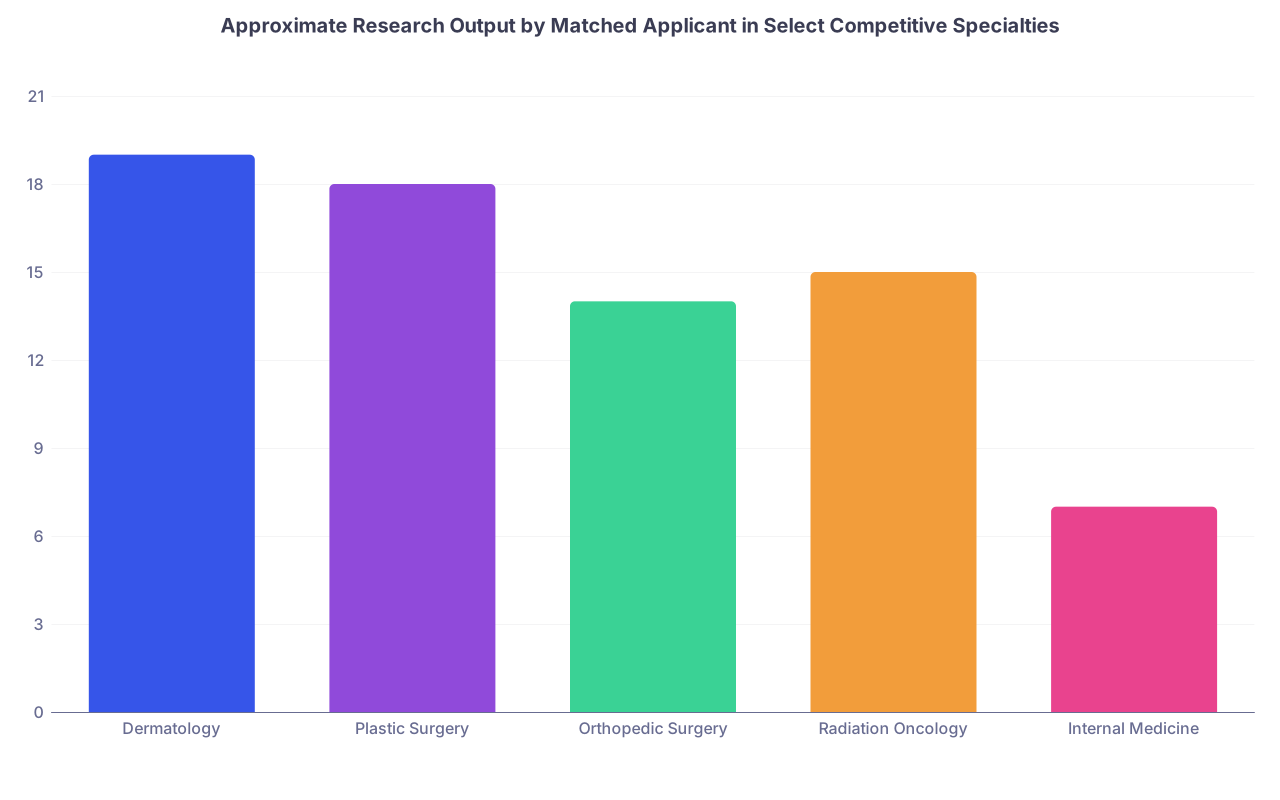
| Category | Value |
|---|---|
| Dermatology | 19 |
| Plastic Surgery | 18 |
| Orthopedic Surgery | 14 |
| Radiation Oncology | 15 |
| Internal Medicine | 7 |
Those numbers are “abstracts/presentations/publications” reported by matched applicants in recent NRMP Charting Outcomes editions (the exact figure shifts year to year, but the pattern holds): high research output is typical in ultra-competitive fields.
But here’s the part people conveniently skip:
- Plenty of applicants with very high research numbers still do not match in those specialties.
- In less competitive fields (FM, psych, peds, IM), research output has a weak correlation at best with match success compared with Step scores, class rank, and strong letters.
Research is often a marker of being at a strong academic institution, having good mentorship, and being organized—not the independent cause of matching.
Now the uncomfortable reality: NRMP and specialty groups don’t publish, “After doing a research year, X% of previously unmatched applicants later matched.” That dataset basically doesn’t exist in a clean, public form. What we have instead:
- Program director surveys: research is consistently below USMLE scores, clinical grades, and letters in importance for most specialties.
- Specialty-specific data (derm, plastics, neurosurgery, ENT) showing high research output among matched applicants—but not a controlled “research year vs no research year” experiment.
So anyone telling you “Research year increases your match odds by X%” is just making things up.
When a Research Year Actually Makes Sense
Let me be clear: I’m not anti–research year. I’m anti–automatic research year.
There are scenarios where it’s a smart, data-aligned move. They’re just narrower than most people think.
1. You’re Targeting a Research-Heavy, Hyper-Competitive Specialty
Dermatology, plastics, neurosurgery, ENT, radiation oncology, sometimes ortho and neurology in academic programs. In these, many matched applicants have double-digit research items and at least some specialty-specific output.
If you were unmatched in derm with:
- Step 2 in range
- No professionalism or major academic red flags
- But only 1–2 derm-related projects and generic letters
then a well-structured derm research year in a department that knows how to “recycle” previous unmatched applicants can materially change your profile. The key there is not the buzzword “research year.” It’s the ecosystem:
- Name-brand PI in the specialty
- Strong track record of former research fellows matching
- Guaranteed chances for manuscripts, abstracts, and meaningful letters
- Ability to attend conferences, meet faculty, and become “known” to programs
If a department can tell you, “In the last five years we’ve had 10 research fellows who were prior unmatched applicants; 8 matched derm, 1 matched IM, 1 switched specialties,” that’s useful information. Most places won’t have anything that specific—but if they dodge the question entirely, that’s your answer.
2. Your Application Is Competitive on Paper but Lacks Specialty Signal
This is not the person with a Step 2 of 214 hoping neurosurgery will suddenly fall in love because they pipetted something. This is the person with:
- Decent scores
- Solid grades
- Some generic internal medicine or basic science projects
- …but essentially no specialty-appropriate narrative or home program support in that field.
A research year in that situation can:
- Generate strong, specialty-specific letters saying “this person is serious and capable in our field”
- Put you in front of faculty who know people on selection committees
- Let you build a clear, coherent narrative of “I am all-in on X specialty”
But again, this works best in specialties where research is as much culture as it is content.
3. You Need Time to Repair Something Else—and Research Is the Cover
Sometimes the true value of the research year is indirect:
- You needed more time to pass Step 2 or CS/clinical skills equivalents
- You had a professionalism incident and need a clean year of excellent performance
- You’re switching specialties and need to rebuild your identity and letters
In those cases, research gives you structure, income (maybe), and a professional setting while you fix the primary problem. The research output is a bonus, not the main driver.
When a Research Year Is Mostly a Waste of Time
Let’s go through the situations where a research year is glorified procrastination.
1. You Want a Less Competitive Specialty or You’re Open to That
Family medicine, internal medicine (non-HEM/onc, non-IR track), psych, peds, prelim/transitional years—these are not research-driven fields outside of competitive academic niches.
For these, your main levers are:
- Step 2 score improvement (if low or failed)
- Expanding your program list and not being prestige-delusional
- Fixing red flags, rewriting your personal statement, and getting better letters
- Applying earlier and more broadly, including community-heavy programs
I’ve seen people do a research year for psych after not matching with a 210-ish Step 2, then apply again with the same exam profile and letter quality. Outcome: still unmatched or scraping a preliminary year. Research did almost nothing for them because it didn’t address the core issue: scores and program list strategy.
2. Your Scores Are Far Below Typical for Your Target Specialty
If your Step 2 is 205 and you’re set on ortho, a research year will not make you “competitive.” It might make some ortho programs tolerate your score if you’re a well-known and trusted insider in their department. But for the national pool? You’re still not getting on most filters.
Programs triage hundreds or thousands of applications. Before anyone cares about your seven abstracts, the screening spreadsheet chops off everyone below a certain Step cutoff. That’s the ugly truth.
If your primary weakness is exam performance, the most valuable “gap year” is a rebuild-your-exam-skills year, not a research hobby layered on top of weak numbers.
3. You Think “Prestige Research” Will Offset a Sloppy Application
Some applicants chase a big‑name institution for a research year, then apply the same lazy way they did last cycle:
- Late personal statement
- Letters requested last minute
- Narrow, top-heavy program list
- One or two programs per city “they really like”
Then they’re shocked when their “Harvard research fellowship” doesn’t save them.
Programs don’t hand out interviews in exchange for brand names. They look at your entire pattern: timing, commitment, communication, narrative. If those haven’t changed, your odds won’t either.
The Hidden Costs Nobody Talks About
People romanticize research years like a free pass to hang around an academic center and pad a CV. The real-world cost structure is uglier.

Financial Cost
- Many research fellowships are badly paid, unfunded, or technically “volunteer”.
- You may be living in a high-cost city with minimal support.
- Loan interest keeps accruing.
- You’re delaying resident salary (which, while not huge, is far better than unpaid “fellow” work).
That’s not trivial. You’re potentially trading tens of thousands of dollars of resident income for a line on your CV that may or may not change anything.
Psychological Cost
A lot of unmatched grads go into research years with this quiet, constant guilt: “I’m behind.” Everyone from their class is posting Match Day photos while they’re tracking cell counts or merging datasets. If the research experience is poorly structured or low-yield, that guilt turns into resentment and burnout.
I’ve watched people finish a chaotic research year with:
- No first-author papers
- One poster they barely remember
- A generic letter from a PI who couldn’t pick them out of a lineup
They weren’t just no better off. They were more demoralized, more in debt, and now applying with a weird extra gap that they had to explain.
How to Decide: Research Year vs Everything Else
Here’s the actual decision tree you should run—mentally, at least.

| Step | Description |
|---|---|
| Step 1 | Unmatched |
| Step 2 | Scores / Exams |
| Step 3 | Specialty too competitive |
| Step 4 | Weak letters / narrative |
| Step 5 | Professionalism / red flag |
| Step 6 | Retake / improve exams |
| Step 7 | Yes: Apply to less competitive field |
| Step 8 | No: Consider targeted research year in that specialty |
| Step 9 | Yes: High-quality research year helps |
| Step 10 | No: Focus on clinical, letters, broader list |
| Step 11 | Address issue + consider structured gap, possibly research |
| Step 12 | Primary issue? |
| Step 13 | Willing to change specialty? |
| Step 14 | Research-heavy specialty? |
Notice something? “Research year” is a good option only in a couple of specific branches. In others, it’s either irrelevant or secondary.
Before signing a contract for any research position, you should be able to answer three questions without hand-waving:
- What exactly caused me not to match the first time?
- How will this specific research position concretely address that?
- What is this department’s track record with people like me (unmatched grads doing research then reapplying)?
If you cannot get clear answers, you’re gambling.
What a High-Yield Research Year Actually Looks Like
If you do decide a research year is right for you, you cannot treat it like a gap-year formality. The details matter.
| Feature | High-Yield Research Year | Low-Yield Research Year |
|---|---|---|
| PI Involvement | Weekly meetings, clear plan | Rarely meets, vague tasks |
| Output | Multiple abstracts/papers planned | Maybe a poster if lucky |
| Specialty Fit | Directly in your target field | Unrelated basic science |
| Track Record | Prior fellows matched in field | No clear applicant outcomes |
| Role | Co-author, presentations, ownership | Data entry, chart reviews only |

You want a setup where you’re:
- Attached to a PI who knows your residency goals and advocates for you
- Embedded in the specialty (department meetings, conferences, journal clubs)
- Given ownership of at least one or two projects likely to yield something citable within 6–12 months
- Seen by multiple faculty members who can write specific letters: “I watched them handle X, Y, Z and they were excellent”
If a potential position sounds like, “We’re always looking for volunteers to help with data collection,” with no clear mentorship, run.
Alternatives That Often Beat a Generic Research Year
Here’s the part almost nobody selling you “just do a research year” will tell you: there are other, often better options.
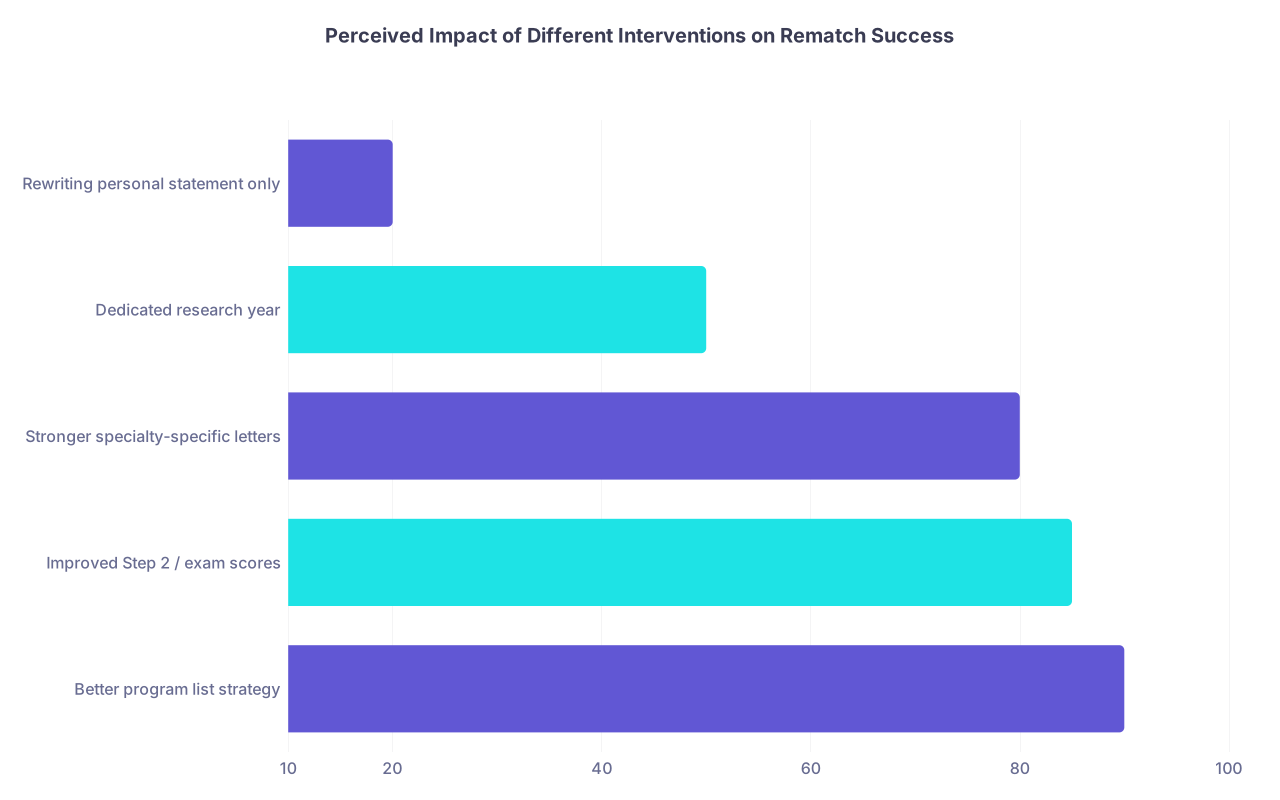
| Category | Value |
|---|---|
| Better program list strategy | 90 |
| Improved Step 2 / exam scores | 85 |
| Stronger specialty-specific letters | 80 |
| Dedicated research year | 50 |
| Rewriting personal statement only | 20 |
These percentages aren’t formal NRMP stats; they’re a rough reflection of what program directors consistently rate as most influential in their surveys, and what I’ve repeatedly seen matter in borderline cases. Strategy, scores, and letters beat “I existed in a lab” almost every time.
Alternatives you should consider seriously:
- Expanding your application list and reapplying immediately to less competitive specialties if your goal is simply “match somewhere.”
- Taking a structured, paid clinical/teaching role (like a chief year, clinical instructor, or prelim-to-cat pathway) that keeps you in patient care and visible to faculty.
- Focusing primarily on exam remediation if your scores are far off target.
- Doing a smaller, part-time research commitment while you prioritize the other fixes.
A full-time research year is the nuclear option, not the default.
The Bottom Line
A research year after not matching is not inherently good or bad. It’s a tool—and like any tool, it’s powerful in the right situation and useless in the wrong one.
If you remember nothing else, keep these three points:
- Research only moves the needle when it aligns with what your target specialty actually values and when it directly addresses why you didn’t match the first time.
- For many unmatched applicants, especially in less competitive fields or with major score issues, fixing exams, letters, and application strategy is far more impactful than a generic research year.
- A high-yield research year is specific, mentored, and productive with a proven track record—anything less is probably just an expensive delay with a fancy name.
Do not let “everyone says I should do a research year” substitute for an honest, brutal audit of your application. You are not a statistic; you’re a case study. Treat yourself like one.


