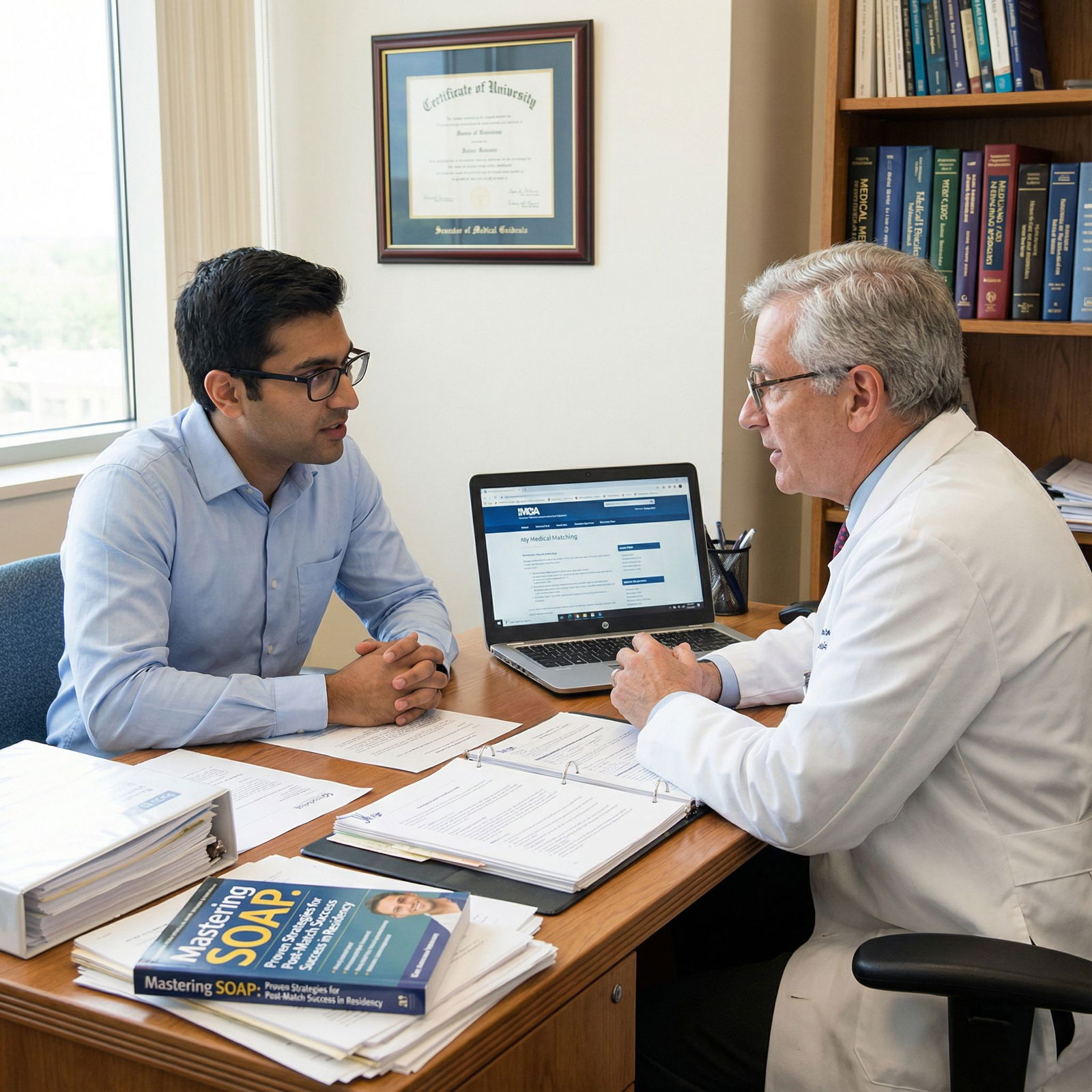
It is the Wednesday after Match Week. Your NRMP screen says “Did Not Match.” SOAP is over. Your phone is quiet. The group chat that was chaos two days ago has gone dead for you. Everyone is posting match photos in short white coats. You are staring at your email, refreshing out of habit, knowing nothing else is coming.
Now you are here:
No residency. No SOAP spot. An MD or DO in hand, but no job, no clear next step, and a growing pit in your stomach.
Let me be blunt: this is brutal. I have watched very smart, very capable graduates spin out at this exact moment—wasting 6–12 months in denial, random jobs, or unfocused “research years” that do nothing for their reapplication.
You do not have that luxury.
What you need is a clear, ruthless 12‑month plan that:
- Fixes what was weak in your application
- Builds concrete, documentable value
- Positions you for a stronger re-application, not just “trying again and hoping”
This is that plan.
Step 1: Diagnose Why You Did Not Match (Weeks 1–2)
Before you do anything else, you need an honest post‑mortem. Not vibes. Not what your classmates think. Data.
A. Get a hard, written assessment
Over the next 1–2 weeks, you are going to collect brutal feedback from three sources:
Your home school / dean’s office
- Ask for a frank evaluation meeting.
- Send your ERAS application, personal statement, and full list of programs applied to ahead of time.
- Questions to ask directly:
- “If you had to pick the top two reasons I did not match, what are they?”
- “Were my program choices realistic for my metrics and profile?”
- “Would you re-write or edit my MSPE if I reapply? What would you change?”
A specialty advisor (ideally not the one who sugar‑coated you into applying too high)
- Find a program director (PD) or APD you know, or a trusted faculty with real match experience.
- Send them your score(s), transcript, LOR list, and program list.
- Ask:
- “If you were reviewing my application at your program, would you interview me? Why or why not?”
- “Would you rank me? In what range?”
- “What would you want to see improved in 12 months to consider me competitive?”
Someone outside your specialty
- This could be a hospitalist, GME faculty, or PD from another field. They are less biased.
- Ask:
- “If you did not know me, and you saw this ERAS, what story do you think it tells?”
- “Where do I raise red flags for you—scores, professionalism, gaps, or something else?”
Document all of this. Literally type it up in a one‑page “Problems List.”
Typical patterns I see:
Scores / exams
- Low Step 1 (pre‑pass/fail) or low COMLEX 1
- Barely passing or failing Step 2 / COMLEX 2
- No Step 2 at time of application in a competitive year or specialty
Red flags
- Course or clerkship failures
- Repeat year
- Leave of absence with poor explanation
- professionalism notes
Application strategy
- Aiming only at highly competitive specialties (derm, ortho, ENT) with mid‑range stats
- Under‑applying: sending 25 applications for a competitive specialty
- No geographic realism (applied only to coasts, ignored community programs)
Experience and letters
- Weak or generic letters
- No strong home department support
- Very little U.S. clinical experience (for IMGs)
- No evidence of commitment to specialty (no elective, no research, no advocacy, etc.)
Until you know exactly which buckets you fall into, everything else is random.
Step 2: Choose Your Target – Specialty, Scope, and Backup (Weeks 2–3)
You cannot design a 12‑month rescue plan without a target.
A. Decide: same specialty vs. pivot
Be realistic, not sentimental.
You should strongly consider a pivot if:
You have:
- Sub‑220 USMLE Step 2 (or equivalent COMLEX 2) with
- No strong home support and
- You applied to derm, ortho, neurosurgery, plastics, ENT, ophtho, or similarly elite fields.
Or you are an IMG with:
- Scores under the typical match range for that specialty and
- No substantial, high‑impact research.
That does not mean it is impossible to match into a competitive specialty later. But using this next 12 months trying to brute-force your way into ortho with a 215 Step 2 is a bad bet.
Specialties that can realistically be targeted in a 12‑month recovery plan for many applicants:
- Internal medicine (especially community programs)
- Family medicine
- Pediatrics (non‑elite academic)
- Psychiatry
- Neurology (community)
- Transitional / preliminary medicine years (as stepping stones)
B. Decide on a primary and backup track
Pick:
- Primary specialty target – where you will build most of your new experiences.
- Backup strategy – what you will do if you get no interviews again.
Example:
- Primary: Internal Medicine (community-heavy list)
- Backup: Family Med / Psych in SOAP, plus willingness to re-apply IM plus those again the following year if necessary
Write this down. Commit. This will drive which research, observerships, and letters you chase.
Step 3: Build Your 12-Month Timeline (Overview)
Here is the structure you are aiming for.
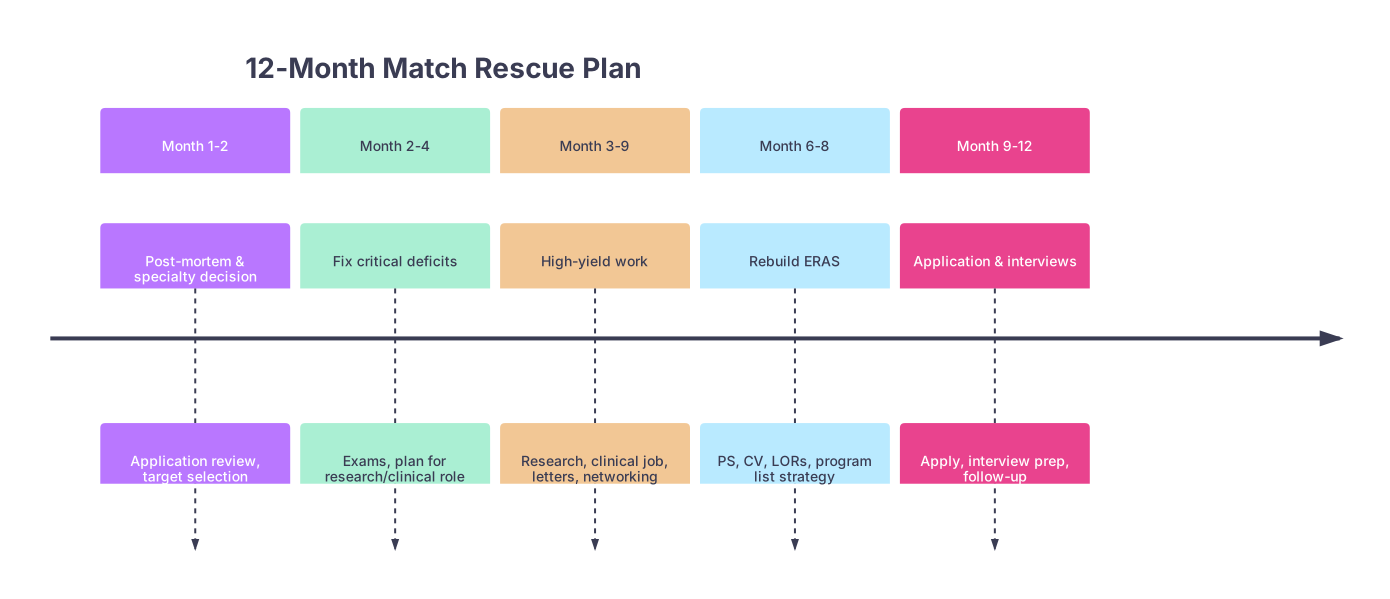
| Period | Event |
|---|---|
| Month 1-2 - Post-mortem & specialty decision | Application review, target selection |
| Month 2-4 - Fix critical deficits | Exams, plan for research/clinical role |
| Month 3-9 - High-yield work | Research, clinical job, letters, networking |
| Month 6-8 - Rebuild ERAS | PS, CV, LORs, program list strategy |
| Month 9-12 - Application & interviews | Apply, interview prep, follow-up |
Now let’s break this into concrete actions.
Step 4: Fix the Critical Deficits (Months 1–4)
You focus here on the things that cannot be fixed quickly later: exams, blatant red flags, and categorically missing requirements.
A. Exams (USMLE / COMLEX)
If exam performance was a primary reason you did not match, you need a clear test strategy.
If Step 2 / COMLEX 2 is low but passed
- You are not retaking unless you failed. But you:
- Aim to crush Step 3 / COMLEX 3 in the next 6–9 months, especially if you are going into IM/FM/Psych/Neuro.
- Use a structured prep: UWorld (1 full pass), AMBOSS if available, plus NBME/CCS review.
- Goal: Show upward trend and assure PDs you have conquered standardized exams.
- You are not retaking unless you failed. But you:
If you failed a step/COMLEX
- Retake as early as reasonably possible (within 3–6 months).
- Use a formal plan: tutor or structured course if you can afford it.
- You must pass comfortably and never fail again. That is harsh, but accurate.
IMGs without Step 2 at time of first application
- Take Step 2 early in this cycle (by late spring or early summer at the latest) so your score is in ERAS by opening.
- Target: Competitive but realistic score for your specialty. For IM/FM, 230+ USMLE or equivalent is helpful, but I have seen lower match with strong clinical and letters.
B. Red flags and professionalism
If there is a significant red flag:
Course/clerkship failure or remediation
- Prepare a clean, concise 2–3 sentence explanation. No excuses. Ownership + resolution.
- Example:
“During my third year I failed my medicine clerkship after struggling with time management and documentation. I met with my clerkship director, completed a remediation rotation with closer supervision, and have since completed all subsequent rotations successfully without concerns.”
LOA for personal/health reasons
- Same thing. Own it factually, then pivot quickly to stability and current function.
You are not going to erase the red flag. You are going to prevent it from owning the whole narrative.
Step 5: Choose the Right High-Yield Role for the Gap Year (Months 2–9)
This is where most people screw up. They grab the first thing that has “research” or “clinical” in the title and hope it will “look good.”
You need a role that gives you four things:
- Strong, recent U.S. clinical or academic recommendation letters
- Daily contact with attendings who can vouch for you
- CV lines that clearly signal commitment to your target specialty
- Concrete outcomes by ERAS opening (papers submitted, responsibilities, quality improvement projects, etc.)
Here are the highest-yield options, in order of impact.
| Option Type | Impact on Reapplication | Main Benefits |
|---|---|---|
| Research Fellowship | High | Letters, publications, networking |
| Clinical Research Coord | Medium-High | Patient contact, QI, letters |
| US Clinical Fellow/Extern | High for IMGs | USCE, specialty exposure, letters |
| Hospital-based Scribe | Medium | Clinical environment, physician access |
| Random Non-Clinical Job | Low | Income only, minimal application value |
A. Research positions (especially academic centers)
Best for: candidates going for IM, Neuro, Psych, Peds, or pivoting from a competitive field.
Look for:
- Full‑time, paid roles in:
- Internal medicine departments
- Psychiatry departments
- Neurology departments
- Any program that has its own residency
What you want in the posting:
- Close contact with a PI who is an attending in your target specialty
- Opportunities for manuscripts, abstracts, or posters
- Clinic exposure or conference attendance
How to use this role:
- Aim for:
- 1–2 abstracts or posters submitted before September
- 1–2 manuscripts submitted (accepted is great, but “submitted” or “under review” still helps)
- Attend every departmental conference and grand rounds. Be a known face.
- Ask for increasing responsibility: data analysis, presenting journal clubs, helping with IRB submissions.
B. Clinical research coordinator / hybrid clinical roles
Better than nothing. Especially helpful for psych, neuro, IM, cards, heme/onc, etc.
You aim to:
- Be in clinic with attendings at least weekly
- Have direct patient interaction or at least chart work
- Identify:
- A letter writer who sees how you work
- A small quality improvement (QI) or workflow improvement project you can lead
C. US Clinical Experience (USCE) / Fellowships / Observerships (esp. for IMGs)
For IMGs, this can be the make‑or‑break.
Look for:
- 3–6 month “clinical fellow” or observer roles in hospitals with residency programs
- Preferably in:
- IM
- FM
- Psych
- Neuro
Your goals:
- Be present. Show up early, stay late, act like a sub‑intern even if you cannot write orders.
- Volunteer for every presentation: topic talks, case reports, morbidity & mortality contributions.
- Explicitly ask attendings for letters once they have seen you for at least 4–6 weeks.
D. Scribe / MA / hospitalist assistant roles
Good when research positions are not available or you need income quickly.
How to make it actually useful:
- Work in settings with attendings in your target field (FM clinic, IM service, psych outpatient).
- Ask if you can:
- Help with non‑clinical QI projects
- Present at staff huddles or in‑service sessions
- Target at least one attending who is willing to know you well enough to write a detailed letter.
Step 6: Rebuild Your Application Components (Months 4–8)
By Month 4, you should be established in your role and working on exams if needed. Now you quietly rebuild ERAS.
A. Letters of Recommendation (LORs)
Aim for 3–4 strong, specialty‑relevant letters:
- 2+ letters from attendings in your target specialty who have seen you:
- In clinic or on service
- In a research or QI role, with concrete achievements
- 1 letter can be from research PI if they are not in the target specialty but carry weight.
How to get a good letter:
- After 6–8 weeks of solid performance, ask:
- “Based on what you have seen of my work, would you be comfortable writing me a strong and detailed letter for [specialty] residency?”
- If they hesitate, thank them and do not use them. You need enthusiastic letters.
B. Personal Statement: Rewrite From Scratch
Your old PS did not carry you. Start over.
Structure:
Clear, concrete “why this specialty”
- Use one or two specific patient or clinical experiences—not clichés about “loving continuity of care” unless you can prove it.
Ownership of your path
- Brief mention of the non‑match year framed as growth:
- “After not matching on my first attempt, I spent the past year working full‑time in [X role], where I [Y achievements]. This experience reinforced my commitment to [specialty] and strengthened my clinical reasoning, teamwork, and resilience.”
- Brief mention of the non‑match year framed as growth:
Evidence, not adjectives
- Instead of “I am hardworking,” write about:
- The time you managed a database of 500 patients and improved follow‑up compliance by 18%.
- The way you took over a stalled manuscript and pushed it to submission.
- Instead of “I am hardworking,” write about:
C. CV / ERAS activities: Clean and strategic
You want your year to show:
- Consistent full‑time effort (no large unexplained gaps)
- Increasing responsibility
- Specialty‑relevant achievements
Avoid padding with 20 meaningless “activities.” Have:
- 3–5 heavy‑hitting entries:
- Full‑time job with real duties
- 1–3 research or QI projects
- Teaching/tutoring roles (Step tutoring, med student teaching, etc.) if you did them
Step 7: Program List Strategy – Fix One of the Main Reasons People Don’t Match (Months 6–8)
I have reviewed dozens of unmatched applications where the main problem was not the candidate. It was the program list.
You need to be strategic and humble here.
A. Understand where you realistically fit
If you are targeting IM or FM after not matching:
- You should be applying to a large number of programs. 60–120+ is not crazy for some profiles.
- Tilt your list toward:
- Community programs
- Newer programs
- Programs in less competitive regions (Midwest, South, certain inland states)
- Programs that historically take IMGs, if you are an IMG
B. Use data, not vibes
Pull:
- NRMP Charting Outcomes for your specialty
- Program websites to see:
- Do they accept IMGs / DOs?
- Do they have minimum score cutoffs?
Build a spreadsheet with:
- Program name
- Location
- IMG/DO friendliness
- Score cutoffs if known
- Notes from residents / mentors
Rank them for yourself:
- Green: Realistic
- Yellow: Stretch
- Red: Extreme reach (you can include a handful if you want, but do not live there)
Step 8: Networking That Actually Matters (Months 3–10)
No, you are not going to “network” your way into a program with a 2-sentence cold email. But targeted, sustained connection works.
A. Where to focus your energy
Your own institution (if it has your target specialty)
- Attend departmental grand rounds, journal clubs, and social events.
- Volunteer to help with student teaching or small projects.
- Let the PD or APD see your face and your work ethic.
Your current gap-year job institution
- If they have a residency in your specialty, this is gold.
- Ask your PI or supervising attending:
- “Would it be appropriate for me to meet with the program director for brief advice on strengthening my application?”
Conferences
- Even small regional conferences count.
- Present a poster if you can.
- Aim to meet at least 2–3 faculty in your specialty and follow up later with a short, specific email.
B. How to contact people without sounding desperate
Template for a PD / faculty you have met at least once:
Subject: Follow-up and Request for Brief Advice – [Your Name]
Dear Dr. [X],
I am a [recent graduate / research fellow] working in [Department] at [Institution]. We met at [context]. I am planning to reapply to [specialty] this upcoming cycle after not matching on my first attempt.
I would be grateful for 10–15 minutes of your time, either by Zoom or phone, to briefly review my plan for the coming year and get your perspective on how to be a stronger applicant.
Thank you for considering this.
Sincerely,
[Name]
You are not asking them to “get you in.” You are showing maturity, humility, and initiative.
Step 9: The Application Cycle – Execution (Months 8–12)
By the time ERAS opens, your year should not just be “I did something.” It should read like a deliberate rebuild.
A. Before ERAS submission (June–August)
Checklist:
- All major exams done or scheduled with documented plan (Step 3 / COMLEX 3 if using it to show improvement)
- At least 2 strong specialty‑specific LORs uploaded
- One from your gap‑year supervisor if appropriate
- CV updated with:
- Full‑time role
- Research/QI projects
- Presentations / posters
- Personal statement polished by:
- One faculty in your specialty
- One person who knows you well personally
B. During application submission (September)
- Submit ERAS early. Do not wait until the last minute.
- Double check:
- Program list breadth (enough community programs)
- No obvious errors in dates, jobs, or exam scores
- All letters properly assigned
C. Interview season: Prepare like a professional, not a panicked reapplicant
You will get the inevitable question:
“So, you are applying again. What did you do in the past year?”
Your answer is where this entire 12‑month plan pays off.
Structure:
Brief acknowledgement:
- “I did not match last cycle, which was difficult but clarifying.”
Focus on growth:
- “Over the past year, I have been working full‑time as a [role] in [department], where I [concrete achievements].”
Tie to specialty:
- “This work has deepened my interest in [specialty] by [specific clinical or academic exposure]. I feel much better prepared clinically and more resilient as a result.”
No self‑pity. No blaming. Calm, factual, forward.
Step 10: Mental Health and Logistics (Month 1–12, Running in Parallel)
If you ignore this part, you risk torpedoing everything else. Not because you are weak. Because this is genuinely hard.
A. Create a basic life structure
Non‑negotiables:
- Consistent wake time and sleep block
- Dedicated weekly planning session (30–60 minutes) for:
- Exam study hours
- Work priorities
- Application tasks
B. Therapy or counseling
If you are walking around with constant shame, anxiety, or depression after not matching, pretending it is not there is a bad strategy. Many residents and attendings see therapists. You can too.
Goals:
- Process the loss and embarrassment
- Prevent paralysis and procrastination
- Develop a script you feel comfortable using when people ask: “So where did you match?”
C. Financial reality
You may need income. Fine. Just do not turn a 1‑year rescue plan into a 3‑year drift.
- If you must take a high‑paying but non‑relevant job to stay afloat, set a strict time boundary.
- Combine it with:
- Part‑time research
- Part‑time USCE
- Or intense exam prep
Example 12-Month Rescue Plan Walkthrough
To ground this, here is a concrete real‑world style plan for a typical scenario.
Profile:
- US MD, Step 1 pass/fail, Step 2: 223
- Applied to categorical Internal Medicine only, 45 programs, mostly academic/coastal
- 4 interviews, no match, did not SOAP in
- No major red flags, but mediocre letters and minimal research
Rescue Plan:
Month 1–2
- Meet with dean’s office and IM clerkship director for honest review
- Identify main issues: too few programs, too academic‑heavy list, no standout letters, nothing special in PS
- Decide to reapply IM, but broaden to many more community programs and some FM as backup
Month 2–3
- Apply aggressively to IM research coordinator or research fellow positions at:
- Community programs with residencies
- Mid‑tier academic IM departments
- Accept full‑time IM research position at a midwestern academic center
Month 3–9
- Work 40–50 hours/week on:
- Outcomes studies in heart failure
- QI project on reducing readmissions
- Aim for:
- 1–2 abstracts submitted to regional ACP by Month 7
- 1 manuscript submitted by Month 9
- Attend weekly IM conferences, take notes, meet residents and faculty
Month 5–7
- Ask two faculty members who have supervised closely for letters
- Rewrite PS highlighting:
- Year of IM research
- Increased clinical insight from following patients over time
- Clean up ERAS to better highlight continuity, teamwork, and concrete responsibilities
Month 7–8
- Build broad program list:
- 100+ IM programs, majority community / university‑affiliated community
- Several in midwestern and southern states
- Include at least 15 programs at current institution’s network level
Month 9–12
- Apply early
- Use PI and letter‑writers to send brief, targeted notes to a handful of PDs they know personally
- Prepare crisp answer about previous non‑match and growth year
This person will not magically become a Hopkins candidate. But they move from “borderline, risky applicant with a short, top-heavy list” to “solid, mature candidate with a productive year in IM, strong letters, and a broad, realistic application strategy.”
That is how you rescue a match.
A Quick Visual: Where Your Effort Should Go
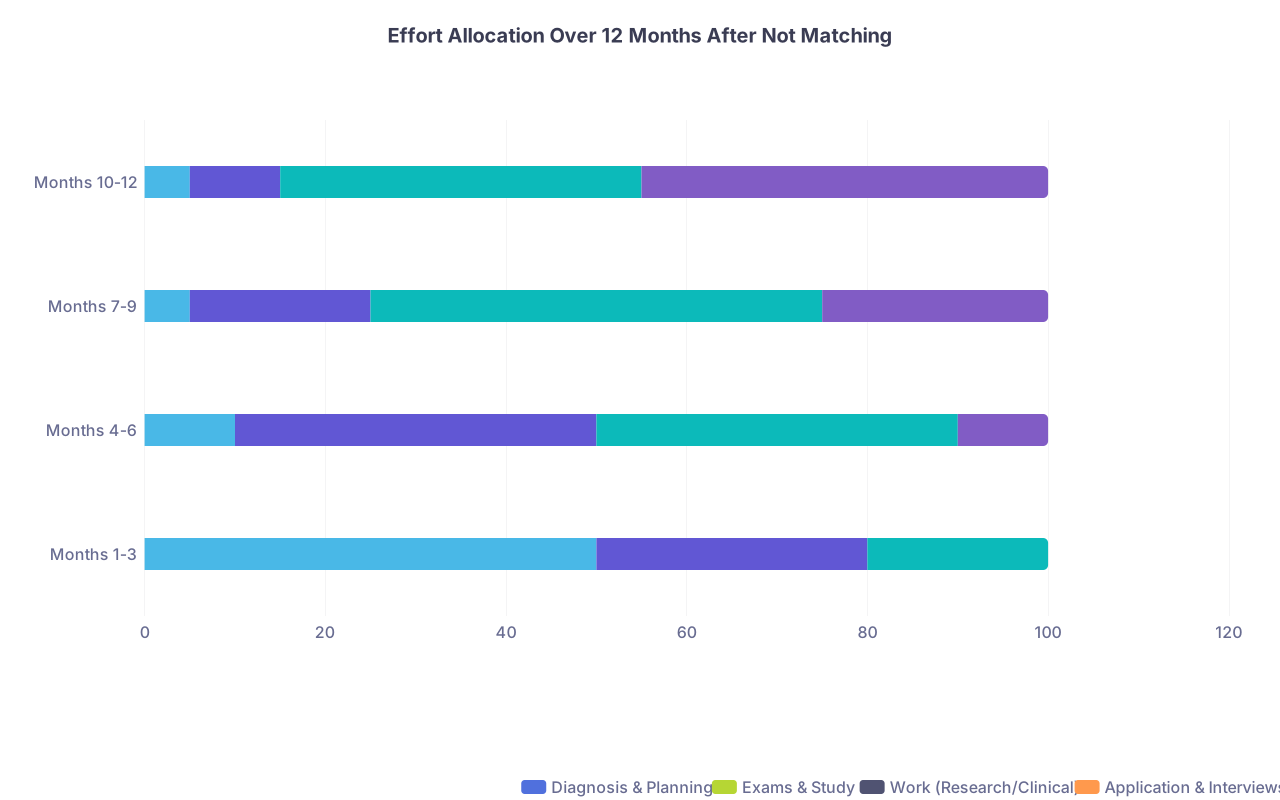
| Category | Diagnosis & Planning | Exams & Study | Work (Research/Clinical) | Application & Interviews |
|---|---|---|---|---|
| Months 1-3 | 50 | 30 | 20 | 0 |
| Months 4-6 | 10 | 40 | 40 | 10 |
| Months 7-9 | 5 | 20 | 50 | 25 |
| Months 10-12 | 5 | 10 | 40 | 45 |

Bottom Line: What Actually Moves the Needle
Let me strip this down to the essentials.
If you did not match and did not SOAP in, a 12‑month rescue plan that works will:
Start with a ruthless diagnosis.
No fantasies, no denial. You need a written list of your top 2–3 deficits and a clear target specialty.Put you in a full‑time, high‑yield role.
Research, clinical, or hybrid—but it must directly connect you to attendings in your target specialty and lead to real letters and achievements, not just “I was busy.”Rebuild your application strategically, not cosmetically.
Strong new letters, a rewritten personal statement, visible exam improvement if needed, and a broad, realistic program list that reflects where you actually match on paper.
You cannot undo this year. But you can make the next one count. If you execute this with discipline, your reapplication will not just say “I tried again.” It will say, “I took a hit, rebuilt, and I am stronger than before.” Program directors notice that.