
You did not match. Your letters of recommendation are now suspect until proven otherwise.
That is the brutal truth nobody says out loud. Program directors look at an unmatched applicant and think: “If those letters were so great, why did nobody take them?” Your job this year is to give them a different answer.
You do that by rebuilding your letter portfolio from the ground up. Not tweaking. Not recycling. Rebuilding.
Here is the exact playbook.
Step 1: Diagnose What Went Wrong With Your Previous Letters
Before you chase new letters, you need a clear working theory about the old ones. Otherwise you will repeat the same mistakes in nicer formatting.
1.1 Get concrete feedback, not vibes
You need data, not feelings. Take half a day and do this systematically:
Review your ERAS application
Print your last ERAS (yes, on paper) and mark:- Who wrote each letter (specialty, seniority).
- How recent they were (older than 6–9 months at time of submission?).
- Whether the letter writer actually knew your clinical work.
- Whether any were from basic science faculty, random researchers, or “famous but distant” attendings.
Ask targeted people for post‑Match feedback
- Former advisor, PD, clerkship director, or someone who actually reads applications.
- Send a short email:
“I went unmatched in the recent cycle. I am planning to reapply to [specialty / or list if dual applying]. I would be very grateful for 15–20 minutes of candid feedback on my application materials. I specifically want to understand whether my letters of recommendation may have been weak or mismatched.”
When you meet, ask:
- “Did my letters line up with my stated specialty choice?”
- “Did any of my letter writers lack sufficient seniority or familiarity with my work?”
- “Did you notice any red flags or faint‑praise language?”
Look for patterns Causes I see repeatedly:
- Letters from non-core physicians for that specialty (e.g., reapplying to IM with all letters from outpatient FM and a basic science PhD).
- Letters that are too generic or short (PDs can smell template letters).
- Letters that do not address performance level compared with peers.
- Letters clearly written by someone who barely worked with you.
- Letters that signal “good worker, average physician” through soft language.
If someone tells you, “Your letters were fine; it was just a competitive year,” assume they are being polite. In an unmatched year, “fine” letters are not fine. You need strong, detailed, specialty‑appropriate letters.
Step 2: Decide Your Strategic Target Before You Collect Any Letters
You do not build letters in a vacuum. They must match your new application strategy.
2.1 Lock in your specialty plan
For the reapplication cycle, choose one of these lanes and commit:
Lane A: Reapply to the same specialty only
Example: Categorical IM, aim: university‑affiliated or mid‑tier community.Lane B: Same specialty + true backup
Example: EM + IM, or Gen Surg prelim + categorical IM, with clear two‑track strategy.Lane C: Pivot to a less competitive specialty
Example: From EM to IM, or from Ortho to Prelim + IM / FM.
Your letters must reflect that choice. Generic “good doctor, hard worker” letters are not persuasive; specialty‑specific advocacy is.
2.2 Decide your main “anchor environment”
PDs pay attention to context:
- Are you currently doing U.S. clinical work?
- Are you in a transitional year, prelim year, research year, or gap with observerships?
- Are you practicing in another country?
Your letters should primarily come from where you are actually working in the 6–12 months before ERAS submission. A letter written three years ago from a different country will not rescue you.
Step 3: Build the Right Mix of Letter Writers
Here is the target composition you should be aiming for.
| Situation | Core Clinical LORs | PD/Chair LORs | Research/Other LORs |
|---|---|---|---|
| Same specialty reapply | 2–3 | 1 | 0–1 |
| Same specialty + backup specialty | 2 (primary) | 1 + 1 backup | 0–1 |
| Pivot to new specialty | 2–3 (new field) | 1 | 0–1 |
| Transitional/Prelim year | 2 (current site) | 1 PD | 0–1 |
3.1 Priority order (who actually moves the needle)
You want letters from:
Program directors and department chairs in your target specialty
- Gold standard: PD who supervised you on service.
- Next best: APD or site director with direct observation.
Core clinical faculty in your target specialty
Attendings who:- Saw you on inpatient or high‑acuity rotations.
- Can compare you directly to residents / peers.
- Supervised you for at least 3–4 weeks.
Current supervisors (if in a research year, prelim year, or job)
- Hospitalist director, service chief, or similar.
- Can speak to reliability, teamwork, progression.
Research mentors
Only useful if:- They are in your specialty, AND
- They can comment on your clinical reasoning and professionalism, not just pipetting skills.
De‑prioritize:
- Letters from basic science faculty.
- Letters from “famous” attendings who barely know you.
- Very old letters (>2 years by application time) unless from a PD / chair and still clearly strong.
Step 4: Create New Clinical Opportunities Specifically to Earn Letters
If you did not match, odds are high you need new clinical eyes on you. You cannot just recycle fourth‑year letters and hope for a different result.
4.1 If you are currently in a prelim or TY year
You have the best platform available.
Your action plan:
Identify 3–4 attendings in your target specialty who:
- See you on busy, representative services.
- Are known to be fair and supportive of trainees.
Perform like your career depends on it. Because it does.
- Show up early. Stay a bit late (within reason).
- Be the person who closes the loop on tasks.
- Proactively volunteer for admissions, procedures, sign‑outs.
- Document clearly. PDs ask about note quality and follow‑through.
Ask for letters near the end of the rotation, not months later.
Script:
“Dr. X, I am reapplying to [specialty] this cycle after going unmatched. Working with you on [rotation] has been a key experience in this year. Would you be comfortable writing a strong letter of recommendation for me that specifically addresses my performance compared to other interns / students you have supervised?”
That “strong” word gives them an out if they cannot do it.
Get a letter from your current PD (unless relationship is poor).
- PD letters that say “we would be happy to have this person stay” are very powerful.
- Make it easy for them: give them a 1‑page summary of your progress, evals, and concrete accomplishments.
4.2 If you are in a research year or gap year
You must engineer fresh clinical exposure:
Secure U.S. clinical experience (if possible):
- Paid positions: hospitalist scribe, clinical research coordinator with bedside presence, telemedicine assistant.
- Unpaid / limited: observerships, externships, post‑clerkship sub‑internships (some schools allow non‑degree students or alumni).
Aim for 4–8 weeks blocks in your target specialty at institutions that actually have residencies in that field.
At the start of the rotation, quietly set your intention:
- “I am reapplying to [specialty] this fall. I would really appreciate any feedback on my performance along the way so I can improve and hopefully earn a strong letter.”
Mid‑rotation check‑in:
- Ask: “What do I need to do in the rest of this rotation to be the kind of applicant you would feel comfortable strongly recommending?”
Then do exactly that.
- Ask: “What do I need to do in the rest of this rotation to be the kind of applicant you would feel comfortable strongly recommending?”
4.3 If you are an IMG without easy U.S. access
You still need new, credible, and recent letters.
Options:
- Rotations at teaching hospitals in your country with strong academic reputations and residency programs.
- Virtual observerships with structured evaluation (not ideal, but better than nothing if documented well).
- If you can afford it, targeted U.S. observerships or externships at community programs in your specialty.
The key: pick sites where someone there actually writes letters that U.S. PDs respect. Ask alumni and seniors which attendings’ letters carried weight.
Step 5: How to Ask for Letters So They Actually Help You
Most unmatched applicants ask for letters poorly. Vague, last minute, no guidance. Then they are surprised when the letter is vague and generic.
You are going to do better.
5.1 The timing window
Aim for:
- 2–4 weeks after finishing a rotation, while you are fresh in the writer’s mind.
- No later than July–August for an ERAS September submission.
If you are reusing a writer (who liked you) from last year:
- Ask them to update the letter with new context:
- That you are reapplying.
- What you have done in the interim year.
- Any new clinical experiences.
5.2 What you send to your letter writer
Your goal is not to script the letter. It is to provide ammunition:
Send in one concise packet (email with attachment or shared folder):
- Updated CV.
- Draft of your new personal statement (or at least your specialty and target programs).
- Your ERAS experiences section (even if in draft).
- A 1‑page “LOR Helper” document that includes:
- 3–5 specific cases or tasks where you performed well under their supervision.
Example:- Managed DKA admission overnight — recognized cerebral edema risk, called ICU early.
- Coordinated complex discharge for CHF patient with limited resources.
- Your specific strengths you hope they will mention: clinical reasoning, communication, work ethic, teachability.
- Your specialty target(s) and any geographic focus.
- 3–5 specific cases or tasks where you performed well under their supervision.
Script for your request email:
Dear Dr. [Name],
Thank you again for the opportunity to work with you on [rotation / service] in [month/year]. I am reapplying to [specialty] this upcoming ERAS cycle after not matching last year.
I learned a great deal from your feedback on my clinical reasoning and teamwork, and I would be very grateful if you would consider writing a strong letter of recommendation on my behalf. I am particularly hoping for letters that can speak to my growth over the last year, my performance relative to peers, and my fit for [specialty].
I have attached my updated CV, a brief summary of my experiences with you, and a draft personal statement for context. If you feel you cannot provide a strong letter, I completely understand and would appreciate your honesty.
Thank you for considering this,
[Name, credentials, contact]
That “if you cannot provide a strong letter” line is not optional. It protects you from lukewarm letters that quietly sink your application.
Step 6: What Makes a “Rebuilder” Letter Different
You are not a first‑time applicant. PDs know you have history. Your letters must do more than say “good student.”
They must address three very specific things:
Current ability and readiness
- Example: “In the past year, I have watched [Name] function at the level of a competent PGY‑1 on a busy inpatient service.”
- “I would not hesitate to have them manage admissions overnight under my supervision.”
Growth and resilience
- Something like: “After not matching last cycle, [Name] sought out meaningful clinical work and has made clear, observable progress in efficiency, documentation, and clinical judgment.”
Comparative strength
- “They are in the top 10–20% of residents / students I have supervised at this stage.”
- PDs read hundreds of letters. Relative ranking language matters.
You cannot force writers to use these phrases. But you can nudge them by:
- Sharing your story honestly.
- Emphasizing your deliberate practice and growth since the unmatched year.
- Asking for specific feedback throughout the rotation, so they have real examples.
Step 7: Replace, Do Not Just Add, Weak Letters
Do not carry dead weight into another cycle.
7.1 Identify letters to retire
You should consider retiring a letter if:
- You do not know what it says and the writer was lukewarm about you.
- The writer worked with you very briefly (1 week elective, 2 clinic half‑days).
- It is from basic science or non‑clinical mentor unrelated to your specialty.
- It is older than 2 years and nothing about it signals “must interview this person.”
- It is from a previous year PD who was not very supportive.
You can keep at most one older letter if:
- It is from a PD/chair.
- You know it is strong.
- You are supplementing it with 2–3 new, recent letters.
7.2 Decide the final letter set
Typical pattern for a strong reapplicant:
- 2–3 new specialty‑specific clinical letters from the past 12 months.
- 1 PD/Chair letter (new if possible, updated if not).
- 0–1 research or other letter only if it adds real value.
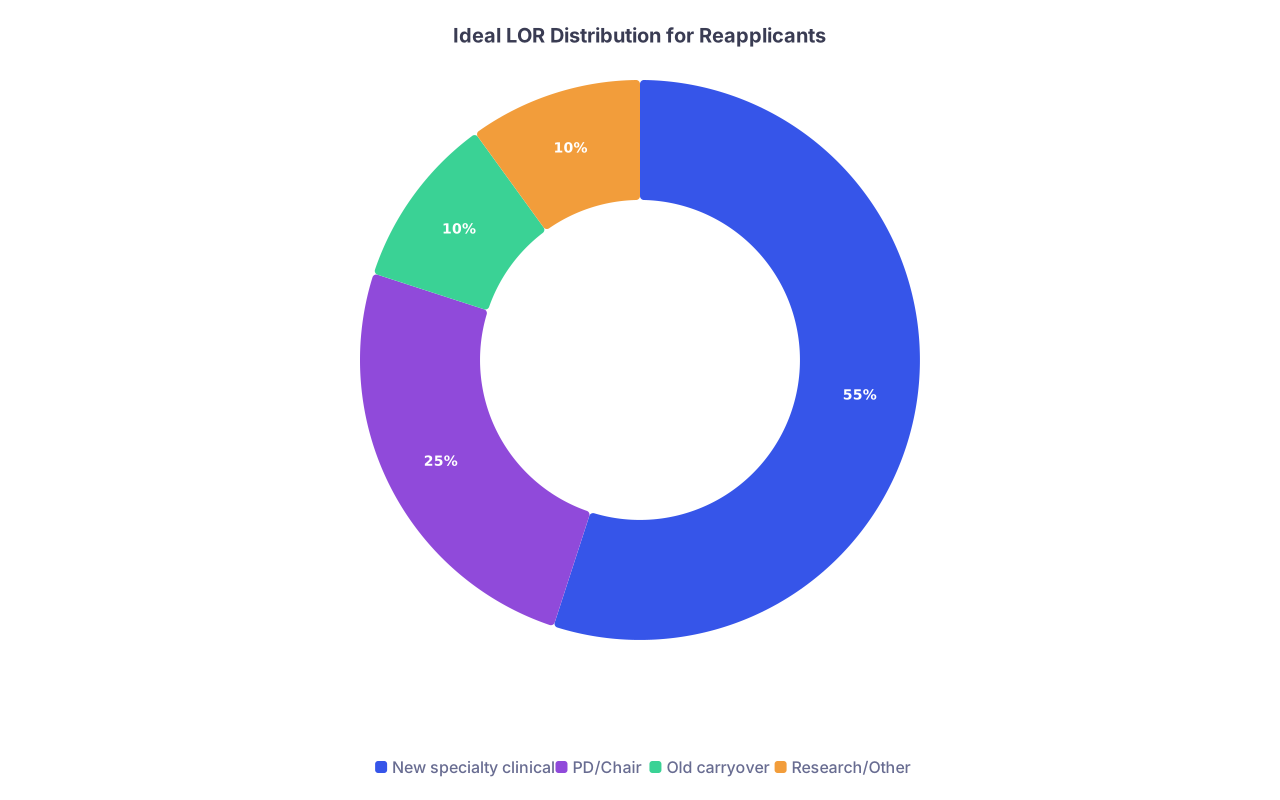
| Category | Value |
|---|---|
| New specialty clinical | 55 |
| PD/Chair | 25 |
| Old carryover | 10 |
| Research/Other | 10 |
Do not submit the maximum number of letters “just because.” Four strong letters beat six mixed‑quality letters every single time.
Step 8: Coordinate Letters Across Multiple Specialties (If Dual Applying)
Dual applying is common after no‑match, but it is very easy to look unfocused if you handle letters sloppily.
8.1 Segment your letters by specialty
You should have distinct sets, even if there is some overlap:
- For your primary specialty:
- 2–3 letters clearly endorsing you as a future [IM physician / EM physician / etc.].
- For your backup specialty:
- At least 1–2 letters directly supporting that field.
- It is fine if some letters are “general but strong” and used for both.
Example:
- Letter A: IM PD, strongly IM‑focused → used only for IM.
- Letter B: Cardiology attending, strong generalist clinical praise → used for IM and prelim.
- Letter C: EM faculty → used only for EM.
- Letter D: Research mentor in EM → used for EM only.
8.2 Avoid obvious mixed messaging
Do not send:
- An EM‑focused letter to an IM‑only program.
- A letter that says “X is deeply committed to a career in EM” to an FM program.
PDs read fast but they are not stupid. If they see you are blanket‑shopping for any spot, they will pass.
Step 9: Document and Demonstrate Growth Beyond Letters
Letters are a piece of the picture. PDs want a coherent narrative: you took the hit, you worked, you improved.
Tie your LOR rebuild into your full application:
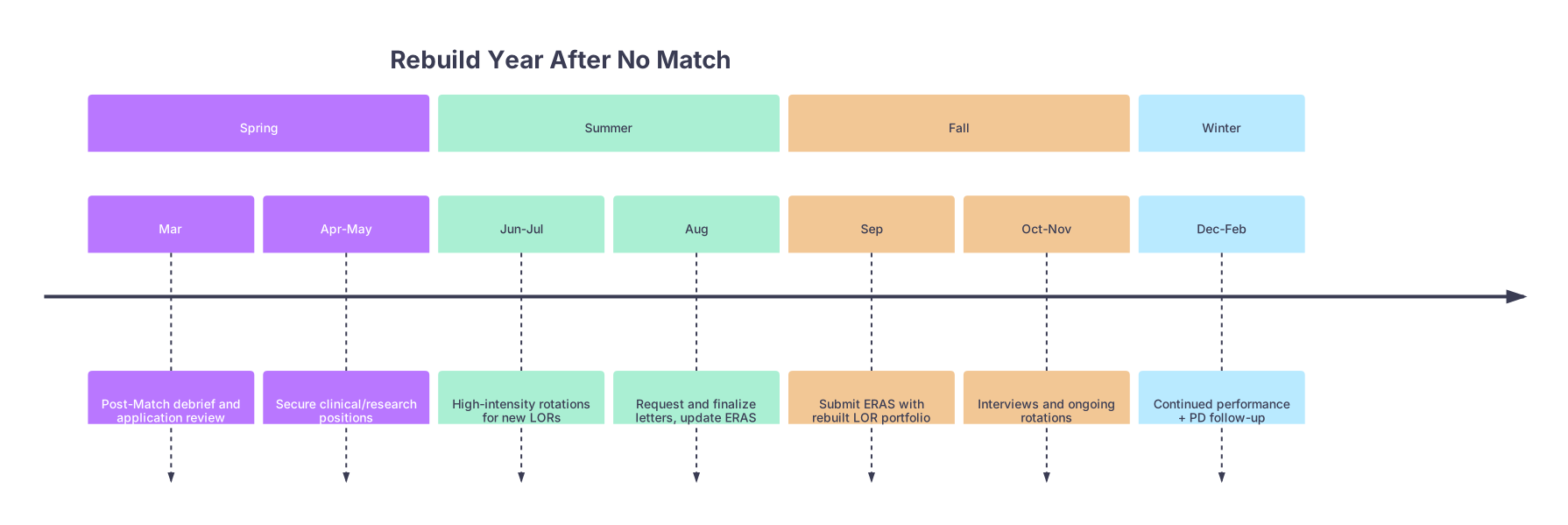
| Period | Event |
|---|---|
| Spring - Mar | Post-Match debrief and application review |
| Spring - Apr-May | Secure clinical/research positions |
| Summer - Jun-Jul | High-intensity rotations for new LORs |
| Summer - Aug | Request and finalize letters, update ERAS |
| Fall - Sep | Submit ERAS with rebuilt LOR portfolio |
| Fall - Oct-Nov | Interviews and ongoing rotations |
| Winter - Dec-Feb | Continued performance + PD follow-up |
During this year, track:
- Rotations with clear evaluation comments you can quote in your personal statement.
- Specific QI projects, teaching roles, leadership responsibilities.
- Any formal recognition (teaching awards, “star intern” mention, etc.).
Then make sure your letter writers know these details. People forget what you did unless you remind them.
Step 10: Quality Control Before ERAS Submission
You will not see the letters themselves (unless you waived rights and the writer shares a copy informally). But you can control the system around them.
10.1 Confirm submission early
By late August you should know:
- Exactly who has uploaded letters.
- Which letter is assigned to which program and specialty.
Common preventable errors:
- Wrong letter assigned to the wrong specialty.
- Old letter assigned when you meant to use the updated version.
- Having “orphan” letters that never get assigned anywhere.
10.2 Sanity check with a trusted advisor
Before you click submit, show your full letter strategy to someone with PD or advisor experience:
- List each letter writer, their role, and which programs will see that letter.
- Explain your specialty plan and how letters support it.
Ask directly:
- “If you were a PD looking at this combination of letters, what story would you tell yourself about me?”
- “Where are the gaps or contradictions?”
Fix whatever they identify. Do not argue. You asked for their expertise, use it.
Example Scenarios: How To Repair Specific LOR Situations
Scenario 1: Unmatched in Internal Medicine, weak letters, now in a research year
Problem:
- Last cycle: 2 generic IM letters, 1 research letter from non‑clinical PhD, 1 FM letter.
- Now doing cardiology research with occasional clinical exposure.
Action steps:
- Secure inpatient IM or cardiology rotations through your institution: 2–3 months total.
- Aim for:
- 1 letter from an inpatient IM attending.
- 1 from a cardiologist who saw you on rounds and knows your reasoning.
- Updated letter from cardiology PI if they can discuss your clinical interactions and reliability.
- Retire:
- FM letter, non‑clinical PhD letter.
- Keep only 1 older IM letter if you have proof it was strong; otherwise replace all.
Scenario 2: Prelim surgery year, unmatched for categorical surgery, considering IM backup
Problem:
- Categorical gen surg is still desired, but options are limited.
- You want IM as a realistic backup.
Action steps:
- During your prelim year:
- Get letters from: Surgery PD, 1–2 core surgery attendings.
- Do at least 1 solid IM rotation; get a letter from a respected hospitalist / IM faculty.
- For applications:
- Surgery programs see: Surgery PD letter + 2 surg attendings.
- IM programs see: IM faculty letter + PD letter (framed around your broad clinical strength) + 1 generic but strong surg attending letter.
Visual: Balancing Your Rebuild Effort
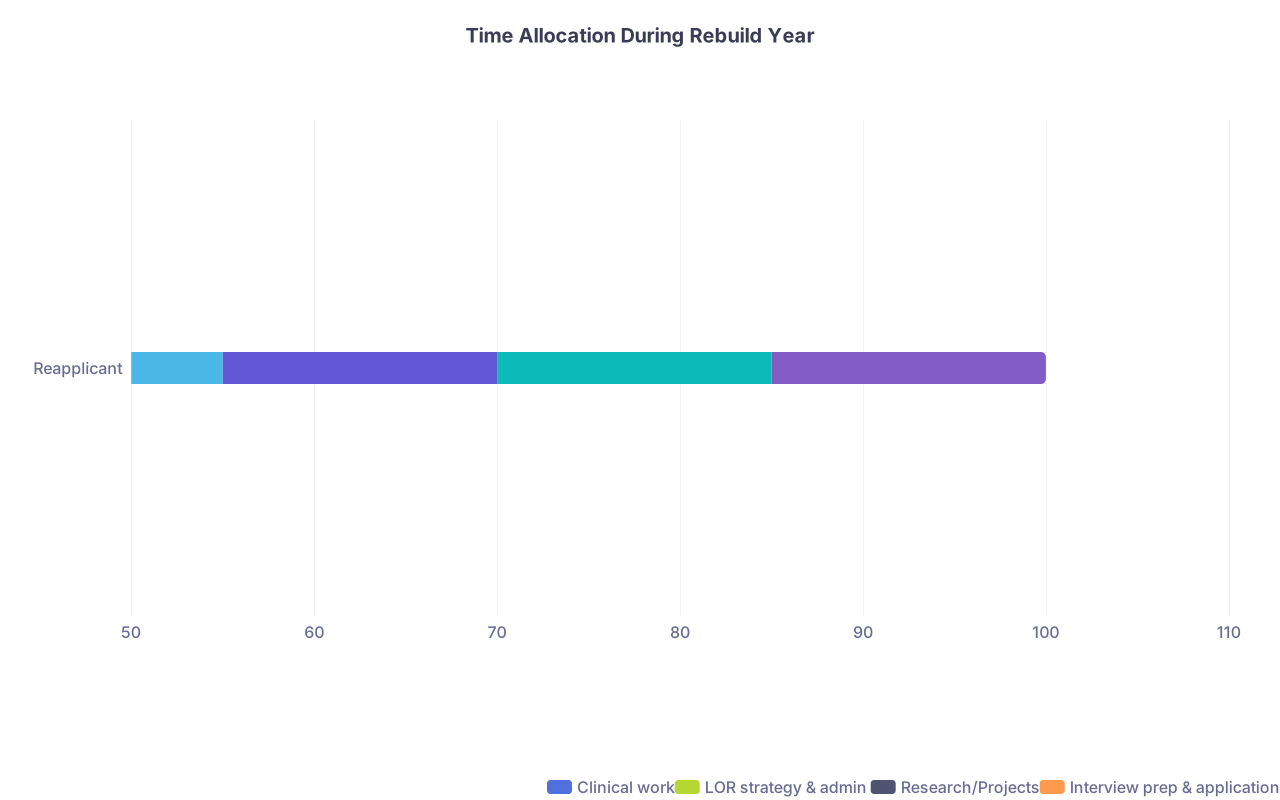
| Category | Clinical work | LOR strategy & admin | Research/Projects | Interview prep & applications |
|---|---|---|---|---|
| Reapplicant | 55 | 15 | 15 | 15 |
If your year is 90% research and 10% clinical with no new letters, you are betting on the wrong horse.
Process Map: From No‑Match To Rebuilt LOR Portfolio

| Step | Description |
|---|---|
| Step 1 | No Match |
| Step 2 | Post-match debrief |
| Step 3 | Decide specialty strategy |
| Step 4 | Secure new clinical roles |
| Step 5 | High-level performance on rotations |
| Step 6 | Request strong, specific LORs |
| Step 7 | Retire weak/old letters |
| Step 8 | Assign letters by specialty in ERAS |
| Step 9 | Submit reapplication |
Quick Comparison: Old vs Rebuilt LOR Set
| Feature | Old Cycle (Unmatched) | Rebuilt Cycle |
|---|---|---|
| Letter age | 1–3 years | ≤ 12 months |
| Writer familiarity | Limited, short rotations | Longitudinal or high-intensity work |
| Specialty alignment | Mixed, some off-specialty | Clearly aligned to target specialty |
| PD/Chair involvement | None or weak | Strong PD/Chair advocacy |
| Growth narrative | Absent | Explicitly described by writers |
FAQ (Exactly 4 Questions)
1. Should I waive my right to see my letters again, even after not matching?
Yes. You should still waive your FERPA rights on ERAS. Program directors trust letters more when they are clearly confidential. If you suspect a writer may give you a weak letter, the solution is not to keep rights; the solution is to not use that writer. Ask directly whether they can write a strong letter before you assign them in ERAS.
2. Is it ever acceptable to reuse a letter from last cycle without changes?
Only if all three conditions are met:
- The letter is ≤ 2 years old at time of reapplication.
- The writer is a PD/chair or highly respected faculty in your specialty.
- You have explicit reassurance from someone who read it (advisor, previous PD) that it is very strong.
Even then, you should prefer an updated version that mentions your growth and activities since the unmatched cycle. Stale letters signal stagnation.
3. My previous PD refused to write me a letter. Am I doomed?
No, but you are flagged as higher risk. You must overcompensate with:
- Multiple recent, detailed letters from other faculty who supervised you closely.
- A clear, non‑defensive explanation (if asked) about your relationship with the previous PD.
- Strong performance this year that generates independently enthusiastic advocacy.
Lack of a PD letter is a problem, but I have seen applicants overcome it with relentless performance and excellent alternative endorsements.
4. How many total letters should I submit as a reapplicant?
Aim for 3–4 letters per program. Three very strong, well‑aligned letters beat six scattered ones. A common strong setup:
- 2 recent clinical specialty letters.
- 1 PD/Chair letter.
- Optional 4th letter from research or another clinical supervisor if and only if it clearly adds new, positive information.
Do not use ERAS letter slots as a dumping ground. Every letter should pull its weight.
Key points:
- Treat your unmatched year as an opportunity to rebuild, not recycle, your letter portfolio.
- Engineer new, high‑quality clinical experiences specifically designed to earn strong, specialty‑aligned letters from people who actually know your work.
- Be ruthless about retiring weak or misaligned letters and intentional about how each remaining letter supports your new narrative.