
What do you say when the program director looks you straight in the eye and asks, “So… why didn’t you match?”
This is where people blow it. Not on test scores. Not on research. Right here. In 90 seconds of badly handled honesty.
You’re in the category programs worry about: previously unmatched. That doesn’t mean you’re toxic. But it does mean you’re under a microscope. One sloppy answer and they’ll mentally stamp you as “high risk” and move on to the safer MS4 who hasn’t “failed” yet.
Let me walk you through how people sabotage themselves—and how you avoid joining them.
The Biggest, Fastest Ways to Self-Sabotage That Question
Let me be blunt. I’ve watched applicants torch their chances in under a minute.
Here are the ways people do it:
They sound like a victim.
“The match is broken… programs don’t read applications… I just got unlucky.”
Translation in the interviewer’s head: This person doesn’t take ownership. Will blame us when things go wrong.They sound bitter.
“I interviewed at X, Y, Z and they strung me along… It was unfair… I don’t know what they wanted.”
Translation: High drama. Potential problem resident.They over-disclose or trauma-dump.
5‑minute story about a breakup, sick parent, bad attending, visa chaos, cousin’s wedding in another country.
Translation: Poor judgment. Poor boundaries. Will bring chaos into residency.They undersell the seriousness.
“Yeah, I didn’t match but I’m sure this year will be fine.”
Translation: Doesn’t understand how big of a red flag this is. No clear plan. No learning.They lie or spin obviously.
“I ranked too few programs” when they clearly didn’t, or “I only applied to 15 derm programs” when their file shows something else.
Translation: Dishonest. If they lie about this, what else will they hide?
That’s what you’re up against. Programs have seen every flavor of bad answer.
Your job: be honest without sounding helpless, bitter, or clueless.
And you need to do it in under 2 minutes with a calm, structured answer.
What Program Directors Are Really Asking When They Say “Why Didn’t You Match?”
They’re not just asking for the timeline. They’re testing you on three things:
- Insight – Do you understand what went wrong?
- Accountability – Do you own your part without destroying your own credibility?
- Growth – Did you actually fix it or are we just repeating last year’s disaster with a fresh ERAS ID?
If you answer in a way that makes them doubt any of those three, you’re in trouble.
Let’s spell that out.
1. Insight: Do you actually know what happened?
Red flag answers:
- “I honestly don’t know, my application was strong.”
- “I think it was just bad luck.”
- “The match is very competitive, that’s probably all it was.”
Those sound naive or evasive. Programs expect some self-analysis:
- Were your scores marginal for that specialty?
- Did you apply too narrowly?
- Were your letters generic?
- Did your personal statement have red flags?
- Did you bomb interviews?
If you can’t name anything specific, they assume:
This person has no idea why they failed and will probably fail again.
2. Accountability: Do you take ownership without self-destruction?
Huge mistake: taking either zero responsibility or 100% responsibility in a self-destructive way.
Zero responsibility:
“The system is broken, it’s all about connections, international grads don’t get a fair shot.”
You might even be right. They still don’t want to hear it that way.Self-destruction:
“Honestly my application just wasn’t competitive, my scores were low, my interview skills were bad, I panicked.”
You’ve just given them five reasons not to rank you.
You need a middle lane:
- “There were weaknesses in my application that I underestimated.”
- “I didn’t apply broadly enough for my profile.”
- “I didn’t have clear specialty-specific mentorship at the time.”
Own what’s yours, but don’t drag yourself through the mud.
3. Growth: What did you do about it—specifically?
This is where most people are too vague.
Bad:
- “I worked on improving my application.”
- “I tried to strengthen my profile.”
- “I gained more clinical experience.”
Those are just buzzwords.
You need concrete, measurable actions, like:
- Completed a research year with 2 manuscripts submitted, 1 accepted.
- Got a new specialty-specific letter from a program director who directly observed you.
- Took/retook Step 2 and improved by 10–15 points.
- Did 2 additional US rotations with strong evaluations.
- Took a structured communication or mock interview course and practiced with faculty weekly.
Programs want to see: problem → insight → action → result.
If they can’t see the arc, they assume you’ll repeat the same mistake.
The Landmine Explanations: How Not to Frame Your Story
Let’s walk through common scenarios and how people explain them badly.
Scenario 1: “I Aimed Too High” (Overreaching)
Bad version:
“I was very passionate about Dermatology and only applied to top programs. Looking back, maybe it was too competitive, but I still believe I would have done well.”
Why this kills you:
- It screams poor judgment.
- No evidence of changed behavior.
- Sounds like you’d repeat the same pattern.
Better framing (conceptually):
- Briefly state: you applied too narrowly or too competitively for your profile.
- Acknowledge your miscalculation.
- Show how your strategy is different now.
Example structure (don’t memorize, adapt):
“I was very focused on [competitive specialty] and applied too narrowly given my scores and lack of [research / home program / US experience]. In hindsight, that was a major miscalculation on my part. Since then, I’ve worked closely with mentors who helped me reassess my fit and competitiveness. That’s why I’ve shifted my focus to [current specialty] where my clinical strengths and experiences align much better, and I’ve done [specific steps] to build a stronger, realistic application.”
Notice:
- You do admit fault.
- You don’t sound helpless or delusional.
- You do show learning and a realistic pivot.
Scenario 2: “Something Personal Blew Up My Application Year”
Things like:
- Family illness
- Your own illness
- Visa issues
- Major life crisis
The mistake people make: turning the answer into a drama monologue.
Bad version:
“During my application year my father suddenly got very sick. I had to travel back home multiple times, handle his appointments, communicate with doctors, and it was very overwhelming. I was emotionally exhausted and couldn’t focus, and some interviews conflicted with his chemo, and…”
You think you’re humanizing yourself. From their angle, they’re wondering:
- Is this situation resolved or is it ongoing?
- Is this going to impact their reliability as a resident?
- Will they be chronically distracted / absent?
How to avoid self-sabotage:
- Be brief and factual. No graphic details. No long narrative.
- Clarify the status (resolved/stable).
- State impact on your application, not your entire life.
- Pivot quickly to what you’ve done since.
Example structure:
- One line: what happened in neutral language.
- One line: how it affected your application (specific, limited).
- One line: status now (resolved/stable).
- Two–three lines: what you’ve done since to demonstrate stability and growth.
You’re not hiding the truth. You’re controlling scope and focus.
Scenario 3: “I Didn’t Have Strong Letters / Mentorship”
A lot of unmatched applicants—especially IMGs and students without a home program—fall here.
Common bad move: blaming your school or faculty outright.
“My school doesn’t help with matching… my attendings didn’t write strong letters… the dean’s office was useless.”
You may be right. Still a mistake to say it like that.
Because they hear:
- Blames others when struggling
- Difficult to work with
- Might talk about us like this later
Sharper approach:
- Acknowledge lack of specialty-specific guidance.
- Own that you didn’t realize the impact soon enough.
- Show what you did differently the second time.
Example structure:
“I didn’t have specialty-specific mentorship during my first cycle, and I underestimated how crucial targeted letters and guidance were. My letters were generic rather than from people who directly supervised me in [specialty]. Since then, I’ve done [USCE / sub-I / observership] in [specialty], worked closely with [title, not necessarily name], and obtained new letters from attendings who observed me directly managing patients in this field. That’s been a major change compared to my prior application.”
Critical thing: You show you learned how the system works and adapted.
Scenario 4: “I Interviewed Poorly”
This one is painful. But lying about it is worse.
Bad version:
“I don’t know, I thought my interviews went great.”
“I think the PD liked me; we had a great conversation.”
Stop. They’ve heard that 1000 times. You didn’t match. Something didn’t land.
You can admit:
- Nervousness
- Lack of preparation
- Poor storytelling
- Not answering questions directly
But you must follow it with very concrete correction steps.
Example skeleton:
“In my first cycle, I didn’t prepare for interviews as systematically as I should have. I gave long, unfocused answers and struggled to clearly summarize my experiences. After I didn’t match, I did [mock interviews with faculty], got direct feedback, and worked on tightening my responses and staying structured. I’ve also had [recent interviews/clinical evaluations] that specifically commented on my clear communication, which I see as progress from where I was before.”
The key:
You don’t label yourself “bad at interviews.” You describe it as a skill you’ve since worked on and can demonstrate improvement.
A Simple Structure That Keeps You From Rambling or Oversharing
You need a template in your head so you don’t panic and go off the rails in real time.
Use this 4‑step skeleton:
Brief context (1–2 sentences)
- The main reason you think you didn’t match.
- Objective, neutral.
Ownership with limits (1–2 sentences)
- Your role without killing your candidacy.
- No blame-fest. No self-attack.
Concrete changes (3–5 sentences)
- Specific actions you took after not matching.
- Skills, experiences, scores, letters, strategy changes.
Present readiness (1–2 sentences)
- Where you are now: more prepared, more aligned with this specialty, more stable.
That’s it. You’re done. You don’t owe anyone a 10-minute confession.
The Quiet But Deadly Mistakes People Don’t Realize They’re Making
These don’t sound dramatic, but they quietly destroy your impression.
1. Sounding defensive—even slightly
Phrases that sound defensive even when you don’t mean them:
- “To be honest…” (implies you weren’t honest before)
- “I know other people with lower scores who matched.”
- “I think my application was actually strong.”
Swap them for calmer, neutral phrasing:
- “Looking back, there were weaknesses I didn’t fully appreciate.”
- “In hindsight, my strategy didn’t reflect my competitiveness accurately.”
You want to sound like someone who can discuss hard things without escalating.
2. Talking too much about the unfairness of the process
Is the match sometimes absurd and unfair? Absolutely.
Should you say that to interviewers? Not if you like ranking.
You can nod to competitiveness and structural challenges once, calmly:
- “It’s a very competitive specialty, especially for [IMGs/no home program applicants], and I underestimated that.”
Then move on. If you linger on:
- “People with worse stats than me matched.”
- “Programs ghost applicants.”
- “It’s all who you know.”
You come across as someone who will stay bitter instead of adapting.
3. Letting your body language betray you
They’re not only listening to words. They’re watching:
- Do your eyes drop when “unmatched” is mentioned?
- Do you get visibly tense, defensive, or flustered?
- Do you speed up, ramble, or go off on tangents?
You need reps on this answer before you ever step into an interview:
- Practice saying “I didn’t match” out loud until the shame sting drops.
- Record yourself answering the question and trim it to under 2 minutes.
- Get someone blunt (not your nicest friend) to listen and tell you where you sound:
- bitter
- evasive
- over-sharing
- helpless
If you don’t rehearse it, you’ll word-vomit under stress. And you will regret it.
4. Forgetting to tailor the story to the specialty you’re now applying to
If you switched specialties, this is a common trap:
You spend all your energy explaining why you didn’t match in Specialty A, but you never clearly bridge to why you’re now a good fit for Specialty B.
You need one explicit connecting line, like:
- “Through that experience, I realized that what I enjoyed most was [type of patient care, pace, continuity, procedures] which aligns much more closely with [new specialty], and that’s where I’ve focused my efforts since.”
Don’t make them guess. Spell out the pivot and show that it’s deliberate, not desperation.
A Quick Comparison: Sabotaging vs. Smart Answers
| Situation | Self-Sabotaging Answer | Smarter Framing |
|---|---|---|
| Overreached specialty | “I only applied to top programs because I wanted the best training.” | “I applied too narrowly for my profile. I’ve since broadened my list and aligned my applications with where I’m realistically competitive.” |
| Personal crisis | 5-min emotional story with details | 1–2 lines of context + clear statement it’s resolved + what you’ve done since |
| Weak letters | “My attendings didn’t support me.” | “My letters were generic and not specialty-specific. I’ve now obtained strong letters from attendings who directly supervised me in this field.” |
| Poor interviewing | “I don’t really know, I thought interviews went well.” | “I realized my interview skills were unfocused. I worked with mentors, did mock interviews, and improved how I present my experiences.” |
| Blaming system | “The match is unfair and random.” | “It’s very competitive, and my initial strategy didn’t reflect that. I’ve adjusted my approach and strengthened specific parts of my application.” |
Visual: Common Reasons Candidates Actually Don’t Match
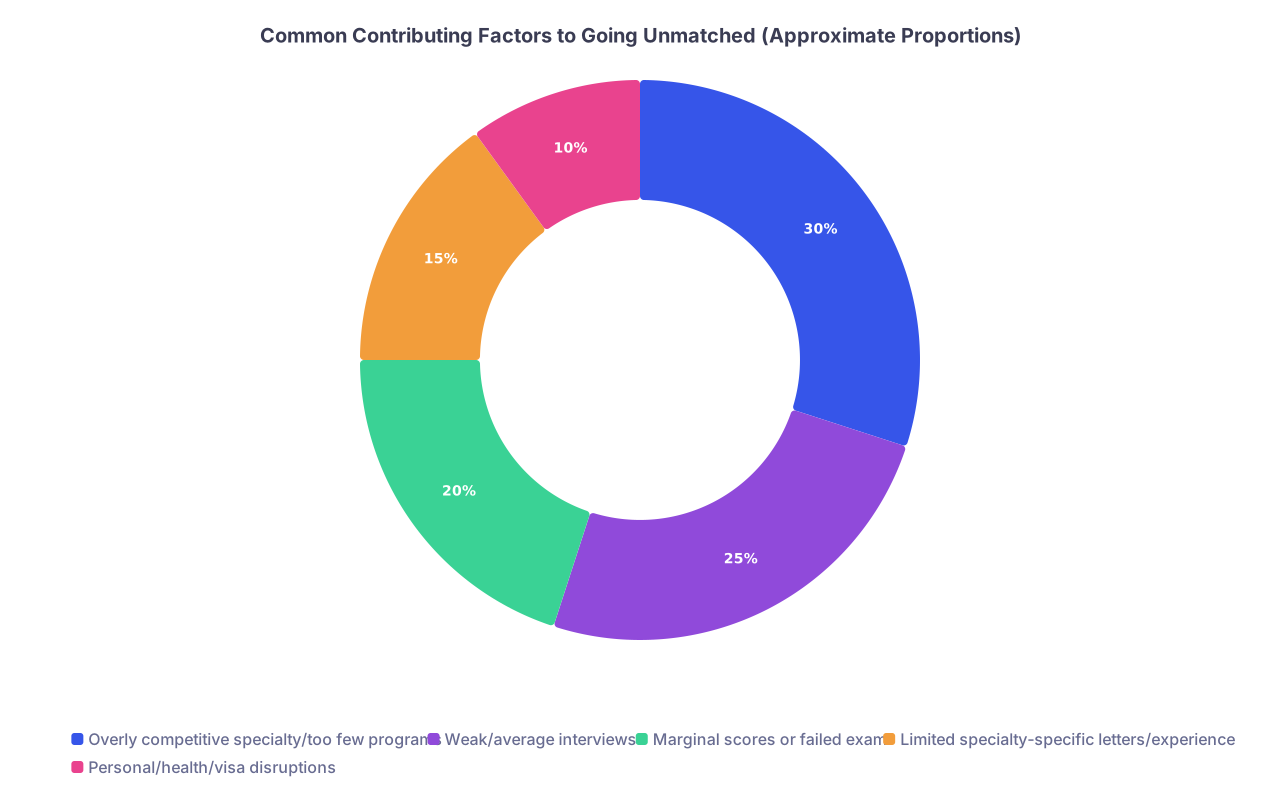
| Category | Value |
|---|---|
| Overly competitive specialty/too few programs | 30 |
| Weak/average interviews | 25 |
| Marginal scores or failed exam | 20 |
| Limited specialty-specific letters/experience | 15 |
| Personal/health/visa disruptions | 10 |
These factors often overlap. Your explanation should show which applied to you and what’s different now.
How to Practice This Without Sounding Like a Robot
You don’t want to sound scripted. But you also can’t improvise this.
Use a 3-step practice loop:

| Step | Description |
|---|---|
| Step 1 | Draft concise 4-part answer |
| Step 2 | Record yourself on video |
| Step 3 | Get blunt feedback from mentor/peer |
| Step 4 | Revise content and tone |
Key practice tips:
- Aim for 60–90 seconds. Under 2 minutes, always.
- Don’t memorize word-for-word; memorize beats:
- What went wrong (headline only)
- Your responsibility
- Specific fixes
- Why you’re ready now
- Practice saying “I didn’t match” calmly, without lowering your voice or rushing past it.
The goal: steady voice, steady eye contact, no apology in your posture.
FAQs (Read These Before You Say Something You Regret)
1. Should I mention that I think I was “unlucky”?
No. Don’t touch that word. Even if luck played a role, “I was unlucky” sounds like:
- You don’t understand your weaknesses.
- You’re deflecting responsibility.
You can say, “It’s a competitive process,” once. But you must clearly name at least one specific, addressable factor you’ve worked on.
2. Do I have to bring up being unmatched if they don’t ask?
If your ERAS history or CV makes it obvious (prior cycle, past interviews, SOAP, a gap that screams “unmatched”), you should be prepared to discuss it and not look surprised.
But you don’t need to open every interview with, “By the way, I didn’t match last year.”
If they don’t ask, fine. If they do, you answer directly. Prepare as if they will.
3. How much detail should I give about personal or family issues?
Less than you think. You’re not in therapy. You’re in a professional recruitment interview.
Stick to:
- One sentence of neutral description (“I had a significant family health issue that required my involvement”).
- One sentence about the impact on your application (missed deadlines, fewer interviews, etc.).
- One sentence on current status (“That situation is now stable/resolved”).
- Then move quickly to what you’ve done since to prove you’re ready and reliable.
If you’re unsure, you’re probably oversharing.
4. What if the real reason I didn’t match is kind of ugly (failed exam, professionalism concern)?
You can’t hide a failed exam; programs will see it. You also can’t spin a professionalism concern into something it’s not if there’s documentation.
You must:
- Acknowledge the issue clearly and without excuses.
- Show what you changed in your behavior, process, or support system.
- Offer evidence of sustained improvement (clean record since, strong recent evaluations, score improvement, etc.).
Do not give a long, defensive backstory. They care less about the drama and more about whether it’s likely to happen again.
5. Is it OK to say I switched specialties because I realized the first one wasn’t right for me?
Yes—but the way you say it matters.
Wrong way:
“I didn’t match in ortho so now I’m trying IM.”
That sounds like desperation.
Better:
- Link your actual experiences, strengths, and preferences to the new specialty.
- Show that you reflected and then deliberately pivoted, not just applied where there were more spots.
- Emphasize what you’ve done to test and confirm the new specialty (rotations, observerships, mentorship, specific responsibilities in that field).
You want them thinking: This person found the specialty that really fits them, not they’re just trying to get in anywhere.
Remember:
- Being unmatched once doesn’t end your career. Explaining it badly can.
- You must show insight, ownership, and specific growth—without turning the interview into a confessional.
- Practice this answer until you can say “I didn’t match” calmly, like a fact, not a scar you’re hiding.
Do not wing this. This question is predictable. People still blow it. Don’t be one of them.