
What if the “productive” gap year you’re planning is the exact reason you still won’t match next cycle?
Let me be very clear: unmatched applicants do not have the luxury of random “exploration.” You are not on a sabbatical. You’re in damage-control mode, whether anyone around you says it out loud or not.
People ruin their second chance with one bad year of choices. I’ve watched it happen more times than I like.
This is the gap-year trap: doing things that sound respectable, keep you busy, maybe even make your family proud—while quietly destroying your reapplication chances.
Let’s walk through what actually hurts you.
1. The Biggest Myth: “Any Clinical Experience Is Good Experience”
No, it’s not. And if you believe that, you’re already at risk.
There’s a huge difference between:
- A structured clinical/research role that generates new letters, recent US clinical experience, and clear continuity with your chosen specialty
versus - A random clinical-ish job that looks like you’re drifting.
Programs can tell.
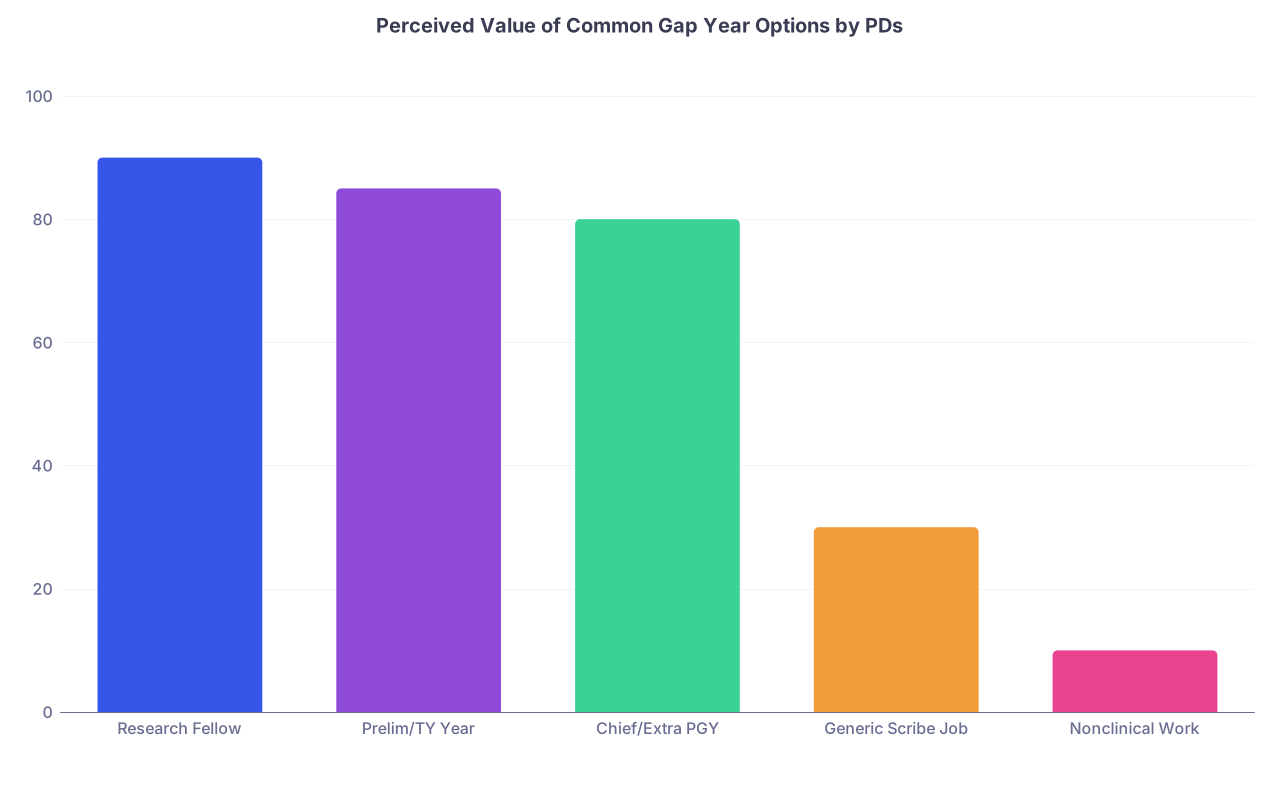
| Category | Value |
|---|---|
| Research Fellow | 90 |
| Prelim/TY Year | 85 |
| Chief/Extra PGY | 80 |
| Generic Scribe Job | 30 |
| Nonclinical Work | 10 |
The scribe job trap
I’ve seen unmatched grads grab a full‑time ED scribe job or outpatient clinic scribe role thinking, “It’s clinical. It’ll help.”
Often it does not. Here’s why:
- No progressive responsibility – You’re not acting as a physician. You’re a typist.
- Weak letters – “This person is a good scribe” is not a residency-level endorsement.
- Mismatch with prior training – You finished an MD/DO and went straight into a job a premed could do. That’s not the story you want to tell.
- No specialty alignment – If you’re reapplying to internal medicine, why are you a dermatology clinic scribe far from any hospital?
Is scribing always bad? No. But for an unmatched graduate, especially with prior USCE or completed rotations, it’s usually a downgrade, not an upgrade.
You want to avoid looking like you fell out of the physician pipeline and landed in premed land.
Volunteer “clinical” roles that go nowhere
Free clinic once a week. Phone triage “volunteer.” Hospital greeter with a stethoscope.
These can be fine if they’re on top of more serious, targeted work. But as the centerpiece of your gap year? Weak.
Selection committees look for:
- Continuity with your target specialty
- Supervision by faculty who can write residency-strength letters
- Skills that look like physician work: decision-making, documentation, patient ownership (to the extent possible)
If your main role can be done by a college student with a weekend course, it will not fix why you went unmatched.
2. Research: How to Turn a Strength into a Liability
Everyone runs to “I’ll do research.” Good instinct. Bad execution, often.
The classic mistake:
You join a lab with zero connection to your specialty or your application story, then vanish into a black hole of “data cleaning” for a year with no tangible product.
Here’s how research hurts you instead of helping:
2.1. Wrong type of research
You’re reapplying to neurology but join a basic science immunology lab in another state because they had funding and were nice to you. Result?
- Your time looks scattered.
- No one in that lab can credibly comment on your clinical strengths.
- The letter you get is about pipetting technique, not patient care or resident potential.
If you absolutely must take a non-aligned research job, you need to build a bridge:
- Co-author with a neurologist
- Work on a project that has some clinical overlap
- Get at least one letter from someone in your intended specialty that cycle
2.2. No outcomes, just vibes
Another common error: “I did research” with nothing to show for it.
You spend 10–12 months:
- joining meetings
- “helping with data collection”
- maybe submitting an abstract that never gets accepted
And on your ERAS you list this huge, time-consuming thing with:
- No accepted abstract
- No poster actually presented
- No manuscript submitted or in progress with your name visible
Programs see a giant time block with no productivity. That raises a red flag: lack of follow-through, poor mentorship choice, or inflated claims.
You do not need 5 first‑author papers; you do need:
- At least something concrete: poster, accepted abstract, submitted manuscript
- A letter that says: “They drove this project, showed resilience, finished tasks”
If your PI isn’t serious about getting you tangible outcomes within the year, that’s the wrong lab for an unmatched applicant. Period.
3. “I Deserved a Break”: The Disappearing Act Year
This one ruins reapplications quietly.
“I was burned out. I needed to step away. I traveled, reconnected with family, took time for myself. Now I’m ready.”
I get it as a human. As an advisor, it’s a problem.
Why a “rest year” without structure is dangerous
Program directors are not thinking about your wellness journey. They’re thinking:
- Will this person vanish under stress?
- Do they actually want to be a doctor?
- What did they do with 12 months?
- Light tutoring
- Casual travel
- A few online CME courses
- Vague “self-study for Step 3” with no exam date
You’ve basically told them: when things got hard, you tapped out.
You don’t have to grind yourself into the ground. But your year must show deliberate progression toward residency:
- Structured roles
- Documented achievements
- Clear explanation of how this year corrected what went wrong
Otherwise, it looks like retreat, not regroup.
4. The Worst Story You Can Tell: “I Gave Up on My Specialty and Then Changed Back”
Programs hate unclear commitment. The “specialty-hopping gap year” is a known trap.

Example: The EM → IM → EM mess
You went unmatched in Emergency Medicine. Then:
- Gap year 1: You work in internal medicine research, apply to IM.
- Do not match.
- Gap year 2: You decide you “always loved EM,” so you reapply to EM.
Every program sees this and thinks:
- This person is chasing any spot.
- They don’t know what they want.
- They might leave our program if they change their mind again.
If you genuinely change specialties, then commit:
- Your entire gap year must align with the new specialty.
- Your personal statement must clearly explain the change.
- You cannot keep your old specialty as “backup” in a way that looks sloppy or scattered.
What kills you is looking directionless, not the change itself.
5. The Step Score Silence: Not Fixing the Academic Problem
If you went unmatched with:
- Low Step 1 (if applicable) and/or Step 2 CK
- Multiple exam failures
- Poor in‑training or shelf scores
…and you spend a whole year doing nothing to demonstrate academic improvement? That is a massive mistake.
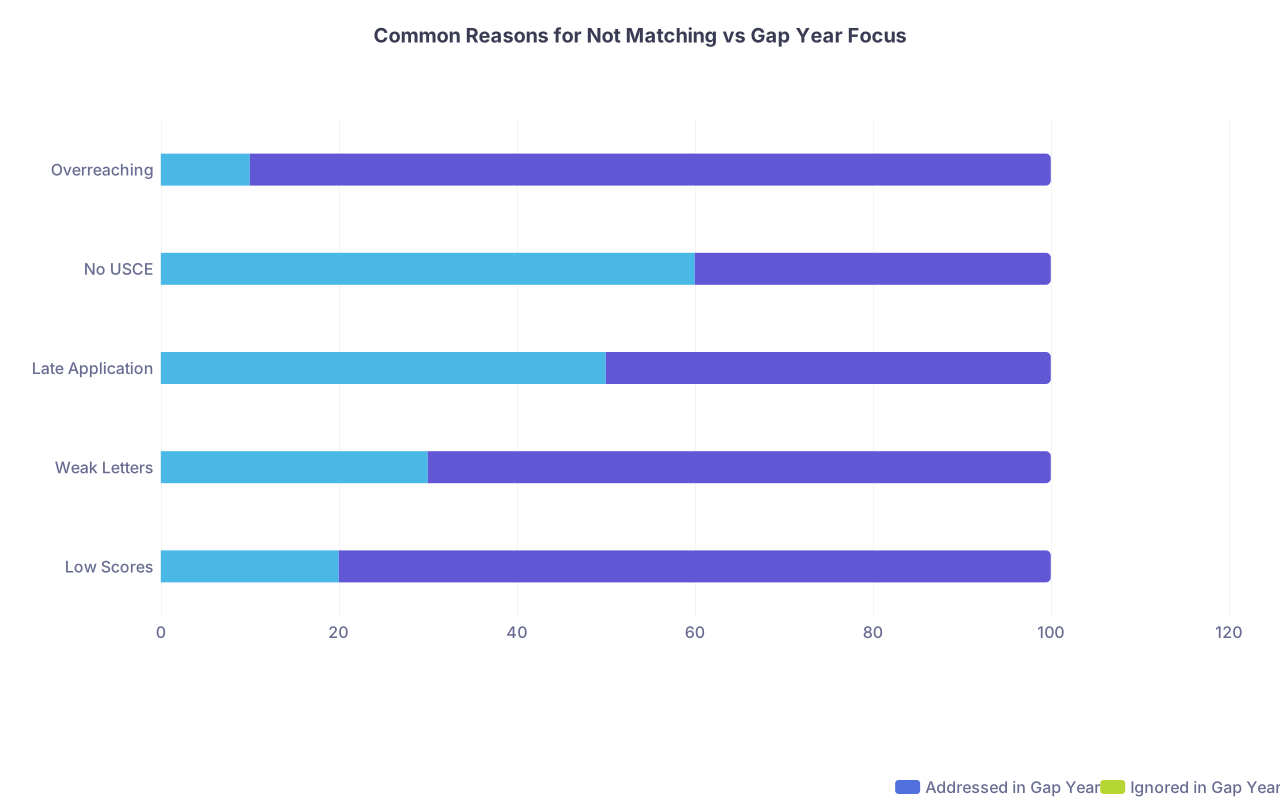
| Category | Addressed in Gap Year | Ignored in Gap Year |
|---|---|---|
| Low Scores | 20 | 80 |
| Weak Letters | 30 | 70 |
| Late Application | 50 | 50 |
| No USCE | 60 | 40 |
| Overreaching | 10 | 90 |
Programs are blunt: if the reason you didn’t match was academic, your gap year must include evidence you can handle the work.
Bad gap‑year choices in this context:
- Doing only research with no exams, no clinical work
- Teaching for USMLE prep without improving your own scores or taking additional exams
- Avoiding Step 3 because you’re scared of failing
If you have multiple low scores, you may need:
- Step 3 taken and passed with a solid score
- Structured remediation, possibly documented through a program or mentor
- Clear, measurable test performance improvement
Otherwise, your application looks frozen in the same weak place it was last cycle.
6. Nonclinical Work That Raises More Questions Than It Answers
Let’s talk about nonclinical gap years. Not always bad. But often mishandled.
Common “looks worse than you think” choices:
- Full‑time non‑medical startup role
- Corporate/finance/consulting with no clinical tie-in
- Long-term family business work with no documentation or outside supervision
- Vague “self-employed” periods that read like unemployment
The issue isn’t that having interests outside medicine is evil. The issue is:
- You went unmatched in a fiercely competitive process.
- You then spent your precious year away from anything that shows you’re serious about fixing that.
If you absolutely have to take nonclinical work (visa, finances, family reasons), then you must:
- Pair it with structured, meaningful clinical or academic involvement:
- Part-time research with real output
- Consistent clinical observership with letter potential
- Remote QI projects with faculty you can list and get letters from
- Be ready to explain in 2–3 sentences how you balanced both and what you accomplished medically
Nonclinical by itself? Reads as career drift.
7. Unpaid “Observerships” Done Wrong
Observerships can be helpful, especially for IMGs. They can also be a complete waste of time.
Red flags I see constantly:
- Observerships at small private clinics with no residency program
- Shadowing where you never meet faculty who can write program-level letters
- Settings where they churn through 30 observers a month—translation: no one remembers you
If your main gap-year “clinical” activity:
- Has no connection to a teaching hospital
- Won’t give you a meaningful LOR
- Gives you no actual tasks beyond following someone around
…then you’re just padding your CV with noise.
Better: 2–3 strong, well-chosen experiences that produce:
- One or two high-quality letters
- Specialty-specific exposure
- Clear documentation in your CV and personal statement
Not: 12 random shadowing gigs in four cities that all blur together.
8. Overloading on Degrees and Certificates
The “I’ll fix it with more letters after my name” trap.
Common examples:
- One‑year MPH with no clinical or USCE alongside
- online MBA with zero medical connection
- “Advanced diploma” or certificate courses that are not recognized or respected by PDs
These can be useful in a different life plan. For an unmatched applicant chasing a residency spot, they can actually backfire:
- They raise the question: Are you leaving clinical medicine?
- They eat time that could be spent getting stronger letters, research, or clinical work.
- They don’t fix your core problems (scores, evaluations, late application, weak letters).
If you pursue a degree, be ruthless:
- Does this directly solve a specific weakness in my application?
- Will it generate new, credible letters and projects within a year?
- Can I maintain parallel clinical involvement so I don’t look detached?
If those answers are no, that degree is likely a distraction.
9. Weak or Nonexistent Mentorship
Here’s a quiet killer: going into a gap year without a real advisor who has:
- Actual experience with residency selection
- No incentive to just make you feel better
- The guts to tell you, “That plan won’t help you match”

Mistakes that come out of poor mentorship:
- Applying to the exact same set of reach programs again after doing nothing to change your profile
- Skipping community programs or prelim spots that would actually help you build a track record
- Taking a highly prestigious but irrelevant position that looks shiny but doesn’t solve your actual problems
- Friends who matched easily
- Family members who are not in academic medicine
- People who say, “You’re great, just try again, it’ll work!”
—you’re in danger.
You need someone willing to say:
- “You should pivot specialties.”
- “You need to apply more broadly, including community programs.”
- “This ‘research’ role is a dead end; here’s a better option even if it looks less glamorous.”
10. Repeating the Same Application Mistakes
I’ve seen people spend a whole year working hard, then flush it by submitting the exact same weak application.
Big self-sabotage moves:
- Reusing the same personal statement with zero reference to what you did this year
- Keeping the same generic, lukewarm letters instead of getting fresh ones
- Applying late—again—because you waited for “just one more” thing
- Overconcentrating applications in big-name cities or prestigious programs, again

| Step | Description |
|---|---|
| Step 1 | Unmatched in March |
| Step 2 | Analyze reasons with mentor |
| Step 3 | Scores/Academics |
| Step 4 | Letters/Performance |
| Step 5 | Application Strategy |
| Step 6 | Plan: Exams, Step 3, remediation |
| Step 7 | Plan: Strong USCE, new LORs |
| Step 8 | Plan: Different specialties/program tiers |
| Step 9 | Targeted gap year activities |
| Step 10 | Revise PS, LORs, program list |
| Step 11 | Apply Early and Broadly |
| Step 12 | Main problem? |
If your gap year doesn’t clearly change the story, you’ve wasted it.
Your reapplication needs to communicate:
- I understood why I didn’t match.
- I took specific, hard steps to address exactly those issues.
- Here is concrete evidence: scores, roles, projects, letters.
Anything less just looks like you hit “resubmit.”
11. Gap-Year Choices That Actually Help (And How to Not Mess Them Up)
Let me flip this and give you a quick calibration. Done correctly, these can be powerful. Done sloppily, they hurt.
| Activity Type | Risk of Hurting Your Application |
|---|---|
| Research in target specialty | Low if productive, high if idle |
| Prelim/TY or extra PGY year | Low if strong, moderate if weak |
| Clinical research fellowship | Low if tied to letters/output |
| Generic clinical scribing | Moderate to high |
| Purely nonclinical full-time | High unless paired with USCE |
High-yield if done right
Research fellow in your specialty
- Must lead to at least one or two tangible products + strong letter
- Ideally at an institution with a residency program in that specialty
Prelim/TY or extra PGY year in related specialty
- Great if you get strong evaluations and letters
- Terrible if you’re mediocre and add new bad performance data
Clinical research coordinator in your field
- Good if there’s patient contact, responsibility, and faculty mentorship
- Bad if you’re a human spreadsheet with no visibility
Well-structured observership or non-ACGME fellowship
- Fine if it’s attached to an academic center and faculty advocate
- Useless if it’s a generic observer mill
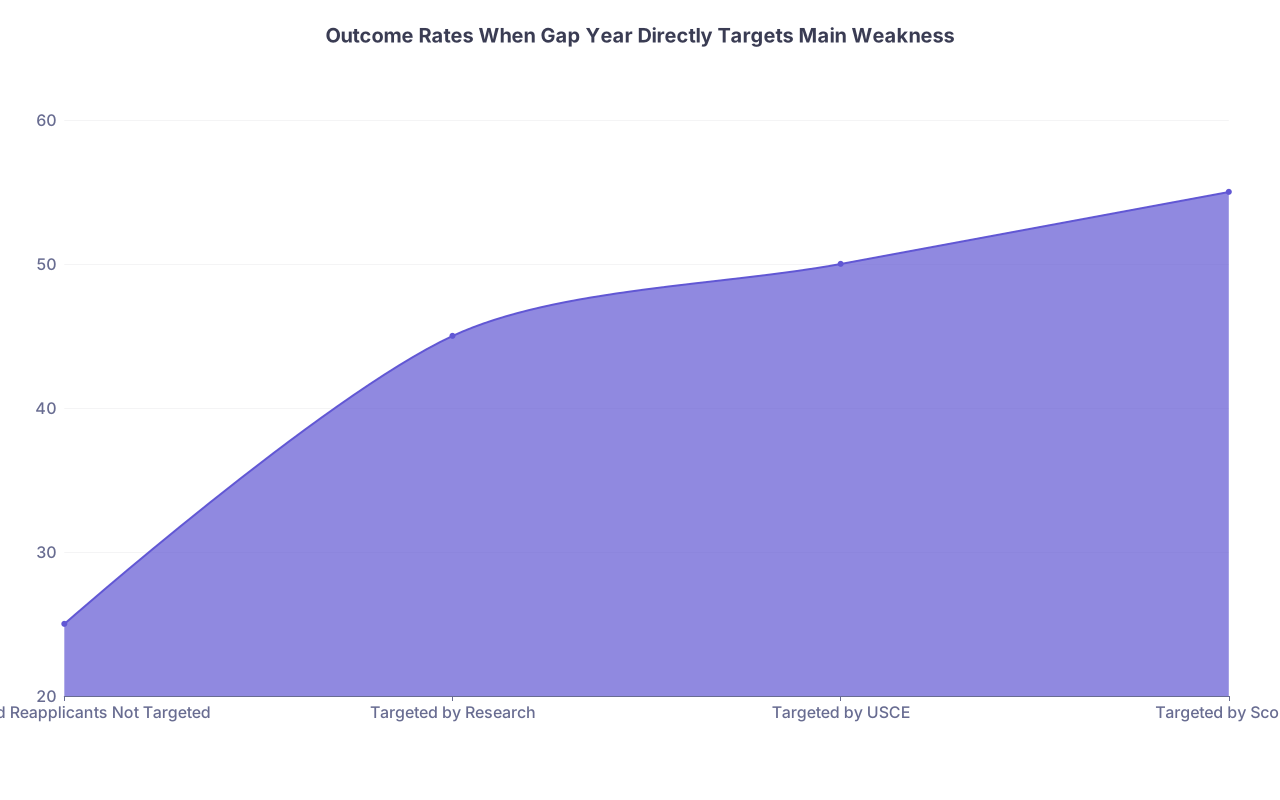
| Category | Value |
|---|---|
| Unmatched Reapplicants Not Targeted | 25 |
| Targeted by Research | 45 |
| Targeted by USCE | 50 |
| Targeted by Scores | 55 |
The pattern is simple:
If your gap year shows you understood your weaknesses and attacked them head-on, it helps.
If it looks like random patchwork or avoidance, it hurts.
Final Takeaways: How Not to Screw Up Your Gap Year
Let me boil this down so you don’t walk into the same traps I see every single year.
Random activity is worse than no activity.
A low-value, unfocused gap year tells programs you still don’t understand what went wrong.Your gap year must directly attack your specific reasons for going unmatched.
Scores → exams/remediation. Weak letters/USCE → targeted clinical roles with strong faculty exposure. Poor application strategy → different program list and better mentorship.If you can’t clearly explain why each major activity helps you match, don’t do it.
Before you commit, ask: “What letter, skill, score, or product will this give me that I can put into ERAS next cycle?” If the answer is fuzzy, that’s the trap.