

It’s Monday afternoon. The NRMP email has already hit your inbox. You didn’t match. You’ve scrolled your phone to death, and there’s…no one obvious to call. Your school’s “advising office” is an email address that sends mass PDFs, your research PI barely remembers your name, and your classmates are posting “I matched!!!” photos on Instagram.
You’re not just unmatched. You’re unmatched and basically mentor-less. No chair fighting for you. No PD texting other PDs. No “let me make a call” person.
This is the scenario: you need a support network yesterday and you’re starting from close to zero.
Here’s how you build one quickly and strategically, so this year doesn’t quietly ruin your trajectory.
Step 1: Stabilize Your Own Story Before You Talk to Anyone
You can’t recruit people to help you if you sound lost, chaotic, or ashamed. So the first “networking” you do is with yourself.
Take one focused hour and write out three things:
- What happened
- What you want now (short term and medium term)
- What you’re realistically willing to do in the next 12 months
Keep it blunt. Something like:
- “US MD, Step 1 P/F, Step 2 CK 222, 1 first-author case report, applied to 60 categorical IM programs, 4 interviews, no match.”
- “Short term: SOAP if possible into prelim/transitional/IM. If not, find a research position or a clinical job that keeps me close to my target specialty. Medium term: Reapply to IM next cycle, open to community programs and less competitive regions.”
That clarity matters. When you start reaching out to people, you must be able to say:
- Who you are
- What happened
- What you’re aiming for
- What you’re asking them for
If you pause and stammer every time someone asks, “So what’s your plan?” people disengage. They won’t say it, but they will.
So before we talk about mentors, make your 3-sentence script:
- “I’m a [US MD/DO/IMG] who applied to [specialty] this year and didn’t match.”
- “My short‑term plan is [SOAP into X / get a research job in Y / do a prelim year].”
- “I’m trying to build a support network and would really value your advice on [specific thing].”
Have that ready. You’ll use it 50 times.
Step 2: Exploit the 3 Fastest “Mentor-Lite” Sources You Already Have
You think you have no mentors. You probably have weak ties that can turn into something if you act like an adult who knows what they need.
Here are the big three you hit today:
1. Your School’s Office of Student Affairs (even if they suck)
Yes, a lot of them are underwhelming. Use them anyway.
Email subject: “Unmatched – Request for Targeted Advising and Contacts”
Body (something like this):
Dear Dr. [Name],
I’m a graduating [MD/DO] student who applied to [specialty] and did not match this cycle. I’m working on a concrete plan for the next year and would appreciate specific guidance on:
- Reviewing my application for weaknesses, and
- Connecting with alumni or faculty who have experience with unmatched applicants, SOAP, or reapplicants in [specialty or adjacent specialty].
I’m available for a brief meeting this week and am prepared with my ERAS application and interview list.
Thank you for any help you can offer,
[Name], [Phone]
You’re not asking “What should I do?” in a vague way. You’re asking for:
- Feedback
- Names
- Introductions
Push for: “Who at our affiliated hospitals handles unmatched grads?” and “Which alumni recently re-applied after not matching?”
You’re not looking for a life mentor here. You’re looking for people to talk to this week.
2. Rotation Attendings (even ones who barely know you)
Think back to the attendings who:
- Gave you decent evals
- Remembered your name
- Let you present more than once
Email them. Yes, it feels awkward. Do it anyway.
Your script:
Hi Dr. [X],
I was a student on your [service] rotation in [month/year]. I learned a lot from working with you, especially about [1 specific thing].
I applied to [specialty] this year and unfortunately did not match. I’m trying to put together a concrete re-application plan and would really value your perspective on:
– How my application might be viewed by program directors, and
– Whether there are research, observer, or other opportunities in your department that might strengthen my application over the next year.I know you’re very busy – even a 15-minute phone call would be extremely helpful.
Thank you for considering this,
[Name]
You’re not asking them to “be your mentor.” You’re asking for one conversation and maybe one opportunity. Mentorship often grows from small commitments, not big promises.
3. Recent Alumni and Near-Peers
These are gold. They remember exactly what this feels like. And they’re often more responsive than senior faculty.
Sources:
- Your class GroupMe / WhatsApp / Facebook group
- Alumni lists from your school
- Residents you worked with on rotations
Post or DM something like:
Hey all – I didn’t match this cycle and am trying to quickly gather advice from people who’ve been through unusual application paths (re-applying, SOAP, switching specialties, research years, prelim years, etc.).
If you’re open to sharing your experience or connecting me with someone who went through this, I’d really appreciate it.
You’re not asking for pity. You’re asking for strategies and contacts. That matters.
Step 3: Use Public Platforms to Find “Cold Mentors” (and Not Sound Desperate)
You don’t have a built-in powerful mentor. So you’re going to manufacture one by being smart on the internet.
LinkedIn: The Underused Weapon
Search: “[Your med school name] internal medicine resident” (or whatever specialty) and filter by current positions.
Message template:
Hi Dr. [Last Name],
I’m a [MS4 / recent grad] from [School]. I applied to [specialty] this year and didn’t match. I saw that you’re now a [PGY level] in [program], and I’d be grateful for 10–15 minutes of your time to hear how you approached your application and what you think helped you succeed.
I’m especially interested in [their program / switching from another specialty / applying as an IMG, etc.].
Totally understand if you’re busy, but any advice or pointers would mean a lot.
Best,
[Name]
You’re asking them to talk about themselves. People will do that. From that call, you ask:
- “Is there anyone you think I should talk to at your program or elsewhere?”
- “Is there anything specific I should do this year to be a stronger re-applicant?”
You’re building a web. One person leads to another.
Specialty Facebook Groups / Discord / Reddit (Yes, Carefully)
There are private FB groups and Discord servers for:
- IMGs in [specialty]
- Non-traditional applicants
- Specific specialties and subspecialties
You do not post a sob story. You post like this:
US MD, no match in [specialty]. 4 interviews, no red flags, Step 2 CK 2xx. I’m looking to build a targeted plan for the next 12 months and would love to talk to anyone who:
– Reapplied successfully after being unmatched, or
– Took a research year / prelim year and matched into [specialty or related].I’m happy to share my ERAS PDF privately for more concrete feedback. Thanks in advance.
You’ll get noise. But you’ll also get 2–3 people who’ve been you three years ago. Those are potential mentor‑equivalents.
Step 4: Turn One-Off Conversations Into Actual Support
Talking to 20 people once is not a network. That’s just phone fatigue.
Your job is to convert a few of these into ongoing allies.
Here’s how:
Follow-up with a visible action.
If they suggest, “You need a research position,” your reply a week later should be:
“I updated my CV and reached out to Dr. X about a research spot, as you suggested. Thank you again – that advice made my next steps much clearer.”Ask small, concrete follow-ups.
Not: “Can you mentor me?”
Instead:
“Would you be willing to look at my revised ERAS personal statement once I update it?”
or
“If your program ever has an opening for a research assistant, would it be okay if I reached out to you to ask who to contact?”Respect their time aggressively.
You say: “Can we talk for 15 minutes?” and actually end it at 15 unless they extend. People are more likely to say yes again when you show you don’t drain them.Make them feel like they’re winning.
People keep helping when they can see it’s working. Tell them when something they suggested led to progress: an interview, a new contact, a volunteer gig, a paper submission.
You don’t need ten mentors. You need 2–3 people who:
- Answer emails
- Tell you the truth
- Have some proximity to your target specialty or programs
Step 5: Plug Yourself Into Ready-Made Systems (You Don’t Have to Build It All From Scratch)
Speed matters. You don’t have 6 months for organic relationships to blossom. You need infrastructure.
Here are real, fast options:
1. National Organizations with Formal Mentorship
Most specialties have student/resident sections:
- American College of Physicians (ACP) – for IM
- American Academy of Family Physicians (AAFP) – FM
- American College of Surgeons (ACS) – surgery
- Specialty-specific groups in psych, EM, peds, etc.
Many have mentorship programs where they pair med students/unmatched grads with attendings or senior residents. That’s low-friction. Use it.
Your move: join, then immediately email the student/resident section coordinator: “I’m an unmatched applicant in [specialty] looking for targeted mentorship as I prepare to re-apply. Is there a structured mentorship program or someone who typically advises re-applicants?”
2. Hospital Volunteer / Scribe / Research Programs
This is about proximity. You want to be physically around the specialty you care about or an adjacent one.
Options:
- Research coordinator or assistant in a department you want to match into
- Clinical research fellow positions (often at big academic places)
- Hospitalist office assistant / scribe attached to a group with residents
These roles put you near:
- Residents who know the inside scoop
- Attendings who can write real letters
- Program people who hear about openings
Do not underestimate what simply being around a program 40 hours a week can do for you when the PD hears, “They’re hardworking, show up on time, and fit our culture.”
Step 6: Use the SOAP / Post-Match Window Strategically for Relationship-Building
If you’re in or just past SOAP, the instinct is to hole up and refresh email. That’s half the story. The other half is this: people are thinking about you right now. That window closes fast.
During SOAP and immediately after:
- Keep tight communication with whoever at your school is assigned to SOAP advising. Even if they’re mediocre, being visible keeps you on their mind when they hear of openings or fellowships.
- Every program that interviews or considers you during SOAP is a network node. If you don’t land there, respectfully follow up afterward: “Thank you for considering my application during SOAP. I remain very interested in [specialty]. If there are research or observer opportunities at your institution that could help me strengthen my application for next cycle, I’d be grateful to know.”
No whining. No guilt trips. Just clear, calm interest.

| Step | Description |
|---|---|
| Step 1 | No Match Result |
| Step 2 | Clarify Story and Goals |
| Step 3 | Contact School Advising |
| Step 4 | Reach Out to Past Attendings |
| Step 5 | Message Alumni/Residents |
| Step 6 | Get Names and Introductions |
| Step 7 | Short Calls & Advice |
| Step 8 | Identify 2-3 Supportive People |
| Step 9 | Ask for Specific Small Favors |
| Step 10 | Ongoing Check-ins and Updates |
Step 7: Fix the Biggest Red Flags While You’re Building the Network
Here’s something people won’t always say out loud: if your stats or application have obvious problems and you pretend they don’t, you will quietly lose allies. No one wants to waste effort on someone in denial.
Common red flags:
- Very low Step 2 CK (or multiple failures)
- No Step 2 CK yet and you applied
- Major professionalism or leave-of-absence issues
- Bad or generic letters
- Unrealistic specialty choice given your record
When you talk to potential mentors, you acknowledge the issue without wallowing in it.
For example:
- “My Step 2 CK of 208 hurt me this cycle. I’m planning to do an intensive dedicated period and aim for a 230+ on a retake before re-applying. I’d appreciate your thoughts on whether that would change my competitiveness for community IM programs.”
or
- “I realize switching into derm after no match in surgery might not be realistic for me. I’m very open to internal medicine or family medicine and want to understand how to position myself well for those.”
It signals: I can face reality. That makes people more willing to invest in you.
Step 8: Protect Yourself from Garbage Advice and Predatory “Helpers”
When you’re unmatched and alone, you’re target practice for bad ideas and exploitative people.
Red flags:
- Someone wants money up front just to “review your ERAS” with no clear credentials or outcomes.
- They guarantee interviews or guarantees a match. That’s fiction.
- They immediately push you into a random Caribbean or offshore program, or into another degree (MBA, MPH) without a coherent plan.
- They tell you, “Oh, you’ll be fine, just apply again,” without looking at your actual application.
You’re allowed to ask:
- “What kinds of applicants have you worked with before?”
- “What specifically do you think was weak about my application?”
- “If I follow your advice and don’t match again, what’s my Plan B?”
If they can’t answer specifically, they don’t get to be part of your inner circle.
Step 9: Build a Peer Support Group Instead of Searching for a Saviour
You may not find a magical senior mentor who adopts you. That’s fine. You can still create a solid support system.
Here’s a practical structure that works:
- Identify 3–5 other unmatched or re-applying people (your school or online)
- Make a weekly 60-minute meeting on Zoom
- Agenda:
- 10 min: each person gives 2–3 bullet updates (“Emailed 4 attendings, got 1 call,” “Heard back about a research position”).
- 30 min: one person presents their ERAS / PS / CV for group feedback.
- 20 min: each person commits to 2 concrete tasks for the next week.
It sounds basic. It works.
You’re building accountability and collective intelligence. And sometimes, one person’s new contact becomes everyone’s opportunity.
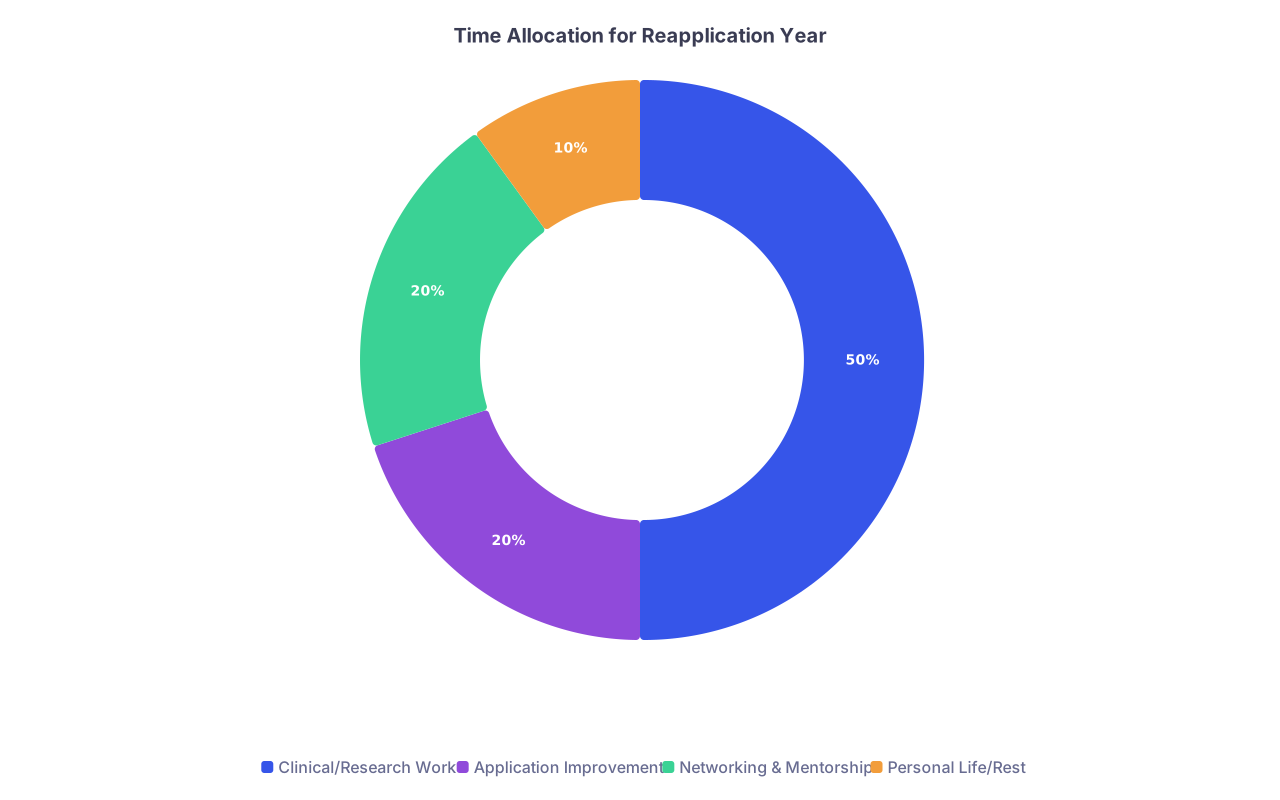
| Category | Value |
|---|---|
| Clinical/Research Work | 50 |
| Application Improvement | 20 |
| Networking & Mentorship | 20 |
| Personal Life/Rest | 10 |
Step 10: Adjust Your Specialty Strategy with Real Input, Not Just Feelings
This is where honest mentors matter. Maybe you aimed for ortho with a 218 and no research. Maybe you shotgun-applied EM without Step 2 in October. Whatever the specifics, you need someone to say, “Look, that was never going to work. Here’s what can work.”
Three realistic paths:
| Situation | More Realistic Next Step |
|---|---|
| Unmatched in highly competitive surg | Prelim surgery, switch to gen surg/IM/Anes/FM |
| Unmatched in lifestyle specialty (derm, rad onc, ophtho) | Research year + consider IM/FM/Neurology/Rads |
| Unmatched in IM/FM/Peds with low scores | Extra clinical year, broaden geography, consider community-heavy list |
Bring your full ERAS (scores, LORs, PS, experiences) to someone who actually knows the specialty and say:
- “If you were me, which specialties would you seriously consider?”
- “What concrete things could I accomplish in 12 months that would change my odds for X specialty?”
You might not like the answer. Listen anyway. Stubbornly reapplying to the same impossible target, alone, is how you end up unmatched twice.
Step 11: Convert Any Position This Year into Future Leverage
Say you land:
- A research assistant role in cardiology
- A prelim IM year
- A non-categorical surgery spot
- A hospitalist scribe or coordinator job
Your mindset:
This is not a consolation prize. This is my one-year audition.
Do three things aggressively:
Become the easiest person to help.
- Answer emails
- Show up early
- Do the annoying tasks without whining
Signal your goals clearly.
- “My goal is to match into categorical IM next cycle. I’d love to be involved in projects or roles that would help demonstrate that I can perform at that level.”
Ask for letter opportunities early.
Don’t wait until August. Around month 3–4, tell your supervising attending:
“If my performance continues at this level, would you feel comfortable writing me a strong letter for my ERAS application this fall?”
People can’t read your mind. You have to connect the dots for them.

Step 12: Tighten Your Communication Game (So People Take You Seriously)
You’re asking busy, powerful people for help. The way you communicate is either making that easy or painful.
Quick rules:
- Subject lines should be clear: “Re-applicant Seeking Advice – [Your Name], [School]”
- First line: who you are and what you want in one sentence
- No walls of text. 3–6 short paragraphs max.
- Always attach your CV if you’re asking for career advice
- Always propose 2–3 time options for meetings, in their time zone
- Always send a brief thank-you email afterward with 1–2 concrete things you’re going to do
And absolutely do not:
- Email someone three times in 48 hours
- Trauma-dump your entire life story
- Argue with their advice in the first conversation
You don’t have to agree with everything you hear. Just don’t turn mentorship into a debate club.
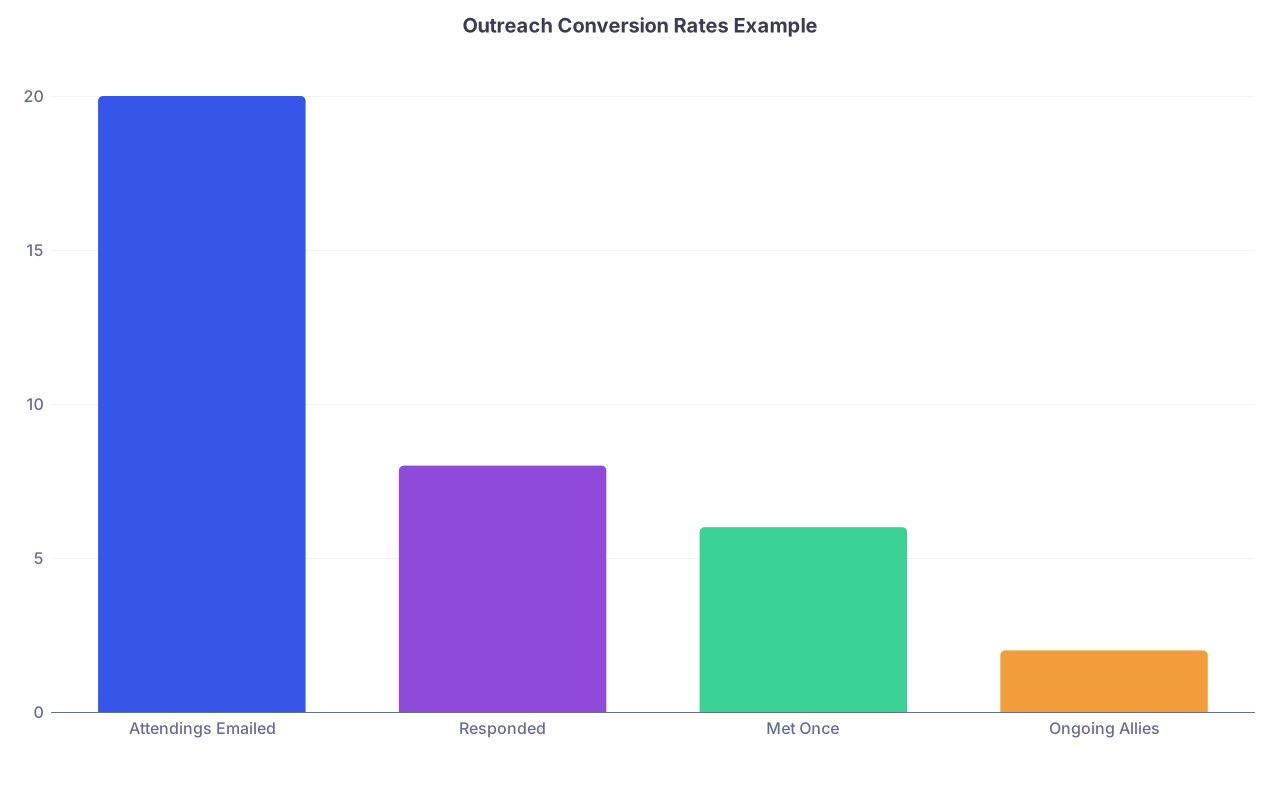
| Category | Value |
|---|---|
| Attendings Emailed | 20 |
| Responded | 8 |
| Met Once | 6 |
| Ongoing Allies | 2 |
Notice those numbers. That’s what this looks like in real life. Lots of outreach, a few real connections. That’s normal. Not a sign you’re failing.
Step 13: Emotion Management So You Don’t Poison Your Own Network
You’re allowed to be angry, ashamed, sad. If you stuff it down, it leaks out sideways. If you lead with it in every conversation, you burn people out.
So you compartmentalize:
- Vent to 1–2 trusted friends, therapist, or anonymous online peers. Full unfiltered mess allowed there.
- Present your “professional self” to mentors: honest but composed. “I’m disappointed, but I’m focused on what I can change this year.”
If you notice yourself saying, “The Match is rigged,” “My school screwed me,” “PDs only care about prestige,” in every conversation, stop. Even if some of that is true, that’s not how you build allies inside the system.
Step 14: A 30-Day Action Blueprint
If you need it spelled out, here’s a practical 30-day plan to kickstart your support network:
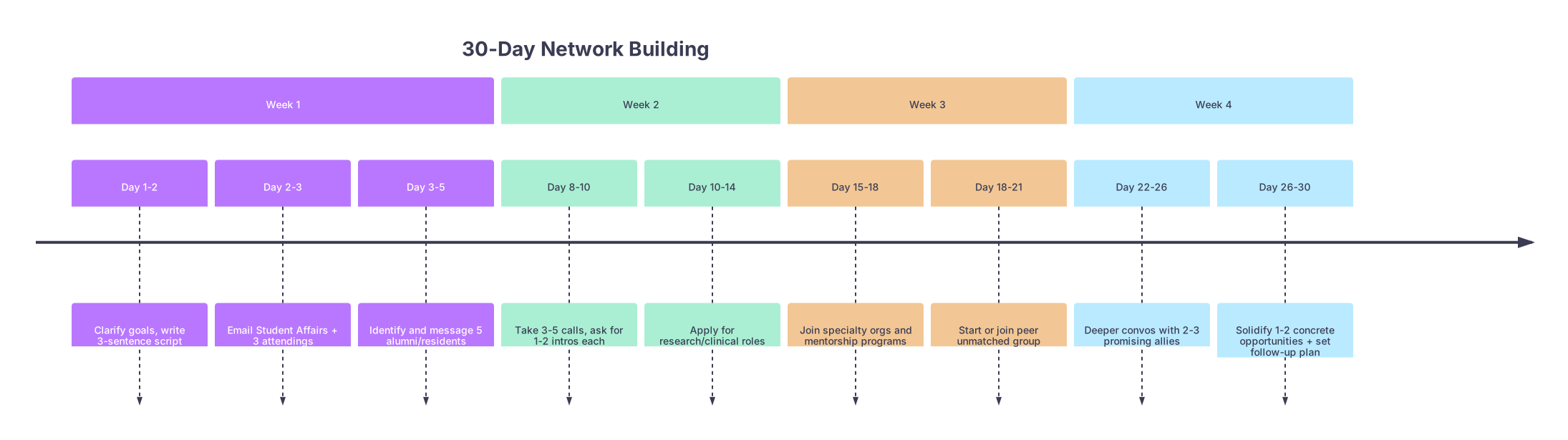
| Period | Event |
|---|---|
| Week 1 - Day 1-2 | Clarify goals, write 3-sentence script |
| Week 1 - Day 2-3 | Email Student Affairs + 3 attendings |
| Week 1 - Day 3-5 | Identify and message 5 alumni/residents |
| Week 2 - Day 8-10 | Take 3-5 calls, ask for 1-2 intros each |
| Week 2 - Day 10-14 | Apply for research/clinical roles |
| Week 3 - Day 15-18 | Join specialty orgs and mentorship programs |
| Week 3 - Day 18-21 | Start or join peer unmatched group |
| Week 4 - Day 22-26 | Deeper convos with 2-3 promising allies |
| Week 4 - Day 26-30 | Solidify 1-2 concrete opportunities + set follow-up plan |
If you execute that, you will not be “alone and unmatched” 30 days from now. You may still be unmatched this cycle, but you will not be mentor-less.
Key Takeaways
- You don’t wait for a savior mentor to appear; you manufacture a support system by reaching out widely and converting a few decent humans into ongoing allies.
- Be brutally clear about your story, your red flags, and your goals. People help re-applicants who face reality and take action.
- Any role you get this year—research, prelim, non-categorical, clinical job—isn’t a consolation prize; it’s a live audition. Treat it like your bridge to next Match, not your failure badge.


