
The biggest CV “spin” mistakes unmatched applicants make are not harmless polish. They are giant red flags that quietly get you filtered out—and often you never find out why.
You’re in the most emotionally dangerous zone right now: hurt from not matching, desperate to “fix” your application, and surrounded by people saying, “Just frame it better” or “Everybody exaggerates a little.” That combination leads good people to make career‑damaging choices on their CVs.
Let me walk you through the traps I’ve seen over and over. And how to avoid ending up as the cautionary tale whispered between PDs on Zoom.
The Core Reality: Programs Don’t Hate Imperfection—They Hate Spin
Programs are not allergic to:
- Failed attempts
- Gaps
- Low scores
- Career changes
- Non‑traditional paths
What they do hate:
- Inflated roles
- “Upgraded” titles
- Vague, unverifiable claims
- Cherry‑picked “truths” that distort what actually happened
- Anything that smells like you’re trying to be clever with the facts
You’re not competing against perfection. You’re competing against applicants who look honest and grounded. When a PD senses spin, they assume:
- You’ll spin your notes.
- You’ll spin your errors.
- You’ll spin your feedback.
That’s where trust dies. And once they don’t trust you, your CV goes to the “No” pile—politely, silently, permanently.
Let’s get brutally specific.
Mistake #1: Up‑Titling Everything (“Project Leader” Syndrome)
This is the classic unmatched‑year move: take every activity and give it a promotion.
Examples I’ve seen (too many times):
- “Research Coordinator” → you were actually a part‑time data entry student helping one resident.
- “Quality Improvement Project Leader” → you attended 3 meetings and sent 2 reminder emails.
- “Teaching Faculty” → you led 2 review sessions as a senior student or PGY‑1.
- “Chief Intern” → there was no such formal role; you just made the schedule twice.
Why this backfires:
Titles are checkable.
PDs know what positions exist at most affiliates. They can, and do, casually email:
“Hey, did you have a research coordinator named X last year?”
If the answer is, “Uh, no, we had a volunteer who helped occasionally,” you’re done.Titles carry expectations.
When you say “Coordinator,” “Leader,” “Director,” or “Faculty,” you’re claiming:- Responsibility
- Decision‑making power
- Administrative or supervisory roles
Then you show up to interviews and can’t describe:
- Budget
- IRB details
- Timeline
- Outcomes
- How you supervised others
They immediately know you inflated the title.
It screams insecurity.
PDs are used to reading CVs. They can see the gap between title and content from across the room.
How to fix it:
Use titles that match your actual level. Examples of safe, accurate titles:
- “Research Assistant – Cardiology Outcomes Study”
- “Student Volunteer – Clinic QI Initiative”
- “Small Group Tutor – Anatomy Review Sessions”
- “Scheduling Assistant – Clinic Template Updates”
Then in the bullet points, you explain your impact. Impact can be impressive without a fancy label.
Rule of thumb: If the institution wouldn’t print that title on a badge or contract, don’t put it on your CV.
Mistake #2: Turning Shadowing and Observation into “Clinical Experience”
This one is rampant among unmatched applicants trying to look “more clinical.”
Common spins:
- Shadowing a private practice doc for 2 weeks → “Outpatient Internal Medicine Experience”
- Sitting in on consults → “Participated in patient management and treatment decisions”
- Observer status (no orders, no notes) → “Managed inpatient care under supervision”
Programs know what true clinical work looks like. They are not fooled.

Why this hurts you:
- Many unmatched or IMG applicants actually do have observer roles. Those are fine, when labeled honestly.
- The spin makes all of your clinical claims suspect. If you’re willing to blur that line, what else are you stretching?
Watch for these red‑flag phrases that programs side‑eye:
- “Actively managed patients” when you had no license or billing responsibility
- “Provided care” when you only observed
- “Independently assessed” when you wrote drafts that attendings edited completely
How to phrase it safely:
- “Clinical Observer – Inpatient Internal Medicine, XYZ Hospital”
- “Shadowed attending in clinic; observed patient encounters and discussed differential diagnoses”
- “Participated in bedside rounds; presented literature to team”
See the difference? You can still show:
- Exposure
- Initiative
- Learning
Without claiming duties you didn’t actually hold.
Absolute do‑not‑do:
- Don’t list observerships under “Employment” or “Work Experience.”
- Don’t imply billable or licensed responsibilities if you were a student, observer, or volunteer.
Mistake #3: “Promoting” Yourself in Research You Barely Touched
Every unmatched cycle I see people try to rescue their CV with research spin. It usually looks like this:
- You joined a project late → CV says “Designed study and led data analysis.”
- You helped with chart review → CV says “Co‑PI on multi‑center study.”
- You edited a draft once → CV says “Primary author” or “Lead author.”
Programs talk to each other. And to your PIs. Quietly.
Here’s how they spot the spin:
- Your name is 8th on a 15‑author paper, but your CV bullet says “Led project.”
- The PI is a well‑known researcher. PDs know exactly how their lab runs and what a typical student role looks like.
- In interviews, you can’t answer:
- What was the primary outcome?
- How did you calculate sample size?
- Why that statistical test?
Once they see one exaggerated research claim, they question your entire document.
Safer, honest ways to frame research:
- “Assisted with data collection and chart review for retrospective cohort study on ___.”
- “Contributed to literature review and editing of manuscript on ___.”
- “Performed preliminary data analysis using SPSS under supervision.”
And only use “first author,” “co‑first author,” “PI,” or “co‑PI” if:
- That’s explicitly how it appears in the publication or abstract, or
- You have written documentation from the PI that this is the case.
If your name is somewhere in the middle of an author list, don’t call yourself “lead.” That one word has sunk more applications than you realize.
Mistake #4: Hiding Gaps and Failures with Vague Time Blocks
Another spin move that PDs can smell: turning gaps into vague‑sounding “roles” or time blocks.
Typical patterns:
- “2019–2021: Clinical Experience” with no specifics, no institution, no supervisor.
- “2018–2020: Independent Research” with no mentor named, no projects listed, no outputs.
- “2020–2022: Personal Development and Family Commitments” used as a catch‑all cover.
Programs are not offended by:
- Caring for sick family
- Serious illness
- Retaking steps
- Working outside medicine to pay bills
They are offended by you trying to bury it in fog.
| Approach | Program Reaction |
|---|---|
| Clear, honest gap | Neutral / mildly curious |
| Brief + explained | Often acceptable |
| Vague multi-year block | Suspicious |
| Contradictions in dates | High-risk red flag |
Where people get burned:
- ERAS dates don’t match what’s on the CV.
- LoRs mention timelines that contradict your stated activities.
- Google/LinkedIn say you were working non‑clinical while CV says “full‑time research.”
Better strategy:
Spell out the gap honestly and briefly:
- “2020–2021: Family caregiver during relative’s critical illness; part‑time employment outside of medicine to support family.”
- “2019–2020: Dedicated Step 2 CK preparation and remediation after previous attempt; concurrent volunteer work at ___ (X hours/month).”
You don’t need drama. But you do need clarity.
Programs don’t need to like your reason. They just need to trust that you’re telling the truth.
Mistake #5: Over‑claiming Teaching and Leadership
This one is subtle. It doesn’t always look like lying. It often looks like stretching language.
Examples:
- You gave two noon conferences → “Extensive teaching experience for residents and students.”
- You were on a committee as a silent member → “Played a pivotal role in key residency program decisions.”
- You joined a student group → “Led institutional initiatives in diversity and inclusion.”
The pattern: using scale words that don’t match reality.
Red‑flag words that invite skepticism:
- “Extensive”
- “Pivotal”
- “Transformative”
- “Institution‑wide”
- “Major” or “significant” initiatives
Unless you can clearly prove those claims, these words do more harm than good.
Safer approach:
Describe what you did, not what you want it to sound like:
- “Delivered two noon conferences on ___ to internal medicine residents.”
- “Served as member of residency wellness committee; contributed ideas for call schedule feedback system.”
- “Co‑organized 3 DEI discussion sessions with average attendance of 15–20 students.”
That still shows leadership and initiative. Without setting off program BS detectors.
Mistake #6: “Polishing” Employment Outside Medicine Into Something It’s Not
Unmatched applicants often feel ashamed of non‑medical work. So they try to spin it:
- Retail job → “Healthcare Customer Relations Specialist”
- Uber driver → “Independent Logistics Contractor serving healthcare facilities”
- Admin assistant → “Clinical Operations Manager”
This is unnecessary and risky.
Programs actually like applicants who:
- Worked to support themselves
- Dealt with real‑world customers
- Held responsibility in any setting
You don’t need to distort it. You need to own it.
Honest but strong framing:
- “Sales Associate, Target – Managed high‑volume customer interactions; ranked top 10% in customer satisfaction scores.”
- “Administrative Assistant, Clinic X – Scheduled patient appointments, coordinated records, and maintained EMR accuracy.”
- “Driver, rideshare – Full‑time night shifts to support family while preparing for USMLE exams.”
What you must avoid:
- Anything that makes them question what is actually true about your work.
- Titles that suggest you were functioning as clinical or administrative leadership when you clearly were not.
Mistake #7: Sloppy Inconsistency—The Quiet CV Killer
Not dramatic. Not emotional. Just sloppy. And deadly.
Common patterns:
Different dates for the same role on:
- CV
- ERAS
- Personal statement
- LoRs
Different titles for the same position:
- “Research Assistant” in one place, “Research Fellow” in another
- “Observer” vs. “Resident” (yes, I’ve seen that)
Different hours/commitment depending on document:
- “Full time” in one description, “10 hrs/week” somewhere else
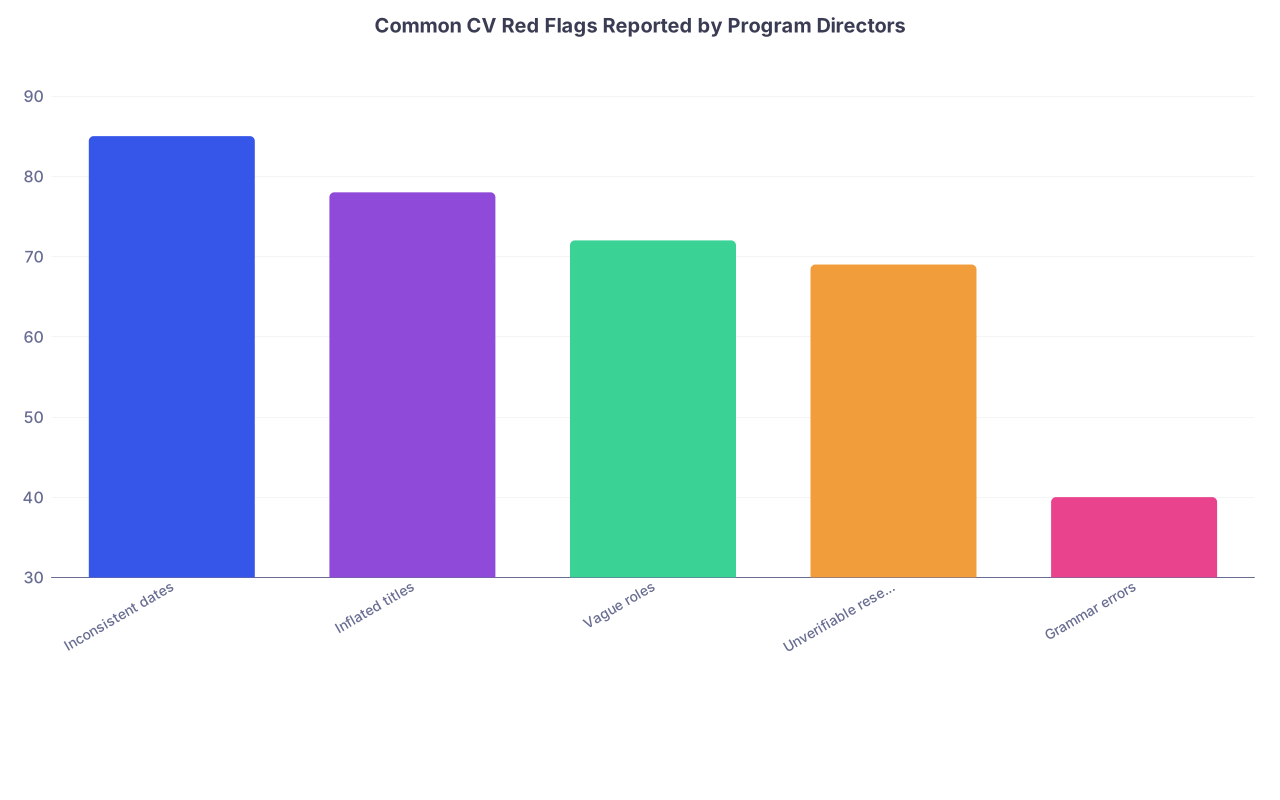
| Category | Value |
|---|---|
| Inconsistent dates | 85 |
| Inflated titles | 78 |
| Vague roles | 72 |
| Unverifiable research | 69 |
| Grammar errors | 40 |
Programs don’t usually email you to ask, “Which one is right?” They assume the worst and move on.
How to protect yourself:
Pick one master document with the correct:
- Start and end dates
- Hours/week (or approximate)
- Title as it appears on official documentation
Make everything else match that master:
- ERAS entries
- CV
- Personal statement references
- LinkedIn (if you have it)
Before you submit, do a brutal inconsistency audit:
- Print your CV and ERAS activity list.
- Line by line: circle every date and title.
- Fix mismatches before you hit submit.
This is boring work. But it’s the stuff that separates “seems trustworthy” from “something’s off.”
Mistake #8: Packing the CV With Filler to Hide Weakness
Another unmatched instinct: fill every inch of space so the reader doesn’t “notice” low scores or gaps.
What this looks like:
3 bullets for “Interests” including “Reading, travel, music.”
A separate section for “Courses Taken” listing basic med school classes.
Inflating “Skills” with:
- “Microsoft Word”
- “Email communication”
- “Zoom”
Listing every single conference you ever attended as if it were an achievement.
The problem:
A bloated CV doesn’t hide your weaknesses. It highlights your anxiety. PDs see the insecurity and assume:
- You’re trying to distract them.
- You don’t understand what matters in residency.
Lean, focused, honest beats long and padded every time.
What belongs on a serious residency CV:
- Education
- Exams and certifications
- Clinical experience (real, clearly described)
- Research and scholarly activity
- Meaningful leadership/teaching
- Work experience
- Selected volunteer experience
Optional but okay:
- One line of genuine hobbies/interests (specific, real)
Delete the fluff. Let them see you’re comfortable with who you are—even if your record isn’t perfect.
Mistake #9: CV and Personal Statement Telling Two Different Stories
This is a more subtle type of spin.
Example:
- CV heavy on research, research, research.
- Personal statement: “I’ve always been dedicated to primary care and clinical work.”
Or:
- CV shows you bouncing specialties.
- Personal statement pretends you were focused on one field since childhood.
Programs don’t expect your path to be linear. They do expect your documents to sound like they’re describing the same person.
Where applicants mess this up:
- They “edit” their story every cycle to match what they think programs want.
- They reuse old drafts and forget what’s on which version.
- They don’t realize PDs are actually reading multiple pieces side by side.
Your CV spin becomes obvious when:
- Your “passion” in the statement barely exists on your CV.
- The most defining experiences in your essay are footnotes or missing from your CV altogether.
The fix:
Decide on a true narrative of your last several years:
- What you tried
- What didn’t work
- What you learned
- Why you’re choosing this specialty now
Make sure the CV:
- Provides the skeleton (dates, roles, facts)
And the personal statement:
- Provides the muscles (meaning, reflection, growth)
If your essay sounds like it’s writing about a different person than your CV describes, programs won’t buy either version.
Mistake #10: Thinking “Everyone Spins” So It Must Be Safe
The most dangerous advice unmatched applicants get:
- “Everyone does this.”
- “You have to sell yourself.”
- “They’ll never check.”
I’ve seen:
- Applicants pulled from rank lists mid‑season because a casual reference contradicted their CV.
- People blacklisted across multiple programs after one PD shared a story.
- Institutions quietly label someone “dishonest” and that word follows them.
You don’t always see the consequences. They don’t announce:
- “We rejected you because this sounded shady.”
They just don’t invite you. Or don’t rank you. Or quietly tell another PD, “I’d be careful with this one.”

| Step | Description |
|---|---|
| Step 1 | Small CV Exaggeration |
| Step 2 | PD Notices Inconsistency |
| Step 3 | Trust Drops |
| Step 4 | No Interview or Low Rank |
| Step 5 | Applicant Unmatched Again |
| Step 6 | PD Mentions Concern to Colleagues |
| Step 7 | Wider Reputation Risk |
The tragedy: many of these applicants had enough real material to build a solid, honest CV. The spin—not the gap, not the score, not the delay—is what killed their chances.
What To Do Instead: Strong, Honest CV Strategy for the Unmatched Applicant
You’re in a tougher position. No point sugarcoating that. But you still have options that don’t involve poisoning your reputation.
Here’s the safer play:
Face your record head‑on.
- Failed exams? List them accurately; highlight eventual pass and recent strength.
- Gaps? Label them. One line each. No drama.
Upgrade substance, not titles.
- Take roles with real responsibility this year: research with deliverables, consistent clinical observership, paid work, structured QI.
- Ask supervisors for concrete tasks you can own—and then describe those tasks honestly.
Build one rigorous, accurate CV and stick to it.
- Let others review it for honesty, not just for grammar. Ask: “Does anything here feel even slightly exaggerated?”
Let your growth show.
- Use your experiences in your personal statement and interviews to show insight, humility, and maturity—not spin.
Remember: programs are reading for character.
- They will take an honest, slightly weaker file over a polished but suspicious one more often than you think.
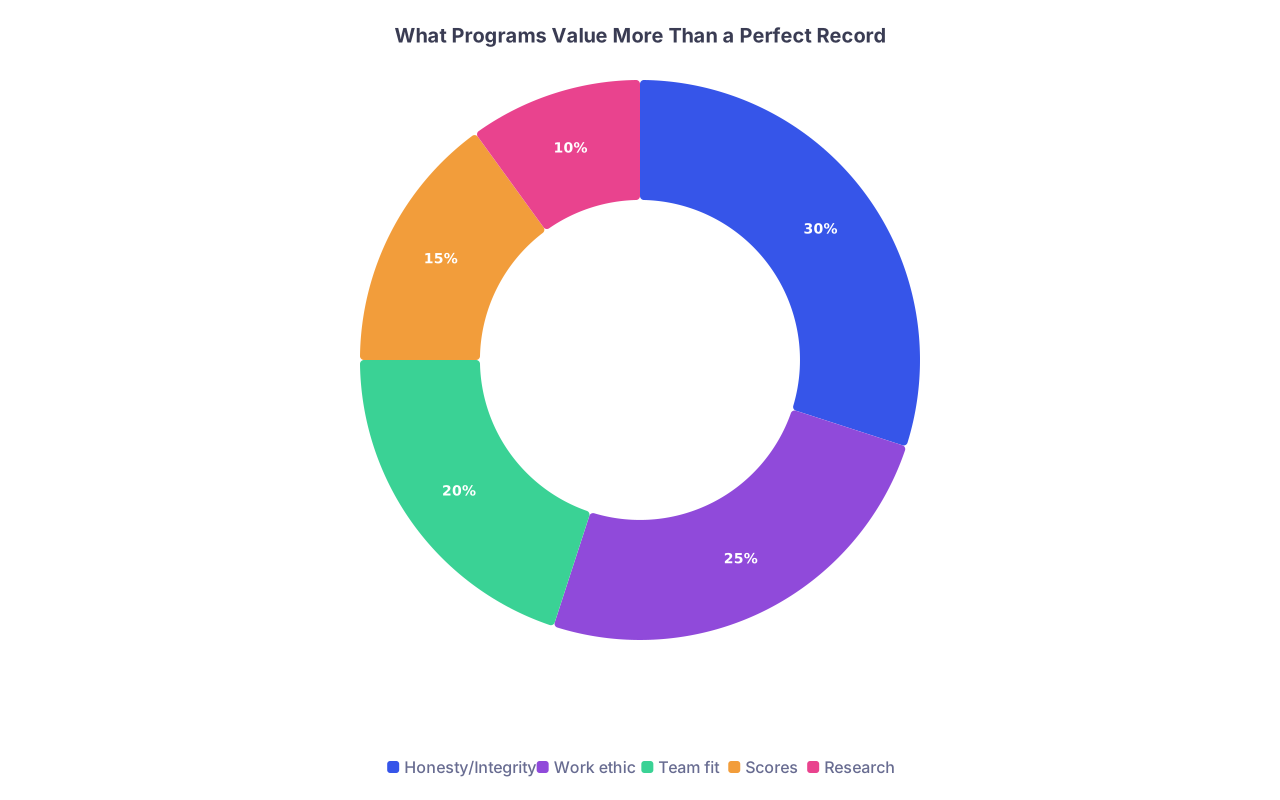
| Category | Value |
|---|---|
| Honesty/Integrity | 30 |
| Work ethic | 25 |
| Team fit | 20 |
| Scores | 15 |
| Research | 10 |
FAQ: The Biggest CV “Spin” Mistakes Unmatched Applicants Make and Regret
1. My mentor told me to upgrade “Volunteer” to “Research Fellow” because it sounds better. Is that really a big deal?
Yes, it’s a big deal. “Fellow” implies a formal, usually full‑time, structured role—often with funding, expectations, and defined responsibilities. If you weren’t hired, didn’t sign anything, and weren’t clearly designated “fellow” by the institution, you’re misrepresenting. Programs know exactly what a research fellow typically is. When they discover you gave yourself that promotion, they start doubting everything else on your CV.
2. Can I round dates or hours for simplicity, or will that look like lying?
You can approximate within reason—“June 2022–Aug 2022” vs. “June 15–Aug 23” is fine. “10–15 hrs/week” is fine. What’s not fine: turning a 3‑week experience into “2022–2023,” or calling a 2‑hr/month role “20 hrs/week.” The test: if your supervisor saw it, would they immediately disagree? If yes, change it. Slight rounding is normal. Reality distortion is not.
3. I did a lot of work on a project but ended up as middle author. Can I say I “led” the project anyway?
No. “Led” suggests top‑level responsibility—design, direction, coordination. If you were truly the leader, you’d very likely be first or co‑first author. You can say: “Contributed substantially to data collection and analysis,” or “Played a key role in day‑to‑day study operations” if that’s accurate. But calling yourself the leader when authorship order doesn’t support that will raise eyebrows fast.
4. I have a long non‑clinical gap and I’m scared programs will judge me. Should I soften or blur the details?
You should be brief, factual, and clear—not dramatic, not evasive. For example: “2019–2021: Full‑time non‑clinical employment in retail while preparing for USMLE exams and supporting family obligations.” That’s honest and direct. Programs may ask about it; you answer calmly and own it. A cleanly stated gap is survivable. A vague, obviously “masked” gap looks worse and invites mistrust.
5. I already submitted a cycle with some spin on my CV. Is it better to keep it the same for consistency or correct it next time?
Correct it. Consistently wrong is not better than newly honest. If you’re worried about a big discrepancy (like dropping a self‑given “fellow” title), you can acknowledge it briefly in an update letter or, if asked, in an interview: “I realized the way I labeled that past role overstated my position, so I’ve updated my CV to reflect my actual responsibilities more accurately.” That kind of course‑correction shows integrity and insight—two things programs value far more than a flawless record.
Open your CV today and circle every title and description that feels even slightly “upgraded.” Then ask yourself one blunt question for each: “Would my supervisor describe it this way without hesitation?” If the answer is anything but an immediate yes, rewrite it—now, before a PD reads it and makes up their mind about you.