
Last cycle, a student who’d gone unmatched in internal medicine called me furious. He’d applied again, stronger on paper, to the same region. Same programs. Same profile—just with a year of solid research added. You know what happened? Seven of those programs didn’t just pass on him. They didn’t even review him. He’d been quietly blacklisted and no one ever told him.
That’s the part most applicants don’t understand: a failed Match isn’t always just numbers and bad luck. Sometimes, behind the scenes, your name is being actively flagged—and not in a good way.
First, the uncomfortable truth: “Blacklist” is real, but not how you think
Let me be very clear: no one in a program will ever write “BLACKLIST” on your ERAS file. They’re not idiots. They know lawyers exist.
But conceptually? Yes. Programs absolutely keep internal “do not rank” and “do not invite” mental (and sometimes written) lists. And once you get on one of those at a certain program, you’re often done there for years, sometimes permanently.
Here’s what “blacklisting” actually looks like inside a program:
- An associate program director saying in a meeting: “If this name comes up again, just skip them.”
- A note in an internal spreadsheet: “Major professionalism concern – no further consideration.”
- An email from PD to coordinator: “Please don’t send this applicant another IV invite in future cycles.”
- Residents being told: “We had a bad experience with this person—if you see their name again, flag it.”
Nobody calls it a blacklist out loud. But functionally? That’s exactly what it is.
And almost always, it has nothing to do with your Step 1, your school, or your lack of research. Those might keep you out the first time. They don’t get you blacklisted.
Behavior does.
The most common paths to getting quietly blacklisted
Let me walk you through the patterns I’ve actually seen in selection meetings, on email chains, and from late-night venting by PDs and chiefs. Because this doesn’t come from theory; it comes from the stuff faculty complain about when the Zoom call ends and someone says, “Okay, off the record…”
1. Nuclear reaction to not matching
This is the big one. The “post-Match meltdown.”
Applicant does not match with a program and then:
- Sends an angry email to the program director or coordinator demanding explanations.
- Accuses the program of discrimination, favoritism, or “using them as a backup.”
- CCs other faculty, deans, or worse—threatens complaints or legal action.
- Posts publicly on social media naming the program and trashing them.
I saw one applicant email a PD:
“I rotated with you, your residents loved me, and I had higher scores than several of your matches. You clearly made a mistake not ranking me higher. I deserve feedback.”
That went straight into the “never again” file. Their name got mentioned in the next recruitment meeting as “that person who sent the hostile email.” People remembered. Months later.
Programs may give generic feedback if you’re professional and low-key. But if your tone is entitled, accusatory, or emotional? You are not getting “feedback.” You’re getting quietly blacklisted.
2. Causing problems on a visiting rotation
This is probably the most dangerous way to blow up your future with a program.
Away rotations/Sub-Is are half audition, half prolonged stress test. Programs are evaluating one thing above all: “Can I stand this person at 3 am when everyone is miserable?”
You get blacklisted if you:
- Talk trash about other students, residents, or rotations.
- Argue with residents or attendings over feedback or expectations.
- Play the “but I already know this” card and overstep clinically.
- Complain constantly: about call, notes, patients, the hospital, the city.
- Treat nurses, MAs, or staff poorly. (They absolutely report back.)
I’ve sat in rank meetings where we didn’t just say “don’t rank this rotator”—we said “and if they reapply in a future year, please remind me not to bring them back.”
One applicant on an away rotation at a big-name IM program openly said to a resident, “Honestly I’m just here for the letter, this place is too malignant for me to actually want to train here.”
Guess who applied there after going unmatched? Guess who didn’t even get a file review?
Residents have long memories. Program leadership listens to them more than you think.
3. Disrespecting staff or coordinators
This one is almost laughably consistent. You’d be shocked how many applicants are overly polished with attendings—and borderline rude with the people who actually keep the program running.
Coordinators talk. And they are trusted.
Red flag behaviors:
- Repeatedly emailing “Hi [first name]” to a coordinator but addressing PD as “Dear Doctor…” with full titles. That contrast stands out.
- Demanding quick responses: “I need this answered today” or “It’s been 24 hours.”
- Being pushy about interview dates, implying their time is more important.
- Treating miscommunications like huge injustices instead of normal chaos.
I’ve literally heard, “Our coordinator had a nightmare time with this applicant, please don’t bring them back.” That’s the soft version. The hard version is: “Put them on the do-not-interview list.”
You’re being evaluated in every interaction, not just when your Zoom box is on.
4. Dishonesty discovered after the fact
Programs hate being lied to more than they hate low scores. You can remediate knowledge deficits. You can’t remediate integrity problems.
Common examples:
- Misrepresenting research: claiming “submitted” papers that don’t exist, exaggerating roles to first-author when you were barely involved.
- Hiding failed attempts, LOAs, or disciplinary actions that later come out.
- Inconsistencies between your ERAS, your letters, and what faculty remember from your rotation.
One faculty member at a midwestern IM program once said, “We found out this applicant’s ‘manuscript in progress’ had been ‘in progress’ for three years at three different institutions. That was the end. And if they ever show up again, it’ll be the same answer.”
When a program feels fooled, they don’t just shrug and move on. They blacklist. Because from their perspective, if you lie during an application, what will you do with documentation, billing, or serious patient issues?
5. Unprofessional or unstable communication
Some applicants implode purely over email and phone etiquette. PDs and coordinators forward these around.
You get remembered—and flagged—if you:
- Send long, emotional emails about your struggles, personal drama, or how “unfair” the system is.
- Flood programs with multiple “update” messages that are more like begging than brief, relevant updates.
- Constantly push boundaries: messaging faculty on social media, texting residents for special favors, or repeatedly asking for an interview after being told no.
One unmatched reapplicant emailed a PD seven separate times over three months with variations on “Please just give me a chance, you won’t regret it.” Each one sounded a bit more desperate. The PD finally wrote to the coordinator: “Flag this name for future cycles. This is not someone we want here.”
Neediness and instability read as risk. Risk gets avoided.
6. Being a chronic “problem” from your home institution
Programs talk. PD to PD. PD to dean. Dean to PD.
If you have a reputation at your medical school for:
- Repeated professionalism issues.
- Poor behavior on multiple clerkships.
- Interpersonal conflicts with residents/faculty.
That follows you in subtle—but very real—ways.
I’ve seen home institutions quietly signal: “We’d appreciate it if you don’t rank this person highly; we’ve had serious issues.” No one ever tells the student that. But your name is mentally tagged.
That doesn’t always become a permanent blacklist. But if you then also send a heated email after not matching? Or act off on a re-rotation? That pushes it from “caution” to “never again.”
7. Social media and digital footprints
Yes, they look. Not all of them. But enough do.
It’s usually residents who find things and pass them upwards. A few patterns absolutely get you blacklisted:
- Publicly trashing programs, hospitals, or cities where you interviewed.
- Posting screenshots of interview questions or rating programs openly.
- Sharing case details or patient stories that skate too close to HIPAA.
- Political or inflammatory content that directly attacks groups of people, especially in healthcare.
Something like: “Program X was a joke, malignant and incompetent, residents looked miserable” posted in March. Then you go unmatched. Then you reapply and add that program back to your list.
You’re not getting invited.
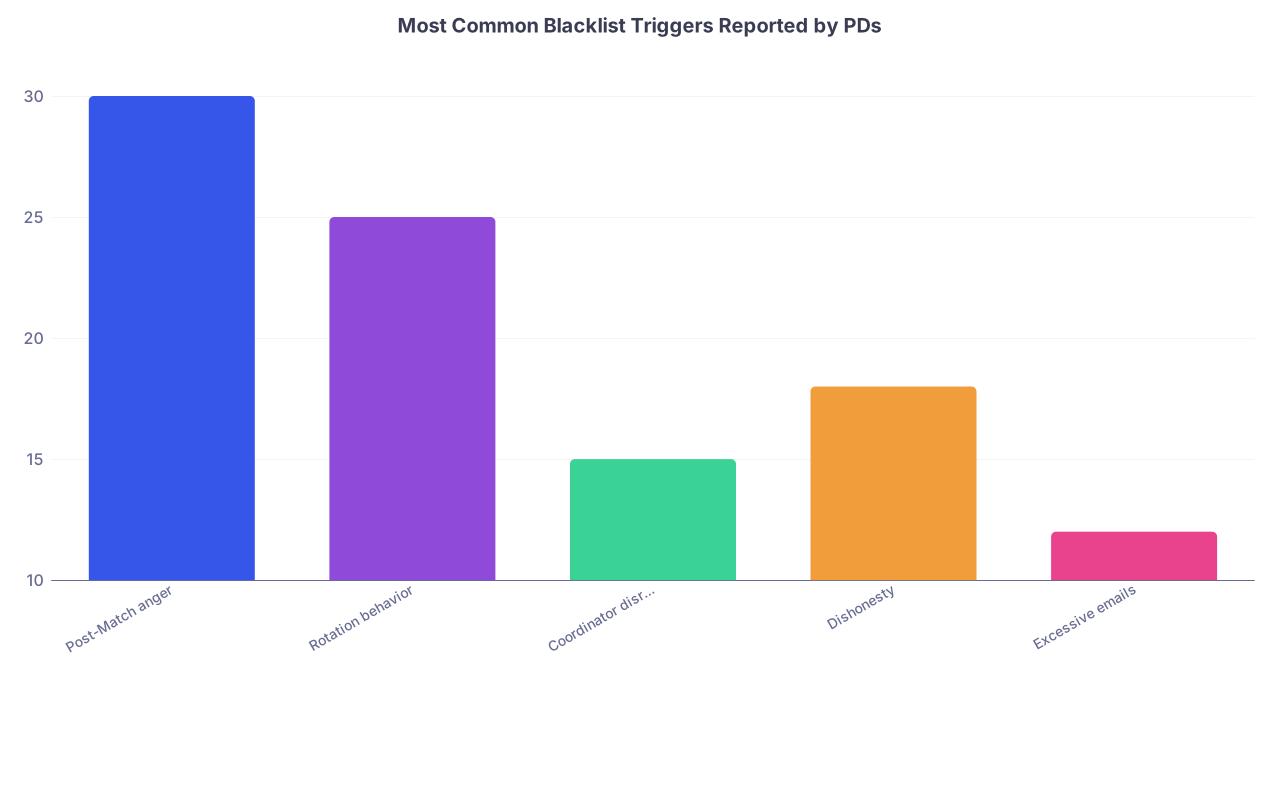
| Category | Value |
|---|---|
| Post-Match anger | 30 |
| Rotation behavior | 25 |
| Coordinator disrespect | 15 |
| Dishonesty | 18 |
| Excessive emails | 12 |
How programs actually track “do not touch” applicants
There’s no central database. No national blacklist.
This is all local, informal, and very human. But it’s not random.
Here’s how it tends to work:
- Program coordinators maintain spreadsheets or notes from prior years: interview no-shows, late withdrawals, behavior issues, names residents flagged.
- Faculty and residents debrief after interview season and specifically call out people they never want to see again.
- PDs pass names verbally to associate PDs and chiefs with short comments: “Behavior issue,” “Very strange,” “Unprofessional email.”
Then, in future cycles:
- ERAS filters out old applicants, but coordinators or PDs recognize the names.
- Someone searches their email: “Didn’t we have an issue with this person?” That email from three years ago pops up.
- They add a quick internal remark: “Do not invite” or “Skip.”
If you’re imagining some highly organized system with standardized criteria, you’re giving programs too much credit. It’s more human than that. And that’s worse for you—because human memory is powered by strong emotion.
If you caused a mess or made them angry? They remember you.
Why unmatched reapplicants are especially vulnerable
Once you go unmatched, you’re already in a fragile position. You’re scared, you’re angry, and you feel stuck. That’s exactly when people make the kind of moves that get them blacklisted.
Typical sequence:
- Applicant doesn’t match.
- Panic. Shame. Frustration.
- They feel they “deserve answers” and start firing off emotionally-loaded emails to programs.
- They overshare in emails, on social media, even on public forums.
- They reapply to the same places the next year, assuming their stronger CV will fix it.
But the problem isn’t just your CV anymore. It’s your file and your footprint.
I’ve seen PDs take a chance on a reapplicant whose scores were mediocre but whose behavior was consistently professional and mature. I’ve also seen them instantly shut down reapplicants with great numbers but even a whiff of drama from the previous cycle.
If you’re an unmatched reapplicant, you are under a microscope. Programs assume you’re under stress. They are watching to see whether that stress brings out maturity—or volatility.
How to avoid getting blacklisted when you don’t match
Let me spell this out plainly: your behavior in the 2–3 weeks after you learn you didn’t match can make or break your future cycles.
Here’s how people who don’t get blacklisted handle it—because I’ve watched both sides.
They do not send long, emotional emails asking, “Why didn’t I match? What did I do wrong?” to every program they interviewed at.
If they reach out to a PD, it looks like this:
“Dear Dr. Smith,
Thank you again for the opportunity to interview at your program this year. I unfortunately did not match and am working with my school on next steps. If, at any point in the future, you have any brief general feedback on how I might strengthen my application, I’d be grateful.
Best regards,
[Name]”
Short. Mature. Zero blame. Zero entitlement.
You’ll still get non-answers most of the time. But you also won’t get blacklisted.
They also:
- Keep social media quiet or private for a while.
- Do not publicly rate or bad-mouth programs after the Match.
- Talk to their dean’s office or an advisor before they contact programs.
- Treat SOAP staff, coordinators, and anyone helping them with extreme respect.

| Step | Description |
|---|---|
| Step 1 | Did not match |
| Step 2 | Contact dean/advisor first |
| Step 3 | Send brief, professional note |
| Step 4 | Focus on plan for next cycle |
| Step 5 | Emotional email or social media post |
| Step 6 | High risk of blacklist |
| Step 7 | Initial reaction |
| Step 8 | Reach out to programs? |
If you suspect you’ve been blacklisted: what now?
Most people won’t know for sure. You don’t get a notification: “Congratulations, you’ve been placed on our permanent no-fly list.”
But there are signs:
- You had a strong interview and many signals, then zero SOAP interest and zero response to a polite follow-up. Next year: again no interview. Meanwhile, peer applicants with similar stats get invites.
- You had a very clear conflict or ugly email exchange with someone in the program.
- You bad-mouthed the program or visibly melted down and now… radio silence every cycle.
If you strongly suspect a particular program or two have tagged you negatively, here’s the hard truth: let them go.
Do not keep reapplying to the same place that has obvious reason to avoid you. That looks either oblivious or desperate. Neither helps.
What you can do:
- Pivot your geographic focus.
- Prioritize programs where you have fresh relationships, new rotations, or faculty who can vouch for your professionalism now.
- Ask your dean or a trusted faculty advocate to quietly sense-check if your reputation is damaged more broadly, or just in isolated places.
Sometimes you can rehabilitate things with time and consistent good behavior. But you can’t do it by forcing yourself back into the inbox of people who’ve already decided “never again.”
The quiet double standard: residents vs. applicants
Here’s one more behind-the-scenes truth. Programs will forgive a surprising amount from current residents. Anger, burnout, even some unprofessional behavior. They’ll work with them, coach them, document and remediate.
Applicants? Different story.
If you show a hint of being “a problem” before you even sign a contract, you’re not worth the risk in their eyes. Why pick a borderline-unstable reapplicant when they can fill the spot with a clean-slate MS4 with fewer unknowns?
That’s what you’re up against. You’re competing not just on scores and publications, but on who looks least likely to give the PD and chief residents headaches for three years straight.
Your job is to make it very, very easy to picture you as:
- Low drama.
- High reliability.
- Good under stress.
- Sane in your communication.
Because no one ever said, “Let’s rank that applicant higher; they seemed sort of intense and unstable in their emails.”

FAQs
1. Can I ever recover if I think a program blacklisted me?
Sometimes. If the issue was relatively minor—like a slightly awkward email or a lukewarm rotation—it may fade over a few years, especially with strong new experiences and letters. But if your behavior was egregious (angry emails, serious professionalism breaches, public trash-talking), that specific program is likely a lost cause. Focus your energy where you’re not swimming against memory.
2. Should I reach out and apologize if I sent a bad email after not matching?
If you truly sent something inappropriate, a single, concise apology can be helpful if it’s done once and done maturely. Something like: “I realize my previous message was written in frustration and did not reflect the professionalism I expect of myself. I apologize.” Then stop. Do not expect a response, and do not follow up repeatedly. The goal is to reduce damage, not reopen the conversation.
3. How can I ask for feedback without looking entitled or desperate?
Keep it short, neutral, and focused on improvement. Emphasize appreciation rather than expectation. Don’t ask “Why didn’t you rank me?” Ask instead whether they have “any general advice on strengthening my application for future cycles.” If they respond, treat that like a gift, not a right. If they don’t respond, drop it.
4. As an unmatched applicant, is it safer to avoid reapplying to places I rotated?
Not automatically. If your rotation evaluations and interactions were genuinely strong, those places can still be your best shot. But if there was any tension, concerning feedback, or awkward interactions—and you know that—be cautious. Ask a trusted faculty member who knows the program whether they think you’re remembered positively or not. If there’s doubt, consider reallocating applications to programs where you don’t have potential baggage.
If you remember nothing else, remember this:
Programs don’t blacklist you because you’re unlucky. They blacklist you because you gave them a story they never want to repeat. Your job—especially when you’re stressed and unmatched—is to deny them that story. Stay professional, stay boring on email, and give them no reason to remember you for the wrong thing.