
The dirty secret is this: program directors only take risks on unmatched graduates when it feels safer than it looks on paper.
Everyone talks about “holistic review” and “second chances.” That’s brochure language. Behind closed doors, PDs are asking one blunt question: If I rank this person, how likely are they to embarrass me in front of my chair, my residents, and my ACGME site visitor?
You want a slot as an unmatched grad? You’re asking a PD to stick their neck out. So you need to understand what actually makes them say yes when all the incentives push them to say no.
Let me walk you through how that decision really happens in the back office, not in the public webinar.
How PDs Actually See an Unmatched Graduate
First, you need to understand the frame. When your application pops up and they see “Independent applicant,” “Re-applicant,” or a graduation date 1+ years ago, the default is skepticism. Not cruelty. Just pattern recognition.
In the conference room, the conversation sounds like this:
“Why didn’t they match the first time?”
“If no one took them last year, why should we be the ones to fix it?”
So they look for risk indicators long before they look for your strengths. Broadly, they bucket unmatched applicants into mental categories:
| Category | PD Reaction |
|---|---|
| Close miss (strong but unlucky) | Maybe |
| Red flag (professionalism/discipline) | Almost always no |
| Weak but coachable | Rare maybe |
| Lost cause / outdated knowledge | No |
| Protected by a trusted insider | Strong maybe |
If you’re not in the “close miss” or “protected by insider” group, you’re in trouble.
Now here’s the part nobody tells you: PDs like redemption stories. They really do. But they only put those on the rank list when three things are simultaneously true:
- The story has a clean, believable explanation.
- The applicant has already done the hard, unglamorous work to fix it.
- Someone the PD trusts is willing to vouch for them.
Everything else is just noise.
The Profiles PDs Are Willing to Gamble On
Let me be blunt. These are the kinds of unmatched or re-applicant profiles that actually get a shot.
1. The “Close Miss” Applicant
This is the person whose file makes PDs say: “Honestly, how did this person not match?”
Typical pattern:
- Step scores decent or better for the specialty.
- Clean MSPE, no professionalism flags.
- Normal timeline, recent grad (0–2 years out).
- Reasonable number of interviews the first cycle, just ranked too aggressively or had bad luck.
If you were, say, an IM applicant with Step 1 pass, Step 2 230–240, solid clerkship comments, a couple of interviews, ranked 8–10 programs and went unmatched — many PDs will quietly label you a “system casualty,” not a “problem applicant.”
Why they’ll take a risk:
Because they can sell your story at the selection meeting. “They over-shot last year, they’ve done an IM prelim this year, no issues, strong evaluations. We’ll get a grateful, hardworking resident who’s been humbled a bit.”
In other words: low emotional risk, and they can defend the decision to their faculty.
2. The “Fixed Weakness” Applicant
This is the person whose file the first year had an obvious problem… and then you come back with clear, objective evidence you fixed it.
Example:
- First cycle: Step 1 borderline pass, Step 2 taken late, mediocre clerkships, no sub-I in desired specialty, generic letters.
- Second cycle: Step 2 CK 240+, strong sub-I with “top third resident-level” comments, targeted letters, maybe some meaningful research or a clinical job with real responsibility.
Here’s what program directors actually say in the room when your name comes up:
“They were not ready the first time. But look at this sub-I from our hospital/system / highly respected faculty. And the Step 2 jump. This looks like someone who grew up.”
They are not looking for perfection. They are looking for a trajectory they can defend.
Key truth: no one wants to be the first person to bet on you. So your job is to show that someone else already did — an attending, a department, a hospital — and you delivered.
3. The “Known Quantity” With a Powerful Advocate
This is the real behind-the-scenes lever.
If I had to choose one thing that most reliably gets an unmatched graduate ranked, it’s not the perfect personal statement or the extra year of research.
It’s this sentence, spoken in a low voice at the end of a faculty meeting:
“I’ve worked closely with this applicant for the last year. I’ll take personal responsibility for them.”
You won’t hear that line. But that line moves mountains.
This happens when:
- You’ve done a prelim year at that institution.
- You’ve worked as a research fellow for a PI who has real pull.
- You’ve done repeated observerships/externships and became “their” student.
- You’re known by the chief residents and they like you enough to lobby for you.
PDs are herd animals like everyone else. If a powerful insider signals, “They’re safe; I’ll vouch,” it lowers the perceived risk dramatically.
The Applicant Types PDs Almost Never Touch
To be fair to you, you need to know the profiles that are essentially dead on arrival at most programs.
I’ve seen these come up over and over:
- Multiple failed attempts at licensing exams with no later strong score to offset.
- Documented professionalism issues: dishonesty, boundary violations, angry patient complaints, serious MSPE “concerns.”
- Long gaps from clinical work with nothing credible to show you’ve stayed sharp.
- Older graduation year + no US clinical activity in the last 12–18 months.
Will someone ever take a chance on these? Rarely. But then it’s almost always through a personal relationship, not the front door ERAS process.
If you’re in one of these categories and banking on “holistic review,” you’re lying to yourself. PDs do not get rewarded for bravery. They get punished for misjudgment.
The Exact Questions PDs Ask Themselves Before Taking a Risk
Let me take you into the room.
Your file goes up on the projector. Someone notes the graduation year. Somebody else mutters, “Independent applicant.” The PD scrolls. Silence for a few seconds. Then the real evaluation starts, and it sounds like this:
“What actually went wrong?”
No one believes “bad luck” as the only explanation. They’re looking for:- Too few applications the first time?
- Late exams?
- Weak letters?
- Interview skills?
- Switching specialties?
If there’s no coherent story, they move on. If there is, they ask:
“Is the problem fixed, or is it permanent?”
Late Step 2 taken early and passed well the second time? Fixed.
Weak early clinicals but stellar sub-I’s now? Fixed.
Poor insight, blaming others in your personal statement? Permanent. PDs can smell it.“Who is standing behind this person?”
This is where your letters and phone calls matter. They scan names quickly and think:- Do I know this letter writer?
- Do I trust their judgment?
- Would they text me privately if there was a concern?
“Will this resident be more grateful or more high-maintenance?”
Re-applicants can go either way.- Some are humble, hungry, over-prepared. PDs like those.
- Others are bitter, entitled, obsessed with what happened to them. PDs avoid those like the plague.
“What’s my worst-case scenario if I rank them?”
That’s the real risk calculation.
If your worst-case scenario looks like “they’re average but safe,” you have a shot.
If it looks like “they might fail boards, crash on nights, or end up in my office every week,” you do not.
What Actually Moves the Needle in Your Favor
Forget the generic advice about “showing passion for the specialty.” Everyone writes that line. PDs skip it.
Here’s what I’ve actually seen sway a room in favor of an unmatched grad.
1. A Clean, Specific, Boring-But-Believable Story
You need a simple, non-dramatic explanation that a PD can repeat without feeling foolish.
Things that work:
- “I applied too narrowly last year while caring for a sick parent, and I didn’t appreciate how competitive this had become. Since then, I’ve completed a prelim year in X with strong evaluations and focused on becoming a better clinician.”
- “I switched late from another specialty after my sub-I in Y, and I did not yet have the letters or experiences to be competitive. This year I’ve done two sub-I’s in Y, both of which are strongly supportive.”
Things that don’t work:
- Long paragraphs blaming the system.
- Rambling explanations of your personal drama.
- Vague talk about “unforeseen circumstances” with no clear specifics.
PDs need to be able to tell your story in 1–2 sentences to their colleagues so they don’t look reckless.
2. Fresh, High-Quality Clinical Work
A graduation date more than a year old sets off alarms. You have one way to silence them: current, verifiable, strong clinical performance.
Best cases:
- A prelim or transitional year with documented strong evaluations.
- A year working as a hospitalist extender, clinical instructor, or similar role with supervisory references.
- Repeated US-based hands-on rotations with detailed, recent letters.
Worst cases:
- “Research” with no clinical contact and no real output.
- Observerships only, especially if they’re short and generic.
- Non-clinical jobs completely disconnected from medicine.
Unmatched or not, PDs care about this: can you step onto the floor on July 1 without causing chaos? Recent clinical work answers that.
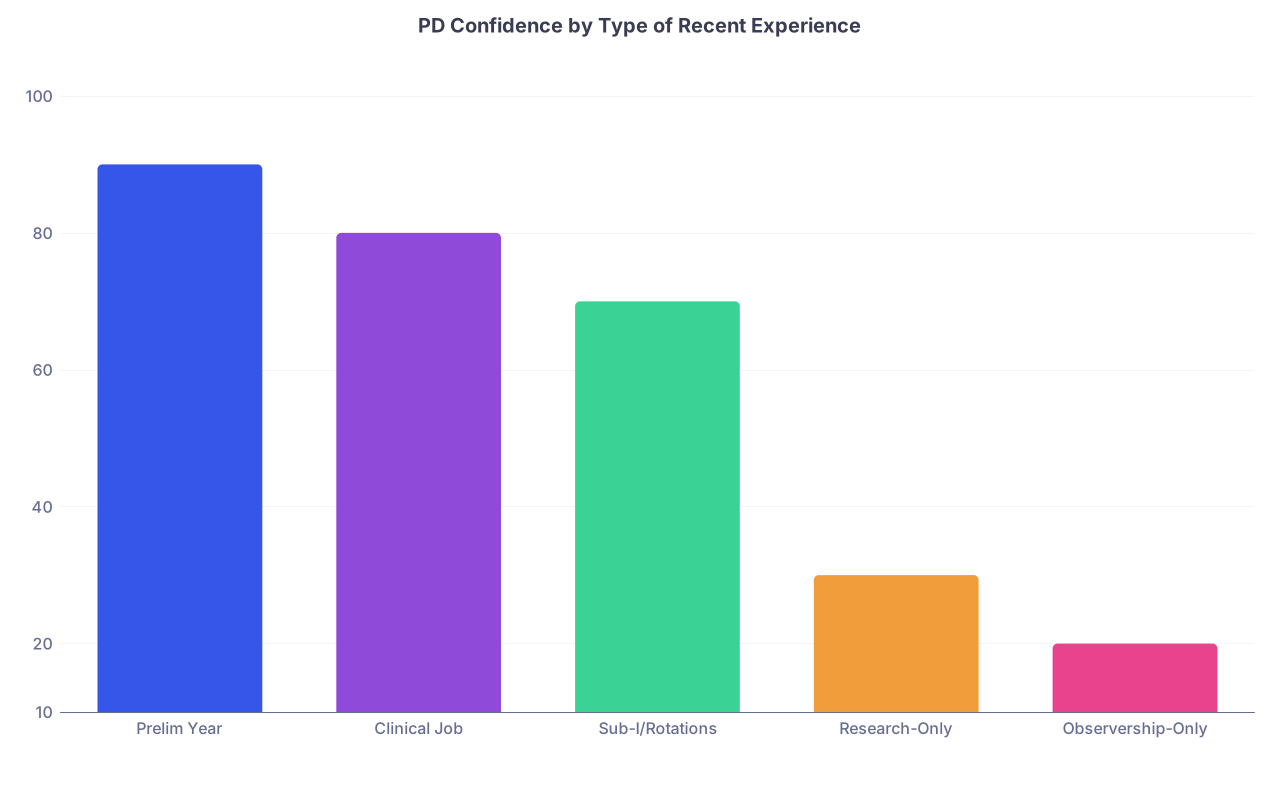
| Category | Value |
|---|---|
| Prelim Year | 90 |
| Clinical Job | 80 |
| Sub-I/Rotations | 70 |
| Research-Only | 30 |
| Observership-Only | 20 |
The numbers aren’t literal, but that’s approximately how their gut weights it.
3. A Letter That Goes Beyond “Hardworking and Compassionate”
Re-applicants live and die by their letters.
You’re not trying to sound “good.” You’re trying to sound safe and known.
Here’s the style of line that makes PDs lean forward:
“We would have been happy to have them in our own program.”
“They function at or above the level of our current interns.”
“I have no hesitation recommending them for residency training; in fact, I will be disappointed if they do not match this year.”
You want a letter writer who speaks in absolutes, not vague compliments. Lukewarm language kills re-applicants.
If your letters say “pleasant,” “hardworking,” and “eager learner” and nothing stronger? That’s background noise.
4. Evidence You’ve Matured, Not Just Suffered
PDs are not impressed that you had a hard year. They are impressed if you used that year.
Concrete things that change minds:
- Passing Step 3 with a comfortable margin while working clinically.
- Taking ownership of past mistakes in a calm, non-dramatic way.
- Doing the unsexy grind — night shifts, cross-cover, admissions — and getting residents or attendings to quietly say, “They’re solid.”
The subtext PDs are looking for: if they hit adversity again during residency, will they crumble or will they stabilize?
The Hidden Role of Timing, Networking, and Opportunism
Now for the really behind-the-scenes part: a lot of unmatched graduates get in not through the front-door Match, but through timing and relationships.
Post-Match Scramble / SOAP
In SOAP, PDs are scared of making a panic hire who will haunt them for three years. So they grab:
- Known quantities (their own prelims, rotators).
- People vouched for by someone who texts or calls them immediately.
- Simple stories. No time for “it’s complicated.”
You want to improve your odds? You must have at least one person who will think of you that week and actively push your name.
Not “I wrote you a letter.”
More like, “I just heard X has an unfilled spot. I’m going to email the PD directly about you.”
Mass applying without any personal advocacy during SOAP? That’s a lottery ticket.
Off-Cycle Spots and Quiet Openings
Programs lose people. Residents resign, switch specialties, go on leave. These openings are usually filled quietly.
Here’s how it really works:
- PD sends an email to a small inner circle: “We may have a PGY-1/PGY-2 opening. Any strong candidates you know who are looking?”
- That inner circle forwards names of people they already believe in.
- Those names get fast-tracked to a brief review, maybe a quick Zoom.
- Position filled. Many applicants never even hear it existed.
If you’re an unmatched grad, your goal is to be the name that comes to mind in that email chain. That means:
- Staying around an academic environment.
- Being professionally excellent enough that people remember you positively.
- Letting key people quietly know, “If you hear of any openings, I’d really appreciate if you keep me in mind.”
No drama. No desperation. Just steady, competent presence.
How Far Back Does “Unmatched” Follow You?
Another thing nobody tells you: PDs don’t exactly forget that you went unmatched, but the sting fades if your subsequent track record is strong.
Once you’ve:
- Completed a prelim year successfully, or
- Been working clinically with solid references, or
- Put 1–2 years of clean, progressively responsible experience together
…the label shifts in people’s minds from “unmatched” to “non-traditional path.”
I’ve been in rooms where someone said “They’re an unmatched grad,” and the PD responded, “Yes, but look what they’ve done since. That was three years ago.”
Time + consistently strong performance rewrites your story.
But — and this is where people delude themselves — time without credible activity does the opposite. A three-year gap doing unrelated work is not neutral. It’s actively toxic to your application.
What You Should Stop Wasting Time On
If you’re an unmatched graduate trying to re-enter, certain things are massively overrated.
You can ignore the polite advice. Here’s the real list.
- Another “better” personal statement draft. As long as it’s clear, honest, and not self-pitying, you’re done. No one is ranking you solely on your essay.
- Spray-and-pray applications to 100+ programs with no strategy or contact. That’s not hustle; that’s desperation.
- Low-yield research you don’t care about just to add lines to your CV. A thin abstract does not cancel out a one-year gap in clinical work.
- Obsessing over “brand-name” programs. You need a PD who’s willing to take a risk, not a logo for your LinkedIn.
You should be spending that time on:
- Getting into a clinical environment and staying there.
- Identifying 2–3 potential advocates and proving yourself to them.
- Clarifying your story so a PD can retell it in under 20 seconds without cringing.

A Concrete Example: How One PD Talked Themselves Into a Risk
Let me walk you through a real composite case that looks very familiar.
Applicant: IMG, graduated 2 years ago, unmatched in IM first cycle. Step 1 pass, Step 2 CK 232. First cycle: 25 applications, 3 interviews, no match.
Year between: Did a medicine prelim at a community program. No failures. Good but not spectacular evaluations. Took Step 3 during the year, scored 220s. Got one very strong letter from the prelim PD, one decent letter from an ICU attending, one bland letter from a ward attending.
Second cycle: Applies to 120+ IM programs, including mid- and lower-tier university and community programs; secures 5 interviews. One of them is at a small university-affiliated IM program with a PD who knows the prelim PD.
Here’s the part you don’t see: after the interview, that PD emails or calls their friend:
“Hey, you had this applicant as a prelim. Are they solid? Any concerns?”
The friend responds:
“They’re not a superstar, but they show up, work hard, no drama. I’d take them again.”
That “no drama” carries more weight than you think.
On rank night, when their name comes up, it sounds like this:
“They went unmatched first time, but they did a full prelim year since then, got Step 3 done, and [Trusted PD] says they’re reliable. I’m comfortable putting them mid-list.”
Not top. Not bottom. Mid-list. That’s your realistic target as a re-applicant. And that’s enough to get you where you want to go if the dominoes fall right.
How to Think About Your Next 12 Months if You’re Unmatched
If you’re reading this in the middle of the pain — just unmatched, or sitting in a research year wondering what’s next — you need a ruthless framework.
Strip it down to three priorities:
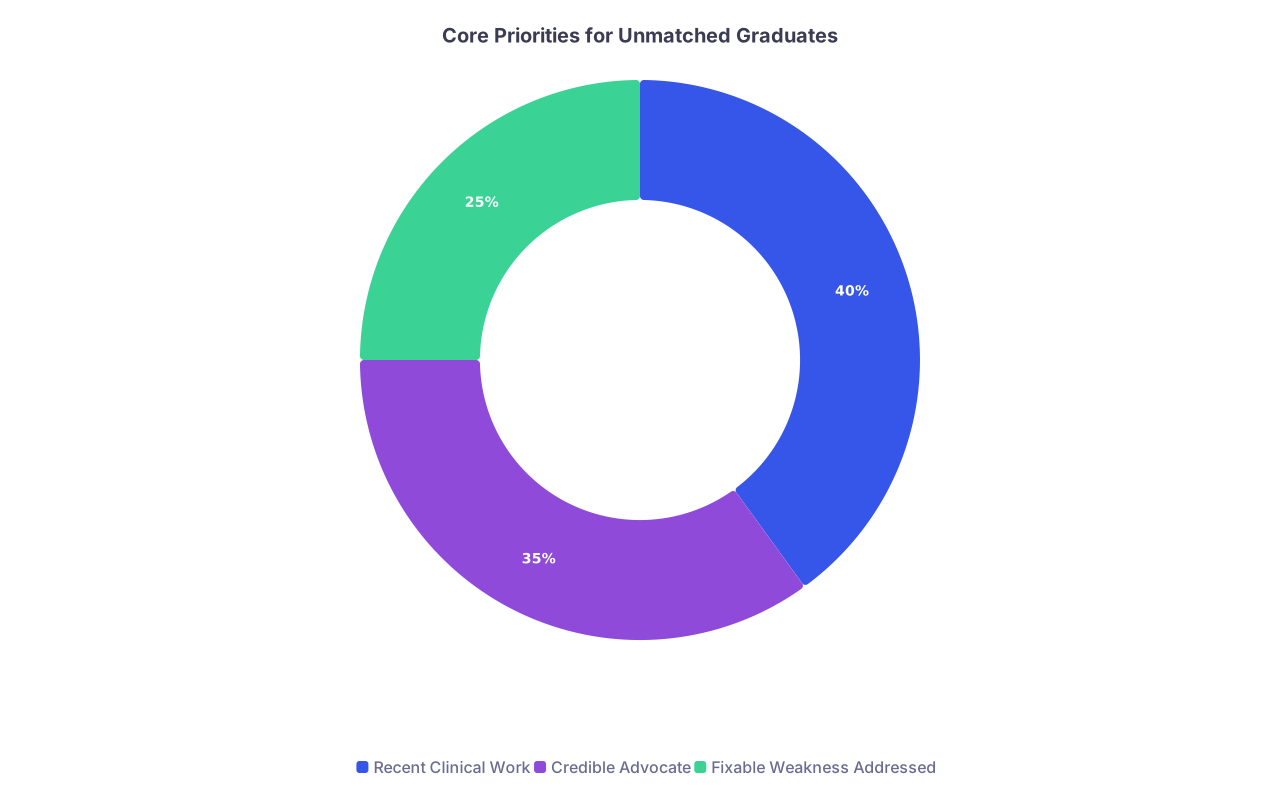
| Category | Value |
|---|---|
| Recent Clinical Work | 40 |
| Credible Advocate | 35 |
| Fixable Weakness Addressed | 25 |
Everything you do should serve one of these:
- Get into a role where real physicians can watch you take care of real patients.
- Identify one or two of those physicians who have the clout and inclination to back you.
- Address, in an objective way, whatever most worried PDs your first time out.
That’s the path PDs respect. That’s the path that makes them say, “Yes, they were unmatched. But they did exactly what I’d want someone to do after that.”
The Bottom Line: What Actually Makes a PD Take a Risk
Let me condense the noise into what really matters.
- They can tell a simple, sensible story about why you went unmatched and why that’s unlikely to happen again.
- They see fresh, real, positive data: recent clinical work, stronger scores, better evaluations.
- Someone they trust is willing to put their name next to yours and say, “This one is safe. This one will do the work.”
If you can’t offer those three, most PDs won’t stick their neck out. If you can, many of them quietly will — even if no one ever admits publicly that they took a “risk” on you.